Knowing that ChatGPT ignores your brand is useful. It is also where most tools stop. You get a score, a dashboard full of red, and a quiet sense that something is wrong. Then you close the tab, because nobody told you what to do next.
That gap is the reason we spent the last three weeks rebuilding Rankry from the inside out.
Rankry 2.0 is the biggest release since we launched. Every surface you use to track and improve how you show up in AI answers has been redesigned, reorganized, or replaced. The goal was simple: stop handing you analytics and start handing you a path. Here is what we shipped.
A dashboard that tells you what changed and what to do about it
The old dashboard was a wall of widgets. You had to assemble the story yourself.
2.0 opens like a command center built around one question: what changed this week, and what should you do about it? You land on a 30-second brief that summarizes your position, four headline metrics with zone-coded badges so you can read your health at a glance, your Rankry Score on a gradient gauge, and an AI Website Readiness score sitting right next to it.
Below that is This Week’s Plan: the handful of moves actually worth shipping in the next seven days. No more guessing where to start.
Navigation that knows whether you’re observing, deciding, or executing
We rebuilt the sidebar and tab bar from scratch.
Five top tabs now cover your report end to end: Dashboard, Visibility, Sources, Compete, and Action Plan. The sidebar groups everything by Analytics, Strategy, and Tools, so at any moment you know which mode you’re in. Are you watching what’s happening, deciding what matters, or getting work done? The structure answers that before you have to think about it.
Visibility, now with the Insights drawer
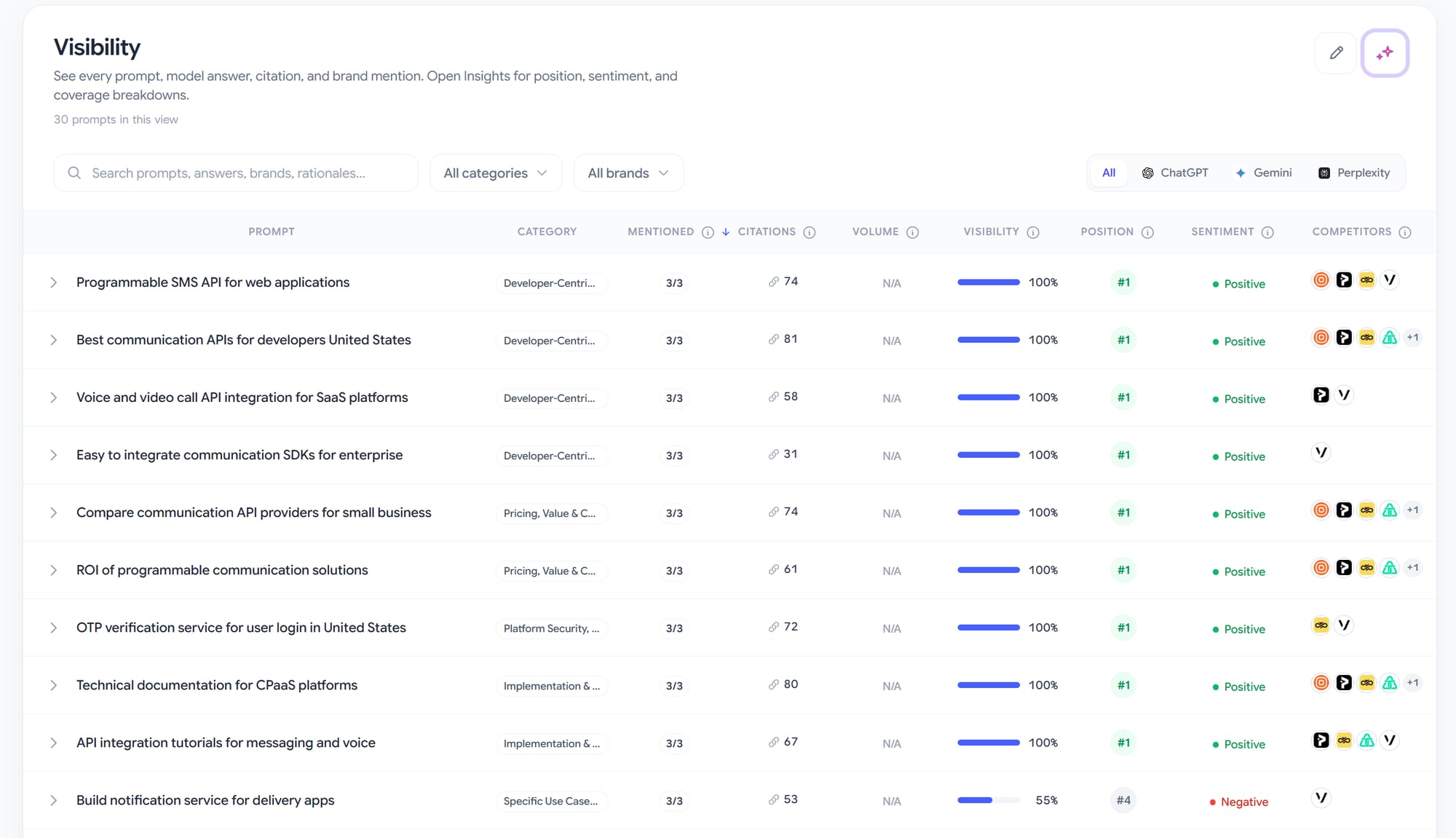
The new Visibility section pulls every prompt, every model answer, every citation, and every brand mention into one filterable view.
The real upgrade is the Insights drawer. Instead of bouncing between separate reports, you open the drawer and ask questions about the scan directly: where you rank, which categories you own, which prompts you lost, where competitors are winning. Sentiment, positioning, and diversity now all live inside the drawer. The page stopped being a stack of disconnected reports and became something you can actually interrogate.
Sources, now with Intent Volume
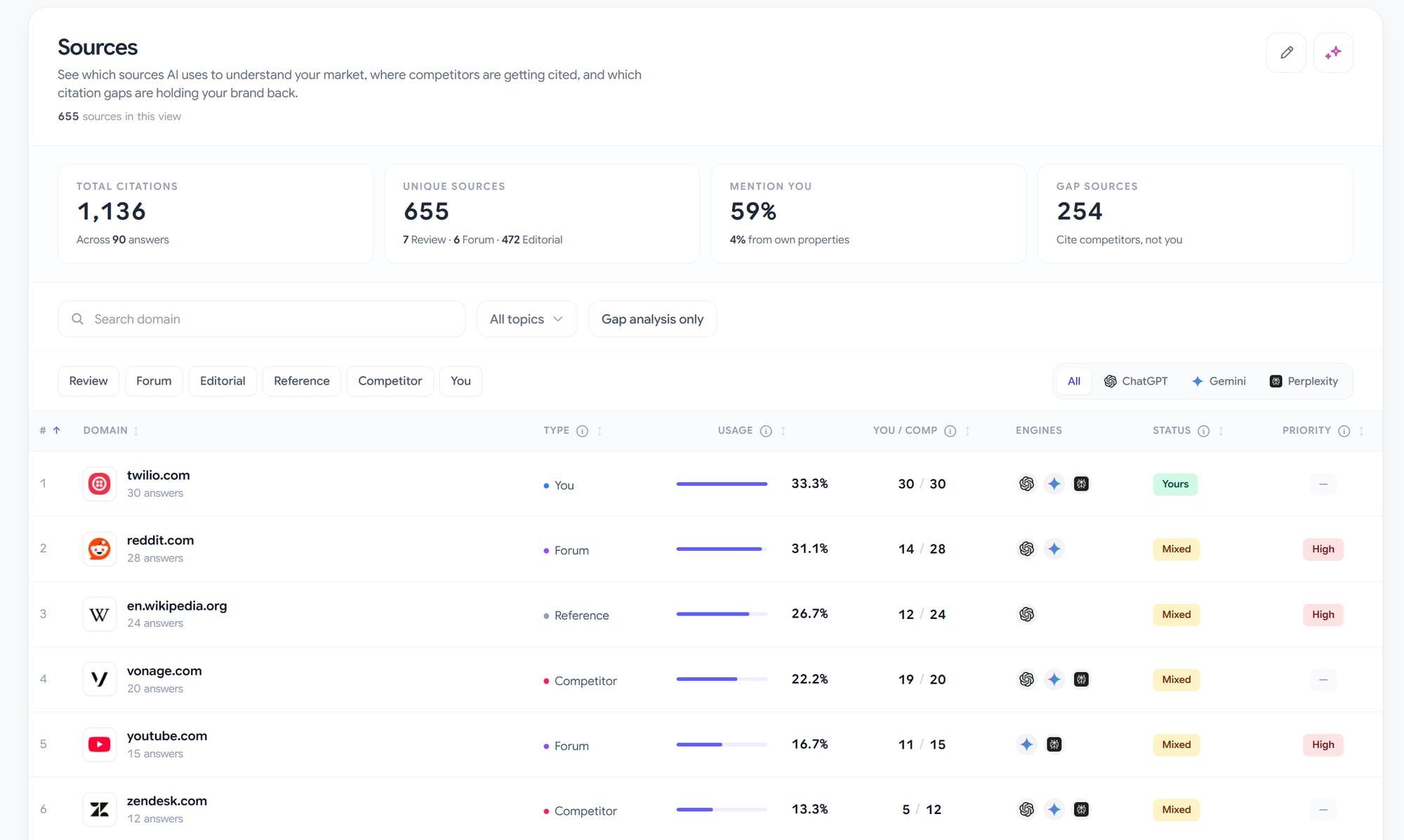
Sources is a brand-new section, and it answers a question every brand should be asking: which domains are AI engines actually pulling from to build answers in your market?
You see those domains with citation counts and a clear status next to each one: Yours, Mixed, or Gap. Then we added Intent Volume, so you can prioritize by how often the prompts behind those citations are actually being asked. A citation that feeds a high-volume question matters more than one nobody triggers, and now you can see the difference.
Every citation links cleanly to the prompt it came from and to the competitor it favors. The path from finding a problem to fixing it is one click.
Compete, rebuilt around your real position
Compete used to be a stack of tabs. Now it opens with your competitive position front and center.
You get a leaderboard of the brands you’re actually up against, Share of Voice, Head-to-Head matchups, performance trends over time, and Model Preferences so you can see which competitor each AI engine quietly favors. It finally feels like a live scoreboard instead of a research folder.
Action Plan and Task Planner
This is the change we’re proudest of.
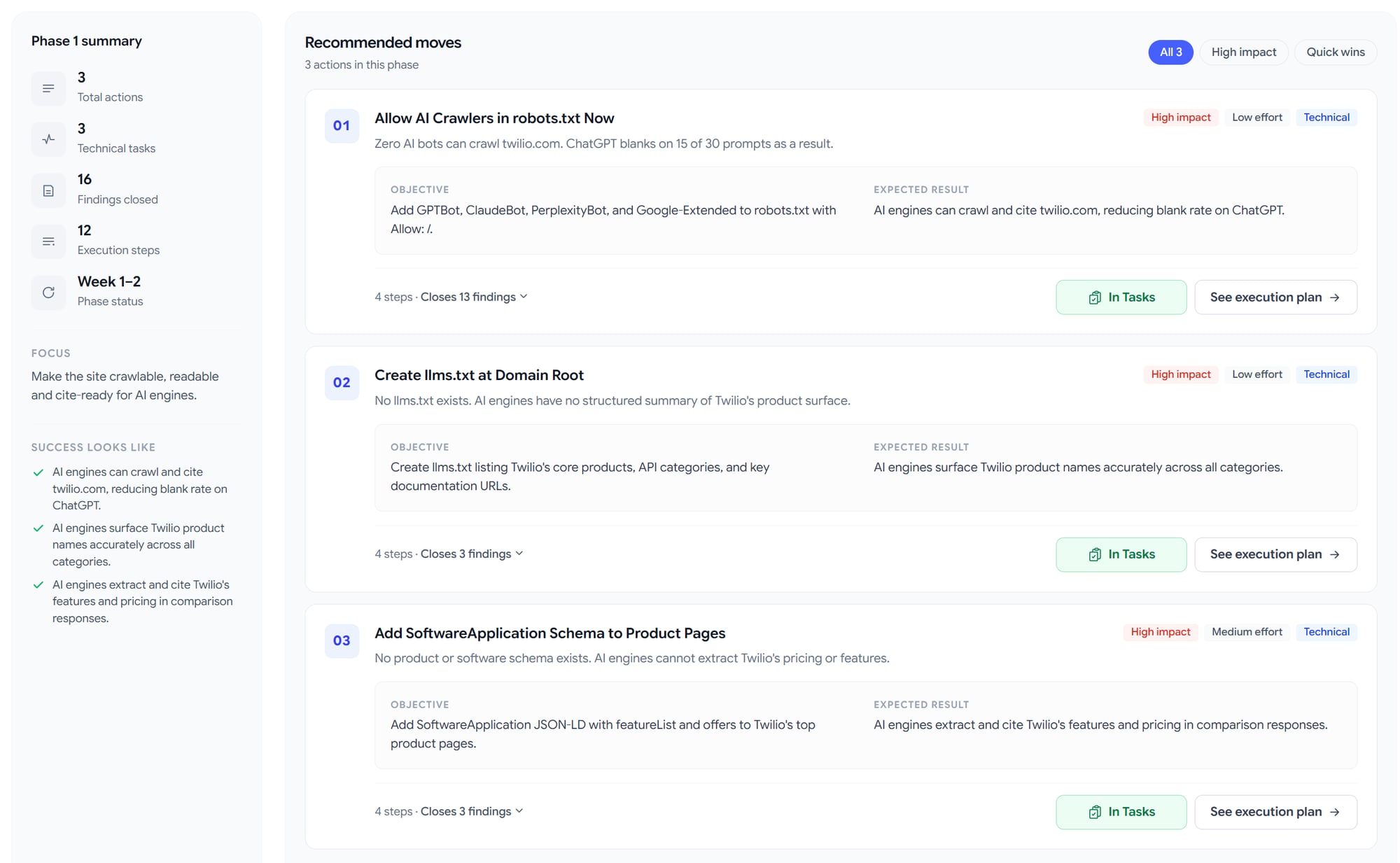
The old Insights page is gone. In its place is Action Plan, a 90-day roadmap that turns findings into phases and phases into specific recommended moves. Each move ships with an objective, an expected result, and a one-click promote to Tasks.
Task Planner is the working surface where those tasks live. You prioritize them, you work them, you close them. The loop from “here’s what’s wrong” to “here’s what I did about it” now happens entirely inside Rankry.
Content Studio: an article generator built for AI answers
Content Studio is new, and it closes the last gap between insight and execution.
Pick a finding. Pick a target prompt. Content Studio drafts an AEO-ready article in your tone, structured the way AI engines actually cite content, ready for you to edit and ship to your blog. You stop staring at a list of “you should publish content about X” and start with a real draft in hand.
Onboarding that gets you a real report fast
First impressions were rebuilt around a single goal: get a real report into your hands as quickly as possible.
Domain pull, competitor detection with a map view, semantic core generation, model selection, and your first scan are now one guided flow instead of a series of disconnected steps. You go from signing up to seeing where you stand in minutes, not in a setup marathon.
What comes next
This is the foundation we’re building the next year on. Everything above is the base layer, not the finish line.
If you have an active account, all of it is already live in your dashboard right now. If you don’t, start a 7-day trial and watch your visibility move.