

AI visibility tracking: see how often AI names your brand
Rankry asks ChatGPT, Claude, Gemini, Perplexity, Grok, Meta Muse, Google AI Overviews, Google AI Mode and Copilot the questions your buyers ask, then counts how many answers name you. Next to that share you see your position, the engines that skip you, and the answer behind every number.
7-day free trial · No card needed
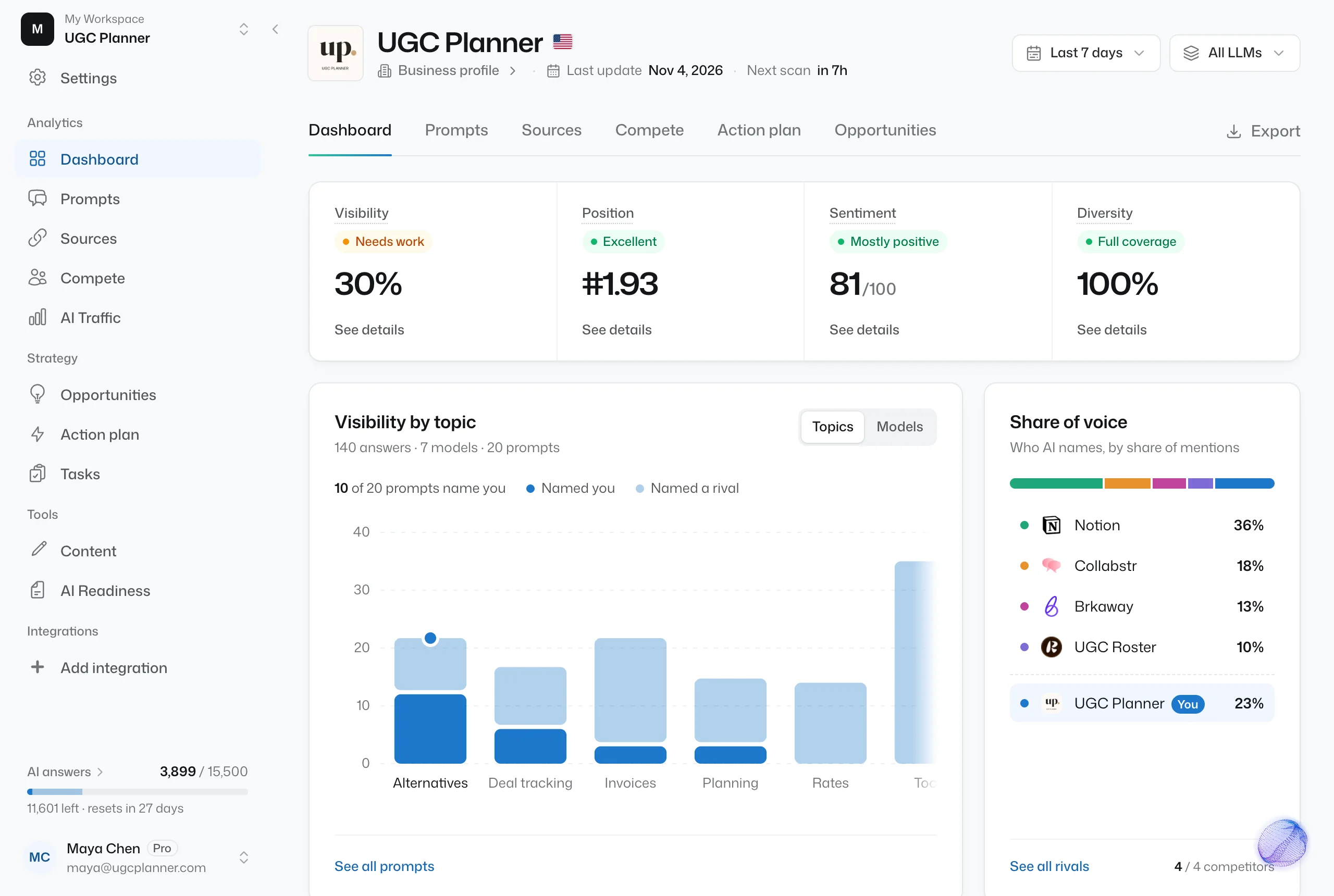
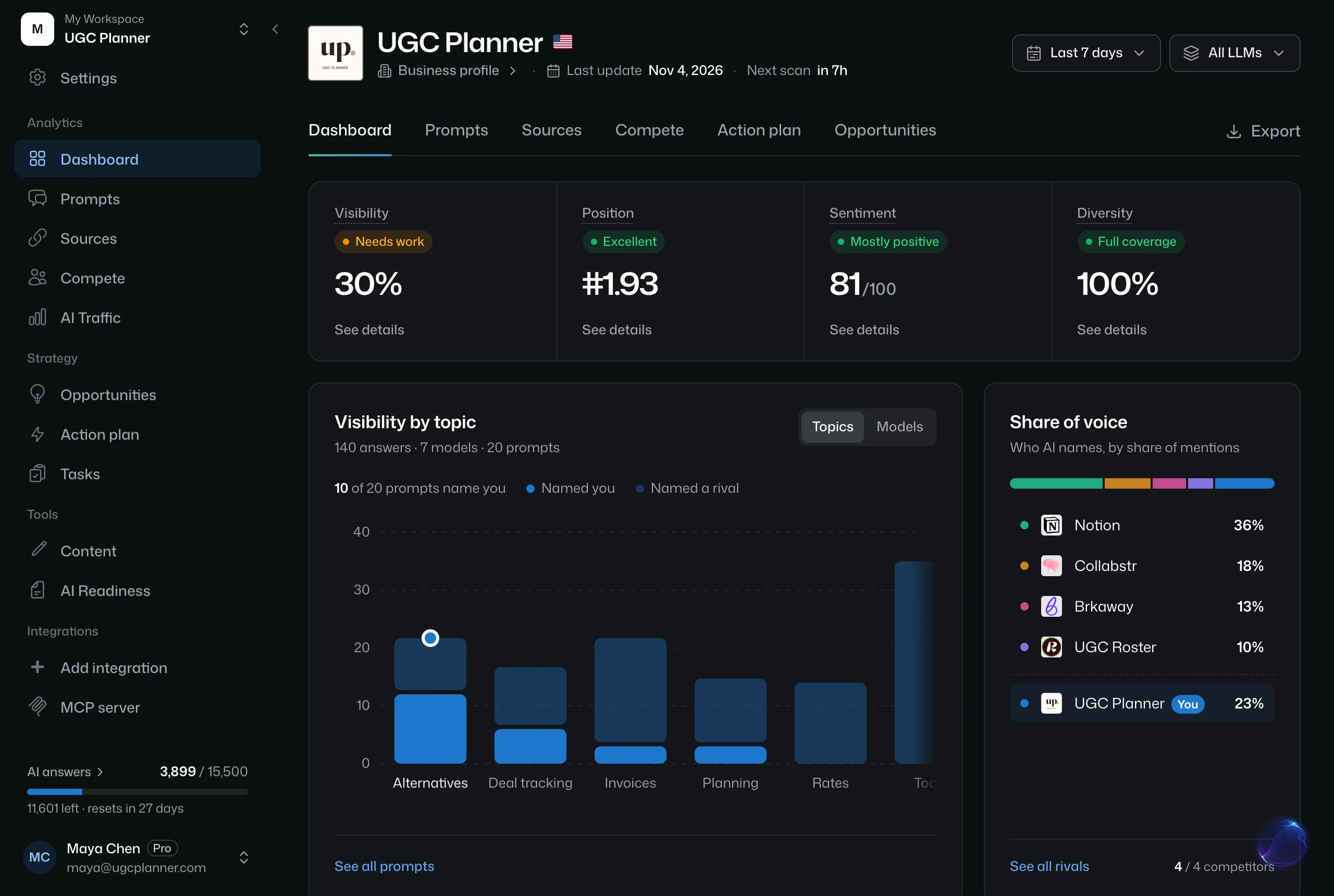
Sample data: UGC Planner
Tracks your brand on
 ChatGPT
 Gemini
 Claude
 Perplexity
 Grok
 Copilot
 Meta Muse
 AI Overviews
 AI Mode
The whole picture of how AI sees you.
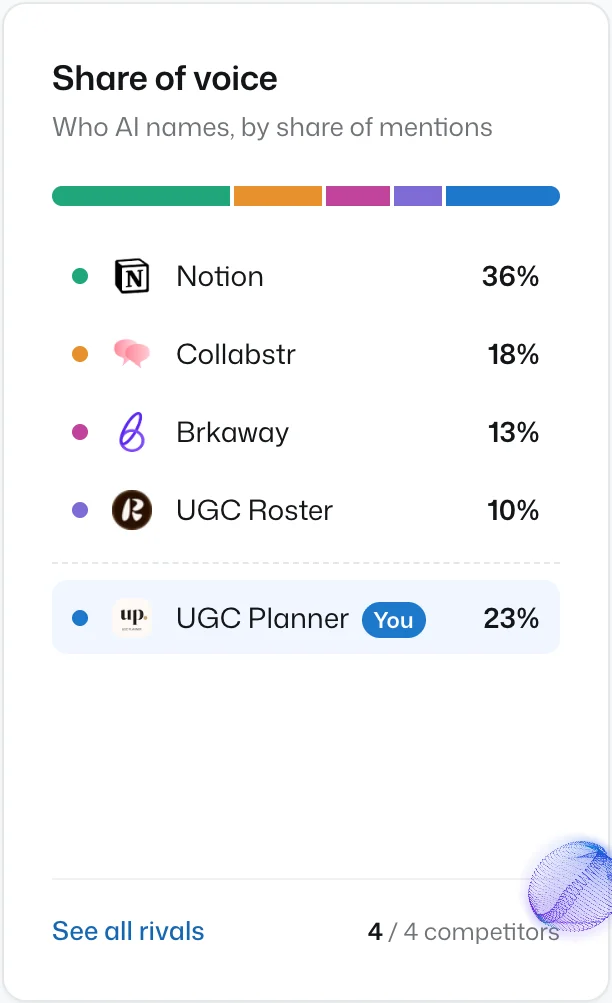
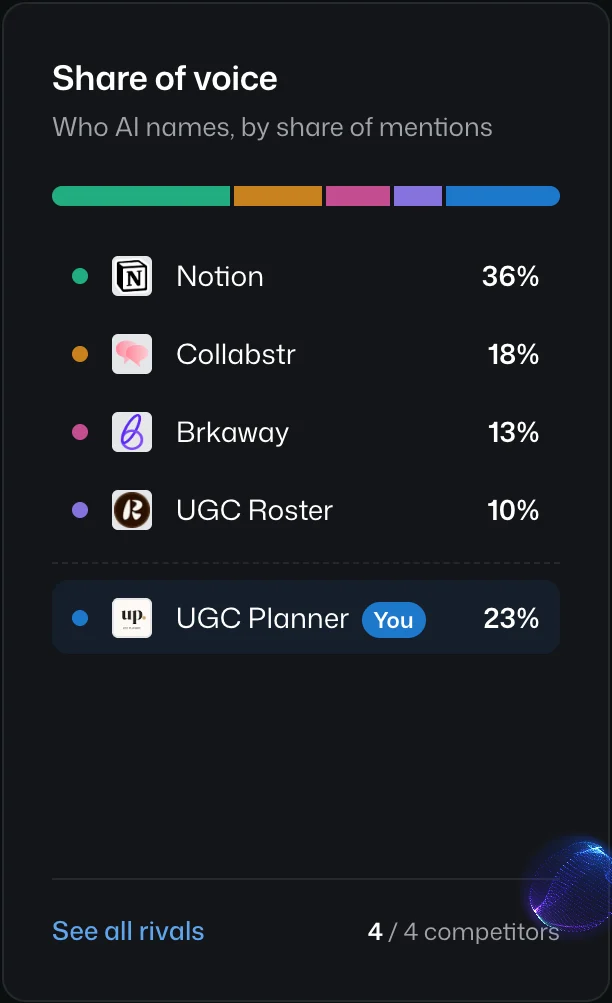
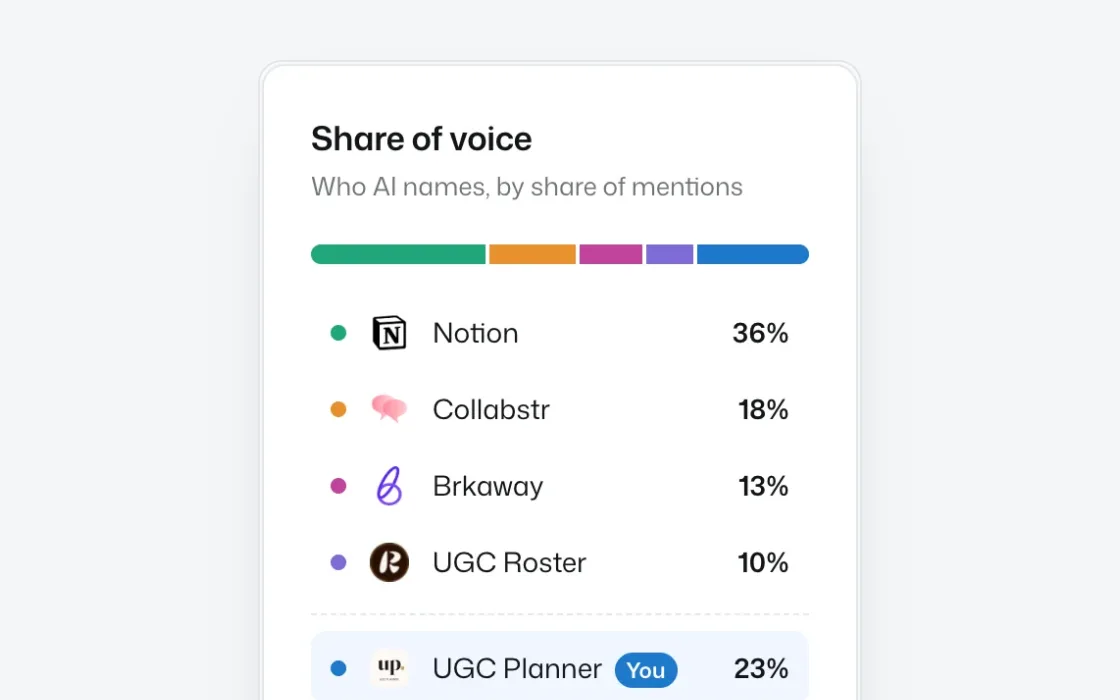
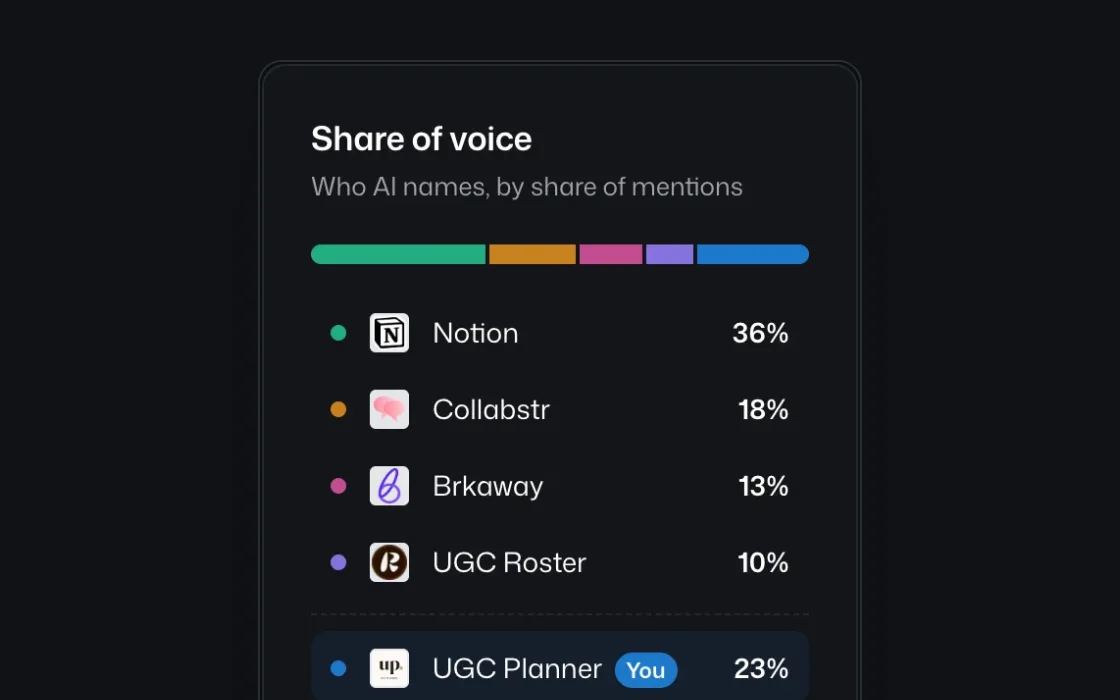
Share of voice
Your share of the mentions among the brands you track, on every engine.
See share of voice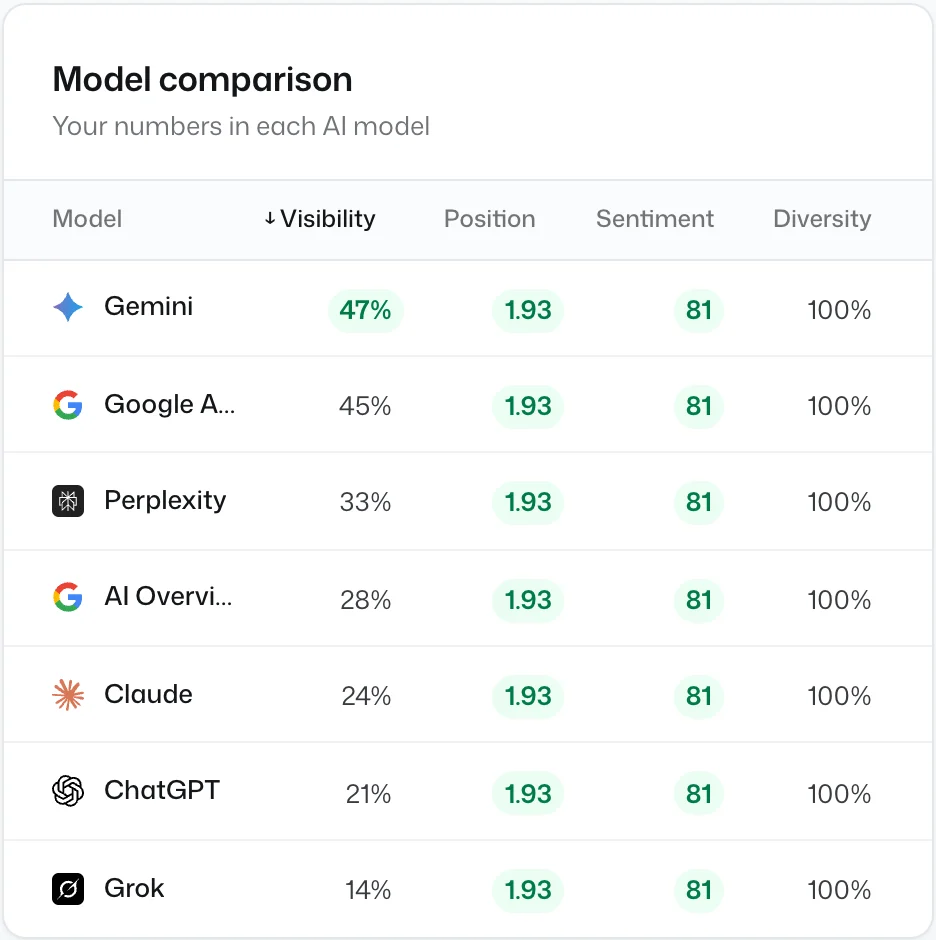
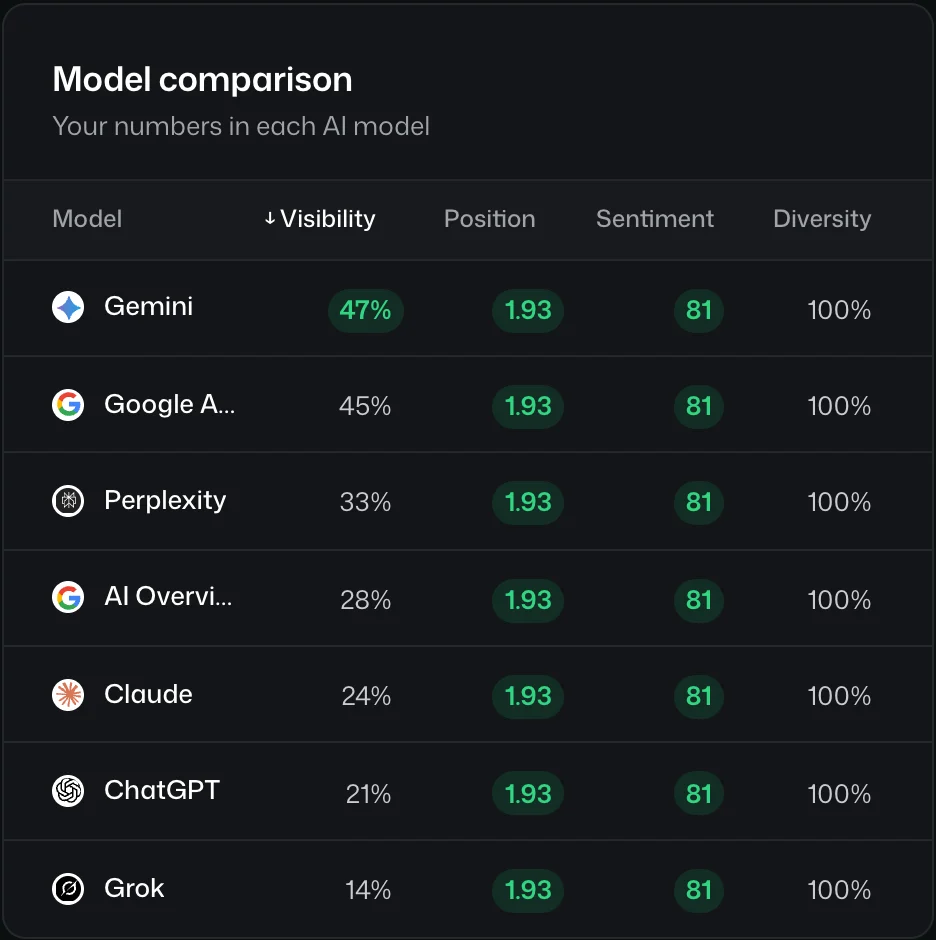
By engine
Your numbers in each model, side by side, so one weak engine cannot hide.
See AI model selectionInside the dashboard
Four numbers tell you where you stand. The rest tell you why.
Visibility, position, sentiment, diversity
One line for every run.
How often you are named, how high, how warmly, and on how many engines.
How position works

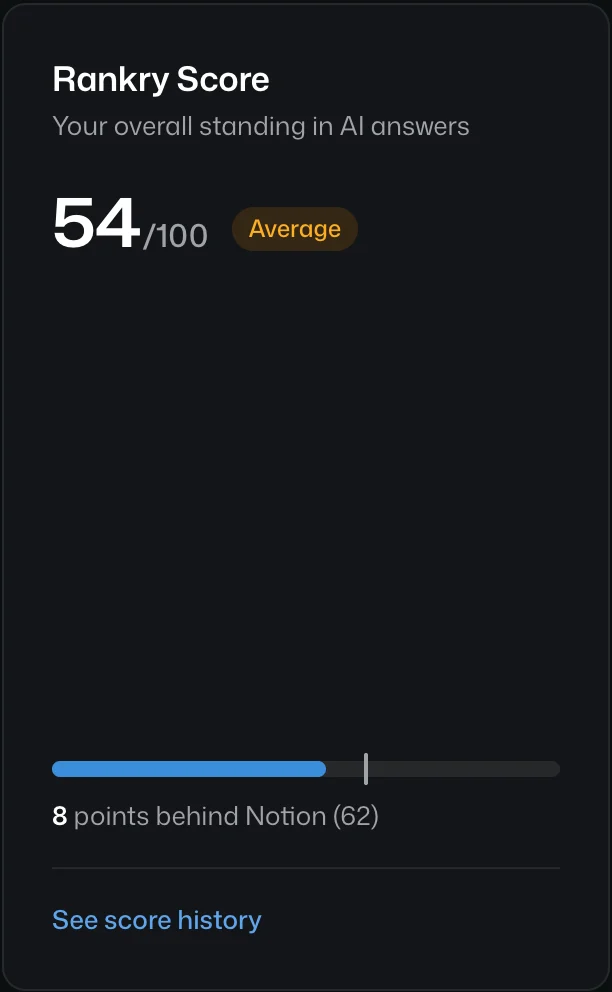
Rankry Score
One score to follow, and the gap to the leader.
Follow it over time and see exactly how many points stand between you and the most named brand.
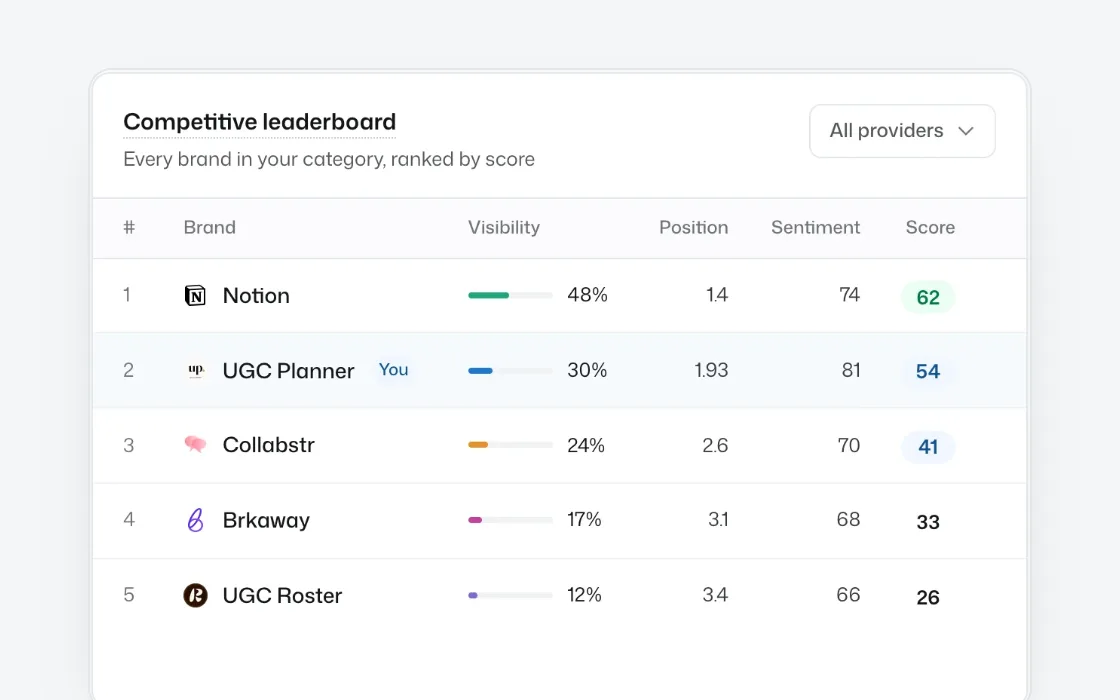
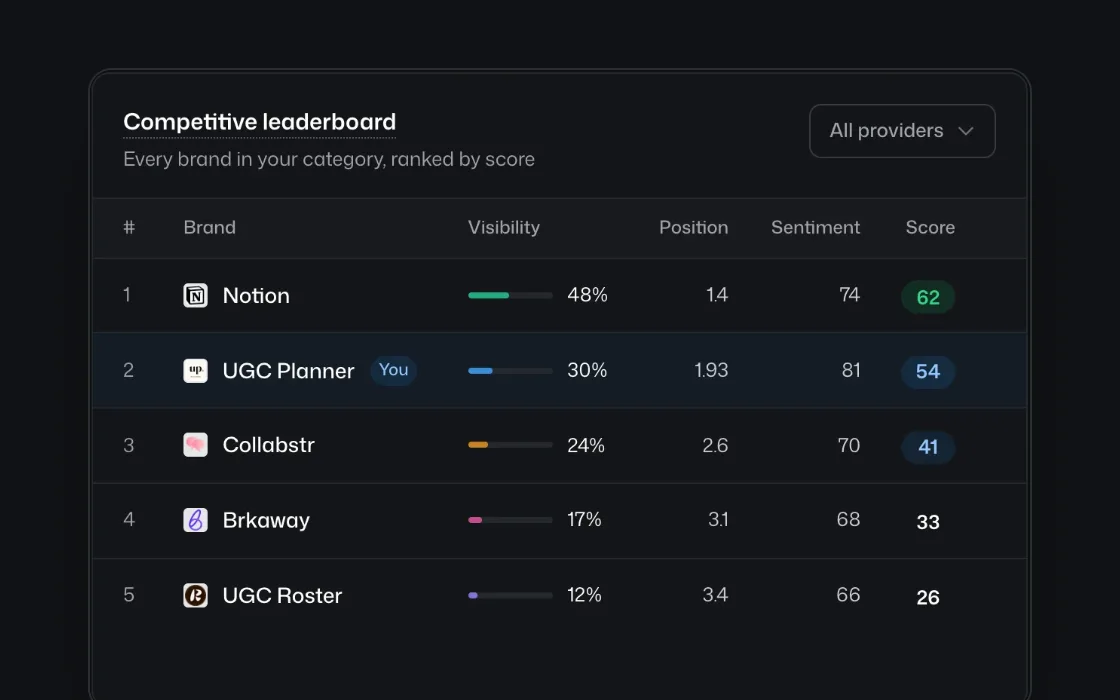
Compare with rivals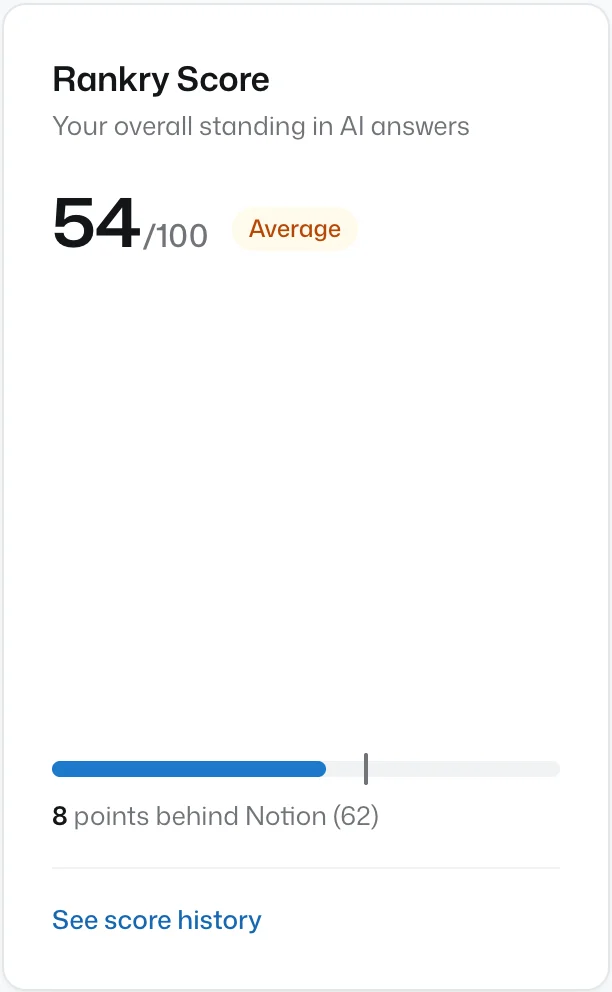
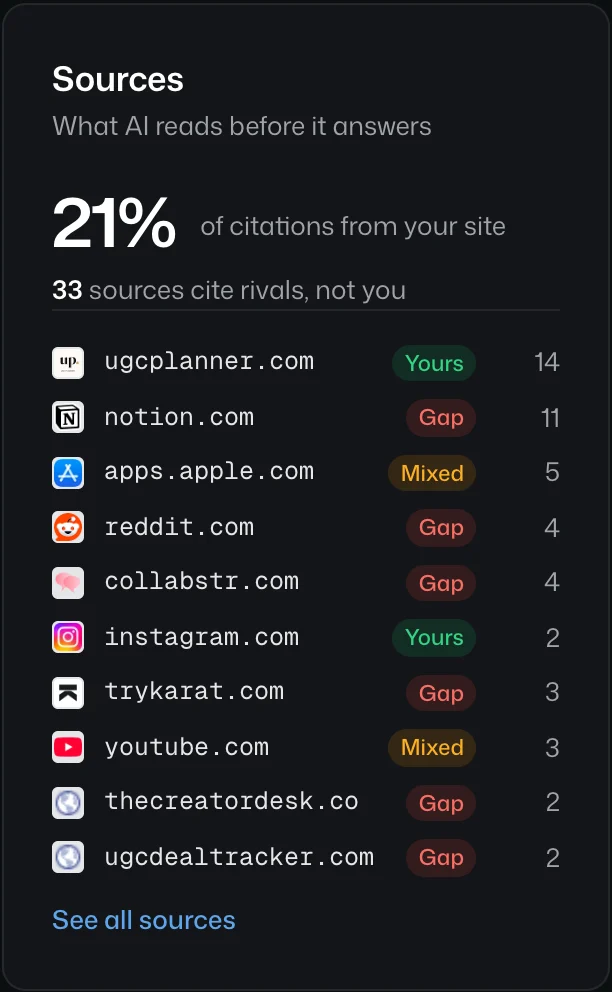
Sources
See what AI reads before it answers.
The sites cited in your category, and the ones that cite rivals and never you.
Explore citations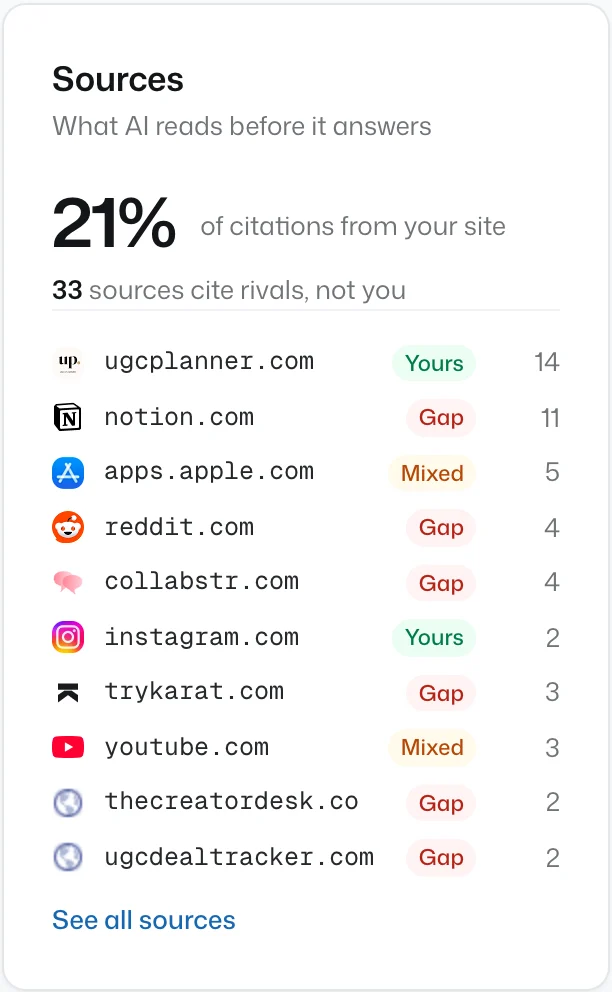
In short
AI visibility is the share of AI answers that name your brand when people ask the questions your buyers ask. Rankry tracks it across nine AI engines: each prompt is answered by each engine, and every answer either names you or it doesn’t. Your Visibility score is the answers that name you divided by all answers in the period you pick.
Mentions vs. share of answers
Why isn’t a mention count enough?
A mention count has no denominator. “Mentioned 42 times” could mean 42 of 50 answers or 42 of 500. It doesn’t say which engine left you out, which question you lost, or whether you were the first brand named or the ninth.
Visibility answers the question a mention count can’t: of all the answers AI gave to your buyers’ questions, how many named you? Rankry counts an answer once, whether it names you in the first line or the last, so the number is easy to read and easy to compare between engines, topics and competitors.
Side by side
What does a share of answers show that a count can’t?
Where you appear in the list is a separate number, Position, shown right next to Visibility. Together they tell you whether AI names you and how high it puts you.
A mention counter says: “You were mentioned 42 times.”
No denominator, so no way to compare. No split by engine, topic or prompt. Nothing to open and check.
What Rankry shows: 30% of answers name you
42 of 140 answers from 20 prompts and 7 engines. Position when named: #1.9. Split by engine, topic and prompt. Every answer one click away. Sample numbers.
One number
What is a good AI visibility score?
There is no universal benchmark. A score depends on your category, how crowded it is, and which prompts you track: questions that name your brand score far higher than open “best tool for…” questions. The useful comparisons are your own trend and the brands you compete with, which is why Rankry shows Visibility next to its change over the period and next to your share of voice.
| Next to your score | Example | What it tells you |
|---|---|---|
| Visibility, last 30 days | 30% · up 4 points this period | Your share of answers, against its own trend |
| Answers naming you | 42 / 140 | The count behind the percentage |
| Position | #1.9 | How high AI puts you when it names you |
| Engines naming you | 7 of 7 | Whether the score is spread across engines or rests on one |
Sample data. Pick the last 7, 30 or 90 days or 12 months, within the history your plan keeps.
The method
How is AI visibility measured?
Four steps, from your prompts to one percentage. The worked example uses 20 prompts and seven engines, for UGC Planner, a deal tracker app for UGC creators. Want the run-by-run view? Every prompt keeps its history, and you can choose which engines a prompt runs on when you add it.
- 01
The questions buyers ask
Rankry writes prompts from your site at setup. You add your own or import a CSV, and group them in categories. Prompts never name your brand unless you write one that does. In the example: 20 prompts.
- 02
The AI engines answer
ChatGPT, Claude, Gemini, Perplexity, Grok, Meta Muse, Google AI Overviews, Google AI Mode and Copilot each answer the prompt; the two Google surfaces are captured from Google’s live results. Your plan and add-ons decide which engines run. In the example: 7 engines.
- 03
Each answer names you or not
Every prompt gets one answer from every engine in each run. A model reads each answer and lists the brands it names, in order. An answer that names you scores 1, any other answer 0. In the example: 140 answers.
- 04
Named answers ÷ all answers
42 answers named UGC Planner out of 140, so Visibility is 30%. Over a longer period Rankry adds up every answer in the window, so one odd run doesn’t swing the number.
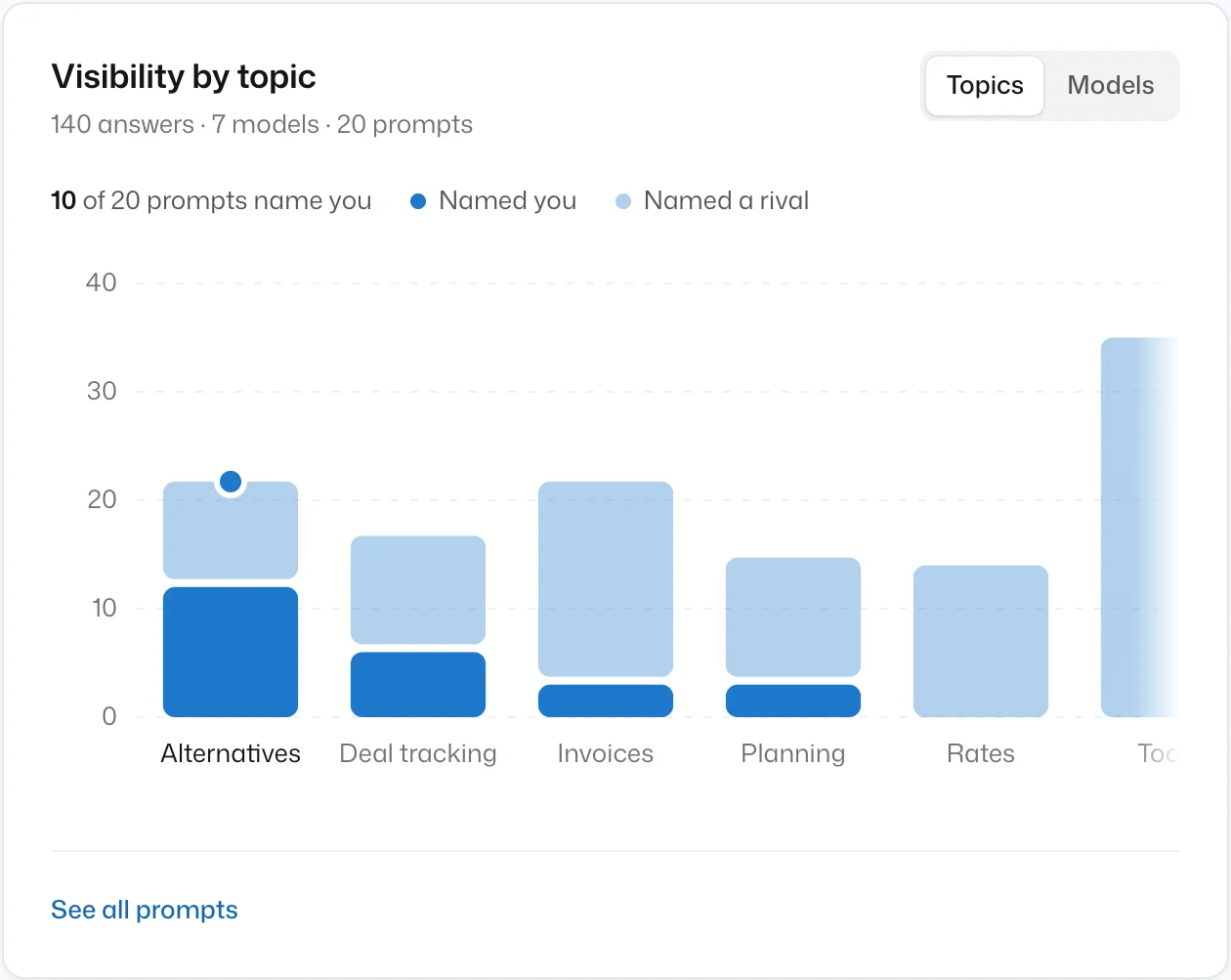
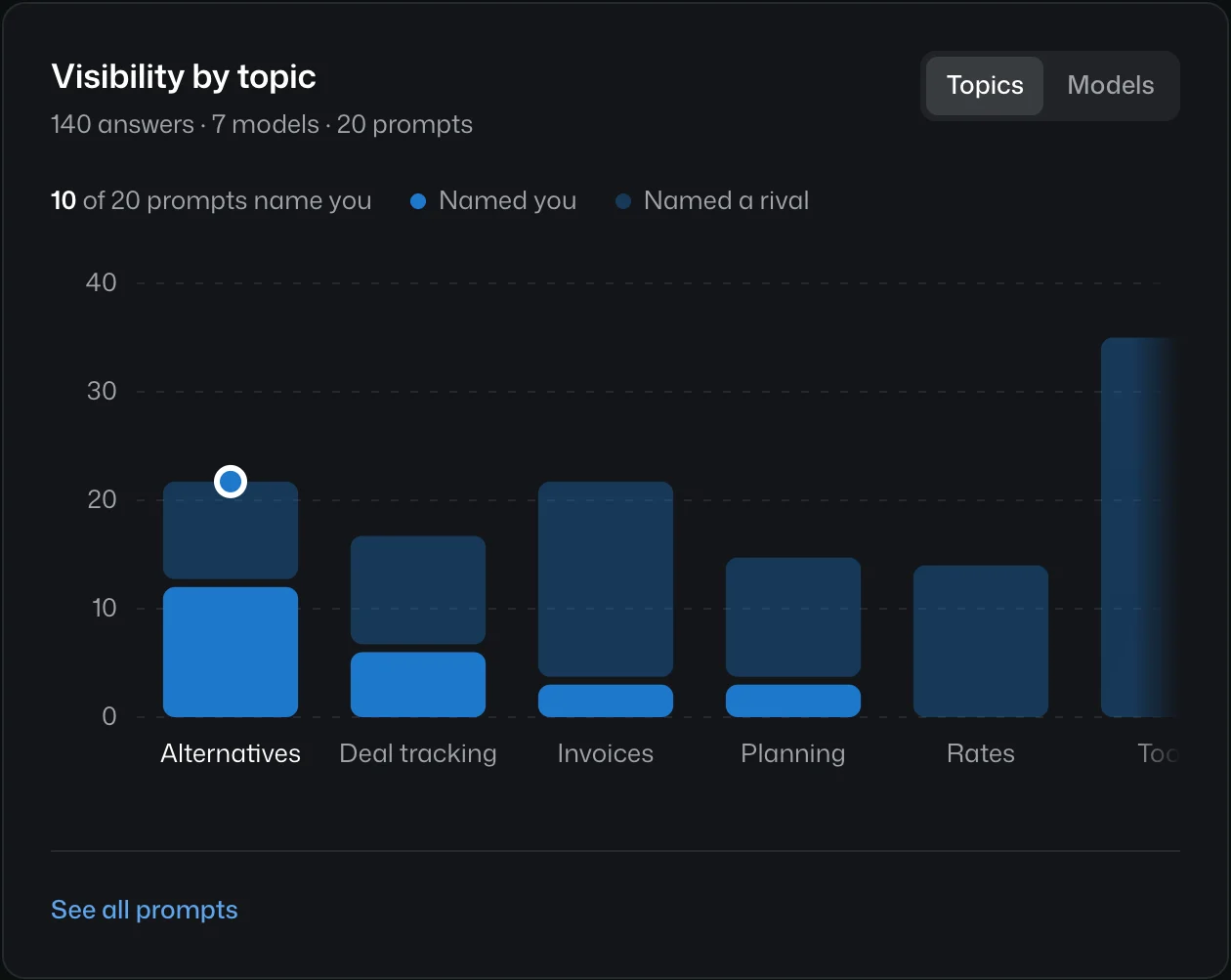
Visibility by topic
Which topics does AI name you for?
Topics are your prompt categories. The “Visibility by topic” card shows how many prompts in each one name you, so you can see where you’re part of the answer and where a rival takes it.
| Topic | Visibility | Position | Prompts | Strength |
|---|---|---|---|---|
| Brand questions | 71% | #1.1 | 3 of 3 | Strong |
| Deal tracking | 43% | #2.4 | 3 of 5 | Strong |
| Invoices & payments | 33% | #1.6 | 2 of 3 | Mixed |
| Alternatives | 29% | #3.1 | 1 of 2 | Mixed |
| Creator CRM | 5% | #4.0 | 1 of 3 | Weak |
| Rate cards | 0% | — | 0 of 2 | Not named |
| Usage rights | 0% | — | 0 of 2 | Not named |
Sample data, grouped by strength for this page: strong means named in most answers, mixed named some of the time, weak rarely named, and not named means no answer named you. A topic nobody owns yet is often the fastest win: see unowned questions.
Behind every number
Can I see the actual AI answers behind my score?
Yes. Open any prompt to see every run, which engines named you, your position in each answer, the brands each engine ranked and the reason it gave, the sources it cited, and the full answer text for every new run.
| Prompt | Engine | Result | Answer |
|---|---|---|---|
| “best app for UGC creators to track brand deals” | ChatGPT | Mentioned · #28 sources | If you want something built for creators rather than a general project tool, UGC Planner tracks each deal’s deliverables, deadlines and payment status in one place. Notion works too if you are happy to build your own template. |
| “how can I track all my UGC deals from my phone?” | Gemini | Mentioned · #112 sources | UGC Planner is designed as a mobile app for creators, on iPhone and Android, so you can update a deal, log a shipment or mark an invoice paid from one screen. |
| “app to manage UGC invoices and payments” | Google AI Mode | Mentioned · #39 sources | Creators often start with a spreadsheet or a Notion template. Dedicated apps such as Collabstr handle payments inside their marketplace, while UGC Planner tracks invoices across every brand you work with. |
Sample answers, shortened, with the brand highlighted for this page. In this example UGC Planner was named in 42 of 140 answers, 30% across 7 AI engines in the last 30 days, up 4 points over the period. Sources appear when an engine searched the web and returned them; an answer given without a search has none. Want to know which domains AI leans on? See AI citations.
Model comparison
Which AI platforms should I track?
The ones your buyers use, and they rarely use only one. Answers differ a lot between engines because each runs its own model and its own search, so a single average hides where you’re missing. Rankry covers nine AI engines and puts them side by side.
| Engine | Visibility | Position | Sentiment |
|---|---|---|---|
| ChatGPT | 21% | #2.4 | 74/100 |
| Claude | 25% | #3.1 | 67/100 |
| Gemini | 57% | #1.2 | 82/100 |
| Perplexity | 29% | #2.0 | 70/100 |
| Grok | 11% | #6.0 | 50/100 |
| Google AI Overviews | 21% | #3.5 | 64/100 |
| Google AI Mode | 46% | #1.8 | 78/100 |
Sample data from a project that runs on seven of the nine engines. The best value in each column is highlighted. Google AI Overviews and AI Mode are included on Pro or available as Base add-ons; engines not on your plan appear greyed out. Coverage across engines has its own metric, Diversity.
History
How does AI visibility change over time?
Every run adds a point. Reports refresh every day (how often Rankry checks), and each headline metric has its own history panel. Compare yourself with tracked competitors to see whether a new page moved the line or a rival took the answer.
| Visibility trend | Sep 29 | Oct 6 | Oct 13 | Oct 20 |
|---|---|---|---|---|
| UGC Planner | 26% | 26% | 28% | 30% |
| Notion | 49% | 50% | 49% | 48% |
| Collabstr | 20% | 22% | 23% | 24% |
Sample data, last 30 days. How much history you can look back on depends on your plan: 90 days by default, up to 12 months on plans that allow it.
Built for
Who uses an AI visibility tracker?
Tracking is the first step. Rankry then helps you act on it: the Action plan puts fixes in order, and Opportunities shows the questions no brand owns yet.
Marketing lead
“Are we part of the answer when buyers ask AI about our category?”One Visibility number per period, split by engine and topic, with its trend and your share of voice against tracked competitors.
SEO / GEO manager
“Which prompts and engines leave us out, and what do they cite instead?”Prompt-level history, the brands each answer ranked, cited sources, and Opportunities that turn open questions into drafts.
Founder or brand manager
“What does AI say about us, and who does it recommend instead?”The full answer for every new run, a sentiment label on each one, “Who wins this prompt” on every prompt, and a Compete page for the brands you track.
Explore Rankry
Related features
What is AI visibility tracking?
AI visibility tracking means asking AI engines the questions your buyers ask, again and again over time, and recording whether each answer names your brand. Rankry does this across ChatGPT, Claude, Gemini, Perplexity, Grok, Meta Muse, Google AI Overviews, Google AI Mode and Copilot, and turns the results into one share-of-answers number you can split by engine, topic and prompt.
How does Rankry calculate the Visibility score?
Each prompt is answered once by each engine in a run. An answer that names you counts as 1 and any other answer counts as 0, wherever your name appears in it. Visibility is the named answers divided by all answers in the period you choose. Where you appear in the list is measured separately as Position.
Which AI models do you cover?
Nine: ChatGPT, Claude, Gemini, Perplexity, Grok, Meta Muse, Google AI Overviews, Google AI Mode and Copilot. ChatGPT, Gemini and Perplexity are on every plan; Google AI Overviews and AI Mode are included on Pro or available as Base add-ons; Claude, Grok, Meta Muse and Copilot are add-ons on Base and Pro. You can also choose which engines a prompt runs on when you add it.
How often does visibility data update?
Reports re-run automatically every day. New prompts are answered right away when you add them.
How many prompts should I track?
Rankry writes a starting set of prompts from your site during setup; how many depends on your plan. Every project keeps at least 10 prompts running, and your plan sets the upper limit. More prompts across more topics give you a steadier number, because one unusual answer moves the total less.
What is a good AI visibility score?
There is no universal benchmark. Scores depend on your category and on the prompts you track: questions that include your brand name score much higher than open questions such as “best app for…”. Compare your score with its own trend and with the competitors you track, using share of voice and the Compete page.
What’s the difference between visibility and position?
Visibility tells you how often AI names you: the share of answers that include your brand. Position tells you where you appear when you are named: your average rank in those answers, where #1 means first. You need both. Visibility gets you into the answer, and position decides how prominent you are in it.
Can I track competitors’ visibility too?
Yes. Rankry picks likely competitors from your first report, from the brands AI names that compete for the same customers. You can add other brands that appeared in your reports or remove any, and every figure recomputes right away from the answers already stored, without a new run. The Compete page then compares you on visibility, position and sentiment.
Can AI visibility be tied to traffic?
Partly. On Pro, Rankry’s AI Traffic script counts the visits that AI engines such as ChatGPT, Perplexity, Claude and Gemini send to your site, with landing pages and countries. It counts visits, not conversions or revenue.
Stop guessing how often AI names you. Start measuring it.
Your first report runs as soon as you finish setup, across every engine on your plan. 7 days to try everything, and you can cancel with one click.
7-day free trial · No card needed