
 ChatGPT
 Gemini
 Claude
 Perplexity
 Grok
 Copilot
 Meta Muse
 Google AI Overviews
 Google AI Mode
Diversity · Cross-model coverage
Cross-model AI visibility: which AI engines name you
Don’t bet your brand on one AI model. Strong in ChatGPT doesn’t mean strong in Gemini or Google AI Mode. Rankry checks your brand across nine AI engines, counts how many of them name you, and shows which ones skip you, prompt by prompt.
7-day free trial · No card needed
Diversity
Latest run100%
7 of 7 engines named you
- Engines naming you7 of 7
- Strongest · Gemini12 of 20 prompts
- Weakest · Grok2 of 20 prompts
- Narrowest · CRM prompt1 of 7
Sample data
In short
Cross-model AI visibility is how widely your brand is named across different AI engines, not just in one. Rankry measures it with Diversity: the share of the engines in a run that name you in their answers. If six of your nine engines name you, Diversity is 67%. It measures coverage, how many engines know you, rather than how evenly your mentions are spread.
The single-model trap
Why does my brand appear in one AI model but not another?
Every engine runs its own model, runs its own web search and trusts its own sources. A page one engine finds and cites may never reach another. Google AI Overviews and AI Mode build their answers from Google’s results, while ChatGPT, Claude, Gemini, Grok and Meta Muse search the web when they decide a question needs it, and Copilot searches with Bing.
So a brand can be a regular in ChatGPT and absent from Grok. If you check only one engine, the others are a blind spot, and your buyers don’t all ask the same one.
Coverage
How many AI engines can Rankry check?
9 AI engines Rankry can track
Six chat engines, Google AI Overviews and AI Mode, and Copilot.
6 chat engines
ChatGPT, Gemini and Perplexity on every plan; Claude, Grok and Meta Muse as add-ons.
2 Google surfaces and Copilot
Google AI Overviews and AI Mode are captured from Google’s live results, on Pro or as Base add-ons. Copilot is an add-on on Base and Pro.
What you get
How do I track brand mentions across ChatGPT, Gemini, Claude and Perplexity?
Add your prompts once. Rankry asks every engine on your plan, or the engines you pick for each prompt, and reads each answer for your brand. Three views show the result.
Diversity: how many engines name you
The share of your tracked engines that name you in their answers. 7 of 7 means every engine mentions you somewhere; 3 of 7 means four never do. It sits on your dashboard next to Visibility and Position.
Visibility by model: how often each engine names you
For each engine, how many of your prompts name you and how many name a rival instead. It shows which engine is your strongest and which one hands the answer to someone else.
Model comparison: every metric, engine by engine
Visibility, Position, Sentiment and Diversity for each engine in one table, with the best value highlighted. Engines that aren’t on your plan appear greyed out.
Visibility by model
Which AI engines mention my brand most?
Diversity tells you how many engines name you. This view tells you how much: for each engine, the prompts where it names you and the prompts where it names another brand instead.
| Engine | Named you | Named a rival | Of 20 prompts, latest run |
|---|---|---|---|
| Gemini | 12 | 7 | 12 of 20 |
| Google AI Mode | 9 | 10 | 9 of 20 |
| Perplexity | 6 | 12 | 6 of 20 |
| Claude | 5 | 13 | 5 of 20 |
| ChatGPT | 4 | 14 | 4 of 20 |
| Google AI Overviews | 4 | 12 | 4 of 20 |
| Grok | 2 | 15 | 2 of 20 |
Sample data for UGC Planner, a deal tracker app for UGC creators, tracked on seven of the nine engines. Every engine names UGC Planner somewhere, so Diversity is 7 of 7, but Grok names it in only 2 prompts and AI Overviews in 4, yet both name a rival in most of the rest. That’s where to look first: open those answers and see which sources they cite.
Prompt by prompt
Which prompts does each engine name you for?
The Prompts page lists every tracked prompt next to each engine’s answer, so gaps show up as empty cells. Open a prompt for its full run history: who wins it, your position in each engine, and the answer itself.
| Prompt | ChatGPT | Claude | Gemini | Perplexity | Grok | AI Overviews | AI Mode |
|---|---|---|---|---|---|---|---|
| Best app for UGC creators to track brand deals | #2 | #3 | #1 | #2 | #6 | — | #1 |
| How can I track all my UGC deals from my phone? | — | — | #1 | — | — | — | #2 |
| How can I track UGC invoices and payments? | #4 | — | #1 | #3 | — | #3 | #2 |
| Are there CRM apps built for UGC creators? | — | — | #2 | — | — | — | — |
| Can UGC Planner replace Notion for my UGC business? | #1 | #1 | #1 | #1 | #6 | #4 | #1 |
| How do I manage UGC brand contacts in one app? | — | — | — | — | — | — | — |
Sample data. “—” means that engine’s answer didn’t name you. Every engine names you on at least one prompt, yet the CRM prompt is named by one engine and the phone prompt by two: coverage that thin is one answer away from zero. A prompt no engine names you for, like the last row, is worth a look in Opportunities.
Terms
What’s the difference between a mention and a citation?
A mention is your name in the answer. A citation is a link to a page the engine used. You can be cited without being named, or named without being cited, so Rankry tracks them separately. Citations live on the Sources page.
| Term | What it means | Where Rankry shows it |
|---|---|---|
| Mention | Your brand is named in the answer text | Visibility, Position, Sentiment |
| Citation | A page the engine used as a source and linked | Sources page: domains, Yours / Gap / Mixed |
| Position | Your place in the list of brands the answer names | Position, Model preferences on Compete |
| Coverage (Diversity) | How many of your engines name you at all | Diversity tile, Gap to leader, Performance radar |
From gap to fix
How do I get named by an engine that skips me?
There’s no switch to flip in an AI engine. What you can change is what it reads. Four steps, all inside Rankry.
- 01
Find the engine that skips you
Visibility by model and the Prompts page show which engines never name you and which prompts they hand to a rival.
- 02
Read what it says instead
Open its answers: the brands it ranked, the reason it gave for each, and the sources it cited.
- 03
Check the sources it trusts
On the Sources page, “Gap” domains cite competitors but not you. Those are the pages to get onto, or to answer with your own.
- 04
Fix, publish, and watch the next run
Use the Action plan and Content Studio to ship the fix, then see in the next runs whether that engine starts naming you.
Explore Rankry
Related features
What is cross-model AI visibility?
Cross-model AI visibility is how widely your brand is named across different AI engines rather than in just one. Rankry checks ChatGPT, Claude, Gemini, Perplexity, Grok, Meta Muse, Google AI Overviews, Google AI Mode and Copilot, and shows how many of them name you and how often each one does.
How is the Diversity score calculated?
Diversity is the number of engines that name you divided by the number of engines run. If six of nine engines name you in their answers, Diversity is 67%. It measures coverage, how many engines know you, not how evenly your mentions are spread between them.
Which AI engines does Rankry check?
Nine: ChatGPT, Claude, Gemini, Perplexity, Grok and Meta Muse, plus Google AI Overviews and Google AI Mode, which are captured from Google’s live results on Pro or with Base add-ons, and Copilot. Claude, Grok, Meta Muse and Copilot are add-ons on Base and Pro.
Why does my brand appear in ChatGPT but not in Gemini?
Each engine uses its own model and its own search, and trusts different sources. If the pages that mention you are ones ChatGPT finds but Gemini doesn’t, only ChatGPT will name you. Open the answers from the engine that skips you to see which brands and sources it uses instead.
What’s the difference between a mention and a citation?
A mention is your brand named in the answer text. A citation is a page the engine used as a source and linked to. You can be cited without being named, or named without being cited. Rankry tracks mentions in Visibility, Position and Diversity, and citations on the Sources page.
Is Diversity the same as Visibility?
No. Visibility is the share of all answers that name you. Diversity is the share of engines that name you at all. You could be named by all nine engines but only rarely by each, which gives high Diversity and low Visibility, so Rankry shows both.
Do I have to track all nine engines?
No. Your plan decides which engines are available: ChatGPT, Gemini and Perplexity are on every plan, Google AI Overviews and AI Mode are included on Pro or available as Base add-ons, Claude, Grok, Meta Muse and Copilot are add-ons, and engines not on your plan appear greyed out. When you add prompts you can also pick which engines each prompt runs on.
How do I get named by an engine that skips me?
Start with what that engine reads. Open its answers to see the brands it names and the sources it cites, then check the Sources page for “Gap” domains that cite competitors but not you. The Action plan and Content Studio help you publish the pages that fill the gap.
How often is coverage updated?
Reports re-run automatically every day, and new prompts are answered as soon as you add them.
Can I compare my coverage with competitors?
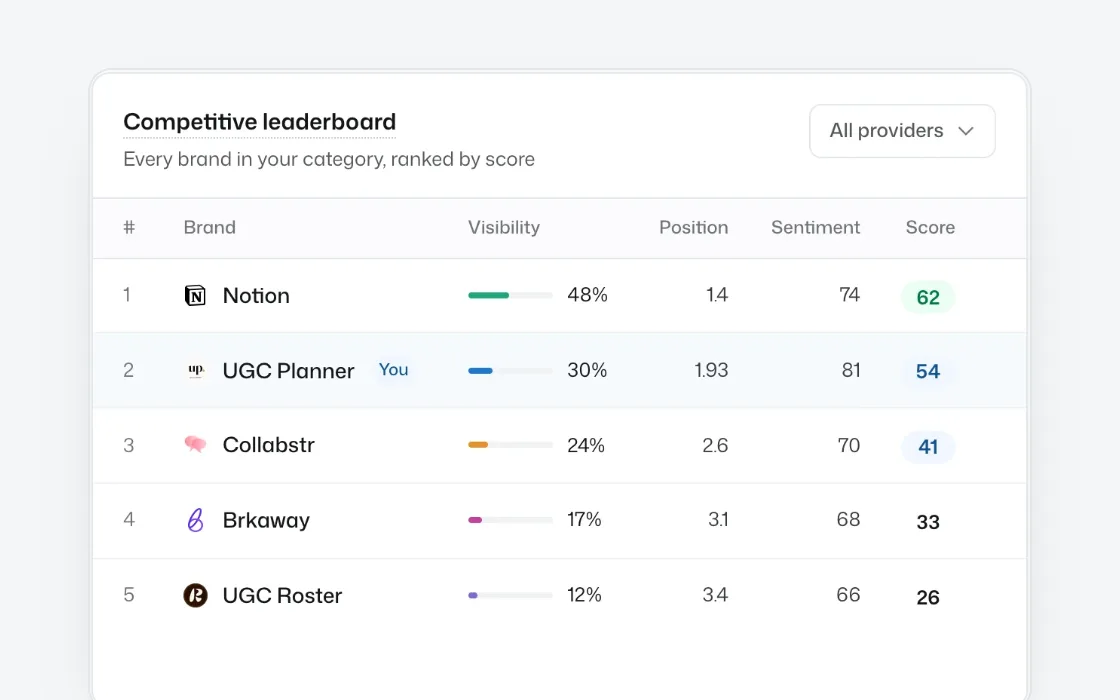
Yes. On the Compete page, Gap to leader and the Performance radar include Diversity for you and your tracked competitors, next to Visibility, Position and Sentiment.
Find the engine that skips you before your buyers do
See which of nine AI engines name your brand, and the prompts where they don’t. Your first report runs right after setup, and you can cancel anytime.
7-day free trial · No card needed