

AI competitor tracking: see who AI recommends instead of you
Rankry finds the brands AI names next to you, then compares you with them across nine AI engines: who leads, who is gaining, which prompts and categories they win, and which engines prefer them.
7-day free trial · No card needed
Sample data: UGC Planner
Tracks your brand on
 ChatGPT
 Gemini
 Claude
 Perplexity
 Grok
 Copilot
 Meta Muse
 AI Overviews
 AI Mode
Know who AI recommends instead of you.
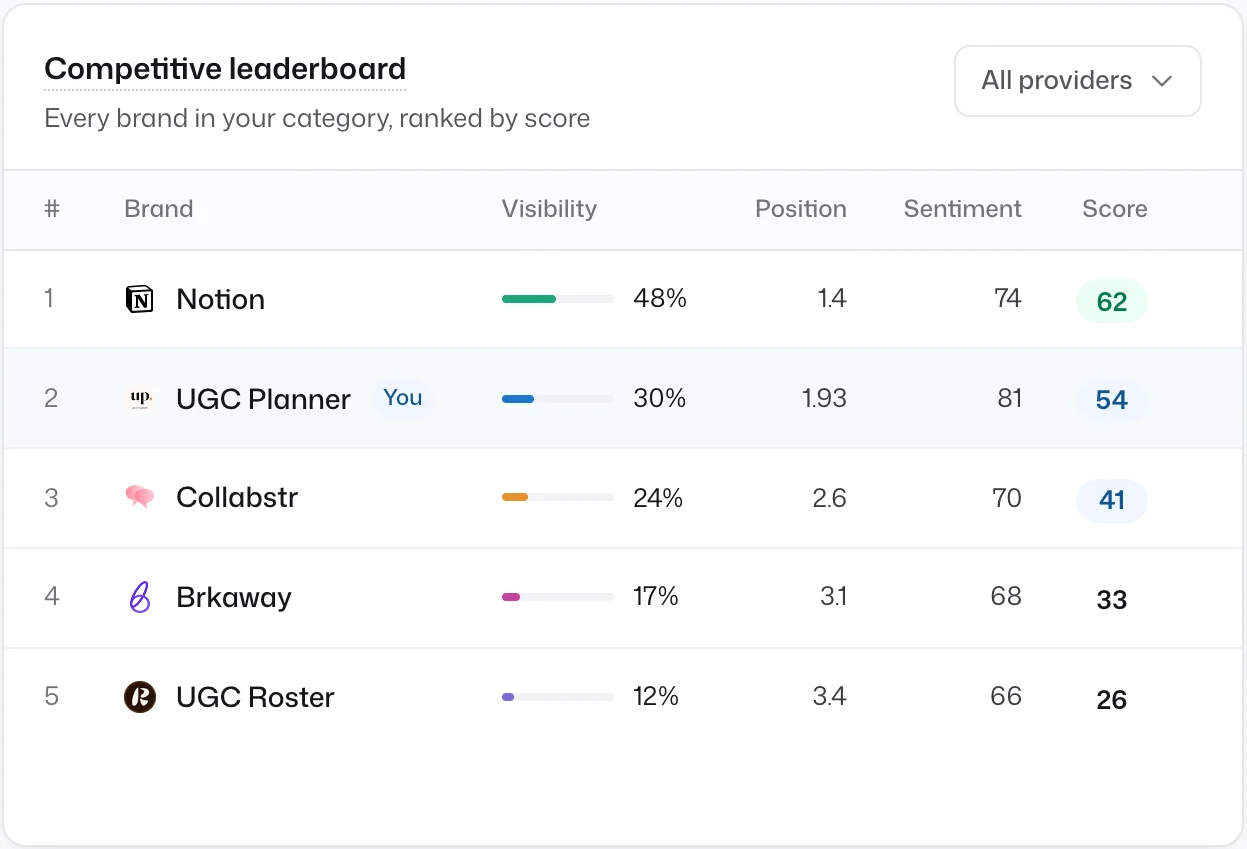
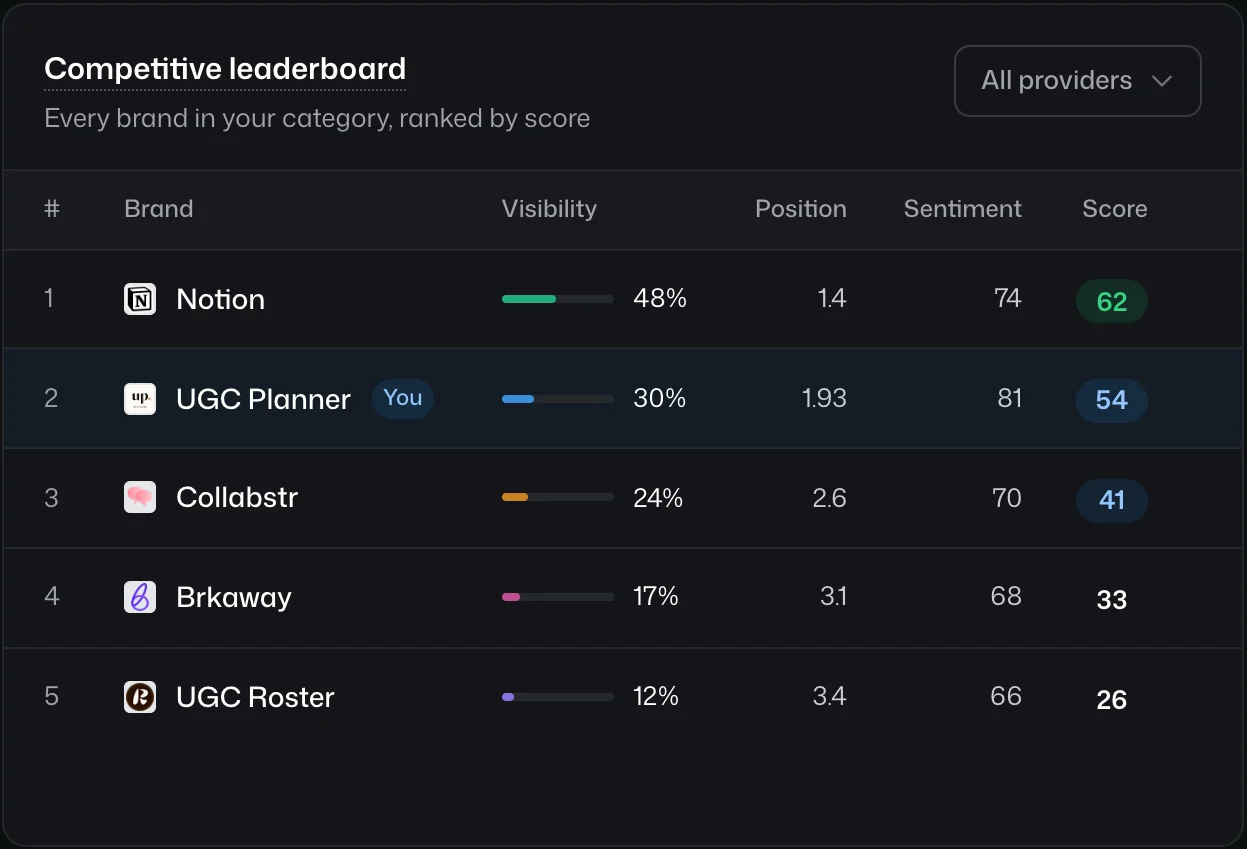
Leaderboard
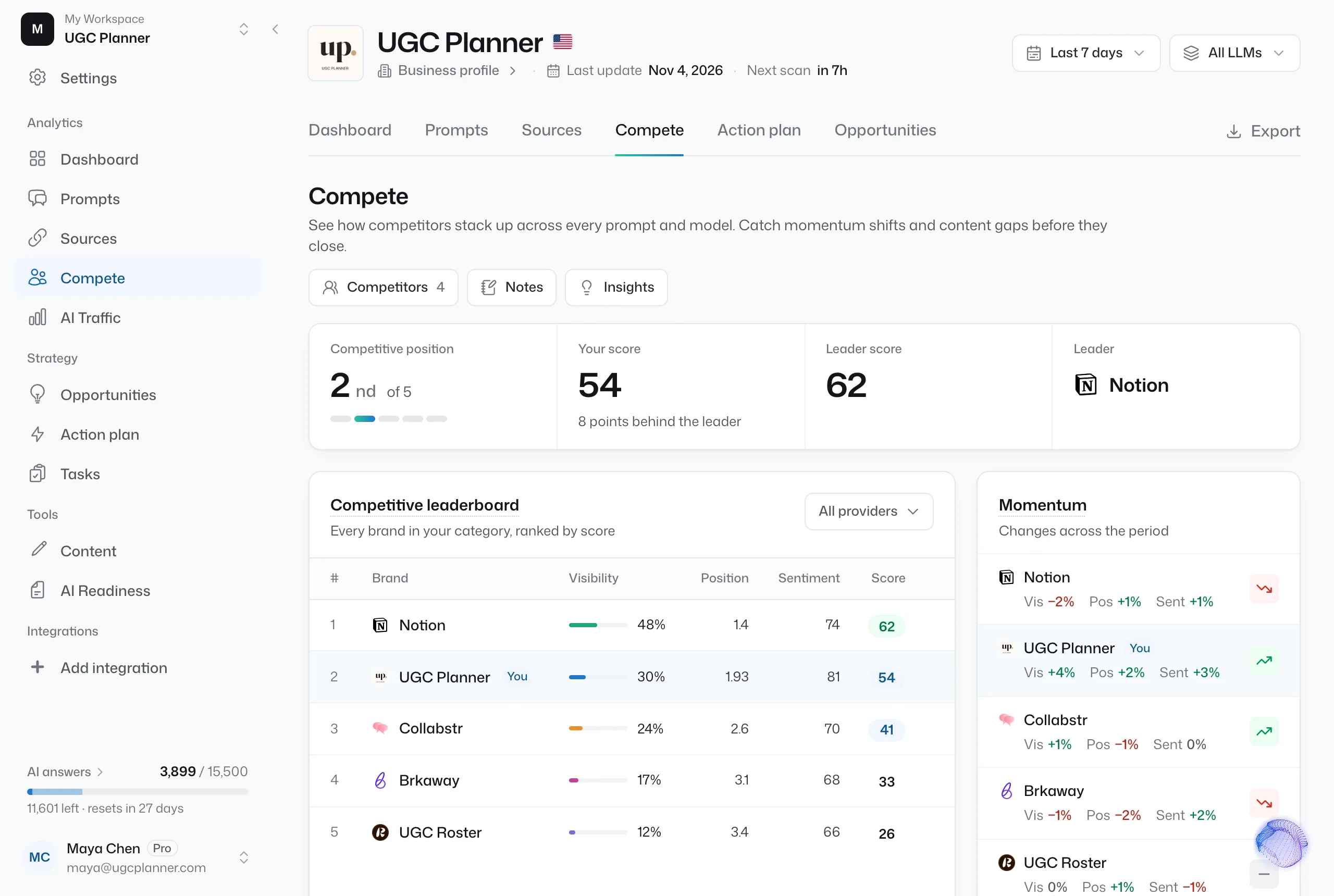
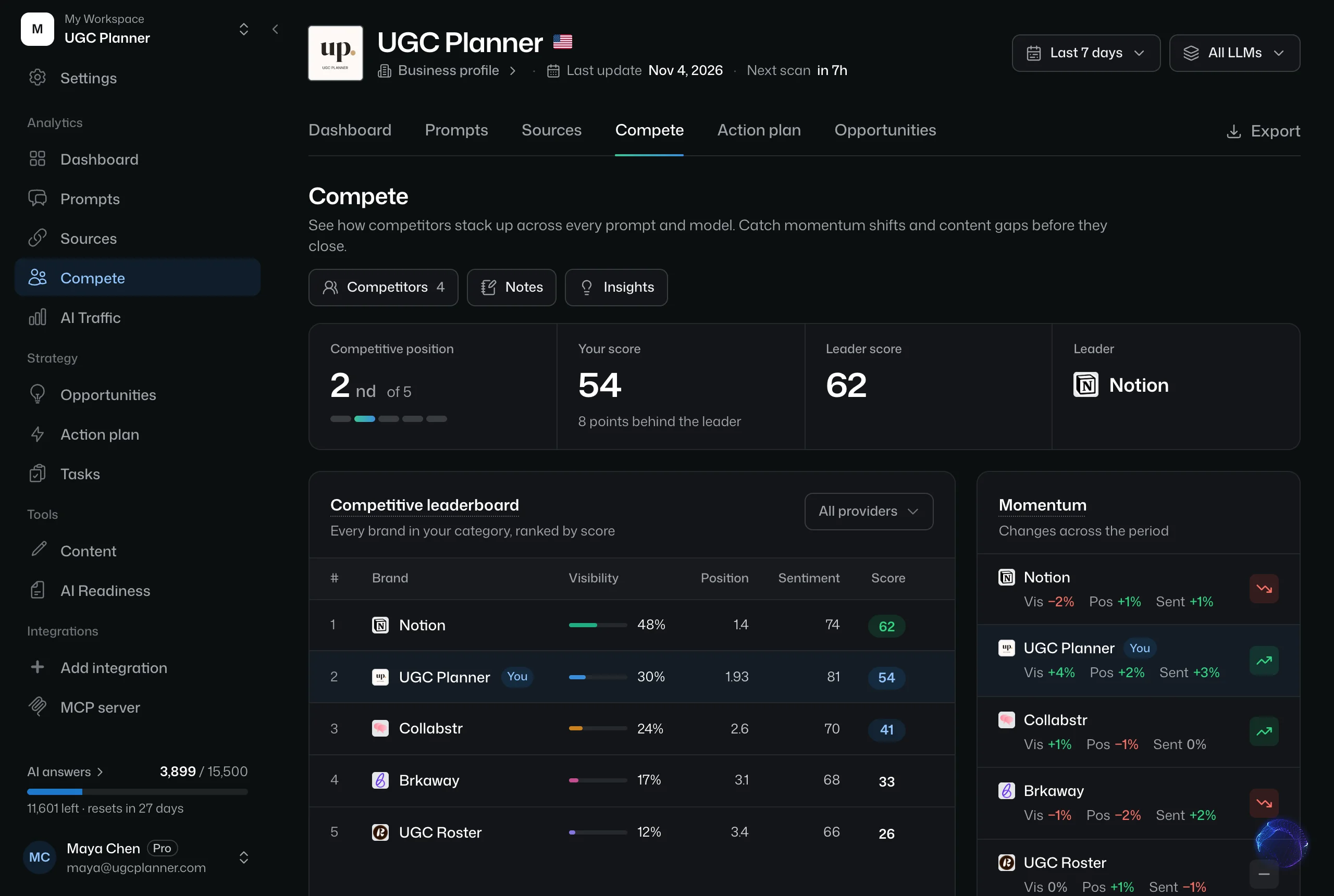
Every brand in your category, ranked by visibility, position and sentiment.
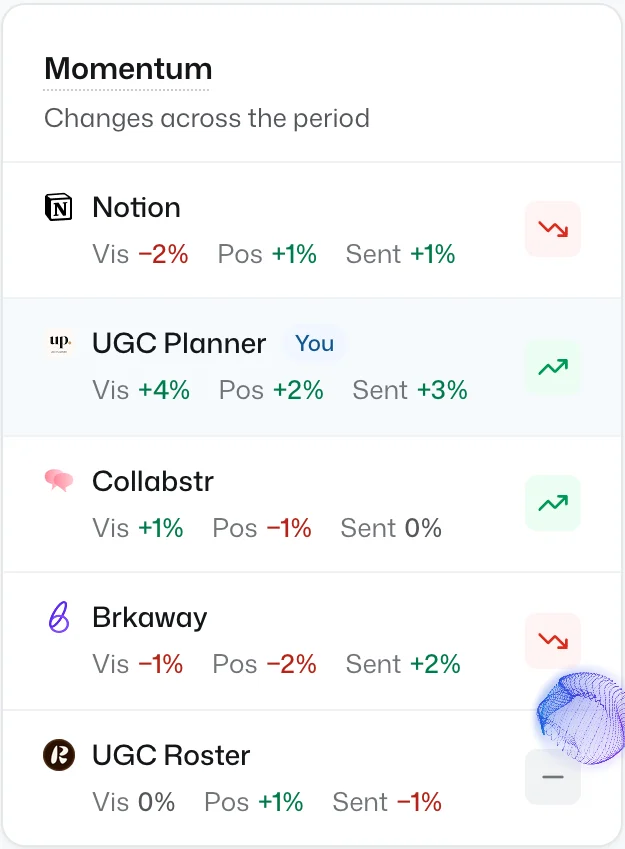
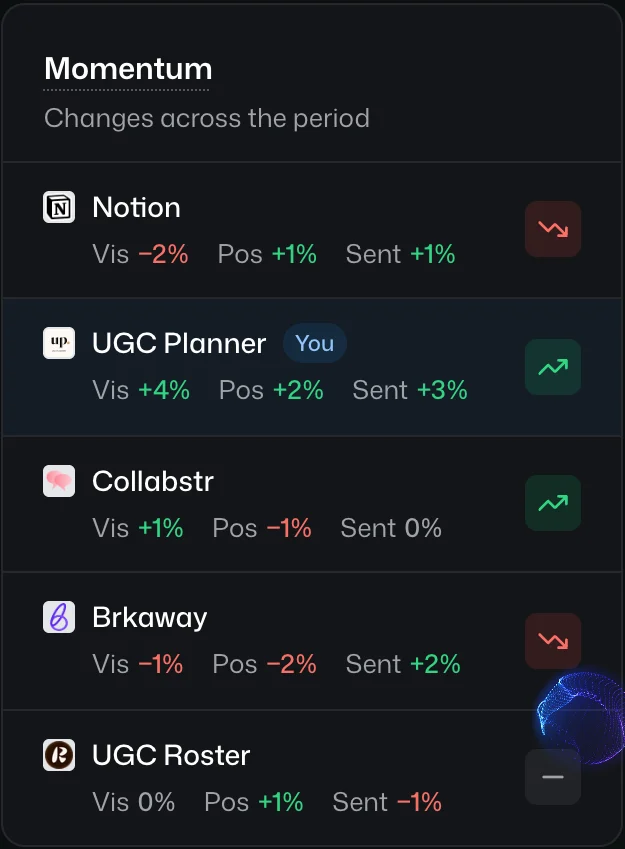
Momentum
Who is gaining and who is losing ground across the period.
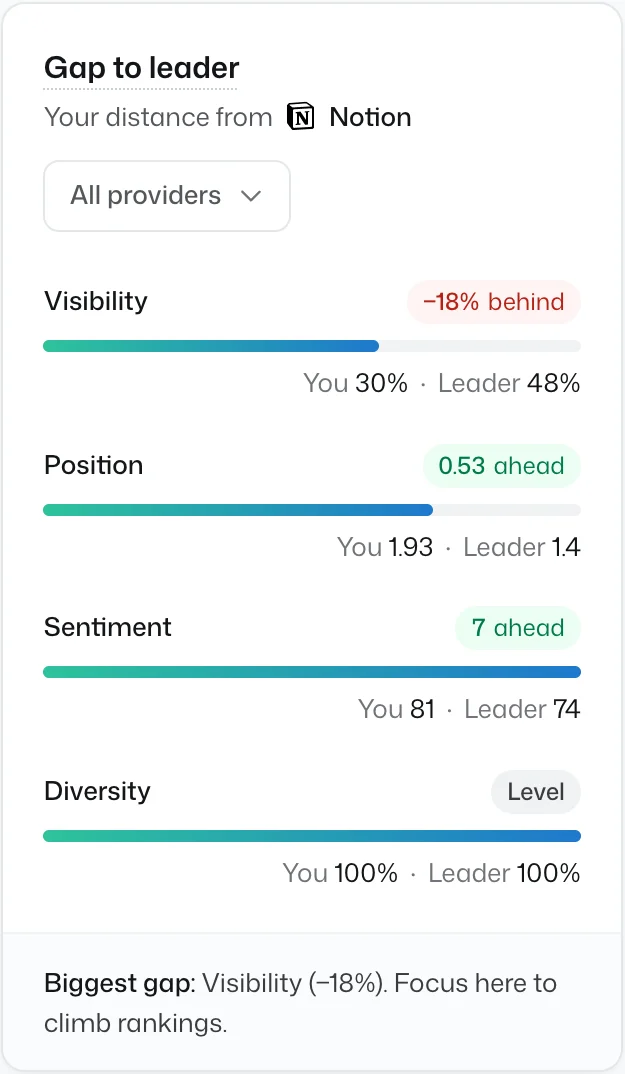
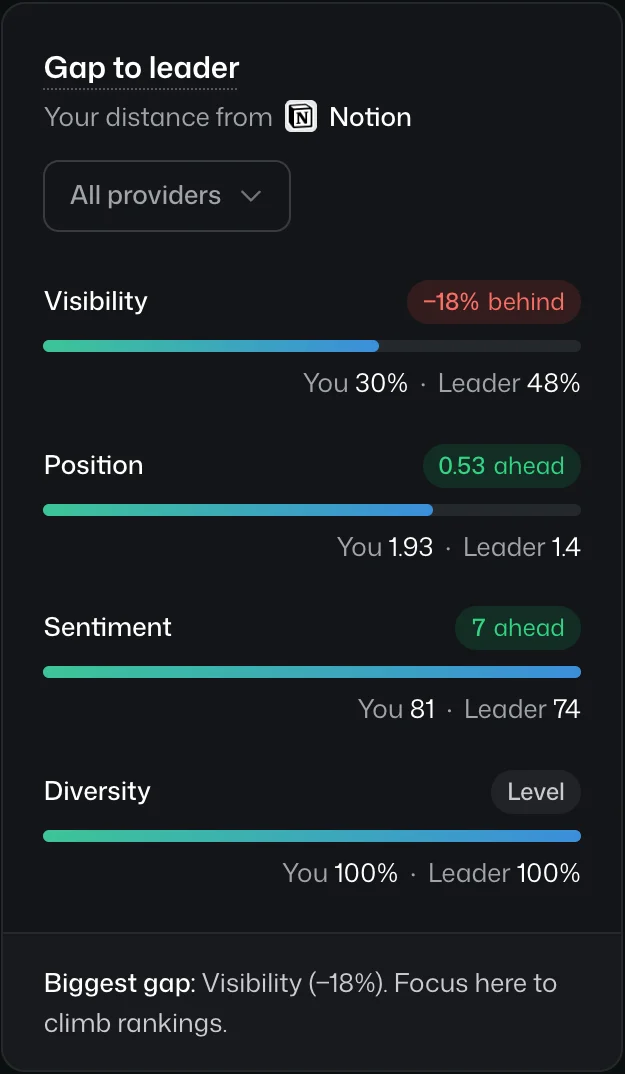
Gap to the leader
Metric by metric, how far you are from the most named brand.
Inside Compete
See where each rival wins, and take it back.
Head to head
You against the rival you pick.
Share of voice on each engine, and the prompts each side wins.
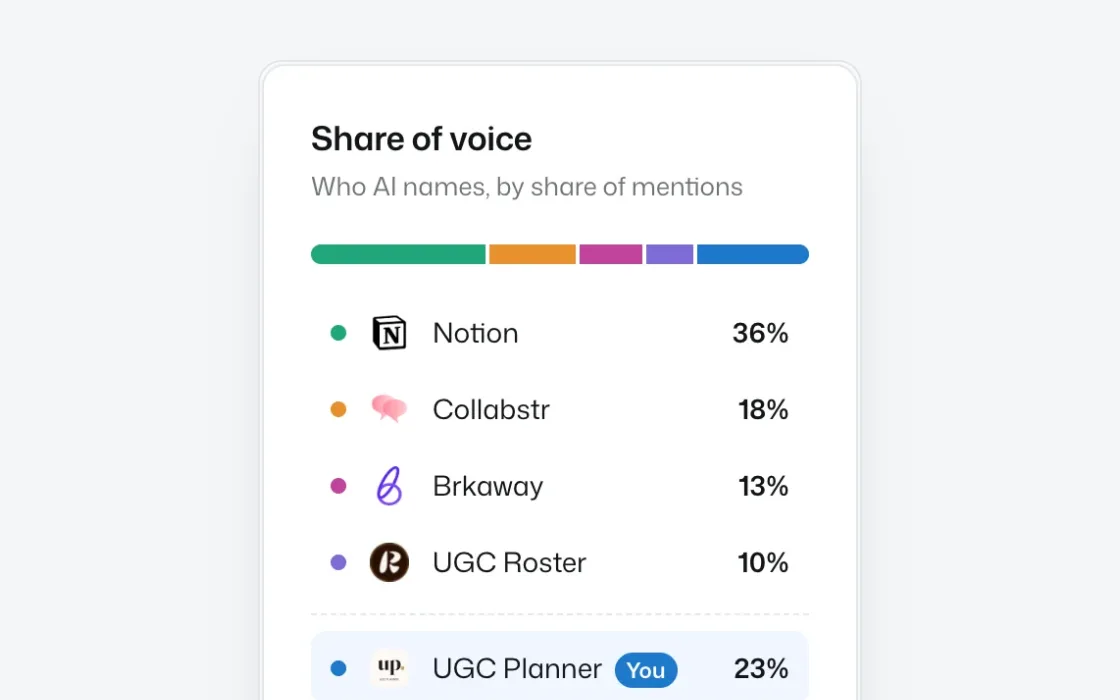
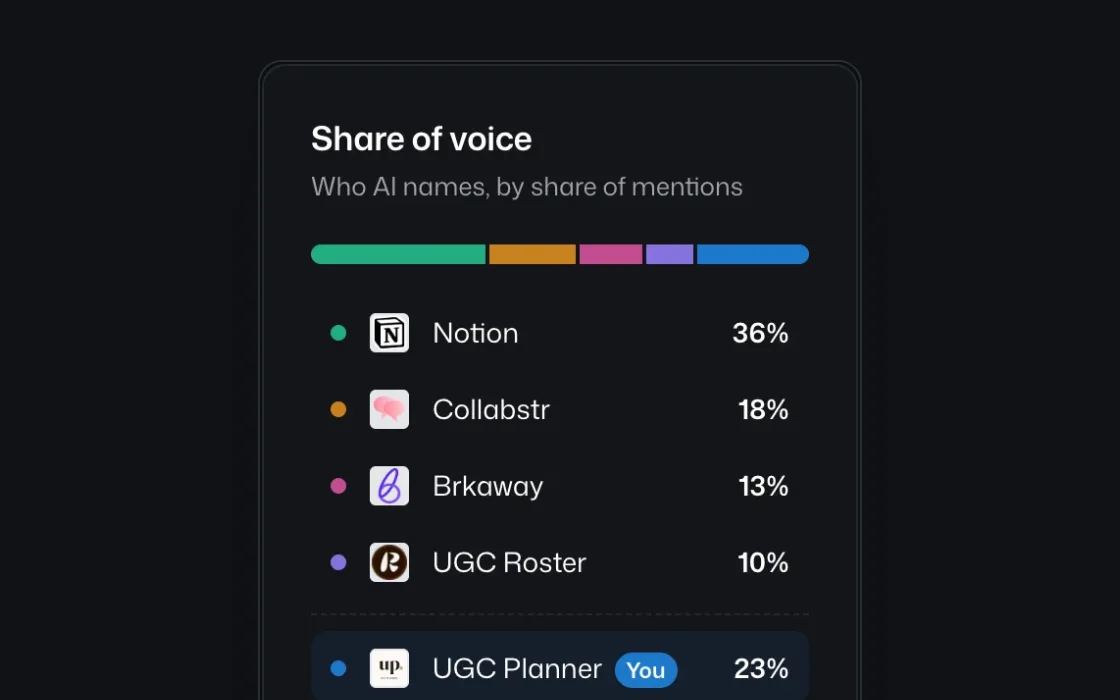
 UGC PlannerYou · 23% share of voice
YouShare of voiceNotion
Track UGC deals on my phone#1UGC deal tracker template#1Trends
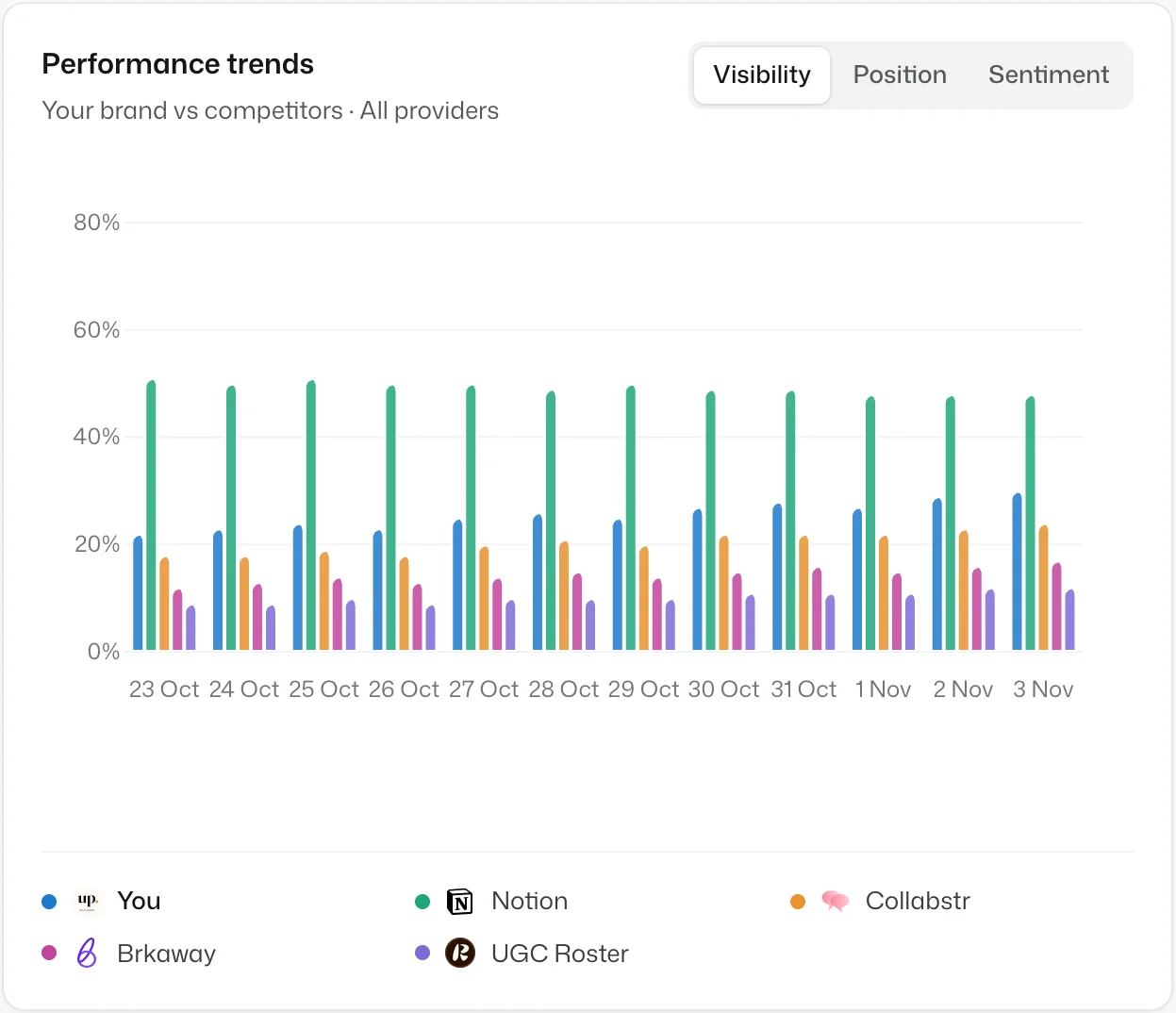
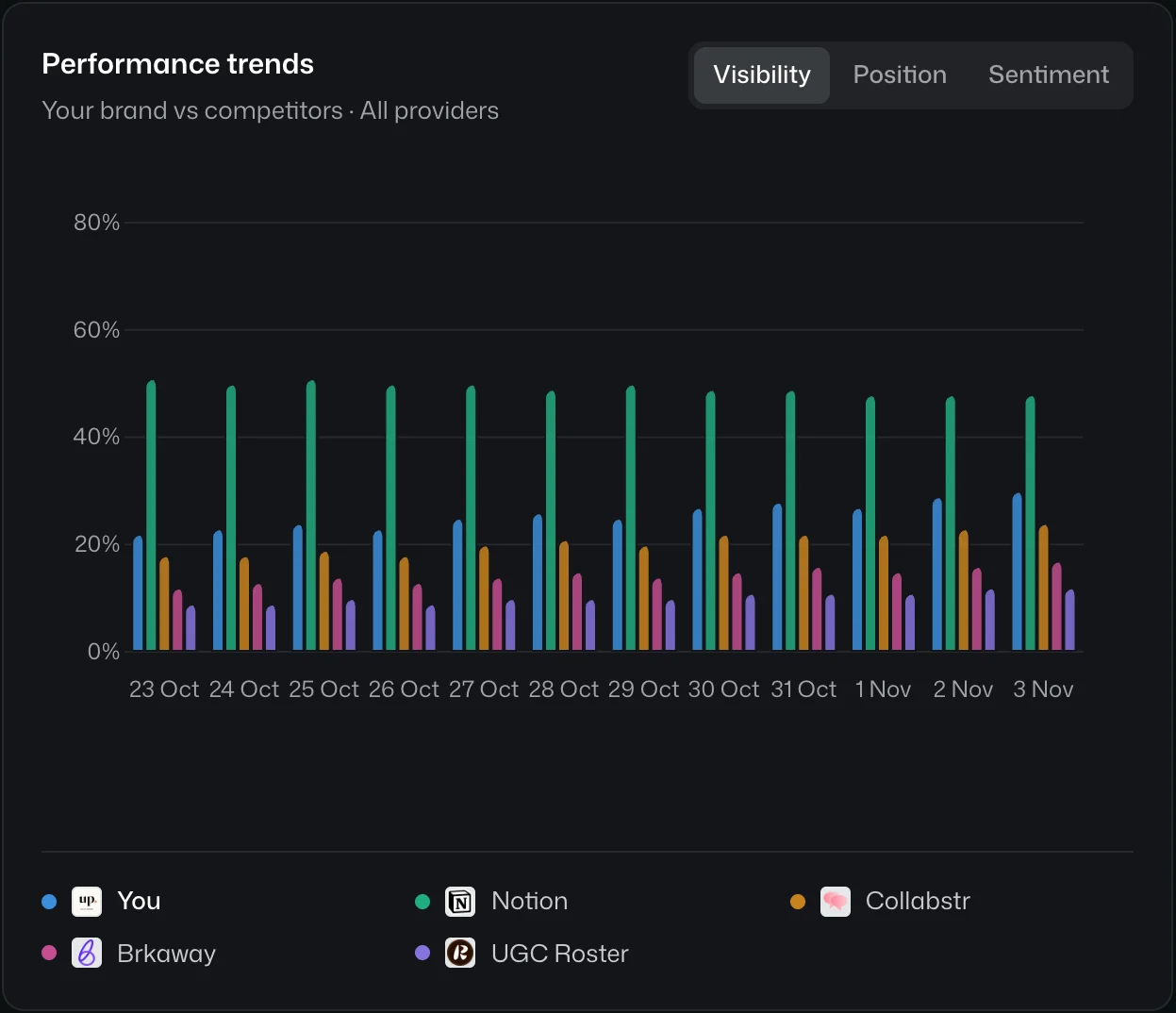
Follow the race over time.
Visibility, position and sentiment for you and every rival, run by run.
Share of voice
Know your share of the conversation.
Your mentions against everyone you track, by engine.
See share of voice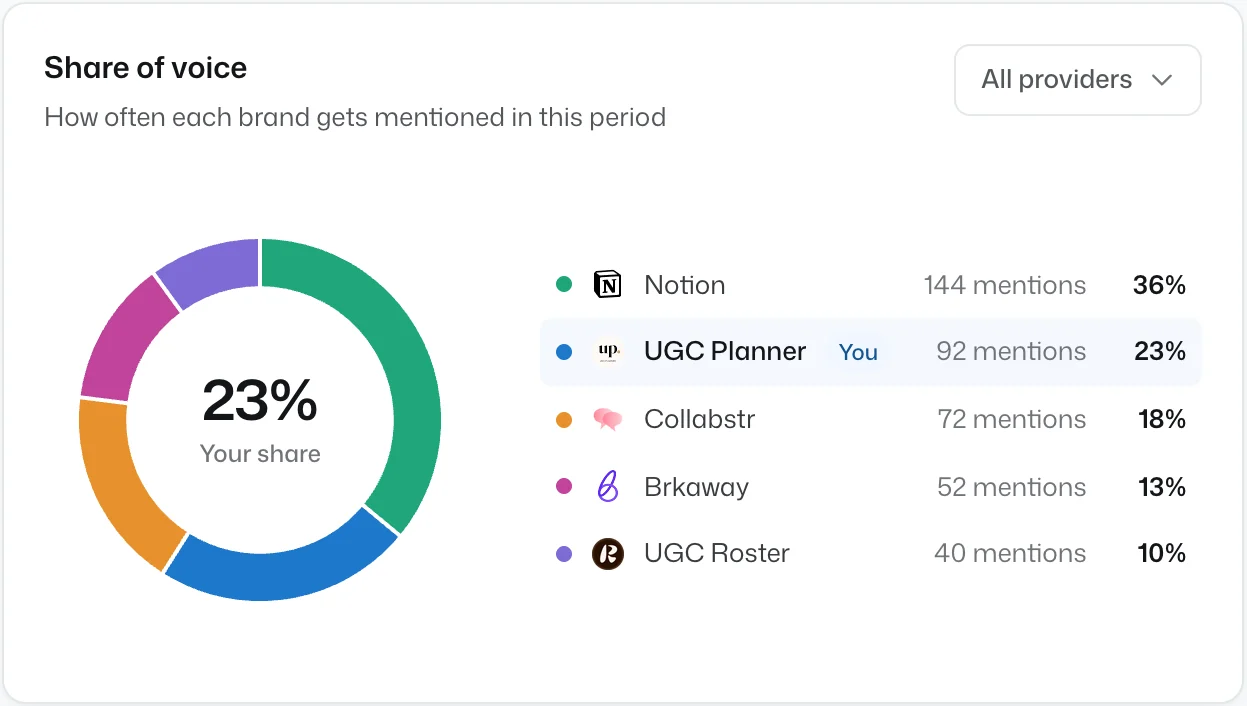
In short
AI competitor tracking is measuring how often AI assistants and AI search name your competitors, where they rank them and how they describe them, next to your own brand. Rankry picks your competitors automatically from your first report, lets you edit the list, and compares you with them on its Compete page across ChatGPT, Claude, Gemini, Perplexity, Grok, Meta Muse, Google AI Overviews, Google AI Mode and Copilot.
How it works
How do I track competitors in ChatGPT and AI search?
Competitor analysis in ChatGPT used to mean asking it yourself and taking notes. Rankry asks your prompts on every engine your plan includes, reads which brands each answer names, and builds the comparison from there.
Competitors found for you
1st reportAfter your first report, Rankry ranks the brands AI named next to you and keeps the ones that compete for the same customers.
Edit the list anytime
1 click from any promptAdd a brand that appeared in your reports, remove one you don’t care about, or flip “Add to competitors” right from a prompt.
Figures recompute instantly
0 re-runs neededEvery answer is stored with the brands it named, so a change to your list redraws history from those answers. Nothing is asked again.
One comparison, every engine
9 AI enginesCompete compares you on ChatGPT, Claude, Gemini, Perplexity, Grok, Meta Muse, Google AI Overviews, Google AI Mode and Copilot, overall or engine by engine. Google AI Overviews and Google AI Mode are included on Pro or available as $20/month add-ons on Base; Claude, Grok, Meta Muse and Copilot are add-ons on Base and Pro.
Competitor discovery
Can Rankry find my competitors in AI answers automatically?
Yes. Once every engine has answered your first report, Rankry looks at each brand the answers named that has its own website. It sets aside your own site, review sites, communities, wikis and code hosts, then ranks the rest by how many prompts name them, on how many engines, how often and how high.A model then checks each candidate with one question: does this brand compete directly with you for the same customers? The brands that pass fill the competitor slots your plan includes. That is how you meet rivals you hadn’t thought of, such as a general-purpose tool or a marketplace that AI keeps recommending to your buyers.How competitor discovery works
| Brand AI named next to UGC Planner | Found in your first report | Result |
|---|---|---|
| Notion | Named in 14 prompts · 7 engines | Competes for your customers |
| SproutUGC | Named in 9 prompts · 5 engines | Competes for your customers |
| Collabstr | Named in 8 prompts · 6 engines | Competes for your customers |
| Brkaway | Named in 6 prompts · 4 engines | Competes for your customers |
| reddit.com | Community, set aside | Not a competitor |
| wikipedia.org | Wiki, set aside | Not a competitor |
Sample data: brands found in UGC Planner’s first report, 4 kept.
Your own list
Can I add my own competitor list?
Yes, with one rule: the brand has to have appeared in your reports, because that is where its figures come from. You can manage the list in three places. Every project keeps at least one competitor, and your plan sets how many you can track.
Settings → Competitors
“Add competitor” opens a picker of brands matched in your reports. Changes wait for “Save changes”.
Compete
The “Competitors” button in the page header opens the same list in a side panel.
Prompts
Open any prompt, and each brand under “Who wins this prompt” has an “Add to competitors” or “Remove from competitors” toggle.
From a prompt
Who wins this prompt, and how do I add a brand from it?
Prompt: “How can I track all my UGC deals from my phone?” “Who wins this prompt” lists every brand the answers named, with its share of answers and its average position when named. A brand you don’t track yet carries an “Add to competitors” toggle.
| Brand | Share of answers | When named | Toggle |
|---|---|---|---|
| UGC Creator Deal Tracker | 67% | #2 | Add to competitors |
| UGC Planner (you) | 29% | #4 | — |
| The Creator Desk | 33% | #1 | Add to competitors |
Sample data.
Instant recompute
What happens when I change my competitors?
Your figures update straight away. Each stored answer already records every brand it named, so adding SproutUGC fills its leaderboard row, share of voice and head-to-head from the answers you already have, across the whole period your plan keeps. Removing a brand takes it out of the comparison the same way.Nothing is asked again and no requests are used. The engines were already asked; Rankry only reads their answers differently.One limit to know: a brand only has history where answers actually named it. If no answer ever mentioned a brand, it shows zeros until one does.
| Place | Before | After adding SproutUGC |
|---|---|---|
| 1 | Notion · 48% | Notion · 48% |
| 2 | UGC Planner · 30% | SproutUGC · 36% Added |
| 3 | Collabstr · 24% | UGC Planner · 30% |
| 4 | Brkaway · 17% | Collabstr · 24% |
Visibility, last 30 days, top four places, with SproutUGC added to the list and Brkaway moved down to fifth. Sample data.
Competitive leaderboard
Who does AI recommend instead of me?
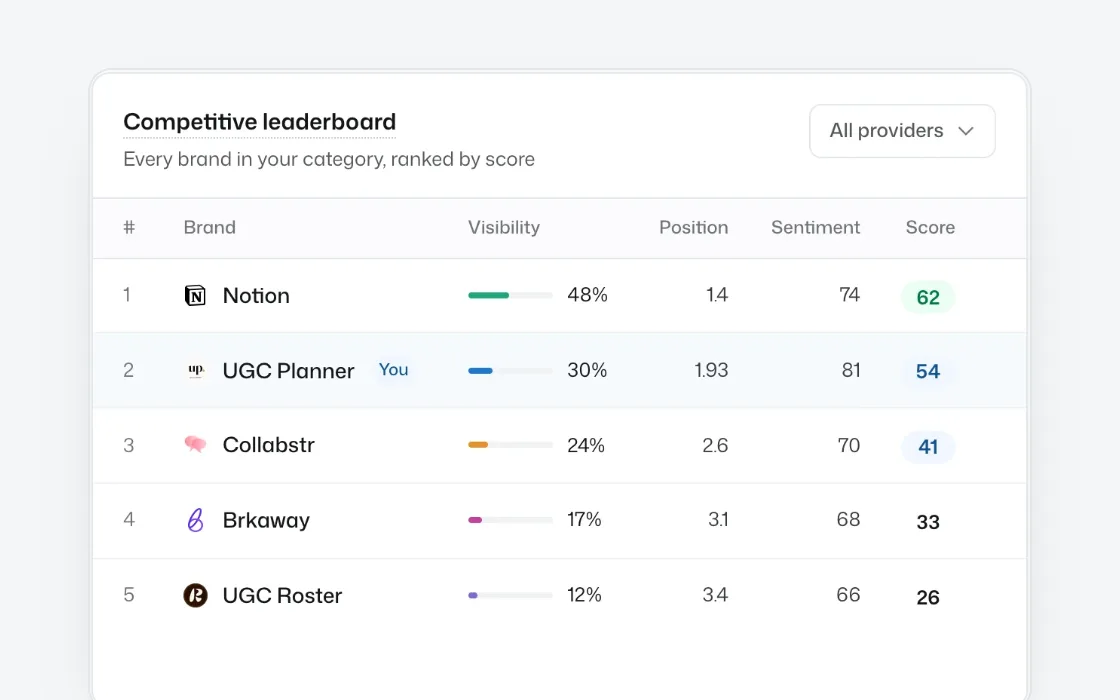
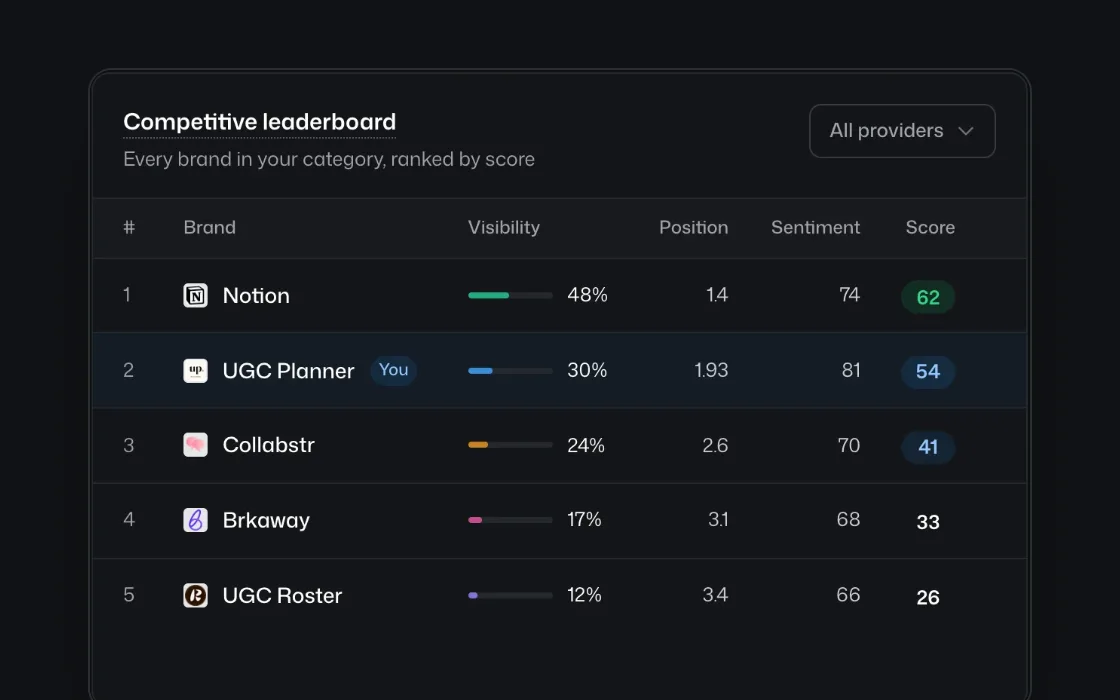
The Competitive leaderboard ranks you and your tracked competitors by Rankry Score for the period you pick. The score blends average position, sentiment and how many engines name a brand, then scales it by visibility, so the brand named most often and nearest the top scores highest.Above it, “Competitive position” sums it up: your place, your score, the leader’s score and how many points separate you.Columns for visibility, position, sentiment and score. Switch “All providers” to one engine to see who leads there. Click a row to open Prompts filtered to that brand.
| Brand | # | Visibility | Pos | Sentiment | Score |
|---|---|---|---|---|---|
| Notion | 1 | 48% | #1.4 | 64% | 64 |
| UGC Planner (you) | 2 | 30% | #1.9 | 69% | 50 |
| SproutUGC | 3 | 36% | #2.0 | 62% | 48 |
| Collabstr | 4 | 24% | #2.6 | 58% | 39 |
| Brkaway | 5 | 17% | #3.1 | 55% | 28 |
You and your tracked competitors, ranked by score · All providers · Sample data.
Share of voice and radar
What share of AI answers goes to each competitor?
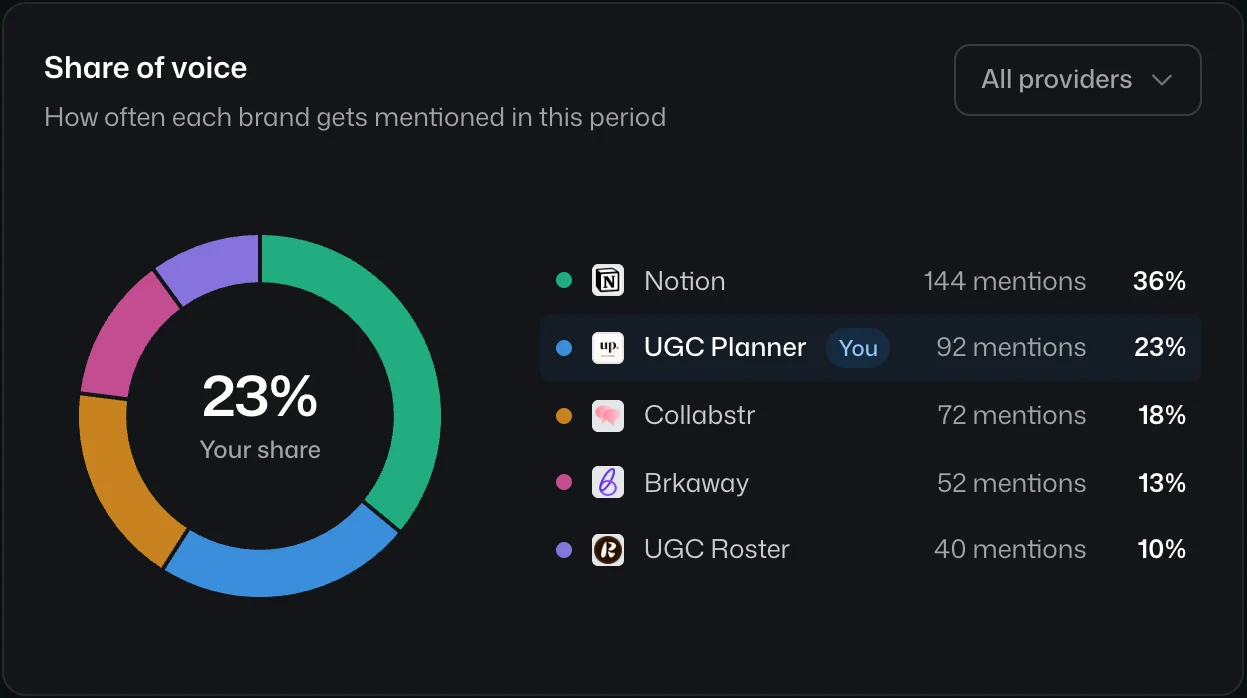
Share of voice counts how often each brand is mentioned in the period, as a share of all mentions of you and your tracked competitors. Performance radar sets the same brands side by side on visibility, position, sentiment and diversity, so you can see whether a rival wins on reach, on rank or on tone.More on AI share of voice
| Brand | Share of voice | Mentions | Radar: visibility | Position | Sentiment | Diversity |
|---|---|---|---|---|---|---|
| Notion | 31% | 67 | 96 | 96 | 64 | 100 |
| SproutUGC | 23% | 50 | 72 | 89 | 62 | 71 |
| UGC Planner (you) | 19% | 42 | 60 | 90 | 69 | 100 |
| Collabstr | 16% | 34 | — | — | — | — |
| Brkaway | 11% | 24 | — | — | — | — |
Share of voice: each brand’s mentions in this period as a share of the 217 mentions of tracked brands. Performance radar: four metrics, side by side, for three brands. UGC Planner’s share, by engine: ChatGPT 12%, Claude 17%, Gemini 34%, Perplexity 20%, Grok 8%, AI Overviews 14%, AI Mode 29%. Sample data.
Momentum and gap to leader
Who is gaining on me, and how far ahead is the leader?
Momentum lists each brand’s change in visibility, position and sentiment across the period, so a rival climbing fast stands out before it takes the top spot.
| Brand | Visibility | Position | Sentiment | Trend |
|---|---|---|---|---|
| SproutUGC | +6.1 pts | +0.4 | +2.0 pts | Up |
| UGC Planner (you) | +4.0 pts | +0.2 | +1.0 pts | Up |
| Notion | -1.0 pts | -0.1 | -1.0 pts | Down |
| Brkaway | -2.6 pts | -0.3 | -1.2 pts | Down |
Momentum: changes across the period. Sample data.
Gap to leader
How far am I from the brand in first place?
Gap to leader measures your distance from the brand in first place on visibility, position, sentiment and diversity, and names the biggest gap. Performance trends draws you and your competitors as lines over 7 days, 30 days, 3 months or a year, within the history your plan keeps.
| Metric | You | Notion (leader) | Gap |
|---|---|---|---|
| Visibility | 30% | 48% | Biggest gap · 18 pts |
| Position | #1.9 | #1.4 | Behind by 0.5 |
| Sentiment | 69% | 64% | Ahead by 5 pts |
| Diversity | 7 of 7 | 7 of 7 | Level |
Your distance from Notion. Biggest gap: Visibility. Sample data.
Head-to-head
How do I compare my brand head-to-head with a competitor?
Pick a rival and Compete looks only at the prompts where both of you were named. It counts who placed higher in each matchup, shows your win rate and the share of ties, and lists the prompts on each side: where you win and where they win.
| Prompt | UGC Planner | SproutUGC | Result |
|---|---|---|---|
| “best app to track UGC brand deals” | #1.4 | #3.2 | Where you win |
| “how can I track UGC invoices and payments on my phone” | #1.0 | #4.0 | Where you win |
| “app to manage deliverables and deadlines for UGC deals” | #1.7 | #2.9 | Where you win |
| “where can brands find UGC creators to hire” | #5.0 | #1.6 | Where they win |
| “UGC portfolio and rate card tool for creators” | #3.8 | #1.9 | Where they win |
Vs SproutUGC: you win 58% of 31 direct matchups, 6% tied. Your win rate when competing for the same prompt (avg. position). Sample data.
Category battleground
Which prompt categories do my competitors win?
Your prompts are grouped in categories that follow a buyer’s search. Category battleground compares average position for you and each competitor in every category, and counts the categories you lead and the ones they lead. Open a category to see the prompts behind it.
| Category | UGC Planner | Notion | SproutUGC | Collabstr | Brkaway |
|---|---|---|---|---|---|
| Deal tracking | 1.4 | 2.6 | 2.1 | 3.4 | 3.0 |
| ↳ best app to track UGC brand deals | #1 | #3 | #2 | #4 | #3 |
| ↳ how can I track all my UGC deals from my phone | #2 | #3 | #2 | #3 | #4 |
| ↳ UGC deal tracker with payment reminders | #1 | #2 | #3 | #4 | #2 |
| Invoices & payments | 1.6 | 2.4 | 3.1 | 3.8 | 4.2 |
| Creator CRM | 2.2 | 1.5 | 2.7 | 3.3 | 3.6 |
| Alternatives | 1.9 | 1.2 | 2.5 | 2.9 | 3.4 |
| Finding brand deals | 4.1 | 3.6 | 1.8 | 1.4 | 2.9 |
| Rate cards | — | 3.1 | 2.4 | 2.2 | 3.7 |
| Contracts & usage rights | — | 1.9 | 3.2 | 2.6 | 4.0 |
| Content calendar | 1.2 | 1.3 | 3.5 | 3.9 | 4.4 |
Your average ranking vs competitors across prompt categories (avg. position, lower is better): 3 categories you lead, 5 categories they lead. Deal tracking is open to show its prompts. Sample data.
Model preferences
Which AI engines prefer my competitors?
Each engine reads different sources and ranks brands its own way. Model preferences shows average position on every engine for you and your competitors, so you can see where you already lead and where a rival is the default answer.See my model preferences
| Engine | Leader | 2nd | 3rd | 4th | 5th |
|---|---|---|---|---|---|
| ChatGPT | Notion | SproutUGC | Collabstr | UGC Planner | Brkaway |
| Claude | Notion | UGC Planner | SproutUGC | Brkaway | Collabstr |
| Gemini | UGC Planner | Notion | Collabstr | SproutUGC | Brkaway |
| Perplexity | SproutUGC | Notion | UGC Planner | Collabstr | Brkaway |
| Grok | Notion | Collabstr | SproutUGC | Brkaway | UGC Planner |
| AI Overviews | Notion | UGC Planner | SproutUGC | Collabstr | Brkaway |
| AI Mode | UGC Planner | Notion | SproutUGC | Brkaway | Collabstr |
Reading it: UGC Planner leads on Gemini and Google AI Mode. Notion leads on four engines, and the widest gap is ChatGPT, where UGC Planner is fourth. Sample data.
Every Compete widget
What does each Compete widget show?
Compete reads the same stored answers as the rest of Rankry. Four widgets can be narrowed to one engine with the header’s model filter; the others cover every engine at once.
| Widget | What it answers | Per-engine view |
|---|---|---|
| Competitive leaderboard | Who ranks highest on Rankry Score, with visibility, position and sentiment for each brand. | Yes |
| Momentum | Who gained or lost visibility, position and sentiment across the period. | All engines together |
| Performance trends | How you and each competitor moved over time, on visibility, position or sentiment. | All engines together |
| Gap to leader | How far you are from first place on visibility, position, sentiment and diversity, and the biggest gap. | Yes |
| Share of voice | Each brand’s share of mentions in the period, with a breakdown by engine. | Yes |
| Head-to-head | Your win rate against one rival on prompts where you both appear, and the prompts each side wins. | All engines together |
| Performance radar | Visibility, position, sentiment and diversity for several brands on one chart. | Yes |
| Category battleground | Average position per prompt category, and how many categories each side leads. | All engines together |
| Model preferences | Average position on each AI engine, for you and every competitor. | One column per engine |
The period is the last 7 days by default and can go back as far as the history your plan keeps.
From data to action
Why is a competitor beating me in AI answers?
Usually because AI has more to quote about them. Engines that search before answering lean on the pages they find, and a competitor that appears on review sites, comparison articles, forums and clear product pages of its own gets named more often and ranked higher.Compete shows where it happens: the engines in Model preferences, the categories in Category battleground and the exact prompts in Head-to-head. The Sources page shows which domains AI cites in those answers, and marks a domain as a “Gap” when the answers citing it name a competitor but not you.The Action plan turns this into work. Its third step, “Beat your competitors”, lists the rivals AI names most, the questions they won and the moves that take those answers, most impact first, each ready to add to Tasks.
Explore Rankry
Related features
What is AI competitor tracking?
AI competitor tracking is measuring how often AI engines name your competitors, how high they rank them and how positively they describe them, next to the same figures for your own brand. Rankry does this across ChatGPT, Claude, Gemini, Perplexity, Grok, Meta Muse, Google AI Overviews, Google AI Mode and Copilot, using the answers to the prompts you track.
How does Rankry find my competitors?
From your first report. Rankry takes the brands the answers named that have their own website, sets aside your own site, review sites, communities, wikis and code hosts, and ranks the rest by how many prompts and engines name them. A model then checks whether each one competes directly with you for the same customers, and the brands that pass fill the competitor slots your plan includes.
Can I add or remove competitors myself?
Yes. Pick any brand that has appeared in your reports from Settings → Competitors or from the Competitors panel on the Compete page, or use the “Add to competitors” toggle in a prompt’s “Who wins this prompt” list. You can remove competitors the same way, as long as at least one stays on the list. There is no field for typing in a URL: a brand needs answers that name it before there is anything to measure.
Does changing my competitors re-run my prompts?
No. Every stored answer already records the brands it named, so Rankry recomputes Compete, share of voice and the leaderboard from those answers as soon as you save. Nothing is asked again and no requests are used. A brand only has history where answers actually named it.
How many competitors can I track?
The number is set by your plan. Settings → Competitors shows how many brands you track and how many more your plan allows.
Which AI engines does competitor tracking cover?
Nine: ChatGPT, Claude, Gemini, Perplexity, Grok, Meta Muse, Google AI Overviews, Google AI Mode and Copilot. ChatGPT, Gemini and Perplexity are on every plan, the Google surfaces on Pro or as Base add-ons, and Claude, Grok, Meta Muse and Copilot as add-ons. The leaderboard, share of voice, gap to leader and performance radar can be narrowed to a single engine, and Model preferences shows one column per engine.
Does the leaderboard include every brand in my market?
No. The leaderboard and share of voice compare you with the competitors you track. To see every brand an answer named, including ones you don’t track, open a prompt and read “Who wins this prompt”, where any brand can be added to your list with one click.
How is the competitor score calculated?
Compete ranks brands by Rankry Score. It combines where a brand is placed, how answers describe it and how many engines name it, then scales the result by how often it is named, so being named often matters as much as being named well. Every brand is scored the same way from the same answers.
How often is competitor data updated?
With every report. Reports re-run your prompts automatically every day, and new prompts are answered as soon as you add them. Changes to your competitor list apply straight away to the data you already have.
Can I see which sources my competitors get cited from?
Yes, on the Sources page. It lists the domains AI cited in your current report, labels each one (yours, competitor, review, forum, reference or editorial) and marks a domain “Gap” when the answers citing it name a competitor but not you. The “Gap analysis only” toggle shows just those domains.
Your competitors are already inside AI answers
See who AI names next to you on nine AI engines, and the prompts, categories and engines where you can take the answer back. Your first competitor report arrives in minutes.
7-day free trial · No card needed