

 ChatGPT
 Gemini
 Claude
 Perplexity
 Grok
 Copilot
 Meta Muse
 Google AI Overviews
 Google AI Mode
AI Sentiment Analysis
AI sentiment analysis: how AI talks about your brand
Being named is half of it. The other half is what the answer says about you. Rankry reads every answer that names your brand in ChatGPT, Claude, Gemini, Perplexity, Grok, Meta Muse, Google AI Overviews, Google AI Mode and Copilot, labels it Positive, Neutral or Negative, and shows where the tone changes by engine, prompt and competitor.
7-day free trial · No card needed
Sentiment
Last 30 days69/100
Share of answers that name you and read positively · 42 answers named UGC Planner
- Positive29 answers
- Neutral10 answers
- Negative3 answers
Sample data
In short
AI sentiment analysis is measuring whether AI answers describe your brand favorably, neutrally or critically. In Rankry, every answer that names you gets one label, Positive, Neutral or Negative, worked out from short claims a model extracts about your brand. Your Sentiment score is the share of those answers that read positively, averaged across the engines that named you.
Beyond the mention
Why does it matter how AI describes your brand?
Knowing that AI named you in 42 answers is a good start. But the same count can hide two different realities: one engine calling you “built for creators” and another adding that you have “fewer integrations than Notion”.
Visibility tells you AI knows your name. Position tells you where it ranks you. Sentiment completes the picture: whether the answer recommends you, simply lists you, or gives the reader a reason to look elsewhere.
Side by side
What does sentiment add to a mention count?
Visibility alone: “Named in 42 answers”
Tells you AI knows you. Not whether it recommends you or warns people off.
With sentiment: 29 Positive · 10 Neutral · 3 Negative
Open the three negative answers and read exactly what was said, and which sources the engine leaned on. Sample numbers.
Three labels
What do Positive, Neutral and Negative mean?
Every answer that names you gets exactly one of three labels for your brand. Answers that don’t name you get none, because there is nothing about you to judge. When claims are tied, the label goes to Negative first, then Positive, so a mixed answer is never counted as praise.
Positive
Most claims about you are favorable. The answer recommends you or praises something specific.
Neutral
The answer names or describes you without judging: a listing, a fact, a feature.
Negative
Most claims flag a drawback, a limit, or a reason to choose someone else.
The method
How does an AI answer get its sentiment label?
A model reads the answer and writes two to six short claims about each brand it names, and labels each claim Positive, Neutral or Negative. Your brand’s label for that answer is the one most of the claims about you carry.One answer · Perplexity · “Best app for UGC creators to track brand deals”“UGC Planner is made for UGC creators and tracks deals, deadlines and payments in one place, on iPhone and Android. It has fewer integrations than Notion, so creators who live in Notion may prefer a template.”
| Claims about UGC Planner | Label |
|---|---|
| Made for UGC creators rather than adapted from a general tool | Positive |
| Tracks deals, deadlines and payments in one place | Positive |
| Available on iPhone and Android | Neutral |
| Fewer integrations than Notion | Negative |
| This answer’s label for UGC Planner | Positive 2 positive · 1 neutral · 1 negative |
Illustration of the method with an example answer. In the app, each answer shows its label, the brands as the model ranked them with the reason given for each, the sources cited, and the full answer for every new run.
By prompt
Which questions bring out praise, and which bring out doubts?
Every answer carries its own label, and the Prompts table has a Sentiment column, so you can see which questions lead AI to recommend you and which lead it to raise objections. Negative answers on comparison prompts can point to a page you haven’t written yet.
| Prompt | Engine | Label |
|---|---|---|
| Best app for UGC creators to track brand deals | Gemini | Positive |
| How can I track all my UGC deals from my phone? | Google AI Mode | Positive |
| Is UGC Planner a good app for managing UGC deals? | ChatGPT | Positive |
| How can I track UGC invoices and payments on my phone? | Perplexity | Positive |
| App to manage UGC brand contacts and deadlines | Google AI Overviews | Positive |
| Can UGC Planner replace Notion for my UGC business? | Claude | Negative |
| Best CRM apps for UGC creators | Grok | Negative |
| UGC Planner alternatives | ChatGPT | Negative |
Sample data for UGC Planner, a deal tracker app for UGC creators: 29 answers read positively and 3 read negatively. Next step: the Action plan and Content Studio help you publish the page that answers the objection.
The evidence
Can I read the exact words behind each label?
Yes. A label is a summary, so the answer is always one click away. Open any answer to read the brands as the model ranked them, the reason it gave for each, the sources it cited, and the full answer text for every new run.
| Prompt | Engine | Label | Answer |
|---|---|---|---|
| “How can I track all my UGC deals from my phone?” | Gemini | Positive | UGC Planner is designed as a mobile app for creators, on iPhone and Android, to track every stage of a deal — deliverables, deadlines, shipments and payment status — from one screen. |
| “Can UGC Planner replace Notion for my UGC business?” | Claude | Negative | For deal tracking alone, yes. But UGC Planner connects to fewer tools than Notion, so if your content calendar, briefs and invoices already live in Notion, a template there may be simpler. |
| “Apps for UGC creators to manage brand deals” | Google AI Mode | Neutral | Options include Notion templates, marketplaces such as Collabstr, and dedicated trackers like UGC Planner, which focuses on deals, deadlines and invoices. |
Sample answers, shortened, with the brand highlighted for this page. Want to see the domains behind an answer? Every source it cited is listed with it, and the Sources page shows which domains AI cites across your report.
Engine by engine
Why does ChatGPT describe my brand differently than Gemini?
Each engine runs its own model and finds its own sources. If one engine reads a review that mentions a limitation and another reads your product page, they will describe you differently. The Model comparison table shows Sentiment for each engine, next to Visibility and Position.
| Sentiment by engine | Share of answers that read positively, last 30 days |
|---|---|
| Gemini | 82/100 |
| Google AI Mode | 78/100 |
| ChatGPT | 74/100 |
| Perplexity | 70/100 |
| Claude | 67/100 |
| Google AI Overviews | 64/100 |
| Grok | 50/100 |
| All engines | 69/100 |
Sample data. An engine that never names you has no sentiment and is left out of the average. Compare your brand’s tone with rivals on the Compete page.
Side by side
How is AI sentiment different from social listening?
Social listening tracks what people say about you. AI sentiment tracks what AI engines say about you when a buyer asks, which often draws on those same reviews and posts. The two work well together.
| Question | Social listening | AI sentiment in Rankry |
|---|---|---|
| What is analyzed | Posts, comments and reviews people write | Answers AI engines give to buyer questions |
| Who is speaking | Customers, fans and critics | The AI engine, summing up what it found |
| One unit | One post or mention | One AI answer that names you |
| Where the tone comes from | The author’s opinion | The claims the answer makes about you |
| What you can change | Reply, engage, fix the issue | The pages and sources AI reads: your site, comparisons, reviews |
| Where to see it in Rankry | Not covered | Sentiment score, per-answer labels, Compete |
Over time
Does AI sentiment change over time?
Yes. An engine starts citing a new review, or a competitor publishes a comparison page, and the tone of answers shifts. Every run adds a point: the Sentiment metric has its own history panel, and Compete’s Performance trends shows Sentiment for you and your tracked competitors over 7 days, 30 days, 3 months or 1 year. Reports re-run automatically every day.
| Performance trends · Sentiment | Sep 29 | Oct 6 | Oct 13 | Oct 20 |
|---|---|---|---|---|
| UGC Planner | 68 | 72 | 66 | 69 |
| Notion | 65 | 67 | 63 | 64 |
| Collabstr | 60 | 53 | 56 | 58 |
Sample data, 30 days, out of 100.
Explore Rankry
Related features
What is AI sentiment analysis?
AI sentiment analysis measures whether AI-generated answers describe your brand favorably, neutrally or critically. Rankry applies it to every answer that names you in ChatGPT, Claude, Gemini, Perplexity, Grok, Meta Muse, Google AI Overviews, Google AI Mode and Copilot, so you can see not just whether AI mentions you but how it talks about you.
How does Rankry measure how ChatGPT describes my brand?
Rankry asks ChatGPT your prompts and keeps each answer. A separate model reads the answer and writes two to six short claims about each brand it names, labelling each claim Positive, Neutral or Negative. The answer then takes the label that most of the claims about your brand carry. The same method is used for every engine.
What counts as a Positive, Neutral or Negative answer?
Positive means most claims about you are favorable, such as a recommendation or praise for a specific strength. Neutral means the answer lists or describes you without judging. Negative means most claims flag a drawback or a reason to choose another brand. When claims are tied, the label goes to Negative first, then Positive.
How is the Sentiment score calculated?
For each engine, Rankry takes the answers that name you and works out the share that read positively. The Sentiment score is the average of those shares across the engines that named you, shown out of 100. Engines that never named you are left out, because there is nothing to judge.
Why does ChatGPT describe my brand differently than Gemini?
Each engine uses its own model and its own web search, and the sources it finds shape what it says. One engine may read a review that mentions a limitation while another reads your product page. The Model comparison table shows Sentiment per engine so you can see where the difference is.
Can I see which sources lead to negative answers?
Open a negative answer to see the sources that engine cited for it, when it searched the web. The Sources page then shows which domains AI cites across your report, whether those answers name you or your competitors, and which domains are gaps.
Can AI sentiment be wrong, and how do I correct it?
A label is a model’s reading of an answer, so read the answer itself before acting on a single label. To change what AI says, change what it reads: fix or add the pages on your site, publish comparisons that answer common objections, and earn mentions on the sites engines cite. Rankry’s Action plan and Content Studio help with those steps.
Does Rankry track competitor sentiment?
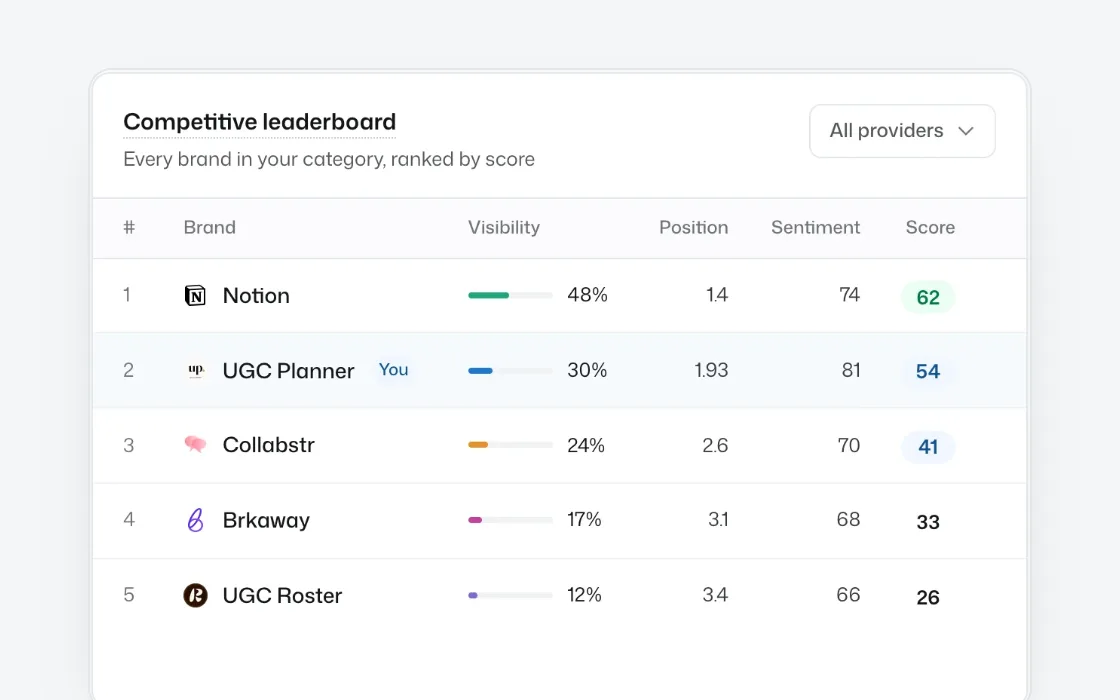
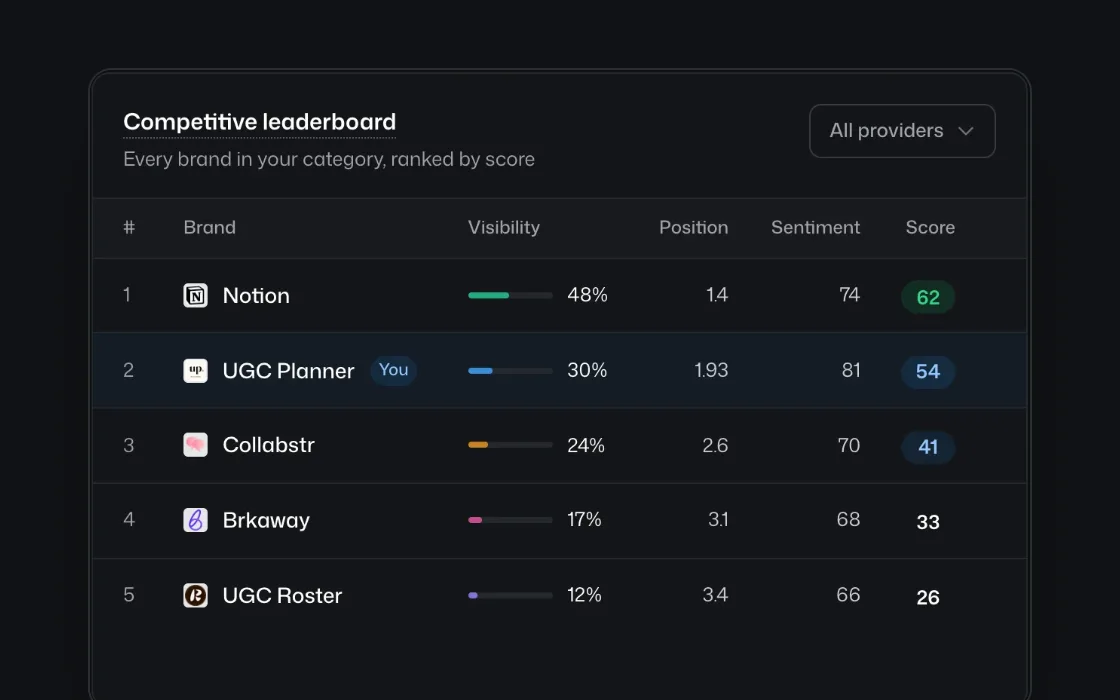
Yes. The Compete page shows Sentiment for you and your tracked competitors in the leaderboard, momentum, performance trends, gap to leader and performance radar, so you can see whose answers read more favorably.
Which AI engines does sentiment cover?
Every engine you track: ChatGPT, Gemini and Perplexity on every plan, Google AI Overviews and Google AI Mode on Pro or as Base add-ons, and Claude, Grok, Meta Muse and Copilot as add-ons.
How often is sentiment updated?
Every new answer that names you gets its own label, so sentiment moves with each run. Reports re-run automatically every day, and new prompts are answered as soon as you add them. History goes back as far as your plan allows: 90 days by default, up to 12 months on plans that include it.
See how AI describes you before your buyers read it
AI engines recommend some brands and add a caveat to others. Rankry labels every answer that names you across nine AI engines and shows where the tone changes, with the full answer one click away. First report in minutes.
7-day free trial · No card needed