A startup can track its AI visibility for around $99 a month, without an enterprise contract or a dedicated analyst. The minimum you need is a tool that reaches every major engine, ChatGPT, Claude, Gemini, Perplexity, Grok, Microsoft Copilot, and Google AI Overviews, so you can run the five that decide your category against the buyer-intent prompts in your category, with a clear read on where you are named and where a competitor wins instead. That is enough to start, and it costs less than most teams spend on a single SaaS subscription.
Here is the part that catches founders off guard. The enterprise AI visibility platforms everyone talks about are priced for Fortune 500 marketing teams, not for a five-person startup. You do not need that, and buying it early is a mistake. But you also cannot afford to stay blind, because the moment a buyer asks AI for the best option in your category, the AI hands them a shortlist, and you are on it or you are not.
This guide shows what a startup actually needs, what it can skip, and how to start this afternoon.
Why startups are invisible in AI answers
When someone asks ChatGPT or Perplexity for the best tool in your category, the model does not invent the answer. It builds a shortlist from the sources it trusts: Reddit threads, listicles, review sites like G2, and comparison pages. If those sources name your competitors and not you, you stay out of the answer, no matter how good your product is.
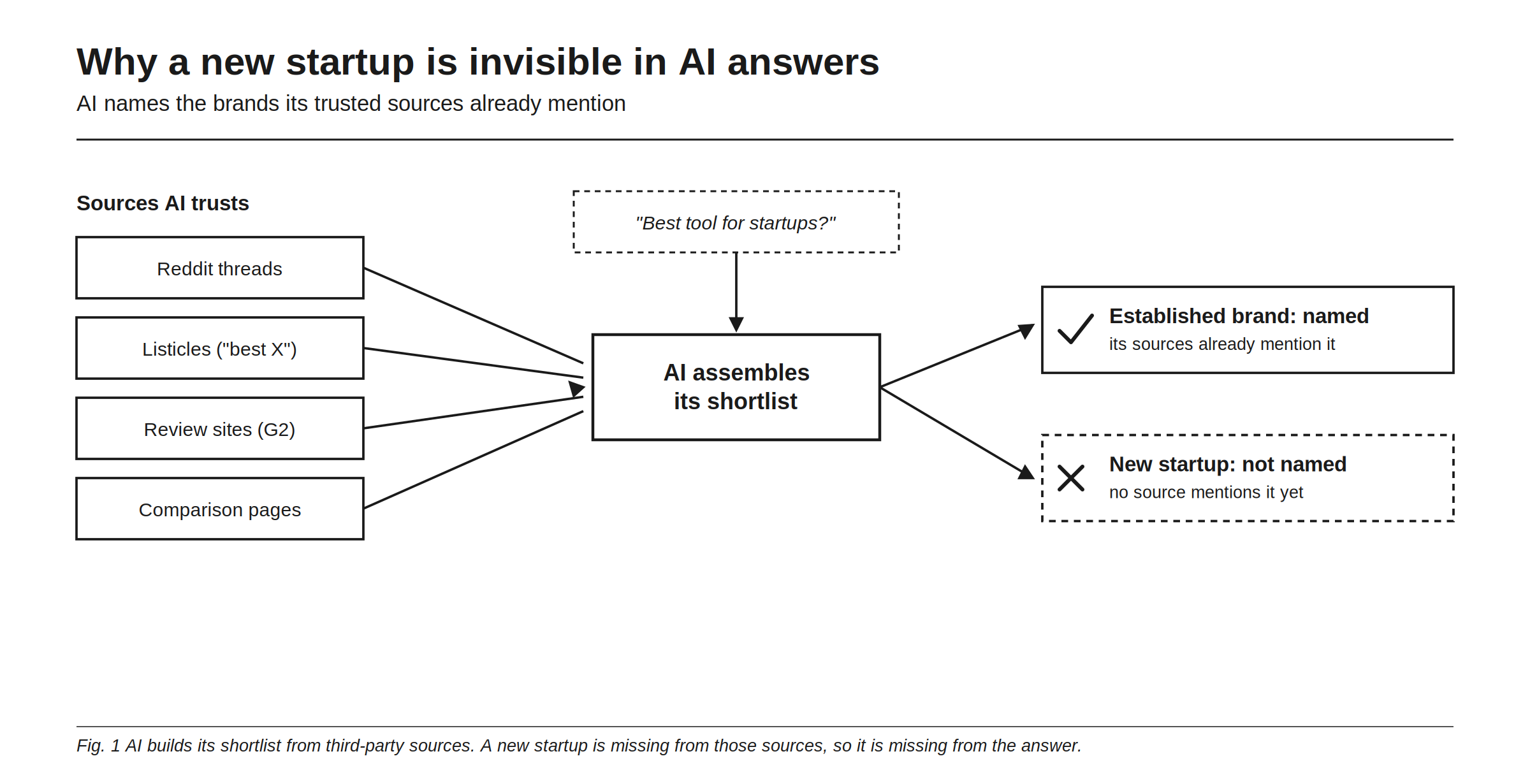
This is the structural problem every young company faces. An established brand has years of mentions stacked up across the web, so AI has plenty to pull from. A startup launched eight months ago has almost none, so AI has nothing to cite and quietly leaves you off the list. We know this one well. We built Rankry, then ran it on our own brand, and we were missing from answers in our own category too. The fix starts with seeing the gap clearly, per prompt and per model.
What a startup actually needs from an AI visibility tool
The category is crowded and most tools market themselves to enterprises. Strip it back to what an early-stage team genuinely needs, and the list is short.
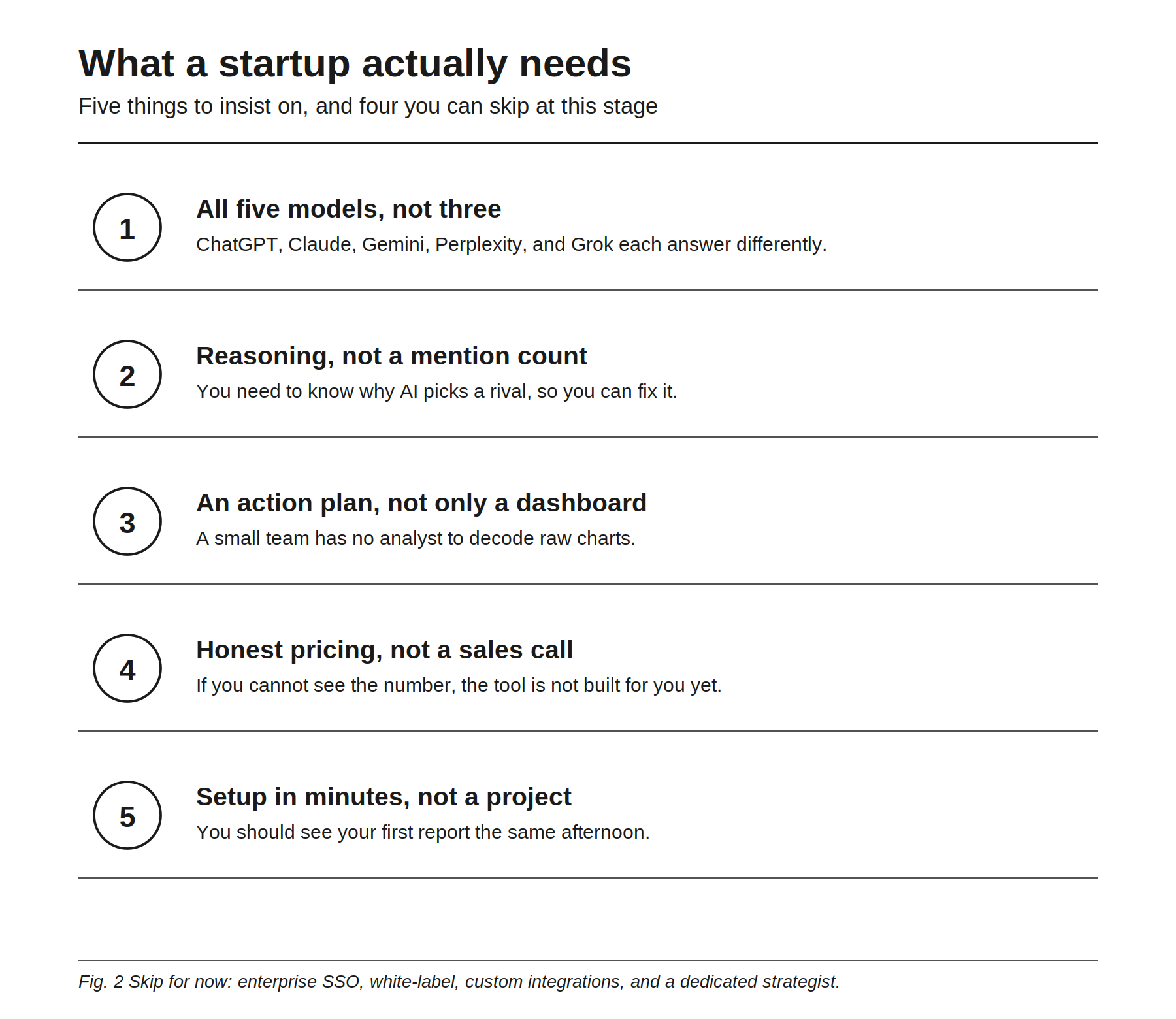
- Seven engines to pick from, not three fixed ones. Each engine answers the same question differently, and a brand that wins in one can be invisible in another. Grok in particular hands out direct recommendations far more often than the others, and most cheaper tools do not track it at all. Tracking three engines gives you a partial picture and a false sense of safety.
- Reasoning, not a mention count. Knowing that you were left out is the easy part. Knowing why AI picked a rival, what it praised, and what objection blocked you, is the part you can act on.
- An action plan, not only a dashboard. A small team has no analyst to stare at raw charts. You need the tool to tell you what to fix first.
- Honest pricing, not a sales call. If you cannot see the number without booking a demo, the tool is signaling who it was built for, and it is not you yet.
- Setup in minutes, not an onboarding project. You should connect your brand and see your first report the same day.
What can you skip at this stage? Enterprise SSO, white-label reporting, custom integrations, and a dedicated strategist. Real things, useful later, but not what decides whether your startup shows up in AI answers this quarter.
The enterprise-tool trap
The best-known platform in this space, Profound, is excellent and built for large brands with budget and a dedicated team. Its Growth plan runs around $399 a month and covers three engines with a 100-prompt cap, and its enterprise tier lands in the mid four figures. That is a fair price for a Fortune 500 marketing org. For a startup it is the wrong tool at the wrong stage. You would pay enterprise money for a data-heavy dashboard you do not yet have the team to act on.
At the other end sit the cheapest monitors. Otterly.AI starts at $29 a month, which is genuinely accessible, but it is a monitoring layer, so it tells you the score and leaves the fixing to you. ZipTie, from around $69 a month, is strong on Google AI Overviews specifically, but it tracks three engines and does not cover Claude, Gemini, or Grok.
The startup-shaped gap is in the middle: a seven-engine catalogue to pick from, the reasoning behind each answer, and an action plan, at a price a founder can approve without a meeting.
How to start tracking your AI visibility this afternoon
You can do a rough version of this by hand:
- Write down 20 to 50 questions a buyer in your category would actually ask AI, the real ones, like “best CRM for a 10-person startup,” not “best CRM.”
- Paste each into the engines your buyers use, at minimum ChatGPT, Claude, and Perplexity.
- Note where you are named, where you rank, and which competitor shows up instead.
Do that and you will learn more about your real position than any traffic report can tell you. The catch is that it takes hours, it is impossible to keep current, and you cannot see the trend over time.
That is the job Rankry’s Base plan automates. For $99 a month ($79 on annual), you get one brand, 50 buyer-intent prompts, and your pick of five engines. That is 250 AI answers analyzed every cycle, scored across 23 metrics, with a blind-test methodology that forces each model to rank brands 1 to 10 and show its reasoning. You also get an Action Plan that tells you what to fix first, an AI Readiness check on your site, and a Prompt Lab to test new ideas before you ship them.
Setup takes under two minutes, the trial runs for 7 days, and it does not ask for a card. You can see the full plan breakdown on the pricing page, or how engine selection works on the features overview. When you outgrow 50 prompts, Pro lifts you to 100 prompts and up to five brands, and a Custom plan covers agency-scale work later.
How do startups track ChatGPT and Claude mentions?
The reliable way is to run a fixed set of category prompts across each model on a schedule and record whether your brand is named, where it ranks, and what the model says about you. Doing it manually works for a one-time snapshot. To see the trend and catch a drop before it costs you deals, you want a tool that runs the prompts for you and stores the history. Rankry does this weekly across the five engines you pick, out of a catalogue of seven, on every plan starting at Base.
Do you need an enterprise tool as a startup?
No. Enterprise platforms are built for large teams with budget, a dedicated analyst, and procurement requirements like SSO and SOC 2. A startup needs the opposite: full model coverage, plain-language guidance on what to fix, and a price it can approve today. Start with an accessible plan, prove the channel, and move up only when your volume and team actually demand it.
FAQ
What is the cheapest AI visibility tool for startups? Otterly.AI starts at $29 a month for monitoring only. Among tools that cover every major engine and add an action plan, Rankry starts at $99 a month ($79 annual), with a 7-day trial and no card required.
How do startups track whether AI recommends them? Set a list of real buyer-intent prompts, run them across the five engines your buyers actually use, and track whether you are named, where you rank, and which competitor appears instead. A tool automates this and shows the trend over time.
Do I need Profound as a startup? Usually not. Profound is built for large brands, with a Growth plan around $399 a month for three engines and enterprise pricing above that. For an early-stage team, a seven-engine tool at around $99 a month is a better fit until your volume grows.
Why isn’t my startup showing up in ChatGPT? Most likely because the third-party sources AI trusts, like Reddit, listicles, and review sites, do not mention you yet. The fix is to measure where you stand, then earn mentions on the pages AI pulls from and structure your own content to be easy to cite. See why isn’t my brand showing up in ChatGPT.
Can I track the major AI engines on a startup budget? Yes. Rankry covers ChatGPT, Claude, Gemini, Perplexity, Grok, Microsoft Copilot, and Google AI Overviews on every plan, including Base at $99 a month. Many cheaper tools track only three engines, so check coverage at the plan you intend to buy.
See where your startup stands across the AI engines that decide your category. Start a free 7-day trial, no card, first report in two minutes.