AI Share of Voice is the percentage of brand appearances in AI answers that belong to you, rather than your competitors, across a set of prompts and engines. You calculate it by dividing your appearances by the total appearances of all brands, yours and your rivals’, then multiplying by 100. If your brand is named 40 times out of 240 total brand mentions across your tracked prompts, your AI Share of Voice is about 17 percent. It is the single clearest number for answering “how much of the AI conversation in my category is about me.”
Share of Voice is an old marketing idea, your slice of the total attention in a market, moved into a new arena. In AI search, the attention is not ad impressions or search rankings. It is how often, and how prominently, engines like ChatGPT name you when buyers ask.
How to calculate it
The formula is simple, and the discipline is in what you feed it.
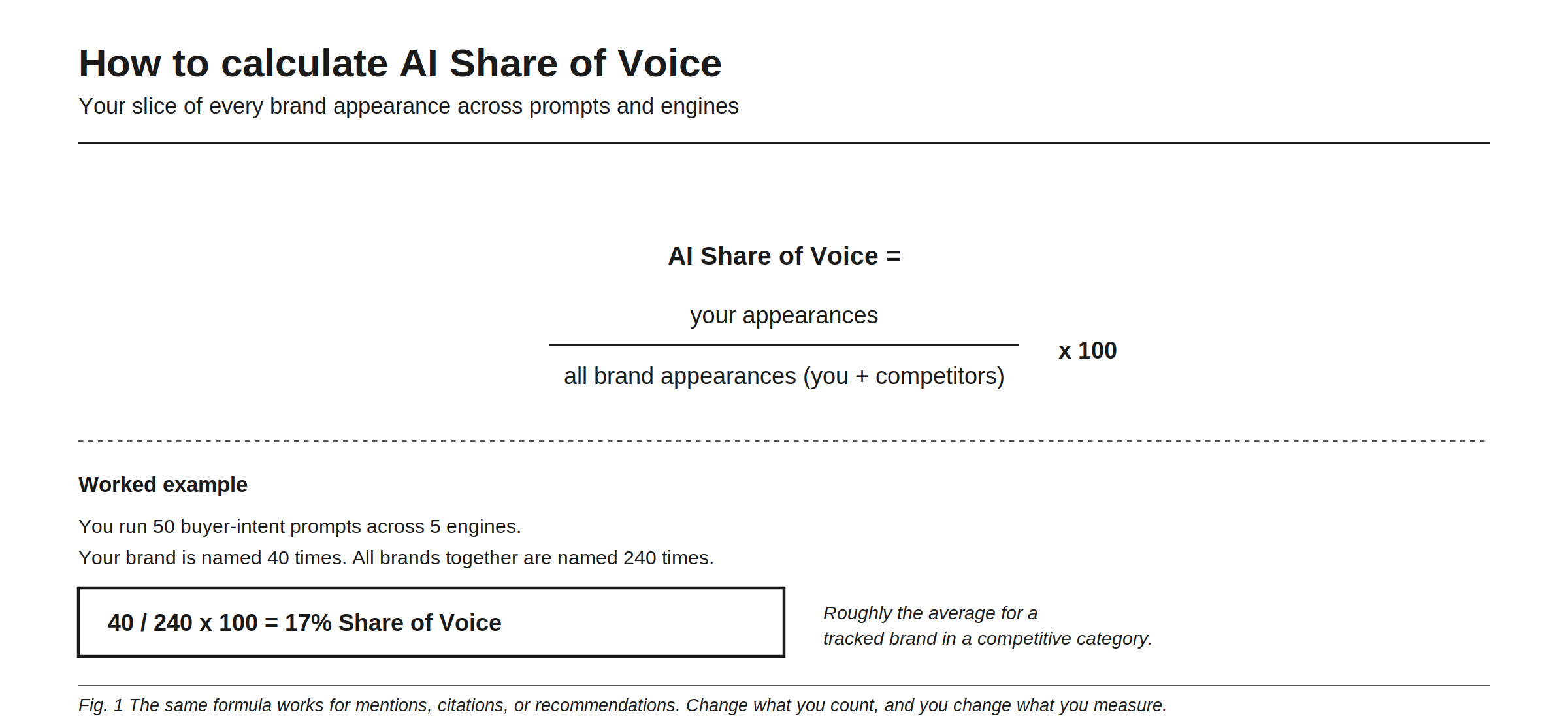
You take your appearances, divide by all brand appearances across you and your competitors, and multiply by 100. The inputs that matter are the prompt set and the engines. Use a focused set of real buyer-intent prompts, run them across the engines your buyers actually use, and count consistently. In the worked example, 40 of your appearances out of 240 total gives a 17 percent share, which is roughly the average for a tracked brand in a competitive category. A share well above that means you dominate the conversation. Well below it means competitors are being named while you are not.
One rule keeps the number honest: define your competitor set deliberately. Share of Voice is always relative to who you count, so measure against the brands you actually compete with, not a random field.
The three kinds of Share of Voice
Here is where most measurement goes shallow. “Appearances” can mean three different things, and they are not equally valuable.
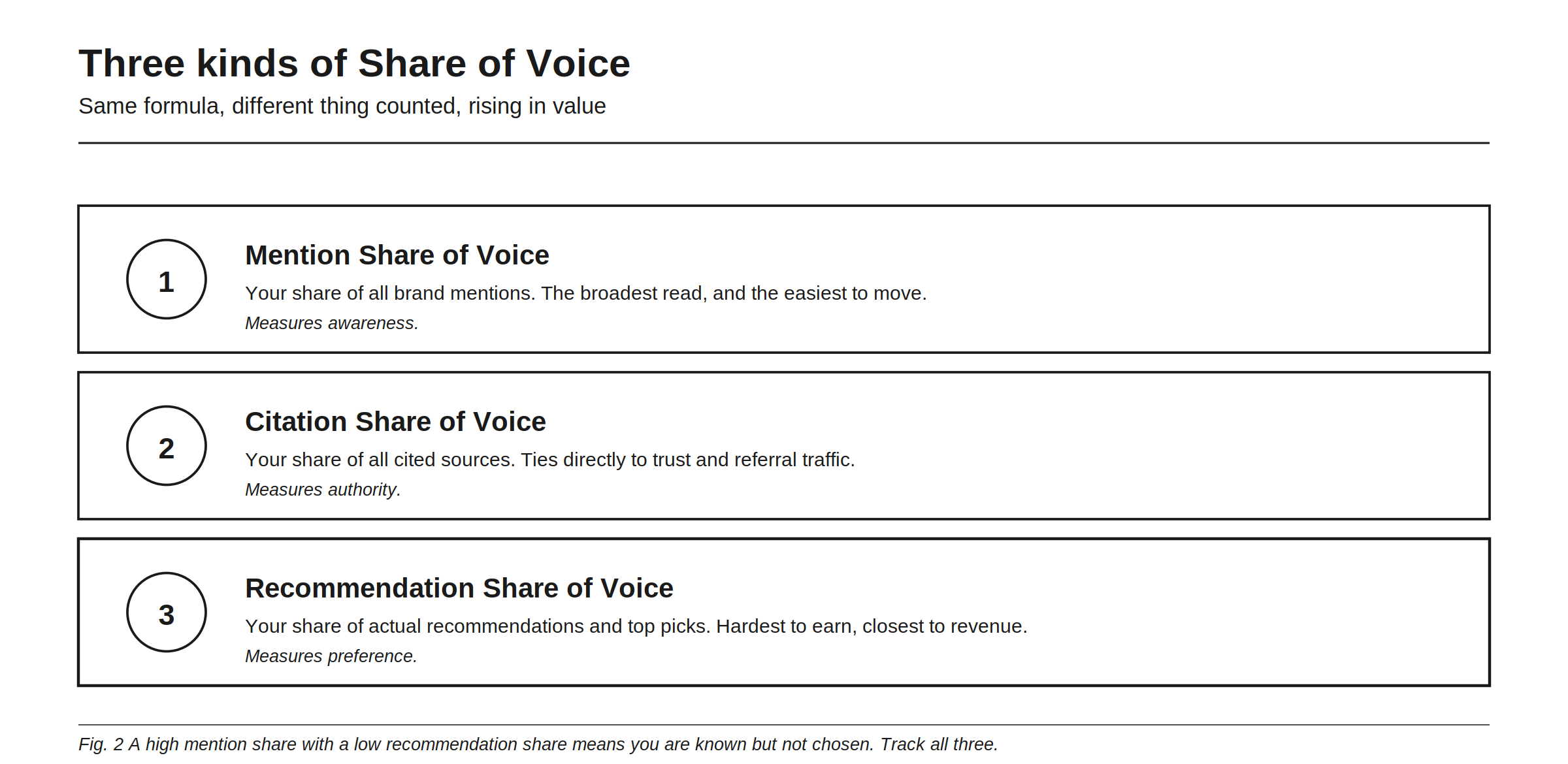
Mention Share of Voice is your slice of all brand mentions. It is the broadest read and the easiest to move, and it measures awareness. Citation Share of Voice is your slice of all cited sources, which ties directly to trust and referral traffic, and measures authority. Recommendation Share of Voice is your slice of actual recommendations and top picks, the hardest to earn and the closest to revenue, and it measures preference. Track all three, because the gap between them is diagnostic. A high mention share with a low recommendation share means you are known but not chosen, which is a very different problem from not being known at all. For the distinction underneath this, see brand mentions vs citations in AI.
What is a good AI Share of Voice?
There is no universal target, because it depends on your competitor set and category. As a rough orientation, a tracked brand in a competitive category often lands somewhere in the mid-teens, which is why 17 percent is a useful reference point rather than a goal. What matters more than the absolute number is the trend and the comparison. Is your share rising or falling over time, and how does it compare to your named competitors? A share that is climbing while a rival’s falls is the story that matters, regardless of the starting number.
How to improve your Share of Voice
Improving Share of Voice is the same work as improving visibility, aimed at a scoreboard. Because the metric is relative, you gain in two ways: by appearing more, and by your competitors appearing less relative to you. In practice, focus on the prompts where you are absent and a competitor is named, earn mentions on the third-party sources those answers cite, sharpen your entity so the model recommends you with confidence, and publish the comparison and use-case content that turns a mention into a recommendation. Then re-measure and watch the share move. For the full playbook, see how to improve your visibility in ChatGPT.
Measuring it without doing the math by hand
You can calculate Share of Voice manually for a one-time baseline, and it is a useful exercise. Keeping it current across three variants, five engines, and a moving competitor set is where it becomes a job. A tool computes all three shares continuously and shows the trend against your competitors. Rankry tracks your mention, citation, and recommendation share across ChatGPT, Claude, Gemini, Perplexity, Grok, Microsoft Copilot, and Google AI Overviews, with a competitor leaderboard and head-to-head view, so the scoreboard stays live without a spreadsheet.
FAQ
What is AI Share of Voice? It is the percentage of brand appearances in AI answers that belong to you rather than your competitors, across a set of prompts and engines. It measures how much of the AI conversation in your category is about your brand.
How do I calculate AI Share of Voice? Divide your brand appearances by the total appearances of all brands, yours and your competitors’, across your tracked prompts and engines, then multiply by 100. For example, 40 appearances out of 240 total is a 17 percent share.
What is a good AI Share of Voice? There is no fixed target, because it depends on your competitor set and category. A tracked brand in a competitive category often lands in the mid-teens, so 17 percent is a rough reference. The trend and the comparison to competitors matter more than the absolute number.
What is the difference between mention, citation, and recommendation Share of Voice? Mention share is your slice of all brand mentions and measures awareness. Citation share is your slice of cited sources and measures authority. Recommendation share is your slice of actual top picks and measures preference. Recommendation share is closest to revenue.
How do I improve my AI Share of Voice? Target the prompts where a competitor is named and you are not, earn mentions on the sources those answers cite, sharpen your entity, and publish comparison and use-case content. Because the metric is relative, appearing more and outpacing rivals both raise your share.
See your mention, citation, and recommendation share against your competitors, across every engine you track. Start a free 7-day Rankry trial, no card, first report in two minutes.