To improve your brand’s visibility in ChatGPT, work the sources it trusts, not only your own website. In order of impact: earn mentions on the third-party pages ChatGPT reads about your category, make your entity unmistakable so the model knows who you are, publish answer-first comparison and use-case content, and make sure ChatGPT’s bots can crawl you. Then measure per prompt and double down on what moves. Most of the gain comes from off-site sources, which is why pouring effort into your blog alone rarely works.
If you have already diagnosed why ChatGPT skips you, this is the playbook for fixing it. If you have not, start with the diagnosis first, because the fixes below only pay off once you know which gap you are closing. See why ChatGPT recommends competitors instead of you.
Which engines this applies to. ChatGPT is the engine most teams optimize for first, so it is the one used throughout. The four levers below are engine-agnostic: Claude, Gemini, Perplexity, Grok, Microsoft Copilot, and Google AI Overviews all read third-party sources, need an unambiguous entity, reward answer-first pages, and have to be able to crawl you. What is not shared is the target list. Each engine trusts a different set of sources, so the same lever points you at different pages depending on the engine, and that is exactly why the measurement step at the end runs on all of them rather than on ChatGPT alone.
Understand where the leverage is
Before you spend a single hour, know which lever actually moves the answer. Effort spent on the wrong one is wasted.
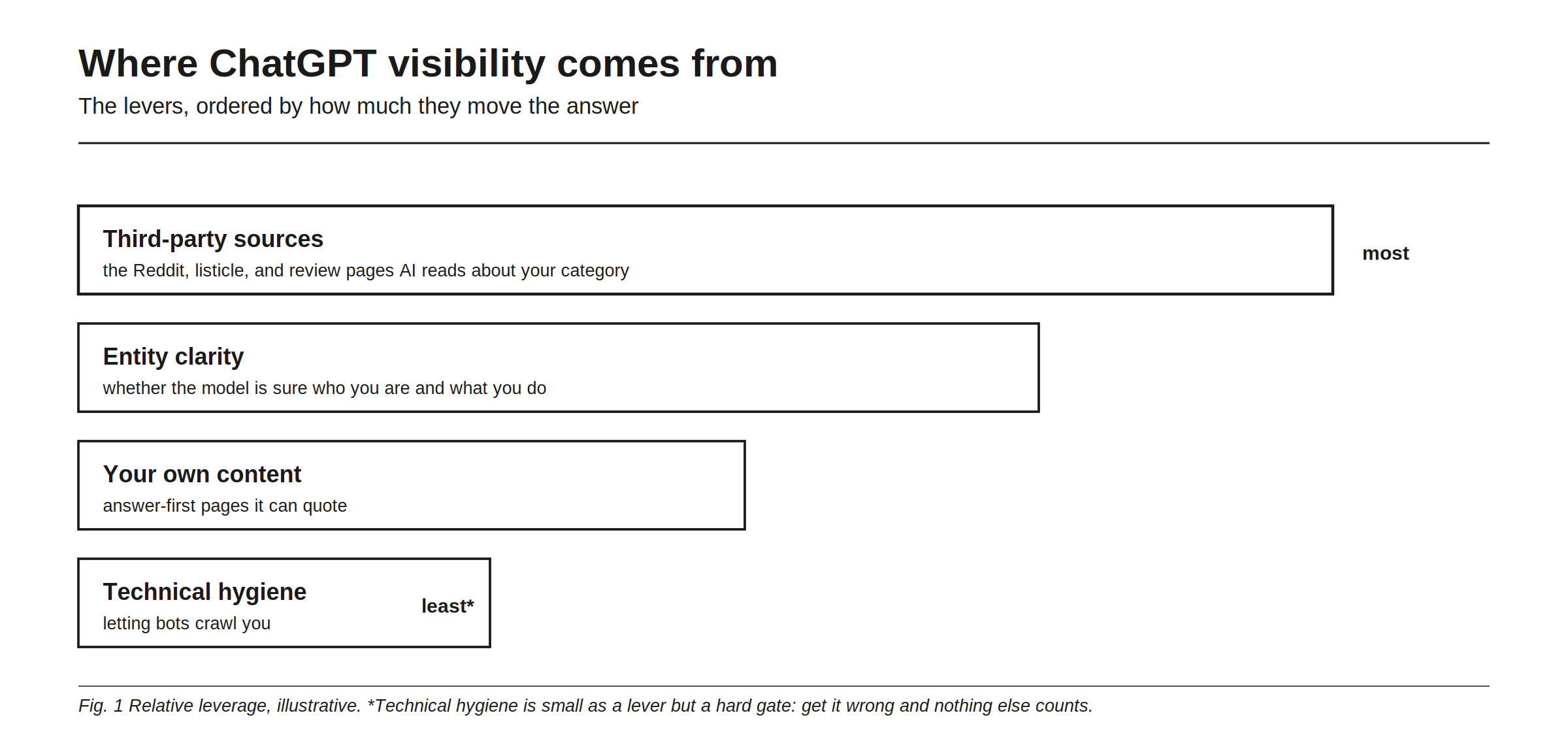
Third-party sources are the biggest lever, because ChatGPT builds its picture of your category from the pages it reads about you, like Reddit, listicles, and review sites. Entity clarity is next, because the model has to be sure who you are before it can recommend you. Your own content matters, but mostly as quotable material the model can lift. Technical hygiene is the smallest lever by impact, but it is a hard gate: get it wrong and none of the others count. The practical lesson is that most teams over-invest in their own blog and under-invest in the off-site sources that decide the answer.
The five moves, in order
1. Earn mentions on the sources ChatGPT trusts
This is the highest-impact work. Find the pages ChatGPT already cites in your category, the specific Reddit threads, listicles, comparison pages, and review sites, and get your brand named on them. That can mean pitching a listicle author, earning genuine reviews on G2 or Capterra, or contributing usefully to the communities where your buyers compare options. One mention is noise. The goal is to be named across several independent sources, so the same story repeats. For the full method, see how to get cited by AI.
2. Make your entity unmistakable
ChatGPT cannot recommend a brand it cannot identify. Use one consistent name and category everywhere you appear, write clear “about” content that states plainly what you do and for whom, and establish identity signals like a Wikidata entry. If different sources describe you differently, the model stays unsure, and unsure brands get left out.
3. Publish answer-first comparison and use-case content
Now your own site earns its keep. Write the pages that answer the exact prompts you lose: direct comparisons, specific use cases, and clear category explanations. Lead with the answer, use plain headings, and keep claims short and easy to quote. You are writing the sentences you want ChatGPT to lift, and giving it a citable page for the claims in your category.
4. Open the technical gate
Confirm the basics. Do not block ChatGPT’s bots in robots.txt, render your content server-side so it does not hide behind scripts, and add clean structured data. This is quick work, but skipping it quietly cancels everything else, because content the bots cannot read does not exist to the model. For which bots to allow, see should you allow or block AI crawlers.
5. Measure per prompt and double down
Visibility work is invisible without measurement. Track each buyer-intent prompt across runs, watch which ones move after each change, and keep doing what works. Because answers shift slowly and vary between runs, you need a baseline and repeated sampling, not a one-time check.
A 30-day plan
You cannot do all five at once and learn anything, so sequence them and measure at both ends.
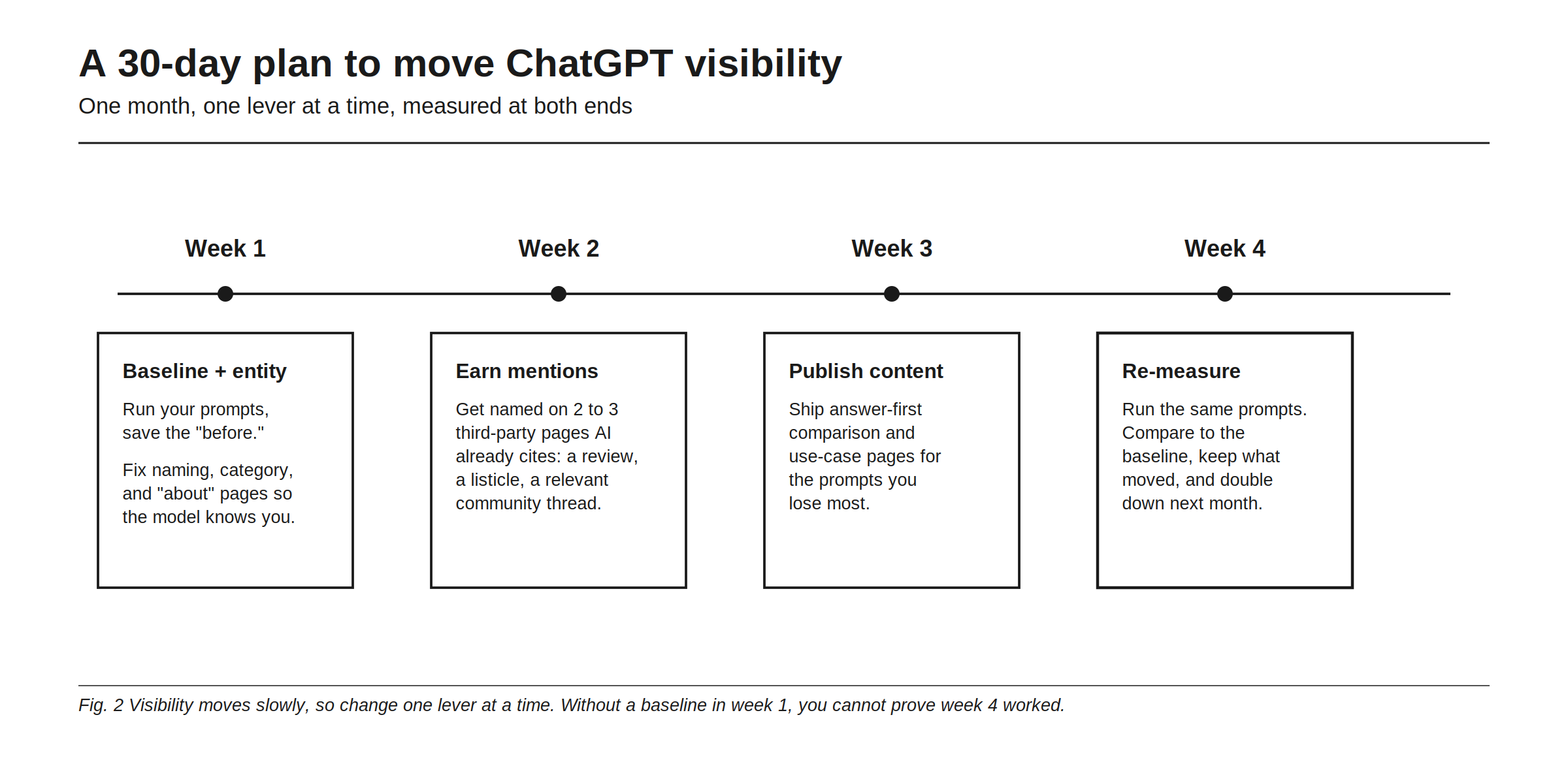
In week one, run your prompts to set a baseline, then fix your entity. In week two, earn two or three mentions on third-party pages ChatGPT already cites. In week three, publish answer-first comparison and use-case content for the prompts you lose most. In week four, re-run the same prompts, compare to the baseline, keep what moved, and plan the next month. Changing one lever at a time is what lets you tell which change actually worked.
How a tool speeds this up
The plan works manually, but the measurement is the hard part to sustain by hand. A tool runs your prompts across the engines, tracks presence and rank over time, and shows which sources win the answers you lose, so you always know the next move. Rankry does this across ChatGPT, Claude, Gemini, Perplexity, Grok, Microsoft Copilot, and Google AI Overviews, and pairs it with an action plan that tells you what to fix first, which turns this playbook into a checklist you can work through. Running every engine in the same report is what makes the plan efficient rather than repetitive: one fix usually lifts several engines at once, and the report shows you which one to spend the week on.
FAQ
How do I get my brand to show up in ChatGPT? Earn mentions on the third-party pages ChatGPT trusts in your category, make your entity clear with consistent naming and identity signals, publish answer-first content for the prompts you lose, and let ChatGPT’s bots crawl you. Then measure per prompt and repeat what works.
Does writing more blog posts improve ChatGPT visibility? Only partly. Your content helps as quotable material and for entity clarity, but most of the gain comes from third-party sources ChatGPT trusts, like Reddit, listicles, and review sites. Blogging alone rarely moves the answer.
How long does it take to improve visibility in ChatGPT? Plan in months, not days. AI answers shift gradually as new sources are read and indexed. A focused 30-day cycle can show early movement, with larger gains compounding over a few months of consistent work.
Can I influence ChatGPT directly? You cannot edit ChatGPT, but you can change what it finds. It builds answers largely from current sources it retrieves, so improving those sources, and your own citable pages, is how you influence what it says.
What is the fastest way to improve my ChatGPT visibility? Fix the technical gate first if you are blocking bots, then earn a few mentions on the specific pages ChatGPT already cites in your category. Those off-site mentions tend to move the answer faster than on-site content.
Does this playbook work for Claude, Perplexity, Gemini, and the other engines? Yes. The four levers are the same on Claude, Gemini, Perplexity, Grok, Microsoft Copilot, and Google AI Overviews, because all of them read third-party sources, need a clear entity, and prefer answer-first pages they can crawl. Only the targets change: each engine trusts a different set of sources, so the specific pages you go and earn a mention on differ per engine even when the plan does not.
Track which prompts you lose in ChatGPT and which sources win them, then fix them in order. Start a free 7-day Rankry trial, no card, first report in two minutes.