ChatGPT recommends your competitors instead of you because it builds its answer from the third-party sources it trusts, like Reddit, listicles, and review sites, and those sources mention your competitors clearly and consistently while your brand is missing, mentioned only once, or hard to identify. ChatGPT is not comparing your website against theirs. It is reflecting the consensus of the sources it has read. Fix the sources and the clarity, and the recommendation follows.
Which engines this applies to. ChatGPT is the worked example here because it is where most teams notice the problem first. The three gates below are not ChatGPT-specific. Claude, Gemini, Perplexity, Grok, Microsoft Copilot, and Google AI Overviews all assemble their shortlists from third-party sources retrieved at answer time, so the same diagnosis runs on each of them. What differs is which sources each engine leans on, which is why the fix list ends up per engine even though the mechanism is shared. The cross-engine version of this loop is in how to monitor your brand across AI search engines.
This is the uncomfortable truth that catches most founders off guard. You can have the better product, the cleaner site, and the stronger team, and still watch ChatGPT name three competitors and leave you out. The model never saw your sales deck. It saw what the internet says about your category, and in that conversation, you were not part of the consensus.
A recommendation is earned at three gates
Think of how the model assembles a shortlist as passing through three gates. When you and the rival clear all three alike, the tiebreakers in how AI picks between two nearly identical brands decide it.
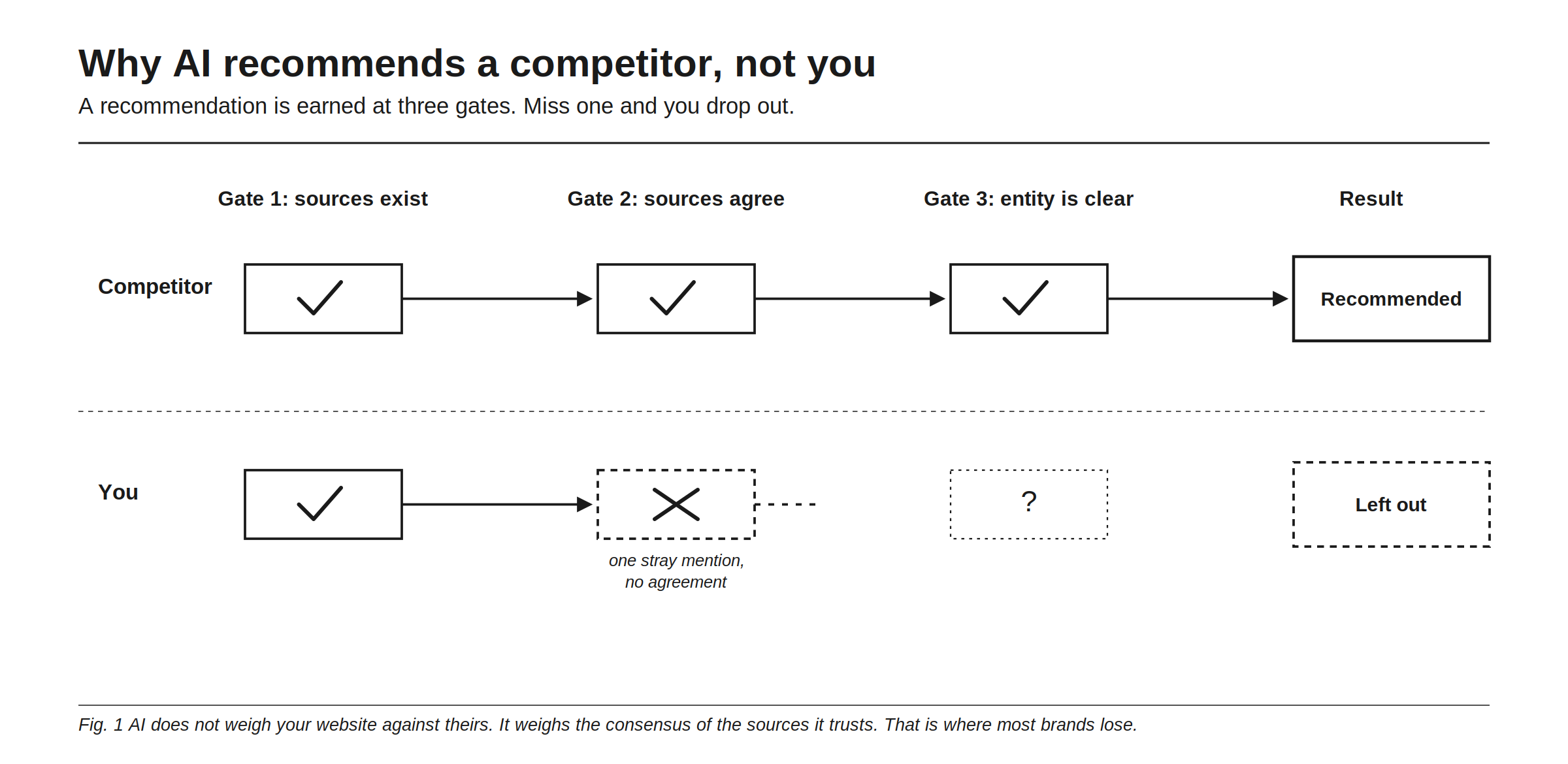
First, sources have to exist. The model needs places that mention you in your category at all. Second, those sources have to agree. One stray mention is noise, but the same brand named across several independent sources becomes a pattern the model trusts. Third, your entity has to be clear, so the model is confident about who you are and what you do. A competitor that passes all three gets recommended. A brand that fails any one of them quietly drops out, and the most common failure is the second gate, agreement.
The key shift in thinking is this: the model is not weighing the quality of your product. It is weighing the quality and agreement of the evidence about your product. Those are different problems, and the second one is the one you can actually move.
The five reasons your brand loses the recommendation
When ChatGPT skips you, it almost always traces to one of five causes. Each has a direct fix, and the tactical sequence for working through them once it is already happening is in the 30-day response playbook.
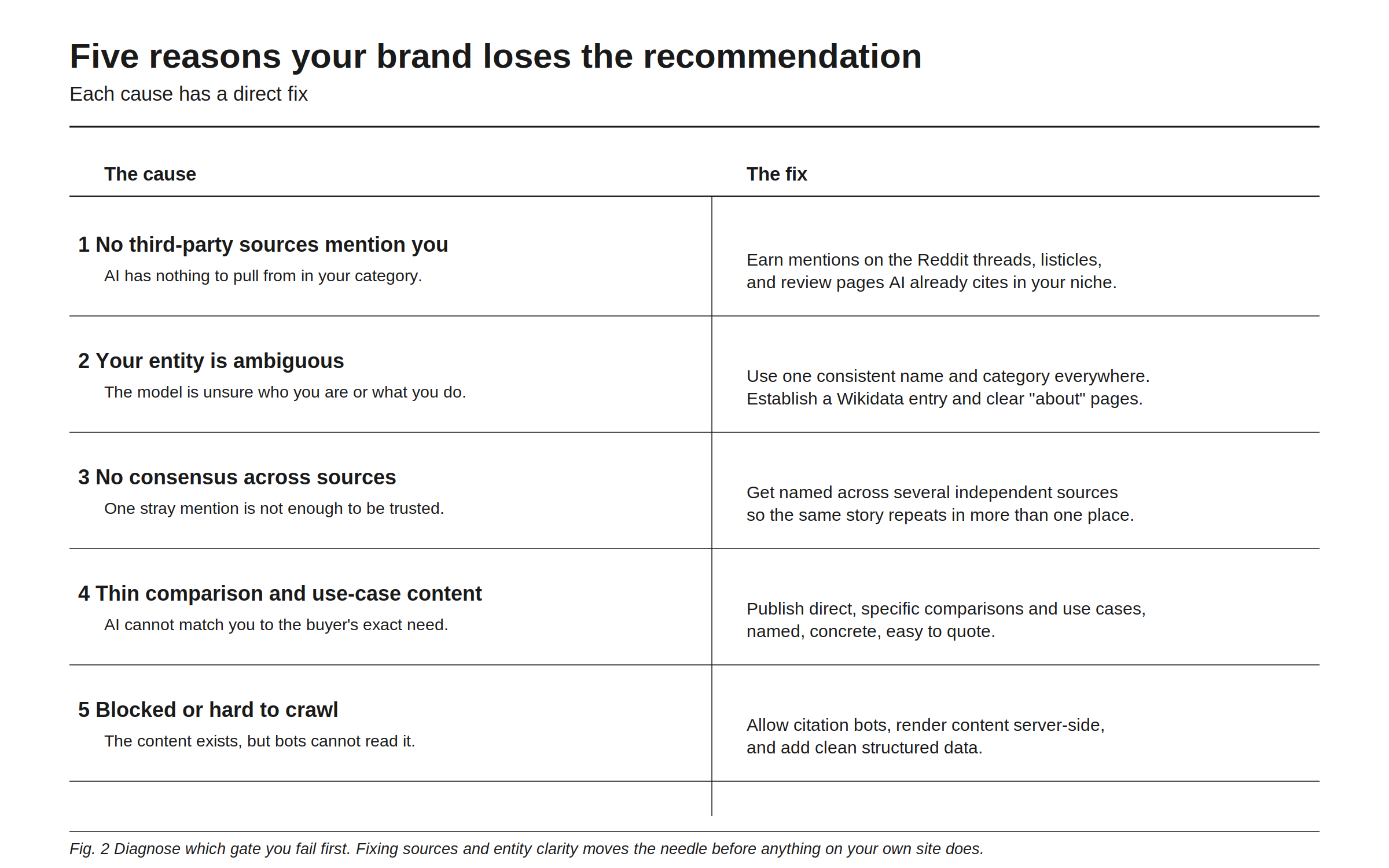
- No third-party sources mention you. The model has nothing to pull from. The fix is to earn mentions on the Reddit threads, listicles, and review pages that already get cited in your niche.
- Your entity is ambiguous. The model is unsure who you are or how to categorize you. The fix is to use one consistent name and category everywhere, and to establish clear identity signals like a Wikidata entry and unambiguous “about” content.
- No consensus across sources. You are mentioned once, in one place, with no echo. The fix is to get named across several independent sources so the same story repeats.
- Thin comparison and use-case content. The model cannot match you to the buyer’s specific need. The fix is to publish direct, named, specific comparisons and use cases that are easy to quote.
- Blocked or hard to crawl. The content exists, but bots cannot read it. The fix is to allow citation bots, render content server-side, and add clean structured data.
Notice that four of the five live off your own website. That is why pouring more effort into your blog rarely fixes this on its own.
Where AI actually learns about brands
There are two ways a model can know about your brand, and they are not equal. One is training, the static knowledge baked in when the model was built, which is months out of date and impossible for you to edit directly. The other is retrieval, the live sources the model pulls in at the moment it answers, which is current and very much shapeable.
When ChatGPT recommends a competitor today, retrieval is usually doing the work. It is reading current pages about your category and summarizing the consensus it finds. That is good news, because retrieval is the part you can influence this quarter. You cannot retrain ChatGPT, but you can change what it finds when it looks. For more on this, see how to get cited by AI.
A mention is not a recommendation
It is worth being precise, because teams celebrate the wrong win. Being mentioned means your name appeared. Being recommended means the model put you on the shortlist for a buyer’s specific need. You can be mentioned often and recommended never, if the sources that name you do not frame you as the answer to anything in particular. This is why generic brand awareness does not translate into AI recommendations. The model recommends brands that sources tie to concrete jobs, not brands that are merely known.
How to diagnose which gate you fail
You cannot fix this by guessing. The practical move is to look at the actual answers, prompt by prompt, and ask three questions: Are you mentioned at all? If so, in how many sources, or in only one? And when a competitor wins, which source did the model lean on?
That last question is the most useful, because it hands you a list of exact pages to go earn a place on. This is the diagnosis an AI visibility tool is built to run. Rankry, for example, runs your buyer prompts across ChatGPT, Claude, Gemini, Perplexity, Grok, Microsoft Copilot, and Google AI Overviews, and shows per prompt and per engine where a competitor is named instead of you, the model’s reasoning for the pick, and the cited sources behind each answer, flagging the ones that mention a rival but not you as gaps to close.
Running all the engines at once is what turns this from a guess into a diagnosis. The same brand routinely clears the agreement gate on one engine and fails it on another, because each engine leans on a different slice of the same web, and the gap between them tells you which sources to go earn first. Rankry pairs the per-engine view with a 36-signal AI Readiness audit for the entity and crawlability gates, so all three gates have evidence behind them rather than a hunch. If you are not in the answer at all, the related read is why isn’t my brand showing up in ChatGPT.
FAQ
Why does ChatGPT recommend my competitor and not me? Because the third-party sources ChatGPT trusts mention your competitor clearly and consistently, while your brand is missing, mentioned only once, or hard to identify. The model reflects the consensus of its sources, not the quality of your website.
How do I get ChatGPT to recommend my brand? Earn mentions across several independent sources AI already cites in your category, make your entity unmistakable with consistent naming and identity signals, publish specific comparison and use-case content, and make sure bots can crawl it. Then measure which prompts change.
Does ChatGPT learn about my brand from my website? Partly, but mostly it relies on the wider set of sources it retrieves about your category, like Reddit, listicles, and review sites. Your own site matters for clarity and crawlability, but third-party consensus usually decides the recommendation.
Is being mentioned by ChatGPT the same as being recommended? No. A mention is your name appearing. A recommendation is being placed on the shortlist for a buyer’s specific need. You can be mentioned often and recommended rarely if no source ties you to a concrete use case.
How can I tell why my brand is being left out? Look at the answers prompt by prompt: whether you are mentioned, in how many sources, and which source the model used when a competitor won. An AI visibility tool automates this and points to the exact pages to fix.
Does this only apply to ChatGPT? No. Claude, Gemini, Perplexity, Grok, Microsoft Copilot, and Google AI Overviews build their shortlists the same way, from third-party sources retrieved at answer time, so the three gates and the five failure modes apply to all of them. What changes is which sources each engine trusts, so run the diagnosis per engine and expect a different gap on each.
See exactly which prompts you lose and which sources win them for your competitors. Start a free 7-day Rankry trial, no card, first report in two minutes.