AI visibility tools are software that track how ChatGPT, Claude, Gemini, Perplexity, Grok, Microsoft Copilot, and Google AI Overviews mention, rank, cite, and recommend your brand. The strongest options in 2026 are Rankry, Profound, Semrush AI Toolkit, Peec AI, Otterly.AI, ZipTie, Searchable, Scrunch AI, AthenaHQ, and SE Ranking. The right pick comes down to three things: how many engines a tool covers, whether it acts on the data or only measures it, and what it costs. For most teams the best choice is the tool that does the most across all three for the least money, not the biggest enterprise contract.
Here is the problem these tools solve. Your rank tracker can tell you that you sit third for a keyword. It cannot tell you that when a buyer asks ChatGPT for the best option in your category, your competitor gets named and you do not. That answer is invisible in Google Search Console and Google Analytics, and for a growing share of buyers it is the only answer that matters. AI visibility tools close that blind spot.
This guide ranks ten of them, with honest strengths and limits for each, so you can match a tool to how your team actually works.
How we ranked these tools
We weighed four things, in this order:
- Engine coverage, and on which plan that coverage actually unlocks.
- Depth of signal: whether the tool separates a passing mention from a real citation, and shows the third-party sources behind each answer.
- Action: whether it tells you what to fix, not only what is broken.
- Honest pricing and fit, including multi-brand and agency support.
One thing we deliberately did not weigh is the headline visibility score each tool reports, because two tools never show the same number for the same brand in the same week.
We ranked for capability per dollar and fit, not company size. By that measure the best all-round value leads: a seven-engine catalogue, real depth, and an action layer at a price you can approve without a sales call. Profound and Semrush are excellent and rank right behind, but they are priced and built for large enterprise teams, so for most readers they are more tool, and more cost, than the job needs.
The 10 best AI visibility tools in 2026
1. Rankry
Rankry leads this list on value: the most capability per dollar in AI visibility, with a seven-engine catalogue and a real action layer at a price most teams can approve without a meeting. It is the one platform built to close the full loop. It measures how every engine you track mentions, ranks, cites, and recommends your brand, shows exactly why competitors win the answers you lose, then turns that into a prioritized fix plan and ready-to-ship content. Most tools stop at the score. Rankry takes you from invisible to recommended, and the enterprise platforms below cost three to four times as much for narrower coverage.
Key features:
- Seven engines to choose from on every plan, including native Grok coverage that most mid-market tools still lack.
- Per-prompt, per-model visibility with brands ranked 1 to 10 and the model’s own reasoning shown, plus raw answer text kept as evidence.
- Compete: a leaderboard, share-of-voice, and head-to-head view against up to ten competitors.
- Sources: citation tracking that surfaces the third-party pages AI pulls from, with intent volume.
- A phased Action Plan and Task Planner that turn the data into specific moves.
- AI SEO Audit and Fix, with exact code on the Pro tier.
- AI Readiness Checker, 36 checks across six categories.
- Content Studio for AEO-ready articles, and Prompt Lab for testing.
Under the hood, the Weekly Core Report runs 100 buyer-intent prompts across your five selected engines, 500 audits per cycle, analyzed by an AI agent into a four-page brief. Methodology is forced-ranking, reasoning-first, and blind, so the scoring resists hand-waving.
Pricing: Base $99/mo ($79 annual) covers 1 brand, 50 prompts, 5 competitors. Pro $249/mo ($199 annual) covers up to 5 brands, 100 prompts, 10 competitors, and Full Fix with exact code. A Custom plan configures any number of brands, prompt volume, seats, and workflow for agencies.
Best for: mid-market B2B teams and agencies that want seven-engine choice with real depth, real evidence, and an action layer at a self-serve price.
Pros: seven engines to pick from including Grok at every tier, reasoning and raw responses as evidence, an action plan paired with a built-in readiness audit and content studio that carry you from measurement to fix, the most coverage per dollar in this list, and a Custom plan that scales to agency work. Cons: newer and smaller than the funded enterprise names, and not aimed at teams that only want a one-line monitoring widget.
See the full feature set on the features overview and the engines covered on the platforms page.
2. Profound
Profound is the enterprise category leader for tracking and shaping brand presence in AI answers. It raised a $96M Series C in February 2026 at a $1B valuation, and its customer list leans Fortune 500. For a large brand with budget and a dedicated analyst, it is the most powerful option here. For a leaner team it is more tool, and more cost, than the job needs.
Key features: real user-prompt data rather than synthetic queries, citation and source analysis that shows which domains models trust in your category, competitive benchmarking, ChatGPT Shopping visibility, and an agent layer for content workflows. Up to ten answer engines on Enterprise.
Pricing: Starter around $99/mo (ChatGPT only), Growth around $399/mo (three engines, 100-prompt cap), Enterprise custom in the mid four figures per month.
Best for: large brands with a dedicated analyst who can work a data-heavy dashboard.
Pros: the cleanest enterprise data layer in the category, strong source intelligence, defensible reporting for a board. Cons: full coverage and self-serve are gated, the learning curve is steep, the entry tiers cost more for fewer engines than mid-market tools, and reviewers note the dashboard can overwhelm teams without a specialist.
3. Semrush AI Toolkit
Semrush is one of the largest SEO platforms in the world, and its AI Toolkit brings AI visibility into a stack millions of marketers already use.
Key features: brand mention and share-of-voice tracking inside the wider Semrush suite, unified reporting alongside traditional SEO data, and tie-ins to keyword and site-audit workflows you already run.
Pricing: the AI Toolkit add-on runs around $99/mo and covers a narrow set of engines, with broader coverage through the Enterprise AIO tier. Bundled value rises if you already pay for Semrush.
Best for: teams standardized on Semrush who want AI visibility without adding a separate tool.
Pros: zero new vendor, familiar interface, one place for SEO and AI reporting. Cons: the AI layer is bolted onto a legacy platform, so it is shallower than purpose-built tools, with fewer AI-specific optimization features.
4. Peec AI
Peec AI is the fastest-growing mid-market challenger, purpose-built for GEO and popular with agencies.
Key features: visibility, sentiment, and position tracking across up to ten engines on paid plans, unlimited seats, project-level control, and free pitch workspaces that make multi-client work practical. An Actions module turns monitoring into prioritized recommendations.
Pricing: from around $85 to $95/mo at entry, scaling by prompt volume into the low hundreds, with an enterprise tier above that.
Best for: agencies and growth teams that prioritize unlimited seats and per-client structure.
Pros: strong agency infrastructure, broad engine coverage, fast momentum and real traction. Cons: cost climbs quickly as prompt volume grows, and the heaviest value sits in higher tiers.
5. Otterly.AI
Otterly.AI is the most accessible entry point in the category, built for monitoring rather than execution.
Key features: brand mention and citation tracking across major engines, sentiment, competitor visibility, and unlimited team members even on the lowest tier.
Pricing: Lite at $29/mo with a small prompt allowance and around four engines, scaling up from there. Strong G2 satisfaction signals.
Best for: small teams and solo operators who want a cheap, clean first look at their AI visibility.
Pros: lowest published paid price, unlimited seats, easy to start. Cons: it is a monitoring layer, not an action layer, so you bring your own fixes.
6. ZipTie
ZipTie, from the team behind technical-SEO agency Onely, specializes in Google AI Overviews and is endorsed by well-known SEO practitioners.
Key features: browser-level tracking that captures what users actually see, with full answer text and screenshots. In published benchmarks it detected AI Overviews on a far higher share of keywords than API-based tools. It also tracks mentions, citations, sentiment, and a Citation Share metric.
Pricing: from around $69/mo on a credit-based model, with annual discounts. Some multi-country AI Overview tiers are listed higher.
Best for: SEO teams whose traffic depends heavily on Google AI Overviews.
Pros: best-in-class AI Overview detection, practitioner trust, concrete content guidance. Cons: it covers three engines (ChatGPT, Perplexity, AI Overviews) and does not track Claude, Gemini, Grok, or others, so it is a partial view of AI visibility on its own.
7. Searchable
Searchable is a content-led AEO platform that ties AI visibility to traffic and revenue.
Key features: continuous tracking across ChatGPT, Google AI Overviews, and Perplexity, with Claude, Copilot, Grok, and DeepSeek available as add-ons. A single benchmarked visibility score, plus a Content Studio and integrations to Google Analytics, Search Console, HubSpot, and Salesforce to connect visibility to outcomes.
Pricing: Starter around $50/mo, with 20% off annual billing.
Best for: marketing teams that want AI visibility wired into content workflows and CRM reporting.
Pros: clean visibility score, strong integrations, content-first workflow. Cons: several major engines sit behind add-ons, so full multi-model coverage costs more.
8. Scrunch AI
Scrunch AI is an enterprise-leaning platform with a real action layer rather than monitoring alone.
Key features: prompt monitoring, competitor analysis, and optimization workflows aimed at growing teams that intend to act on what they find.
Pricing: from around $250 to $300/mo at entry, scaling into a Growth tier and custom enterprise plans.
Best for: teams and agencies that want monitoring plus a path to execution and can support the spend.
Pros: action-oriented, built for scale. Cons: entry price sits above the mid-market tools, so it is heavy for a first AI visibility purchase.
9. AthenaHQ
AthenaHQ is an enterprise GEO platform and one of the few tools that track Google AI Mode alongside the mainstream engines.
Key features: multi-engine visibility with AI Mode coverage, competitive analysis, and enterprise reporting.
Pricing: custom, arranged through sales.
Best for: larger organizations that specifically need Google AI Mode coverage in the mix.
Pros: broad coverage including AI Mode, enterprise-grade reporting. Cons: sales-call pricing and an enterprise posture make it a poor fit for small teams that want to start today.
10. SE Ranking
SE Ranking is a well-known SEO suite that layers AI visibility onto a familiar keyword and audit workflow.
Key features: AI visibility tracking across engines including ChatGPT, Perplexity, and Claude, layered on top of classic rank tracking and site audits.
Pricing: plans from around $65/mo, with AI tracking as an extension rather than the core product.
Best for: existing SE Ranking users who want to add AI visibility without a separate stack.
Pros: easy to adopt if you already use it, bundled with traditional SEO data. Cons: AI tracking is an add-on, so it is less specialized than purpose-built platforms.
Comparison table
| Tool | Engines tracked | Mentions + citations | Competitor tracking | Action plan | AI Readiness audit | Entry price* | Free trial |
|---|---|---|---|---|---|---|---|
| Rankry | 5 on every plan (incl. Grok) | Yes, with raw evidence | Up to 10 | Yes, phased | Yes (36 checks) | $99 ($79 annual) | Yes |
| Profound | Up to 10 (Enterprise) | Yes | Yes | Partial (agents) | No | ~$99 (ChatGPT only) | No |
| Semrush AI Toolkit | 3 (more on Enterprise AIO) | Partial | Yes | No | No | ~$99 add-on | Limited |
| Peec AI | Up to 10 | Yes | Yes | Yes (Actions) | No | ~$85-95 | Yes |
| Otterly.AI | ~4 | Yes | Yes | No | No | $29 | Yes |
| ZipTie | 3 (AI Overviews focus) | Yes | Yes | Content guidance | No | ~$69 | Yes |
| Searchable | 3 + add-ons | Yes | Yes | Content Studio | No | ~$50 | Yes |
| Scrunch AI | Multi | Yes | Yes | Yes | No | ~$250 | Varies |
| AthenaHQ | Multi (incl. AI Mode) | Yes | Yes | Yes | No | Custom | Varies |
| SE Ranking | Multi (add-on) | Partial | Yes | No | No | ~$65 | Yes |
*Entry prices are public figures as of June 2026 and change often. Confirm current rates on each vendor’s site.
What is an AI visibility tool?
An AI visibility tool is software that measures how often, how accurately, and in what position your brand appears inside AI-generated answers. It runs a set of buyer-intent prompts across large language models, reads each answer, and reports metrics like mention rate, share of voice, citation rate, placement, and sentiment. It replaces the impossible manual job of querying every engine by hand, hundreds of times a week, and turns the results into something a marketing team can act on.
How do these tools track brand mentions in ChatGPT, Claude, and Perplexity?
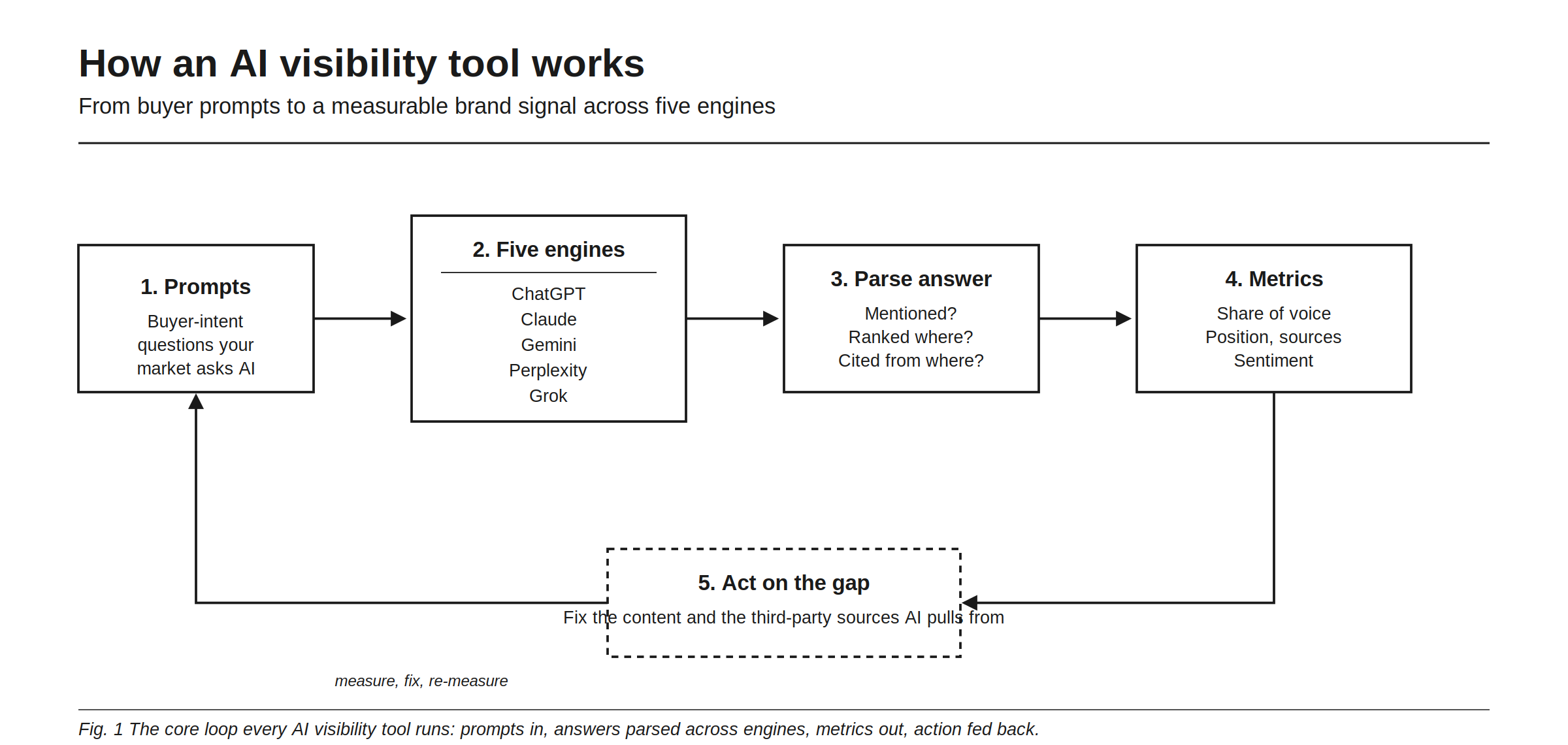
Most tools follow the same loop. They take your prompts, send them to each engine on a schedule, and capture the full response. Then a parser reads each answer for three separate things: whether your brand is mentioned at all, where it ranks among the options named, and which third-party sources the model cited to build the answer. Those signals roll up into scores you can track over time and compare against competitors.
The detail that matters is the difference between methods. Some tools call model APIs, which is fast but can miss what real users see, especially in Google AI Overviews. Others drive a real browser to capture the live answer. And the best tools keep the raw answer text as evidence, so a visibility score is something you can audit rather than trust on faith.
How to choose the right AI visibility tool
The category is crowded, and a lot of tools look identical on a landing page. Five questions separate the real platforms from the shallow trackers.
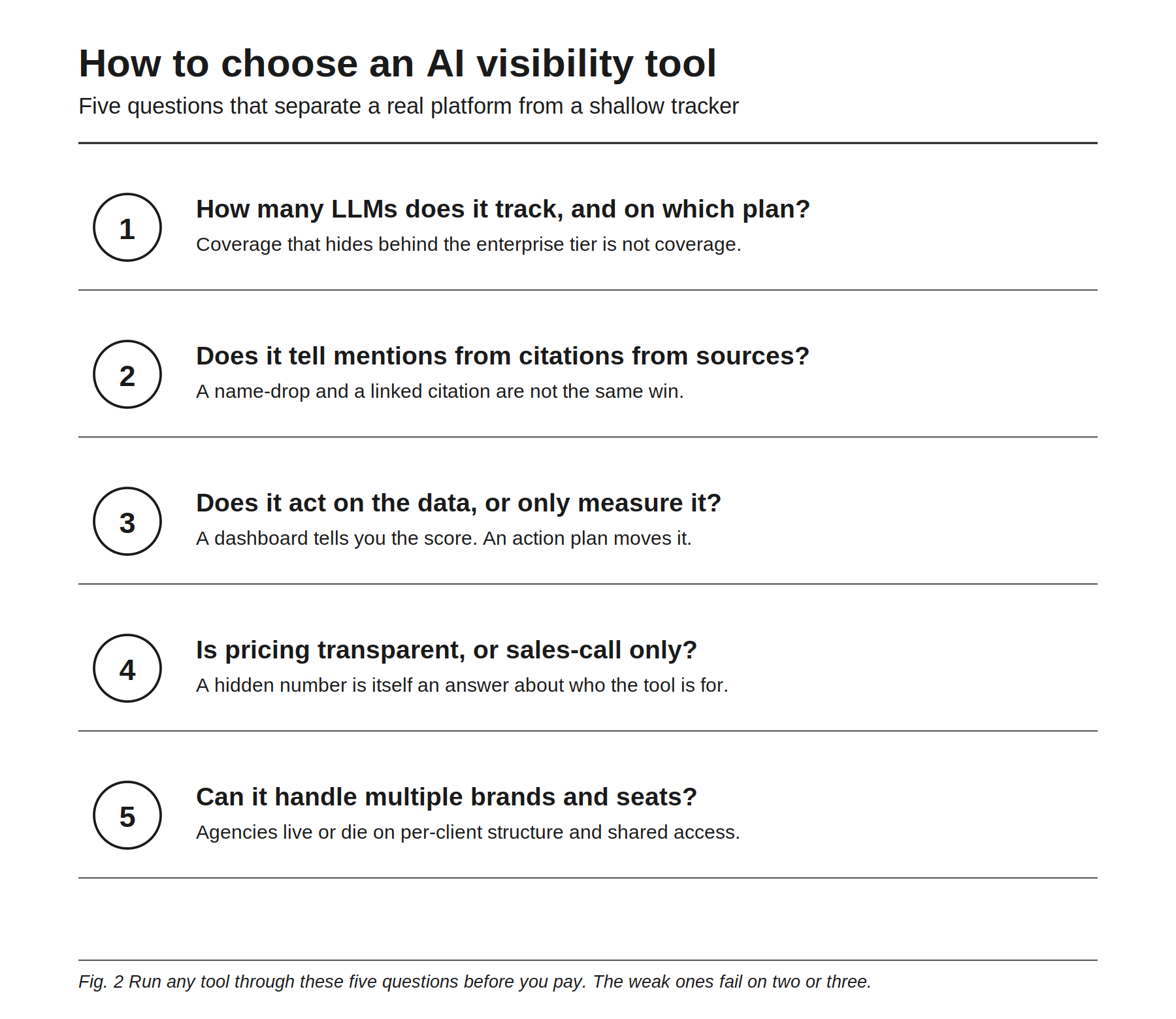
- How many LLMs does it track, and on which plan? Coverage that only unlocks at the enterprise tier is not coverage you can use today.
- Does it tell mentions from citations from sources? A name-drop without a link and a real cited source are different outcomes that need different fixes.
- Does it act on the data, or only measure it? A dashboard reports the score. An action plan moves it.
- Is pricing transparent, or sales-call only? A number a vendor will not show you is itself an answer about who the tool is built for.
- Can it handle multiple brands and seats? Agencies live or die on per-client structure and shared access.
Run any tool on this list through those five questions. The weak ones fail on two or three.
Why isn’t my brand showing up in AI answers?
Usually because the third-party sources AI trusts in your category do not mention you. Models build recommendations from places like Reddit, listicles, review sites, and comparison pages, not mainly from your own blog. If those sources name your competitors and not you, you stay invisible no matter how good your website is. We go deeper on this in why isn’t my brand showing up in ChatGPT and how to get cited by AI.
The fix has two parts. First, measure where you stand, per prompt and per model, so you know which questions you lose and to whom. Second, work the sources: earn mentions on the pages AI actually pulls from, and structure your own content so it is easy to cite. That is the loop a good AI visibility tool is built to run. You can see how Rankry handles it on the features overview, or compare it directly against other tools on the comparison pages.
FAQ
What software helps track brand visibility in LLM-generated answers? Purpose-built platforms like Rankry, Profound, and Peec AI track how ChatGPT, Claude, Gemini, Perplexity, Grok, Microsoft Copilot, and Google AI Overviews mention and recommend your brand, and report visibility, share of voice, and the sources behind each answer.
What tool tracks brand mentions in ChatGPT and Perplexity? Most tools in this guide cover both. Rankry tracks every engine you track on every plan and keeps the raw answer text as evidence. Otterly.AI is the cheapest entry point if you only need monitoring.
How do I monitor whether AI recommends my brand? Set a list of buyer-intent prompts your market would ask, run them across the major models on a schedule, and track whether you are named, where you rank, and which sources are cited. A tool automates this and shows the trend over time.
Which AI visibility tool is best for agencies? Agencies should weigh per-client project structure, seats, and pricing. Rankry’s Custom plan, Peec AI’s unlimited seats, and Profound’s enterprise tier are the common picks, depending on budget.
What is the cheapest AI visibility tool? Otterly.AI starts at $29/mo for monitoring. Among purpose-built tools with an action layer, Rankry starts at $99/mo ($79 annual) with all seven engines available.
Do these tools track Claude and Grok, not only ChatGPT? Some do, some do not. Coverage varies a lot by plan. Rankry offers all seven engines on every tier, with any five active per project. Several tools track only three engines, so check before you buy.
Do I need every engine tracked at once? No, and no tool gives you that cheaply. What matters is that the catalogue is wide enough that your five are in it, and that adding one is not an upsell. Several tools in this guide fix you to three engines and charge per extra, which is where a low headline price stops being low. Judge the catalogue, then judge what a swap costs you.
See where your brand stands across the engines you pick. Start with Rankry pricing.