Google Search Console now shows how often your pages appear inside AI Overviews and AI Mode, and read correctly, that data is a to-do list for AI search, not a report card. The pattern most owners misread, impressions up while clicks fall, is usually not a failure: it means the AI is answering on the results page and citing you at the moment of decision, so visibility and traffic have split into two separate signals you read as a gap, not one number. Inside that data, four patterns each point to a specific action: high impressions with weak clicks means sharpen the answer; a high-value query where you are absent means build the page; pages the AI already trusts mean strengthen and expand; declining presence means refresh before it is gone. The one hard limit: GSC is ground truth for Google only, blind to ChatGPT, Claude, and Perplexity, so pair it with a cross-engine prompt check. This guide shows how to read it for opportunity.
Google shipped its generative AI performance data in mid-2026, and it is the most-requested report in Search Console history. Most people still glance at the click total and close the tab. That is leaving the most useful signal of the year unread.
Impressions up, clicks down is not failure
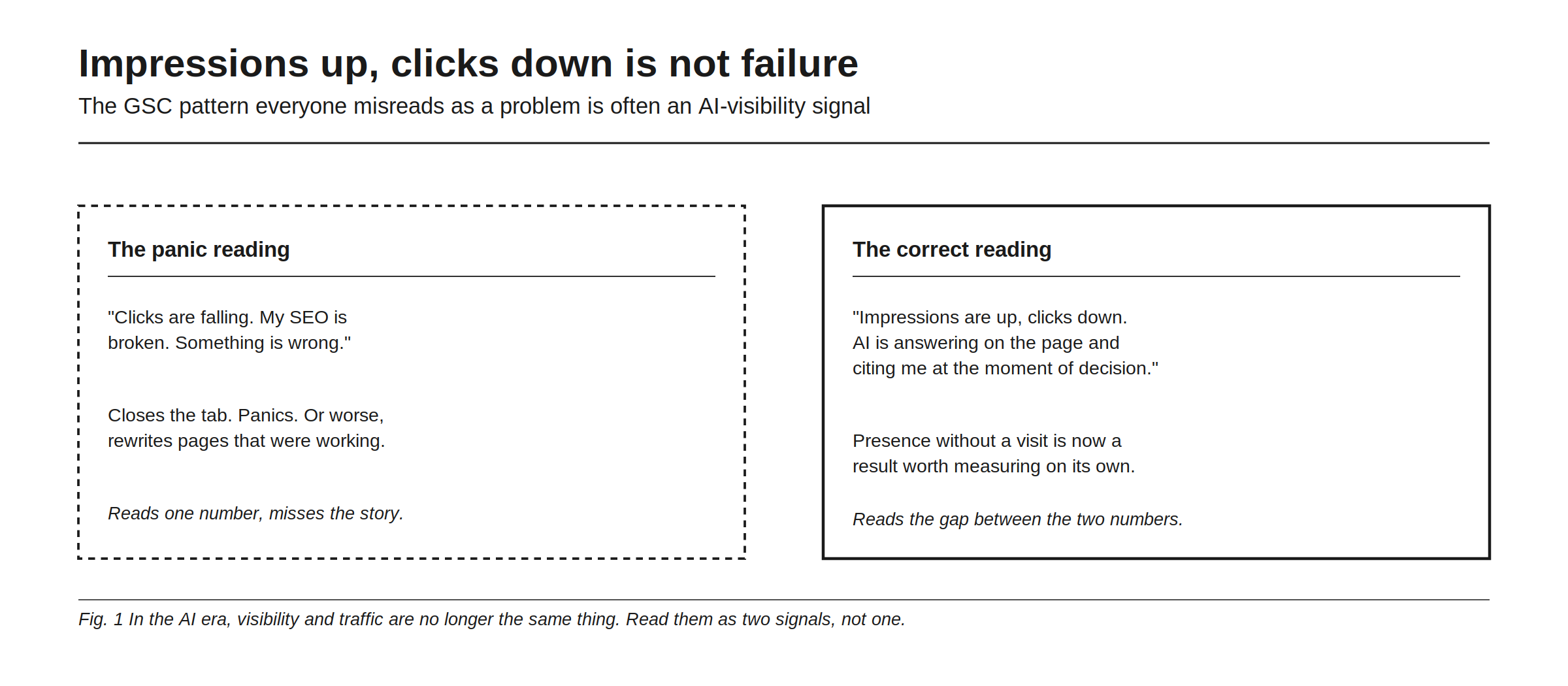
Two ways to read the same chart. The panic reading: “Clicks are falling, my SEO is broken, something is wrong,” so you close the tab and panic, or worse, rewrite pages that were working, reading one number and missing the story. The correct reading: “Impressions are up, clicks down, AI is answering on the page and citing me at the moment of decision,” so you treat presence without a visit as a result worth measuring on its own, reading the gap between the two numbers.
In the AI era, visibility and traffic are no longer the same thing, so read them as two signals, not one. A rising impression count on a query the AI answers in place means your brand is present when the buyer decides, even with no click, which is the zero-click dynamic explained in agentic search versus zero-click. One caution on the mechanics: AI impressions are already folded into your overall totals, so never add the AI report’s numbers on top of your organic totals, that double-counts and inflates the picture.
Four patterns to hunt for in your data
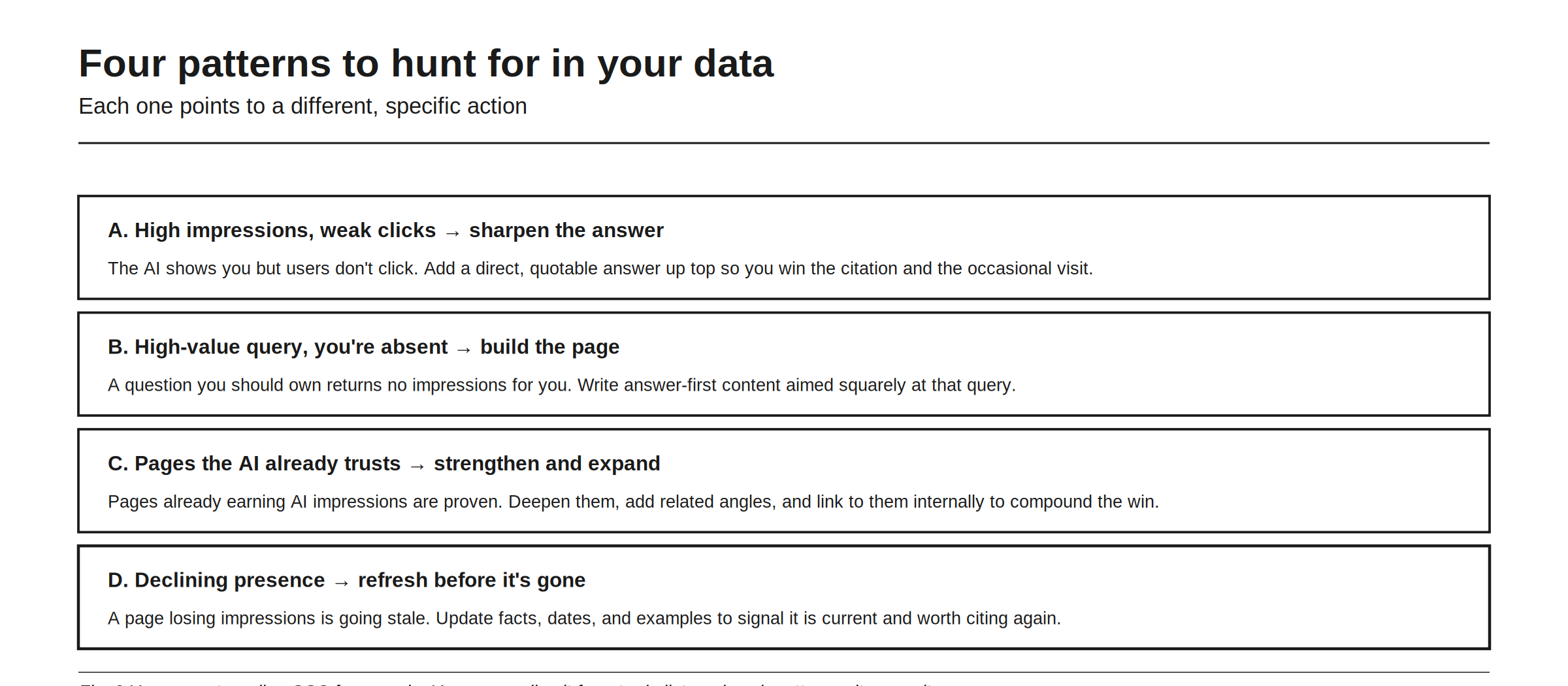
Each pattern writes one to-do item. A) High impressions, weak clicks, sharpen the answer: the AI shows you but users don’t click, so add a direct, quotable answer up top to win the citation and the occasional visit. B) High-value query, you’re absent, build the page: a question you should own returns no impressions for you, so write answer-first content aimed squarely at that query, which starts with knowing which prompts matter, per choosing which buyer questions to track. C) Pages the AI already trusts, strengthen and expand: pages already earning AI impressions are proven, so deepen them, add related angles, and link to them internally to compound the win. D) Declining presence, refresh before it’s gone: a page losing impressions is going stale, so update facts, dates, and examples to signal it is current and worth citing again, the freshness discipline in the 3-month citation cliff.
You are not reading GSC for a grade. You are reading it for a to-do list, and each pattern writes one item. A practical way to surface these: sort queries by impressions descending, then look at the ones where you show up but conversion to a click is weak, those are your sharpen-the-answer candidates hiding in plain sight.
GSC is half the picture
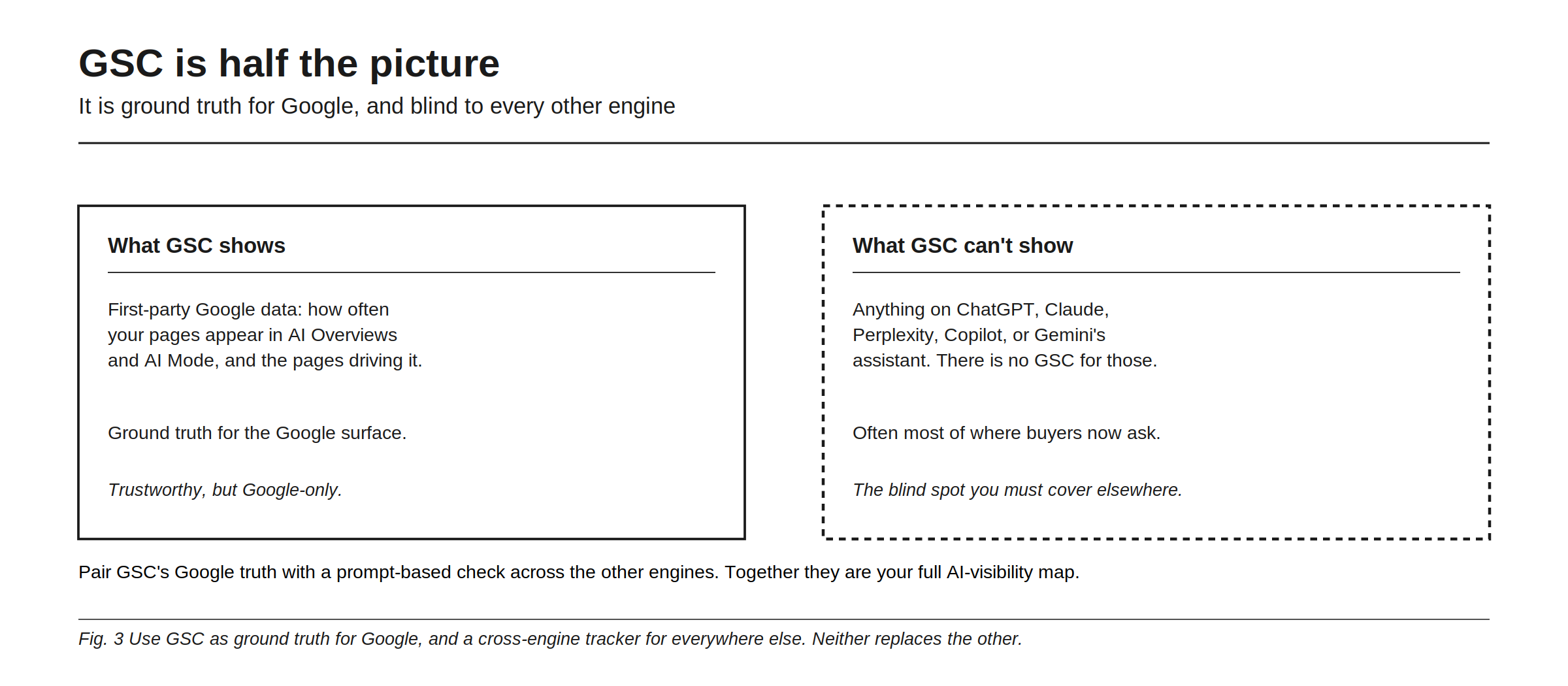
Know the boundary. What GSC shows: first-party Google data, how often your pages appear in AI Overviews and AI Mode, and the pages driving it, ground truth for the Google surface, trustworthy but Google-only. What GSC can’t show: anything on ChatGPT, Claude, Perplexity, Copilot, or Gemini’s assistant, because there is no GSC for those, and that is often most of where buyers now ask.
Pair GSC’s Google truth with a prompt-based check across the other engines, and together they are your full AI-visibility map. Use GSC as ground truth for Google, and a cross-engine tracker for everywhere else; neither replaces the other. This is exactly the gap a proper audit is built to close, covered in how to run an AI visibility audit, and it is the reason a Google-only view will quietly mislead you about your real reach, since the engines each source answers differently, per where AI actually gets its sources.
A simple weekly rhythm that compounds
The mistake is treating this as a one-time audit. The owners who win with GSC’s AI data run a short, repeatable loop. Once a week, spend fifteen minutes on three questions: which pages gained AI impressions (candidates to strengthen and expand), which lost them (candidates to refresh), and which high-value queries still show you absent (candidates to build for). Turn each answer into one concrete edit, then move on. Over a quarter, that rhythm quietly reshapes your footprint: the trusted pages get deeper and better-linked, the stale ones get refreshed before they fall out, and the gaps get filled with answer-first content aimed at real queries. Two guardrails keep it honest. First, weekly wobble in AI impressions is often just Google testing interface formats, not a content problem, so act on trends across a few weeks, not a single dip. Second, remember the report is impressions-first, with click data still rolling out, so read it as a reach-and-presence signal rather than a traffic one for now. Done consistently, this turns a report most people ignore into a steady stream of specific, low-guess improvements, and it pairs naturally with watching the non-Google engines, which is where the other half of your buyers are asking. Rankry covers that other half, tracking how ChatGPT, Claude, Perplexity, Gemini, Copilot, Grok, and Google’s AI answer for your prompts, so your GSC read and your cross-engine read form one picture, from $99 a month on a no-card trial.
FAQ
How do I find AI search data in Google Search Console? Open the Performance area and look for the generative AI report, or filter Search results by the AI Overview and AI Mode features. It shows impressions for how often your pages appear inside Google’s AI answers, grouped by page, launched in mid-2026 as the most-requested report in GSC history.
Why are my impressions rising while clicks fall in GSC? Because AI Overviews often answer the query on the results page, so users see and even rely on your cited content without clicking through. This is normal in the AI era and usually signals that Google’s AI trusts your content enough to cite it, not that your SEO is failing.
Should I add GSC’s AI impressions to my organic totals? No. AI feature impressions are already included in your overall Search Console totals. Adding the AI report’s numbers on top double-counts them and inflates your visibility figures. Read the AI report as a breakdown of existing totals, not an addition to them.
What actions should GSC AI data drive? Four: sharpen the answer on pages with high impressions but weak clicks; build answer-first content for high-value queries where you are absent; strengthen and internally link pages the AI already trusts; and refresh pages whose AI presence is declining, since falling impressions often signal staleness.
Does GSC show my visibility in ChatGPT or Perplexity? No. GSC only reports your performance in Google’s own generative features. It cannot see ChatGPT, Claude, Perplexity, or Copilot. To get the full picture, pair GSC with a prompt-based check across the other answer engines, because for many categories those are where most buyers now ask.
GSC covers Google. Rankry covers the rest, tracking how ChatGPT, Claude, Perplexity, Gemini, Copilot, Grok, and Google answer for your prompts. Start a free 7-day trial, no card, first report in two minutes.