From September to early November 2026, the AI visibility tool market changed in three ways. Large rounds and revenue milestones: Profound announced a $180 million Series D at a $1.8 billion valuation on September 15, and Peec AI said on November 2 that it had passed $20 million in annual recurring revenue. Products converged: Peec AI, Profound, Writesonic, Conductor and Ahrefs all announced agents, recommended actions, sentiment or citation-decay features in that period. And the platforms underneath shifted: ChatGPT links lost their UTM tag between October 8 and 15 in what OpenAI reportedly confirmed was a bug, rank trackers reported Google serving them swapped results, and Semrush told enterprise customers it would stop tracking Copilot on November 9. If you are choosing or renewing a tool, how it collects data now matters more than its feature list.
Most of this news came as press releases and product posts, so most items are the vendor’s own description. Here is what was announced, dated and sourced, plus a checklist to test any tool, ours included.
Where the money and the deals went
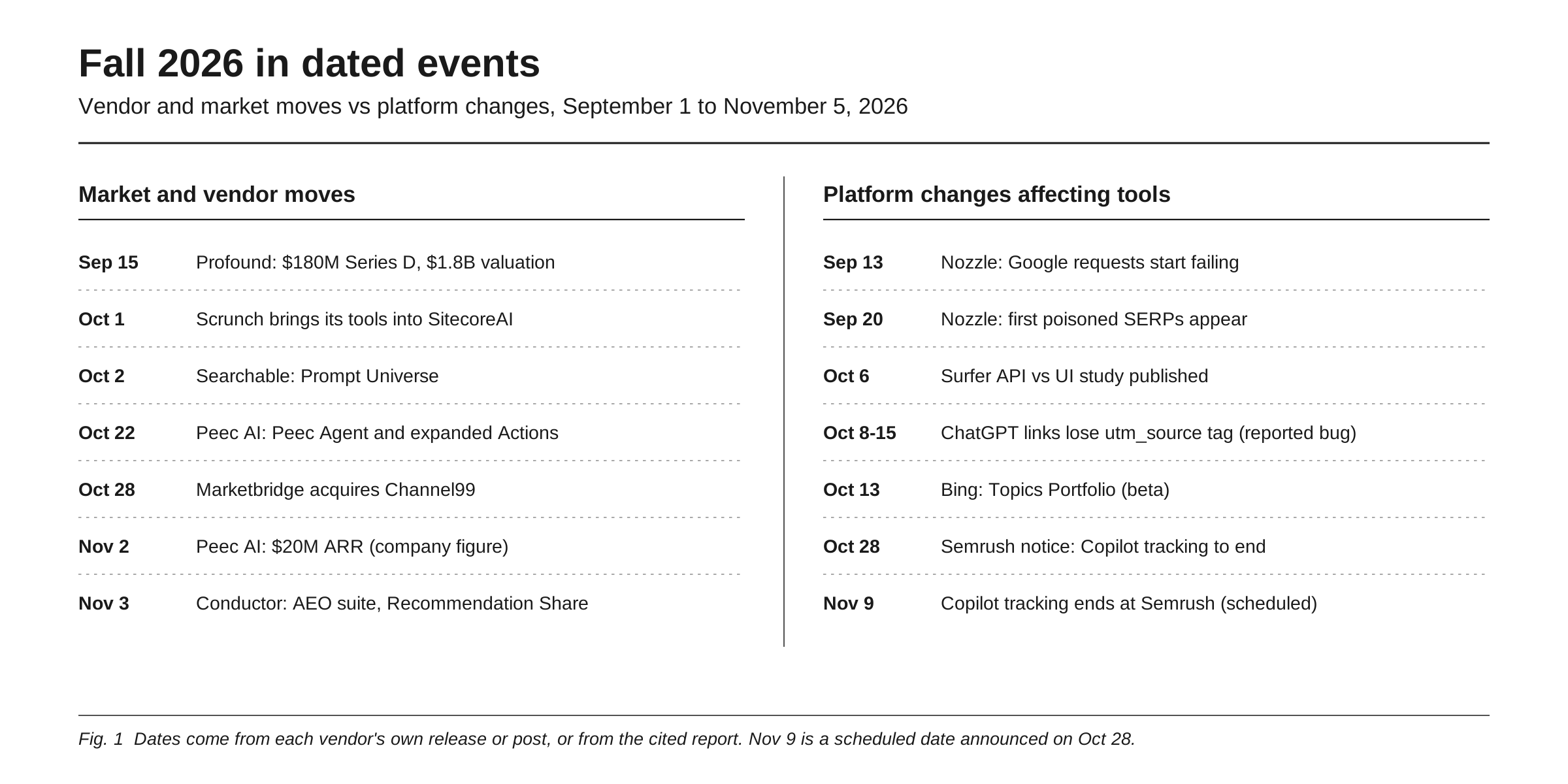
Profound’s $180 million Series D was co-led by Sequoia Capital and Kleiner Perkins and, per the company’s release, came less than seven months after a $96 million Series C. The company says it serves more than 1,000 enterprise brands. Its newsroom also lists partnership announcements with The Estée Lauder Companies on September 15 and Bazaarvoice on October 20.
Peec AI reported growth instead: its November 2 release says ARR passed $20 million, up from $10 million in May 2026, with more than 4,000 customers. These are self-reported company figures.
Buyers from adjacent markets arrived too. Marketbridge, a US consulting and marketing firm, acquired the B2B measurement platform Channel99 on October 28 and launched an AI Visibility offering alongside the deal; terms were not disclosed. Two earlier deals still shape products: Adobe completed its Semrush acquisition on April 28, and Sitecore acquired Scrunch on June 3. On October 1, Scrunch brought its AI search monitoring and recommendations into SitecoreAI.
Similarweb named Michael Akkerman CEO on September 24, effective November 2, succeeding founder Or Offer; the company said there was “no change to the Company’s strategy, operations, or financial outlook.” We found no shutdown announcements from the vendors named in this article during the period.
What vendors shipped: agents, actions and new engines
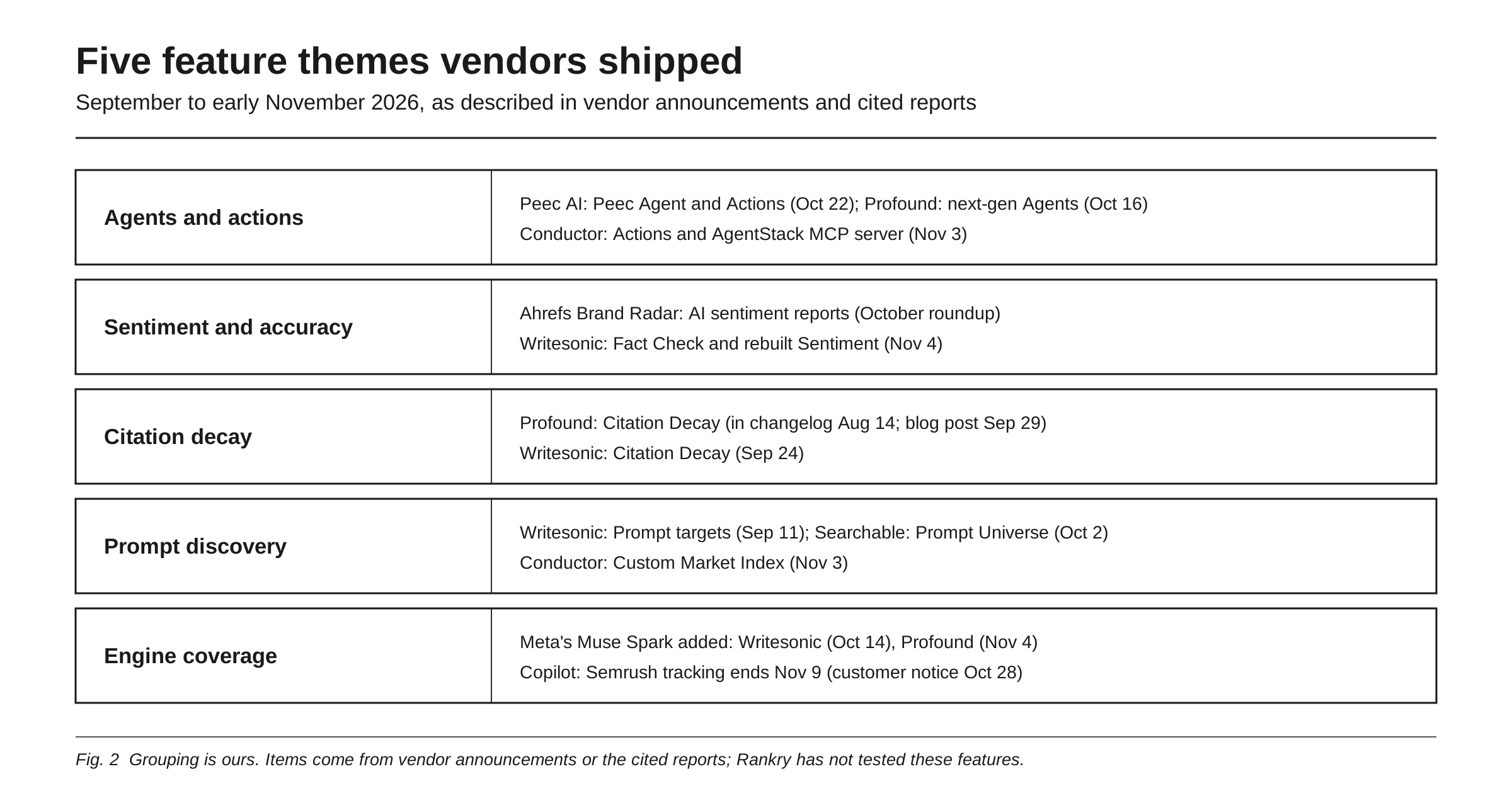
Read the product posts side by side and five themes repeat. The grouping is ours, and we have not tested these features.
Agents and recommended actions. Peec AI launched Peec Agent on October 22, an assistant that answers questions about charts and results and can turn findings into content briefs, page updates or tasks, with 30 skills, more than 25 connectors and approval before changes by default. Its Actions feature now covers technical fixes, owned content, third-party mentions and inaccurate claims. Profound introduced a new generation of Agents on October 16. Conductor announced an AEO suite on November 3 that includes Recommendation Share, which it describes as “a new KPI that measures how strongly AI recommends a brand over its competitors,” alongside Conductor Actions and an MCP server.
Sentiment and accuracy. Ahrefs added AI sentiment reports to Brand Radar in its October roundup, broken out by AI platform and by aspects such as price and quality. Writesonic announced Fact Check and a rebuilt Sentiment feature on November 4.
Citation decay. Profound and Writesonic each offer a feature called Citation Decay, which tracks how pages gain or lose AI citations over time. Profound’s product changelog listed it on August 14 and its blog post followed on September 29; Writesonic introduced its version on September 24.
Prompt discovery. Writesonic launched Prompt targets on September 11, and Searchable launched Prompt Universe on October 2. Searchable says businesses switching from other providers may track as little as 2% of their relevant prompts; it did not publish a method for that figure.
Engine coverage. Writesonic added tracking for Meta’s Muse Spark on October 14, and Profound announced Muse Spark tracking on November 4. UsagePricing, a third-party pricing tracker, logged that on October 15 Writesonic’s Starter plan went from ChatGPT only to ChatGPT, Gemini and Google AI Overviews, with no price change. On October 8, OtterlyAI and Getfluence announced a partnership in which Getfluence uses OtterlyAI’s visibility insights to plan editorial placements.
The direction is consistent: from reporting what AI says to recommending, and sometimes drafting, the fix. An action is only as good as the measurement that triggered it.
Platform changes behind the numbers
Three changes outside any vendor’s control affected the data.
ChatGPT stopped tagging links for a week. Adobe’s Cedric Huesler reported that ChatGPT stopped adding utm_source=chatgpt.com; Relevant Audience’s timeline puts the start at about 2 p.m. PT on October 8. On about 500 pages, comparing October 9 to 13 with the week before, he measured ChatGPT down about 31,000 visits a day and direct up about 26,000. He later said OpenAI confirmed to him on October 14 that it was a bug, with a fix rolling out from October 15. That confirmation is secondhand, and he wrote that the referrer is still missing on most ChatGPT clicks. The tag matters: BrightEdge data, as reported by The Next Web, put ChatGPT at 95.1% of AI referral traffic to websites in August 2026, though the article does not describe BrightEdge’s method.
Rank trackers reported swapped Google results. Nozzle reports that its requests to Google began failing on September 13 and that poisoned pages, normal-looking results with the usual sites swapped out, appeared from September 20. As of its November 1 update, page one was poisoned on 14.3% of the SERPs it collected since September 13, against a 0.17% baseline, with a daily peak of 34.8% on October 27. Ahrefs said Google appears to show different results to suspected SERP data providers and put the affected share at 5% to 20%, depending on the data provider. Semrush wrote on October 27 that “Google hasn’t commented publicly.” Nozzle also found AI Overview sources changed on poisoned pages, and tools that read AI Overviews or AI Mode from scraped Google pages share that path; details are in our piece on poisoned SERPs.
Copilot got harder to track. According to PPC Land, Semrush emailed Enterprise AIO customers on October 28 that “Recent changes to Microsoft Copilot’s access requirements” prevent AI visibility platforms from collecting the data, and that Copilot tracking would be discontinued on November 9. PPC Land notes the timing is consistent with Copilot terms requiring a Microsoft account; Semrush had not said that was the change it meant.
First-party reports grew, but answer a narrower question. Google’s Search Console generative AI reports reached all sites on August 31, showing impressions by page, country and date, with no click data at rollout. Bing’s AI Performance report, launched in public preview on February 10, covers Microsoft Copilot, AI summaries in Bing and select partners. Its Topics Portfolio beta arrived on October 13, and Microsoft says to treat its numbers “as directional signals for planning, not as a precise ledger.” Neither covers ChatGPT, Claude or Perplexity.
The API versus UI debate, now with data
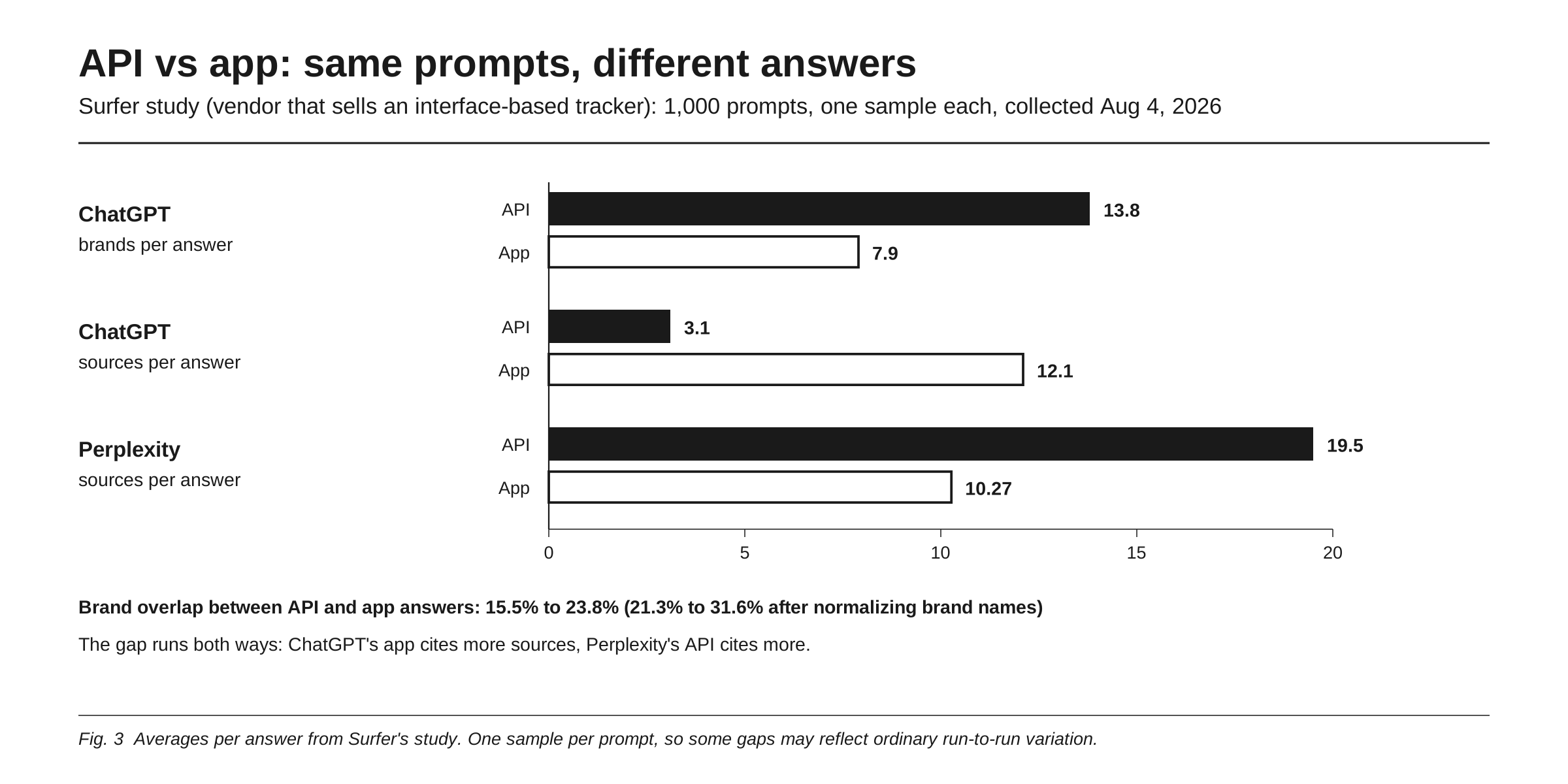
The category’s oldest method question got a large test. In a study published October 6, Surfer compared answers collected through official APIs with answers scraped from the consumer apps: 1,000 prompts across ChatGPT, Perplexity, Gemini, AI Mode and AI Overviews, 13,779 answers, collected on August 4. Brand overlap between the two methods was 15.5% to 23.8%, or 21.3% to 31.6% after normalizing brand names. ChatGPT’s API answers named 13.8 brands on average against 7.9 in the app, while the app cited 12.1 sources against the API’s 3.1. On Perplexity, the source gap ran the other way: 19.5 for the API, 10.27 for the app.
Read it with its limits. Surfer sells a tracker built on interface data and argues for that method. It took one sample per prompt, and the authors note that the same prompt asked twice does not return the same answer, so some differences may be ordinary run-to-run variation. Its API runs also used what it calls the closest purchasable equivalent of each app’s model.
Our reading: this fall exposed a cost on each side. Interface collection reflects what users see, but it is the path affected by the swapped Google results trackers reported and by access changes like Copilot’s. API collection is stable and reproducible, but its answers can differ from the app’s. Neither method is wrong. Mixing them without labels is. Why tools disagree is covered in why AI visibility trackers never show the same number.
A buyer’s checklist for choosing or re-evaluating a tool
This is Rankry’s framework, not an industry standard. Use it on any vendor, including us, and get answers in writing.
- Engines covered, now and next quarter. Check each engine your buyers use against the plan you would buy. Ask what happens to history and credits when an engine is dropped, as Copilot was at Semrush, and how fast new engines such as Muse Spark get added.
- API or UI, per engine. Ask which method each engine uses and whether reports label it. A dashboard that mixes methods silently cannot be compared week to week.
- Runs per prompt. One answer per prompt per day is a sample. Ask how many runs sit behind each number and whether you can raise it.
- Google surface data source and spot-check policy. Ask how AI Overviews and AI Mode are collected, which filters reject poisoned pages, and whether flagged days are marked. Then cross-check Search Console yourself.
- Citation and source tracking. Ask for cited URLs, not only domains, per engine. Recommended actions need page-level evidence you can open.
- Export. Ask for raw answers, citations and scores in CSV or via API. With several tools now inside larger suites, keeping your history is cheap insurance.
- Price per run. Divide the monthly price by prompts × engines × runs × days, add-ons included. The method is in our cost-per-prompt guide.
For feature-level comparisons across vendors, see the best AI visibility tools.
Where Rankry fits
Rankry is one of the tools in this market. It tracks how ChatGPT, Claude, Gemini, Perplexity, Grok and Google AI Mode and AI Overviews mention, rank, cite and recommend brands across a stable set of buyer-intent prompts, every day, with competitor comparison. Its Google Search Console integration puts first-party data next to the AI results, and its AI traffic tracking shows the visits AI platforms send to your site. Hold Rankry to the same seven questions.
FAQ
What changed in the AI visibility tool market in fall 2026? Three things. Profound raised a $180 million Series D at a $1.8 billion valuation, and Peec AI reported passing $20 million in ARR. Vendors including Peec AI, Profound, Writesonic, Conductor and Ahrefs announced agents, recommended actions, sentiment and citation-decay features. And platform changes, a reported ChatGPT tagging bug, swapped Google results reported by rank trackers and new Copilot access rules, affected how tools collect or attribute data.
Did ChatGPT stop passing referral data in October 2026? Temporarily, for the UTM tag. Adobe’s Cedric Huesler reported that ChatGPT stopped adding utm_source=chatgpt.com on October 8, so visits showed up as direct. He said OpenAI confirmed a bug to him and a fix rolled out from October 15. OpenAI had not commented publicly, and he wrote that the referrer was still missing on most ChatGPT clicks.
Are AI Overview numbers from visibility tools reliable right now? Treat them with care. Since September, rank-tracking vendors have reported Google serving swapped results to rank trackers and SERP data providers, and tools that read AI Overviews or AI Mode from scraped pages use that same path. Ask your vendor how it filters suspect pages and whether flagged days are marked, and compare against Search Console’s generative AI report before acting.
Should an AI visibility tool use the API or the user interface? Each has trade-offs. Surfer’s October study of 1,000 prompts found low brand overlap between API and app answers, though Surfer sells an interface-based tracker and took one sample per prompt. Interface data reflects what users see but faces scraping defenses and access changes. API data is reproducible. What matters most is that the tool tells you which method each engine uses.
Do Search Console or Bing Webmaster Tools replace an AI visibility tool? No, but they are the best referees you have. Search Console’s generative AI reports show impressions in Google’s AI features by page, country and date, without clicks at rollout. Bing’s AI Performance covers Copilot, AI summaries in Bing and select partners. Neither covers ChatGPT, Claude or Perplexity, or shows the answer text, so they complement prompt tracking rather than replace it.
Sources
- Profound Raises $180M Series D at $1.8B Valuation to Build the AI Platform For Marketing Teams, Profound, September 15, 2026
- Newsroom (Estée Lauder and Bazaarvoice releases), Profound, September 15 to October 20, 2026
- Peec AI doubles revenue in six months to hit $20M ARR, Peec AI via GlobeNewswire, November 2, 2026
- Peec AI launches Peec Agent and expands actions so marketing teams can act on what AI search says about their brand, Peec AI via GlobeNewswire (The Manila Times), October 22, 2026
- Marketbridge Buys Channel99, Adds AI Visibility Tool, Daily Research News Online, October 28, 2026
- Adobe Completes Semrush Acquisition, Strengthening CX Enterprise with Enhanced Brand Visibility Capabilities, Semrush, April 28, 2026
- Sitecore acquires Scrunch to help brands influence discovery and buying decisions in the AI-search era, Sitecore, June 3, 2026
- Introducing Scrunch in SitecoreAI: Observe, optimize, and ship in one place, Scrunch, October 1, 2026
- Similarweb Names Michael Akkerman as New Chief Executive Officer, Investing News Network, September 24, 2026
- Blog (Introducing the next generation of Agents, Oct 16; Introducing Citation Decay, Sep 29; Muse Spark is now available, Nov 4), Profound, September 29 to November 4, 2026
- Product changelog: Content Citation Decay, YouTube citation breakdowns and more, Profound, August 14, 2026
- Product blog (Prompt targets, Sep 11; Citation Decay, Sep 24; Muse Spark tracking, Oct 14; What’s new in Writesonic, Nov 4), Writesonic, September 11 to November 4, 2026
- Conductor Launches New AEO Product Suite, Empowering Brands to Win AI Recommendations, Conductor via Business Wire (Yahoo Finance), November 3, 2026
- Rapports de sentiment IA, score de visibilité IA et bien d’autres (Octobre 2026), Ahrefs, October 31, 2026
- AI Visibility Platform Searchable Launches Prompt Universe to End the Guesswork in AEO Tracking, Searchable via Newsfile, October 2, 2026
- Getfluence and OtterlyAI partner to turn AI Search Visibility Into editorial action, GlobeNewswire, October 8, 2026
- Writesonic Pricing, UsagePricing, change logged October 15, 2026
- OpenAI Drops UTM Parameters From ChatGPT Results (GPT-6), Search Engine Roundtable, October 14, 2026
- ChatGPT UTM tag loss was a bug, Adobe’s Huesler says; fix rolling out, Relevant Audience, October 16, 2026
- ChatGPT now sends 95.1% of AI referral traffic to websites, BrightEdge says, The Next Web, September 24, 2026
- Poisoned Google SERPs, Nozzle, October 10, 2026 (updated November 1, 2026)
- An update on Google’s poisoning of search results, Ahrefs, October 22, 2026
- Poisoned SERPs: An update on Google ranking data in Semrush, Semrush, October 27, 2026
- Semrush drops Copilot from AI visibility tracking on November 9, PPC Land, October 29, 2026
- Google Search Console AI Reports Rolled Out Worldwide, Search Engine Journal, August 31, 2026
- Introducing AI Performance in Bing Webmaster Tools Public Preview, Microsoft Bing, February 10, 2026
- Introducing Topics Portfolio (Beta) in AI Performance, Microsoft Bing, October 13, 2026
- Why You Cannot Track AI Visibility Through an API: 2026 Data From ChatGPT, Perplexity, Gemini, AI Mode, and AI Overviews, Surfer, October 6, 2026
Track how ChatGPT, Claude, Gemini, Perplexity, Grok and Google AI search describe your brand on a stable set of buyer prompts, and check the numbers against your own first-party data. Start a free 7-day Rankry trial, no card required.