The monthly price of an AI visibility tool tells you almost nothing until you divide it by what it buys: prompts × engines × runs per month. Normalized that way, plans that look far apart can land in the same place. Using plan terms as listed by Ryze AI in August 2026, Otterly.AI’s $29 Lite plan and its $189 Standard plan both work out to about $0.016 per prompt-engine-run, while Profound’s $399 Growth plan works out to about $0.044. There is also a useful reference floor: at Anthropic’s list prices for Claude Haiku 4.5 and Claude Sonnet 5, one web-searched API answer costs roughly $0.025 to $0.040 under our stated token assumptions, which is more than the entry plans in our table earn per run. That gap is one likely reason cheap plans run each prompt once a day, query fewer engines, or collect answers in ways you should ask about before you buy.
Buyers tend to compare these tools by the number on the pricing page. That habit costs money, because two plans at the same price can deliver a tenfold difference in actual answers.
Why the monthly price misleads
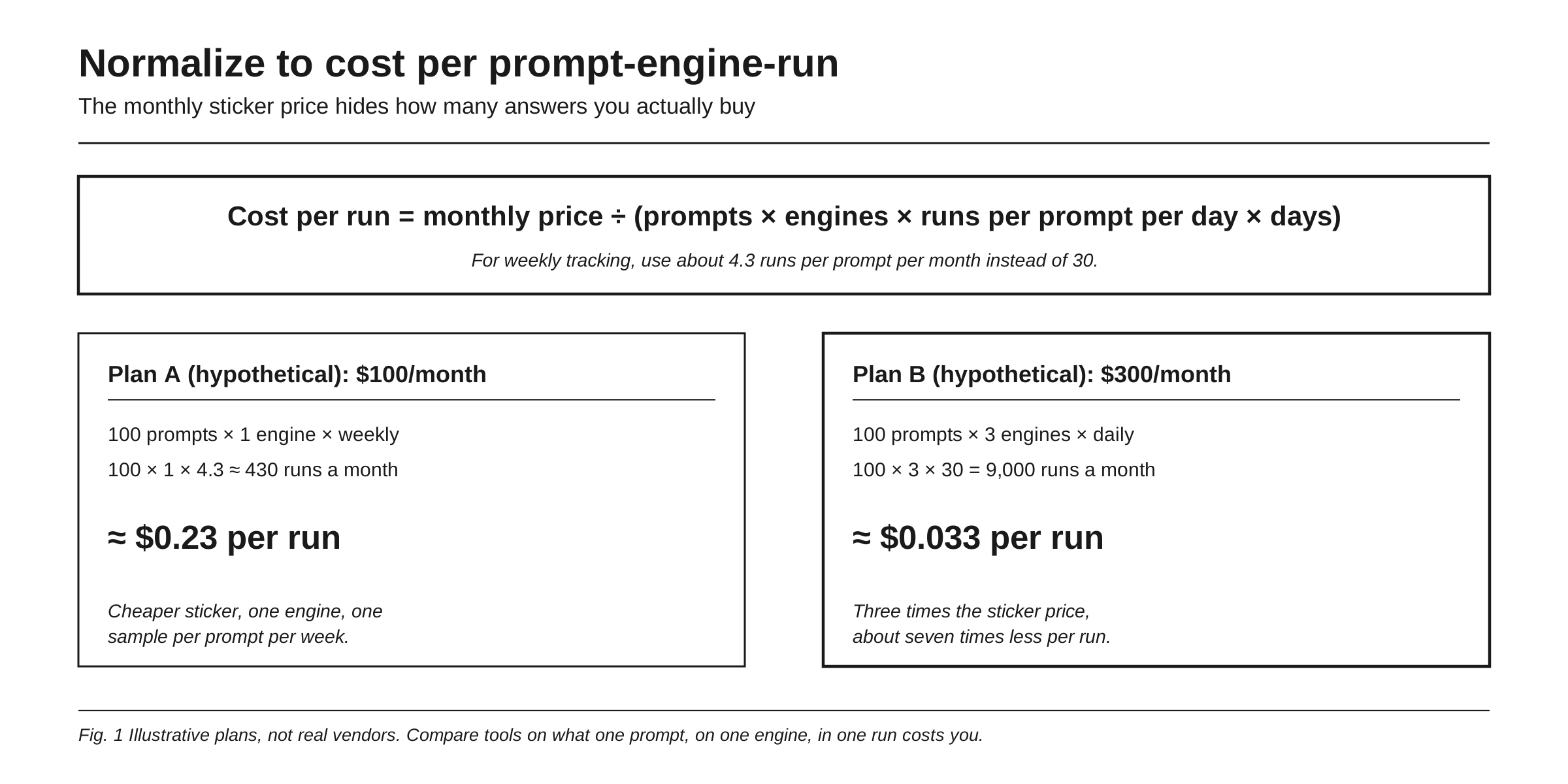
AI visibility tools sell the same raw material: an AI engine’s answer to a prompt you chose. Four variables decide how many answers your plan pays for:
- Prompts: how many questions you track.
- Engines: how many AI products each prompt runs on, such as ChatGPT, Perplexity or Google AI Overviews.
- Frequency: daily, weekly or monthly.
- Runs per prompt: how many times each prompt is asked on each engine per cycle. Few pricing pages state it; Profound’s published numbers imply one.
The formula that makes tools comparable:
Cost per run = monthly price ÷ (prompts × engines × runs per prompt per day × days in the month)
Take two made-up plans. Plan A costs $100 a month for 100 prompts on one engine, checked weekly: about 430 answers, or roughly $0.23 each. Plan B costs $300 for 100 prompts on three engines, checked daily: 9,000 answers, or about $0.033 each. Plan B costs three times as much per month and about seven times less per answer.
Some vendors already count this way. Ahrefs defines one check as “one prompt times one AI tool times one location,” and lets you set daily, weekly or monthly tracking separately for each AI tool. Profound’s Growth plan, according to a Ryze AI review from August 2026, covers 100 prompts and 9,000 responses a month on three engines, which is exactly 100 prompts × 3 engines × 30 days.
What listed plans cost per run
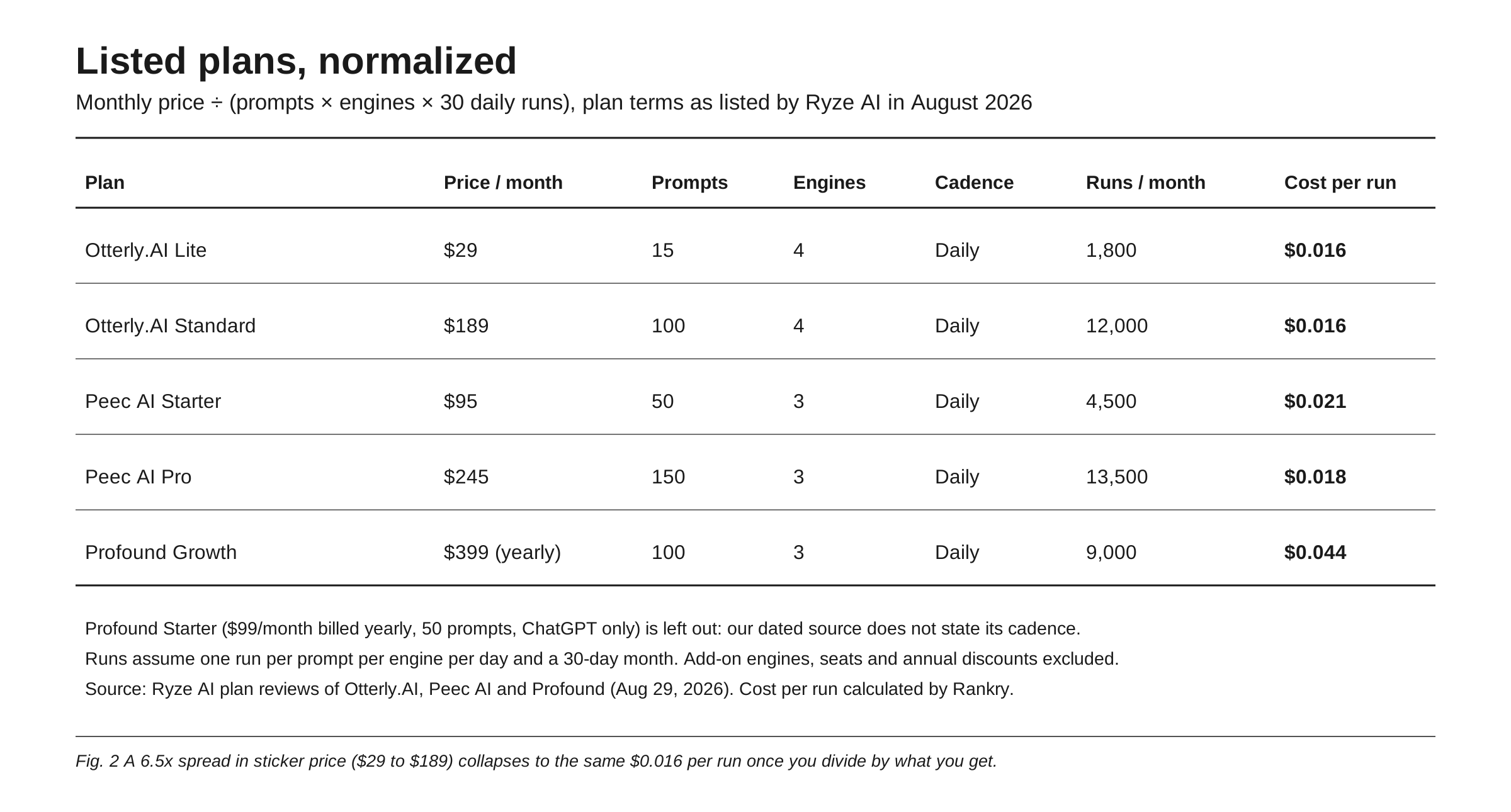
Here are published plans normalized with the formula above. Otterly.AI, Peec AI and Profound terms are as listed by Ryze AI, a competing vendor, on August 29, 2026. Semrush terms are from Semrush’s knowledge base. We assumed one run per prompt per engine per day and a 30-day month, and excluded add-ons, seats and annual discounts.
- Otterly.AI: Lite is $29 a month for 15 prompts, Standard $189 for 100, Premium $489 for 400. Every plan tracks the same four engines (ChatGPT, Google AI Overviews, Perplexity and Microsoft Copilot) daily; Claude, Google AI Mode and Gemini are paid add-ons. Lite and Standard both land near $0.016 per run.
- Peec AI: Starter is $95 for 50 prompts, Pro $245 for 150, Advanced $495 for 350, each with a choice of three models, tracked daily on all self-serve plans, with extra models at $30, $70 or $140 a month at annual rates. On three models, Starter comes to about $0.021 per run and Pro to about $0.018.
- Profound: Starter is $99 a month billed yearly for 50 prompts on ChatGPT only, and Growth is $399 a month billed yearly for 100 prompts on ChatGPT, Perplexity and Google AI Overviews. Growth comes to about $0.044 per run. The review we used does not state Starter’s cadence, so we did not compute it.
- Semrush AI Visibility Toolkit: $99 a month for 25 prompts, with prompt tracking updated daily and 50 more prompts available for $60 a month. Detailed lists the same $99 for 25 prompts on three models.
An independent comparison from Detailed, published September 8, 2026, normalized prices with a different method. Glen Allsopp compared what each tool lists for 10,000 checks a month, with prices “exactly as I found them on the pricing page of each platform.” Per check, that came to $0.0145 for Ahrefs, $0.0199 for Promptwatch, $0.0245 for Peec AI, $0.0250 for Scrunch, $0.0299 for Semrush, $0.0359 for Surfer and $0.0400 for Searchable. Profound was “Talk to Sales” at that volume. Two caveats: Allsopp discloses that he now works at Ahrefs, and his per-check figure is the plan price divided by 10,000, so a plan that includes more than that (Peec AI Pro, at 13,500 runs under our daily assumption) looks more expensive per check there than per run in our table.
The takeaway: the per-run spread is far narrower than the sticker spread. Otterly’s two plans differ 6.5x in price and both round to $0.016 per run.
The API cost floor: what one tracked answer costs a vendor
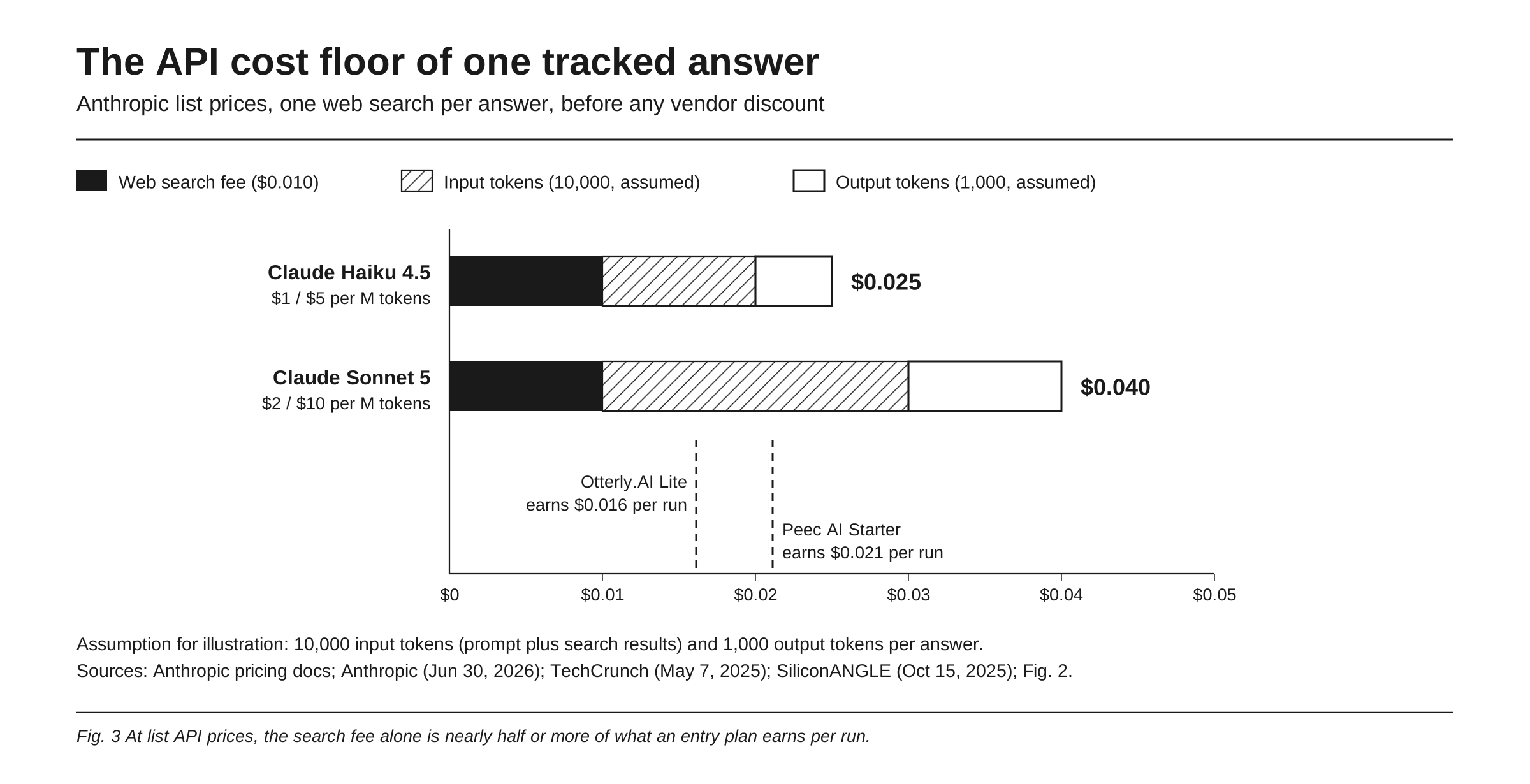
Every tracked answer costs the vendor something. Official API pricing shows the floor most clearly: a web-grounded API answer costs a search plus tokens.
Anthropic charges $10 per 1,000 web searches on its API, plus standard token costs, and its documentation says search results are counted as input tokens. Claude Haiku 4.5 is priced at $1 per million input tokens and $5 per million output tokens. Claude Sonnet 5, released June 30, 2026, is $2 and $10, a rate Anthropic made permanent in August 2026. OpenAI also bills web search per call on top of tokens; PricingSaaS logged a cut in OpenAI’s web search tool price from $25 to $10 per 1,000 calls, detected between its March 23 and April 1, 2026 captures.
A worked example, with token counts that are our assumption, not a measurement: one search, 10,000 input tokens (prompt plus search results) and 1,000 output tokens per answer.
- Haiku 4.5: $0.010 search + $0.010 input + $0.005 output = $0.025 per answer
- Sonnet 5: $0.010 search + $0.020 input + $0.010 output = $0.040 per answer
Anthropic notes that Sonnet 5’s newer tokenizer can count the same text as up to about 1.35 times as many tokens, so treat its figure as a lower bound.
Now set that against the plans. Under our one-run-a-day assumption, Peec AI Starter delivers 4,500 answers a month for $95. The search fee alone on 4,500 API answers would be $45, or 47% of the plan price. At the Haiku floor, 4,500 answers cost about $112.50, more than the plan. Otterly Lite’s 1,800 monthly answers would cost about $45 at the same floor against a $29 price.
This is not what any vendor actually pays. Vendors can negotiate volume pricing, use cheaper models, cache, or collect answers from the consumer apps instead. It does show the economics are tight, and something in the method absorbs the difference.
Why cheap plans run prompts rarely, once, or through the UI
When per-run revenue sits near per-run cost, vendors have four levers, and each changes what your data means.
One run per prompt per day. Profound’s published response count implies a single answer per prompt per engine per day, and our table assumes the same for every plan. AI answers vary from run to run, so a single daily sample is a noisy reading of your real visibility. How many runs you need to trust a number is covered in how many times to ask before you trust the answer.
Lower frequency. Weekly or monthly tracking cuts runs by a factor of seven to thirty. That is fine for slow-moving categories and a problem when you are testing whether a content change moved anything.
Fewer engines. Profound’s $99 Starter covers ChatGPT only. Otterly charges extra for Claude, Gemini and AI Mode. A cheap plan on one engine can hide that you are missing from the engine your buyers prefer.
API versus UI collection. Some tools query official APIs; others automate the consumer interface. The two can return different brands and sources for the same prompt, one reason tools disagree, as explained in why AI visibility trackers never show the same number. Neither method is free: API calls carry the fees above, and interface collection has its own infrastructure and maintenance costs.
None of these levers is dishonest. The problem is when a buyer compares a once-weekly, one-engine plan with a daily, four-engine plan on monthly price alone.
Questions to ask a vendor before you buy
Use these to turn any pricing page into a comparable cost per run.
- How many times is each prompt run per engine per cycle? One answer per day is a sample, not a measurement. Ask whether you can raise it and what it costs.
- How often does tracking run, and can I set it per engine? Daily, weekly and monthly differ by up to 30x in answer volume for the same price.
- Which engines are included, and which are add-ons? Get the price with the engines your buyers use, not the base plan.
- Do you collect answers through the API or the user interface? Ask which engines use which method, and whether location and logged-out state are controlled.
- What counts as a prompt, a check or an answer? Ahrefs counts location as a multiplier. Many pricing pages list prompts only. Convert everything to prompt × engine × run.
- What is the price per run at my volume, with annual and add-on terms included? Ask the vendor to fill in the formula for you. A vendor who cannot is telling you something.
For a side-by-side of tool features beyond price, see the best AI visibility tools.
Where Rankry fits
Rankry runs a stable set of buyer-intent prompts every day across ChatGPT, Claude, Gemini, Perplexity, Grok and Google AI Mode and AI Overviews, showing where you are mentioned, how you rank, which sources are cited and how you compare with competitors. New prompts are answered as soon as you add them. Hold Rankry to the same standard as every other vendor: ask the six questions above and compare the answers per run.
FAQ
How do I calculate the cost per prompt of an AI visibility tool? Divide the monthly price by prompts × engines × runs per prompt per day × days in the month. For weekly tracking, use about 4.3 runs per month instead of 30. The result is a cost per prompt-engine-run you can compare across any vendor, whatever unit its pricing page uses.
Is a cheaper AI visibility tool actually cheaper? Often not per answer. In plans as listed by Ryze AI in August 2026, Otterly.AI’s $29 Lite and $189 Standard both worked out to about $0.016 per run, while Profound’s $399 Growth worked out to about $0.044. A low sticker price can mean fewer prompts, fewer engines or less frequent tracking, so normalize before you compare.
What does one AI answer cost a vendor to generate? At Anthropic’s list prices, a web search costs $0.01 plus tokens. Assuming 10,000 input and 1,000 output tokens, one answer costs about $0.025 on Claude Haiku 4.5 and $0.040 on Claude Sonnet 5. Vendors can lower this with discounts, cheaper models or interface collection, so treat it as a reference floor, not anyone’s actual cost.
Why do AI visibility tools run each prompt only once a day? Because every answer has a cost, and entry plans earn roughly $0.016 to $0.021 per run in our normalized examples. One daily run per prompt per engine keeps volume affordable, but AI answers vary between runs, so a single daily sample is noisy. Ask whether more runs per prompt are available and at what price.
Does API vs UI data collection matter for AI visibility tracking? Yes. An API returns the model’s answer to a programmatic request, while the consumer app can use different settings, search behavior, sources and formatting, and that is what real users see. The two can name different brands for the same prompt. Ask each vendor which method it uses per engine, and do not compare numbers collected in different ways as if they were equal.
Sources
- I Compared Prompt Tracking Prices Across 8 AI Visibility Tools, Detailed (Glen Allsopp), September 8, 2026
- Otterly.AI Review & Pricing 2026: The $29 Entry Point, Ryze AI, August 29, 2026
- Peec AI Review & Pricing 2026: Clean Reporting, Nothing More, Ryze AI, August 29, 2026
- Profound Pricing 2026: $99 and $399, Annual Billing Only, Ryze AI, August 29, 2026
- AI Visibility Toolkit, Semrush Knowledge Base, 2026
- How to use Brand Radar: Custom prompts, Ahrefs Academy, 2026
- Anthropic rolls out an API for AI-powered web search, TechCrunch, May 7, 2025
- Pricing, Claude API documentation, Anthropic
- Anthropic debuts entry-level Claude Haiku 4.5 hybrid reasoning model, SiliconANGLE, October 15, 2025
- Introducing Claude Sonnet 5, Anthropic, June 30, 2026 (pricing update August 10, 2026)
- OpenAI API slashes web search tool price 60% to $10 per 1k calls, PricingSaaS Pulse, April 2, 2026
See where you are mentioned, ranked and cited across ChatGPT, Claude, Gemini, Perplexity, Grok and Google AI search, on a stable set of buyer prompts tracked every day. Start a free 7-day Rankry trial, no card.