WebMCP is a proposed browser API that lets a web page offer AI agents a set of named tools, such as “search flights” or “add to cart,” instead of making them read and click through the page. It is incubated in the W3C’s Web Machine Learning Community Group with editors from Google and Microsoft, and as of November 2, 2026 it is a draft community group report, not a W3C standard. In Chrome it runs behind a testing flag, and Google announced an origin trial starting in Chrome 149. We found no confirmation that a mainstream agent uses it in production yet; in May, Google said Gemini in Chrome “will soon support WebMCP APIs.” The agents people already use, including ChatGPT Atlas, Gemini in Chrome, Perplexity Comet, Claude in Chrome and Meta’s Muse, read your markup and act through your buttons and forms. So readiness today means accessible HTML, readable forms, clear prices and stock, and a deliberate bot policy, with WebMCP on the watch list.
Much of the “agent-ready” advice going around starts with WebMCP. That gets the order wrong: the standard is in testing, and the agents on your site this week work from what your page already exposes.
What WebMCP is, and where it actually stands
WebMCP gives a page two ways to describe what it can do. The declarative API annotates an existing HTML form with a tool name and description, using the attributes toolname and tooldescription in Chrome’s guide. The imperative API registers tools in JavaScript with document.modelContext.registerTool(), each with a name, a description, an input schema and a function the page runs. The agent calls the tool with structured inputs, and your own client-side code does the work, inside the user’s tab and session.
Chrome’s developer guide, last updated October 20, 2026, is direct about status: “WebMCP is currently in Early Preview on Chromium-based browsers (such as Chrome and Edge).” It requires Chromium 146.0.7672.0 or later plus a testing flag, and it says the specification is “not yet a standards-track recommendation.” The draft itself, dated November 2, 2026, states that it “is not a W3C Standard nor is it on the W3C Standards Track.” Its four editors work at Microsoft and Google.
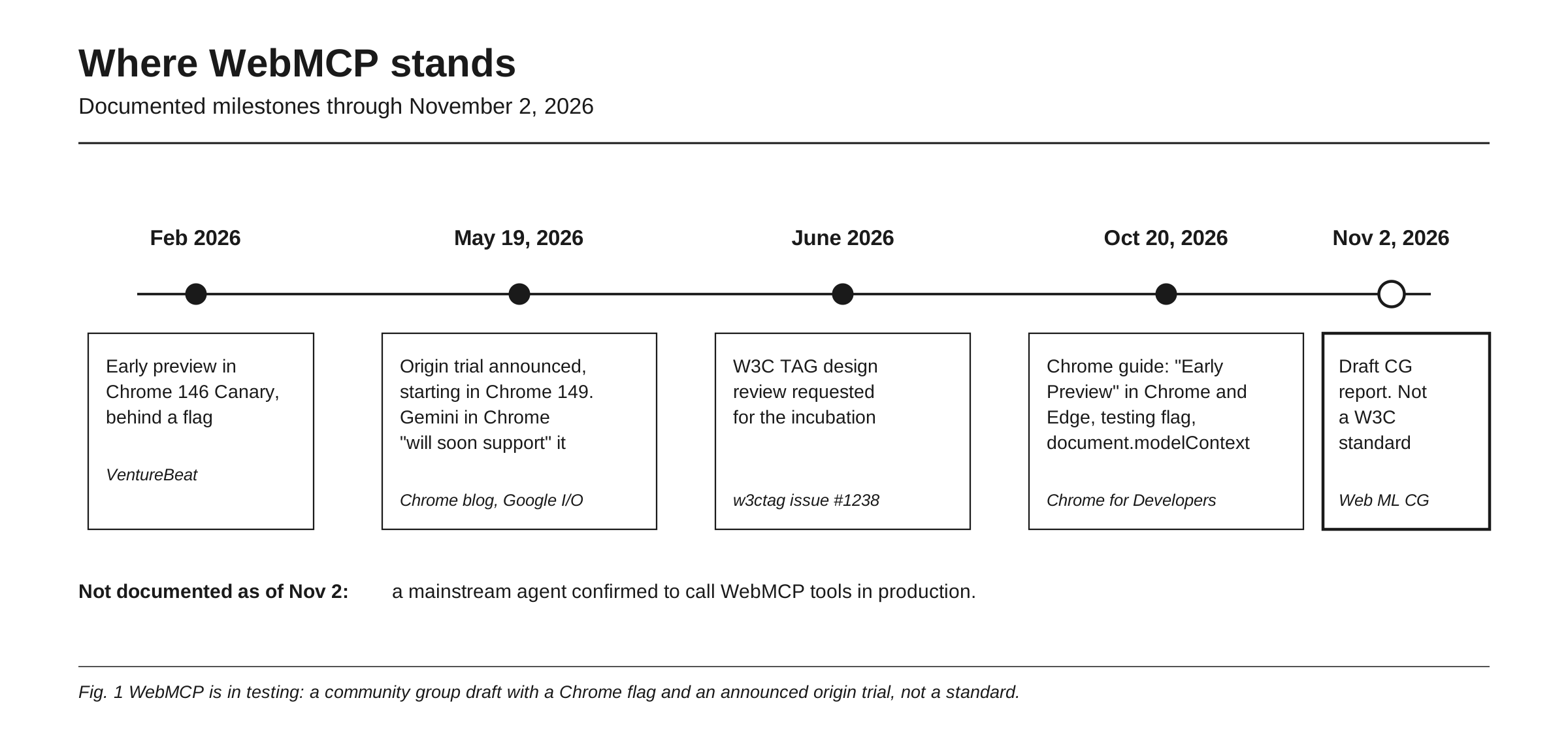
The milestones so far:
- February 2026. VentureBeat reported an early preview in Chrome 146 Canary behind a flag, describing WebMCP as “developed jointly by engineers at Google and Microsoft.”
- May 19, 2026. At Google I/O, the Chrome team wrote that “the experimental WebMCP origin trial starts in Chrome 149” and that Gemini in Chrome will soon support it.
- June 2026. A request for a W3C Technical Architecture Group design review of the incubation was filed.
Scope matters. The guide says WebMCP “only supports Tools,” with no Resources or Prompts, and is not a backend server. It works only on HTTPS. And per VentureBeat’s summary of the proposal, “headless and fully autonomous scenarios are non-goals”: it is built for an agent working alongside a person in a visible tab.
One naming trap: early coverage, including PPC Land in May 2026, describes the API as navigator.modelContext, while Chrome’s current guide and the November draft use document.modelContext. Check the date on any sample code you copy.
WebMCP vs MCP servers, llms.txt and Agent2Agent
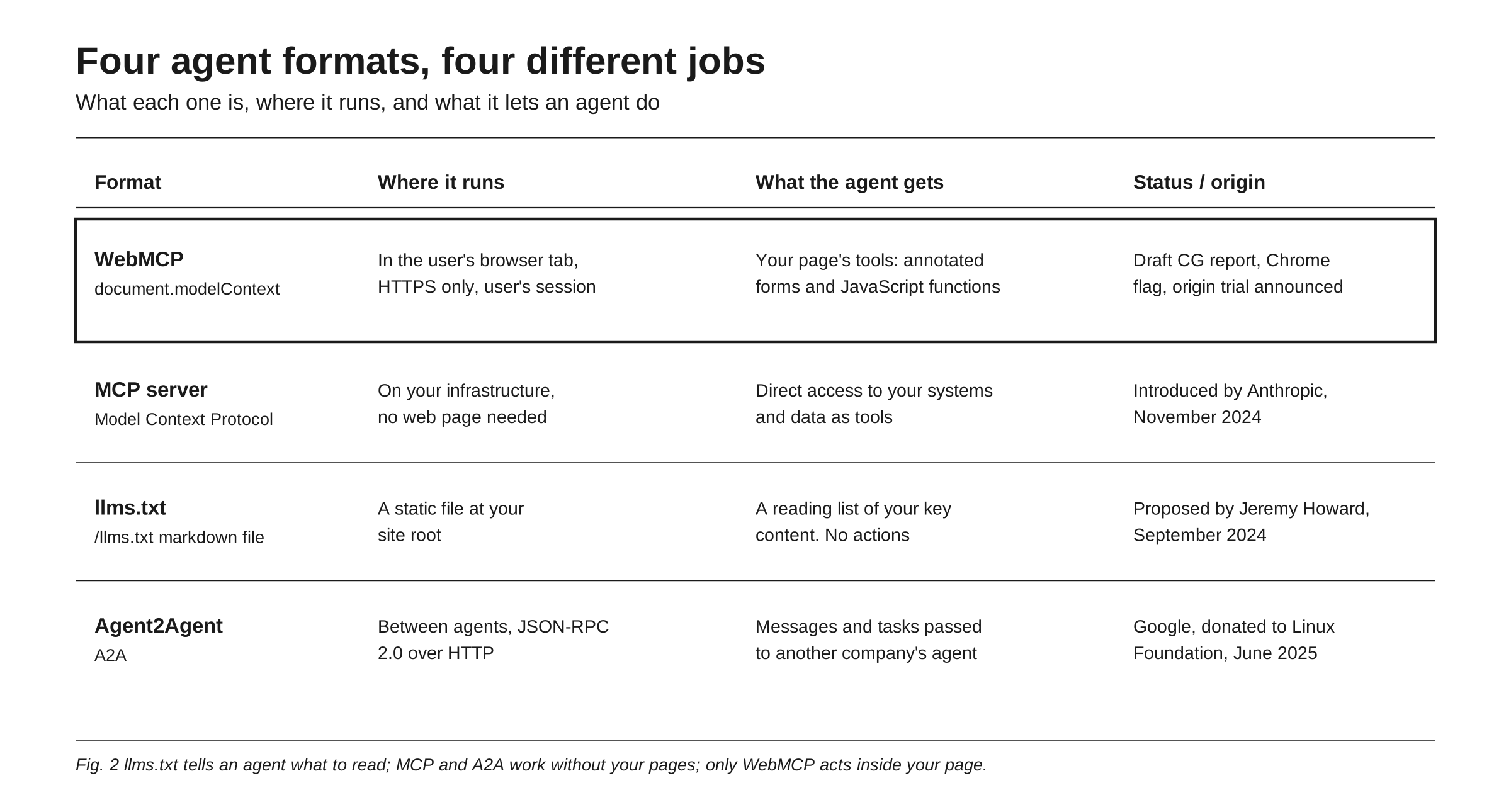
MCP servers. Anthropic introduced the Model Context Protocol in November 2024 as a way to connect LLM applications to external systems. A remote MCP server runs on your infrastructure and an AI client connects to it directly; no web page needs to be open. WebMCP borrows the idea of a tool, but Chrome’s guide says it is not a backend server and uses no HTTP, SSE or stdio transport.
llms.txt. Jeremy Howard proposed it on September 3, 2024: a markdown file at /llms.txt that points language models to your most useful content. It describes content and offers no actions.
Agent2Agent (A2A). Google donated A2A to the Linux Foundation in June 2025. It carries messages between AI agents as JSON-RPC 2.0 over HTTP, and Google says it is designed to complement MCP. It matters if you run your own agent that has to talk to other agents, not for making your pages usable.
In our framing: llms.txt tells an agent what to read, an MCP server lets an agent work with your systems without a browser, A2A lets your agent talk to another company’s agent, and WebMCP lets an agent inside the user’s browser call your page’s own functions with the user’s session. Commerce has its own track too: Google said in January that Chrome will support the Universal Commerce Protocol, the checkout layer behind Google’s Universal Cart.
How browsing agents use your site today
Without WebMCP, agents work the way a careful new user would: read the rendered page, pick an element, click or type, check what happened, repeat. The main ones as of November 2, 2026:
- ChatGPT Atlas. Launched October 21, 2025 on macOS, with agent mode for Plus, Pro and Business users. OpenAI’s publisher FAQ says Atlas uses ARIA tags, the labels and roles that support screen readers, to interpret page structure and interactive elements, and asks sites to “follow WAI-ARIA best practices by adding descriptive roles, labels, and states to interactive elements.”
- Gemini in Chrome. Auto browse began rolling out on January 28, 2026 in preview for US Google AI Pro and Ultra subscribers. Google says it is designed to pause and ask for confirmation before tasks like making a purchase.
- Perplexity Comet. Launched July 9, 2025 and made free on October 2, 2025, with an assistant in each tab that Perplexity says can “take any action on your behalf.”
- Claude in Chrome. Anthropic launched it on August 26, 2025 to 1,000 Max plan users and opened the beta to all paid plans on December 18, 2025.
- Meta Muse. In a vendor study, Profound ran 50 prompts from one retail category through one Muse instance and reported that Muse moves through pages using the accessibility tree, does not identify itself, and routes traffic through residential connections. Profound calls the sample small and exploratory. More in how Meta Muse builds its shortlist.
The pattern is consistent: the accessibility tree and your labels are the agent’s map. An icon button with no name, a dropdown built from styled divs, or a modal that traps focus is where a run fails.
What blocks agents is usually deliberate. On September 21, 2026, SiliconANGLE reported that Amazon blocked Muse. Amazon’s terms require agents to identify themselves in their HTTP requests, which, per the report, Muse does not do. In November 2025, Amazon sued Perplexity, alleging in its complaint that Perplexity “purposely configured its CometAI software to not identify the Comet AI agent’s activities.” Perplexity rejected the claims. In August 2026, a federal appeals court overturned an injunction that had barred Comet from Amazon, and the lawsuit continues. Identification is becoming the dividing line: in August 2025 Cloudflare introduced a “signed agents” category for agents whose requests are cryptographically signed, with ChatGPT agent in the first group. CAPTCHAs and aggressive bot rules stop agents by design. That is fine where you mean it and costly on a checkout you want completed. For how agents differ from crawlers, see the five types of AI bots.
The Rankry agent-readiness checklist
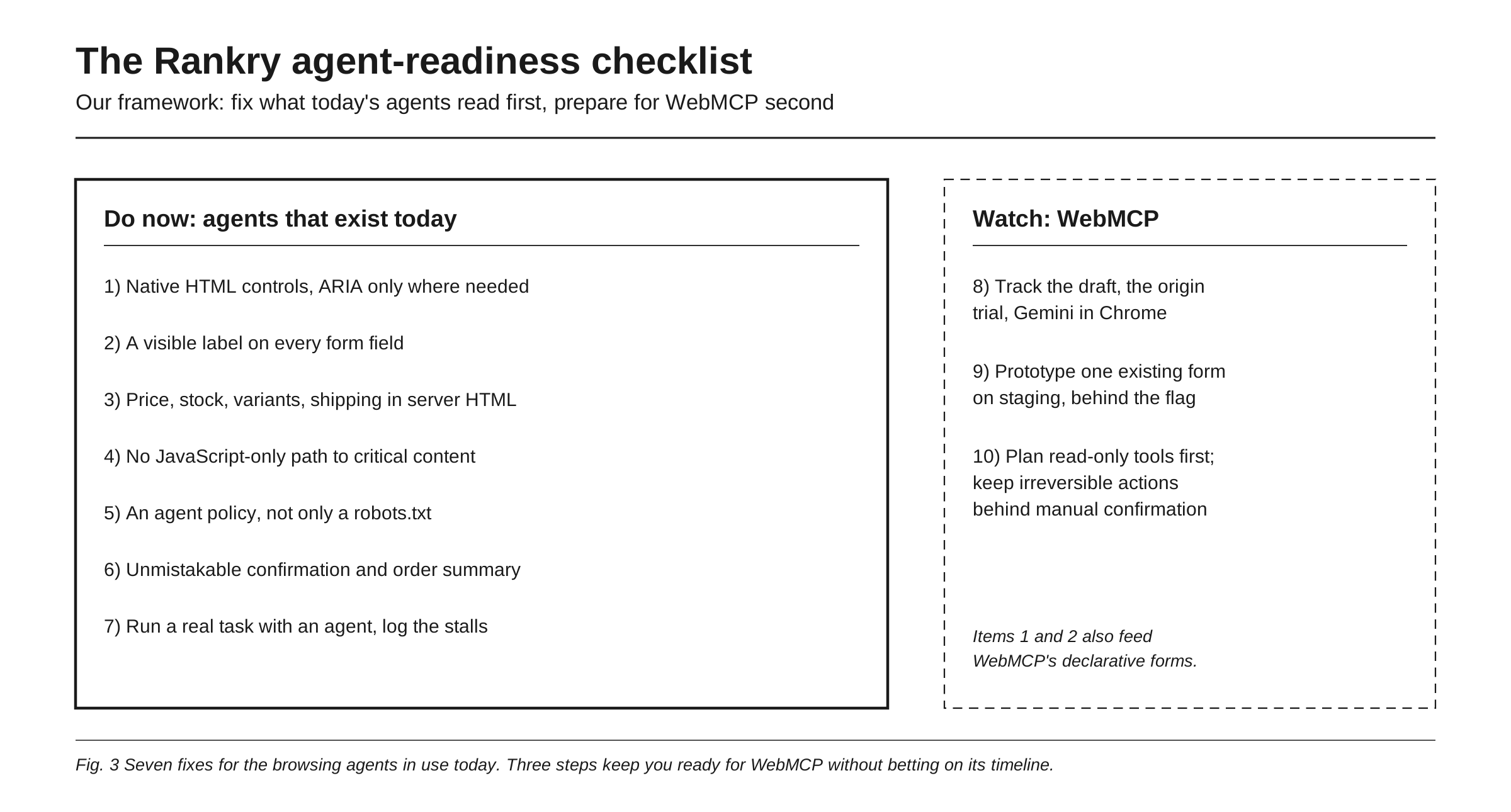
This is Rankry’s framework, not a published standard. Items 1 to 7 help with agents that exist today. Items 8 to 10 are for WebMCP.
Do now
- Use native HTML controls. Real
<button>,<a>,<select>and<input>elements carry roles and states into the accessibility tree for free. Add ARIA roles, labels and states where native elements fall short, which is what OpenAI’s Atlas guidance asks for, not as a layer of keywords. - Label every form field. Each input needs a visible
<label>, clear error text and a standard submit. This helps today’s agents, and WebMCP’s declarative API builds on the same forms. - Put price, stock, variants and shipping in server-rendered HTML. Google’s Merchant Center help says Googlebot reads “the HTML returned from your web server” and that if data is passed with JavaScript after the page loads, “this will trigger an error.” Per PPC Land’s account of the Muse instructions Profound says it captured, a product page “has to show the item is in stock and can be added to a cart.”
- Keep critical content out of JavaScript-only paths. Browser agents render JavaScript, but the crawlers and feeds that shape an agent’s options often read server HTML. Specs, policies and pricing should not depend on hover states or client-side fetches.
- Write an agent policy, not only a robots.txt. robots.txt governs crawlers; agents acting for a logged-in user are a firewall and bot-management decision. Decide which flows agents may use, allow agents that identify themselves where you want the sale, and treat blocking, as Amazon did with Muse, as a deliberate option rather than a default.
- Make confirmation steps unmistakable. Gemini in Chrome and Atlas pause before sensitive actions. A clear order summary with totals, taxes and shipping makes that handoff to the human clean.
- Run a real task with an agent. Ask Atlas, Gemini in Chrome, Comet or Claude in Chrome to find a product, pick a variant and reach checkout. Log every point where it stalls.
Watch
- Track WebMCP’s status. Watch the community group draft, the Chrome origin trial and whether Gemini in Chrome ships support. Re-check before committing roadmap time.
- Prototype on staging. Behind the flag, start with declarative annotations on one form you already have, such as search or store locator. It is the lowest-risk test.
- Plan your tool inventory. List the read-only actions worth exposing first, such as search, availability and order status. Chrome’s guide advises against auto-submitting tools for destructive or irreversible actions unless the user must confirm manually, outside the agent’s control.
How to tell whether agents can use your site
Readiness has two halves: agents need to pick you, and then they need to get through your pages. Rankry covers the first half and part of the second. Its AI traffic tracking shows the visits AI platforms send to your site. The AI Readiness Checker runs 36 checks in 6 categories on your site’s AI readiness. And Rankry’s prompt tracking shows whether ChatGPT, Claude, Gemini, Perplexity, Grok and Google AI Mode name your brand on buyer-intent prompts, every day, next to competitors, which is where an agent’s shortlist starts. Rankry does not test WebMCP tools or run agents through your checkout, so pair it with item 7 above. For a commerce-specific pass, use an agentic commerce readiness check.
FAQ
What is WebMCP? WebMCP is a proposed browser API that lets a web page register tools for AI agents, either by annotating HTML forms or by registering JavaScript functions through document.modelContext. The agent calls a tool with structured inputs instead of clicking through the interface, and the page’s own code runs in the user’s tab. It is incubated in the W3C Web Machine Learning Community Group.
Is WebMCP a W3C standard? No. The draft dated November 2, 2026 says it is not a W3C Standard and is not on the W3C Standards Track. It is a draft community group report with editors from Microsoft and Google. Chrome calls its implementation an early preview, available behind a testing flag, and announced an origin trial starting in Chrome 149.
Do ChatGPT Atlas or Gemini in Chrome use WebMCP today? We found no announcement that either uses WebMCP in production as of November 2, 2026. In May, Google said Gemini in Chrome will soon support WebMCP APIs. OpenAI’s publisher guidance for Atlas does not mention WebMCP; it asks sites for descriptive ARIA roles, labels and states, so accessible markup and standard forms are what to fix first.
Is WebMCP the same as an MCP server? No. An MCP server runs on your infrastructure and AI clients connect to it directly, with no web page involved. Chrome’s guide says WebMCP is not a backend server and uses no HTTP, SSE or stdio transport. It runs in the browser tab, supports tools only and works only over HTTPS.
Should I block AI browsing agents? It depends on the flow. Amazon blocked Meta’s Muse, whose requests do not identify it as an agent as Amazon’s terms require, and sued Perplexity over its Comet agent, a case still in court. If you want agents to complete purchases, allow agents that identify themselves, such as those Cloudflare classifies as signed agents, and keep CAPTCHAs off the paths you want completed.
Sources
- WebMCP (Web Model Context Protocol), Chrome for Developers, last updated October 20, 2026
- WebMCP, Draft Community Group Report, W3C Web Machine Learning Community Group, November 2, 2026
- Google Chrome ships WebMCP in early preview, turning every website into a structured tool for AI agents, VentureBeat, February 12, 2026
- 15 updates from Google I/O 2026: Powering the agentic web with new capabilities, tools, and features in Chrome, Chrome for Developers, May 19, 2026
- Chrome 149 origin trial puts WebMCP in developers’ hands at last, PPC Land, May 20, 2026
- [w3ctag/design-reviews] Incubation: WebMCP (Issue #1238), public-webapps-github archive, W3C, June 2026
- Anthropic open-sources protocol for connecting AI models to datasets and tools, SiliconANGLE, November 25, 2024
- The /llms.txt file, Jeremy Howard, llmstxt.org, September 3, 2024
- Google donates Agent2Agent Protocol to the Linux Foundation, SiliconANGLE, June 24, 2025
- The new era of browsing: Putting Gemini to work in Chrome, Google, January 28, 2026
- OpenAI launches ChatGPT Atlas browser with embedded AI agent, SiliconANGLE, October 21, 2025
- Publishers and developers FAQ (ChatGPT Atlas), OpenAI Help Center, n.d. (accessed November 2026)
- Perplexity releases Comet browser globally at no cost after three-month limited rollout, PPC Land, October 3, 2025
- Claude in Chrome release notes, Anthropic, accessed November 2026
- The era of personal agents: Muse and Instinct, Allison Huang, Profound, October 2, 2026
- Meta’s shopping agent must fill its top 5 picks with well-known merchants, PPC Land, October 11, 2026
- Amazon blocks Meta’s Muse agent from shopping on users’ behalf, SiliconANGLE, September 21, 2026
- Amazon Sues Perplexity Over ‘Agentic’ Shopping Tool, Reuters via Insurance Journal, November 5, 2025
- Court lets Perplexity’s AI agent shop on Amazon, overturning a ban, The Next Web, August 5, 2026
- The age of agents: cryptographically recognizing agent traffic, Cloudflare, August 28, 2025
- How to fix: Mismatched product price, Google Merchant Center Help, n.d. (accessed November 2026)
See whether AI engines name your brand before an agent ever opens your product page, and whether AI platforms already send you visitors. Start a free 7-day Rankry trial, no card.