An AI visibility report card is a one-page monthly summary that shows a local business how often AI assistants name it for its customers’ questions, which sources those assistants rely on, and the three fixes most likely to move the numbers. It sells because the gap is real and usually unseen: in BrightLocal’s September 2026 study of about 200,000 localized prompts, ChatGPT mentioned a tracked business in 33% of searches, against 66% for Google Maps, and named an average of 4.1 businesses per answer. It renews because answers keep moving: ChatGPT’s result sets overlapped by only 23% on average between repeat searches. A credible card reports mention rates across repeated runs, shows positions as ranges, ties each fix to a specific source such as Yelp or Bing Places, and never promises a ranking. Below are Rankry’s template, the data behind each row, and a monthly workflow.
Owners think they are covered. In BrightLocal’s October 2026 survey of 1,002 US small business owners, 84% were confident customers can easily find them online, and 54% said they had checked and were confident they appear in AI results. A report card replaces that confidence with a count.
Why local clients need a separate AI scorecard
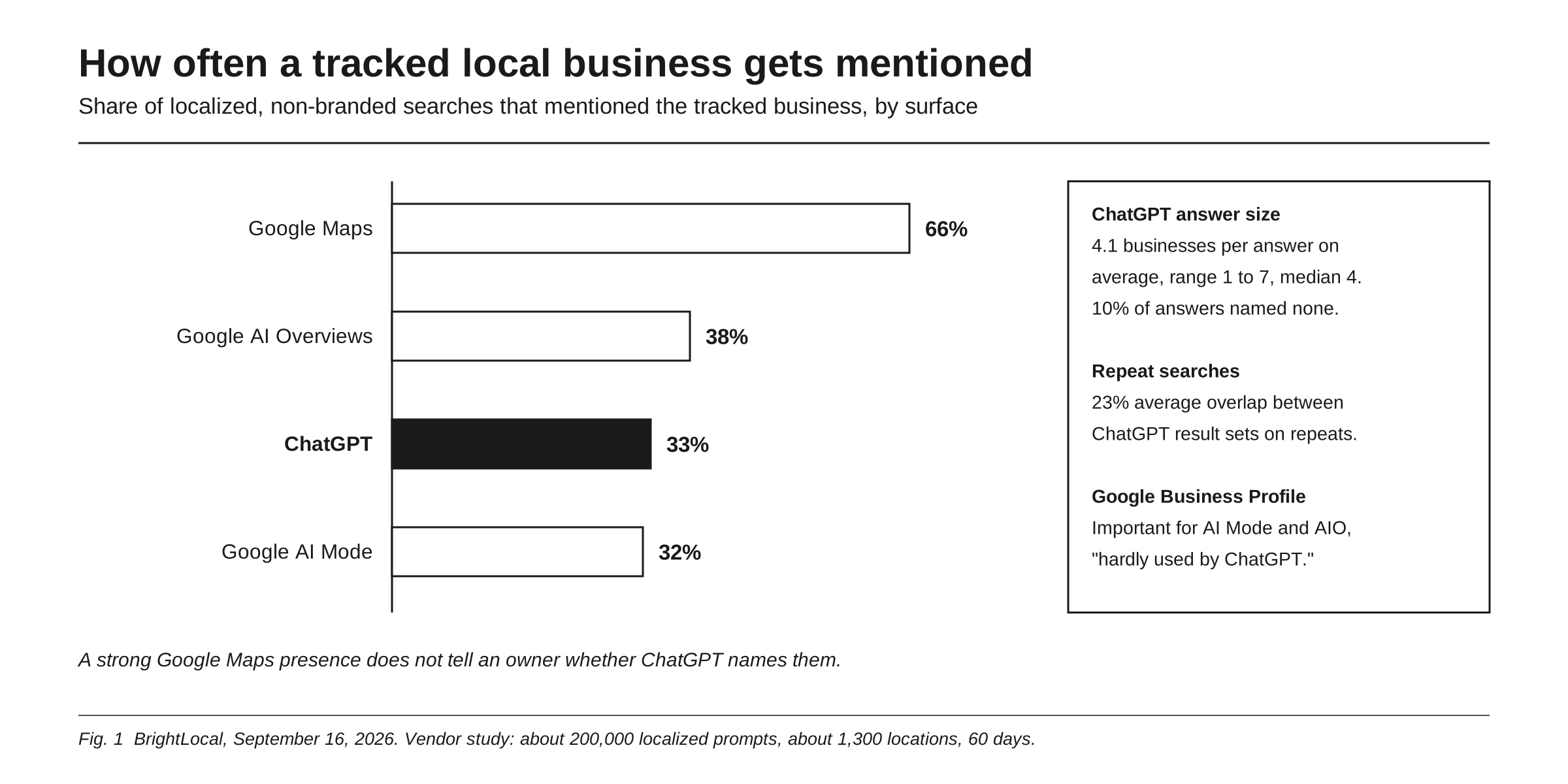
A map pack report does not answer the new question. BrightLocal, which sells a local AI visibility tracker, ran about 200,000 non-branded, localized prompts for roughly 1,300 business locations over 60 days on ChatGPT, Google AI Mode and AI Overviews. A tracked business was mentioned in 66% of Google Maps searches, 38% of AI Overview searches, 33% of ChatGPT searches and 32% of AI Mode searches.
Answers are short: ChatGPT named 4.1 businesses per response on average (range 1 to 7), and 10% named none. SOCi’s 2026 Local Visibility Index, a vendor press release covering more than 350,000 locations of 2,751 multi-location brands, put the gap more sharply: ChatGPT recommended 1.2% of locations, while the average appearance rate in Google’s local 3-Pack was 35.9%. The press release describes no query method, and SOCi studied chain locations, not independent dentists or plumbers, so read it as direction, not a benchmark.
A strong map position does not tell an owner whether ChatGPT names them. The general local playbook is in our local AI visibility guide; the report card is how an agency measures it monthly.
Each engine reads different sources, so the card splits them
A single “AI score” hides the most useful finding: the engines read different places. BrightLocal found that Google Business Profile made up 28.5% of all citations across the three platforms it tested, yet stated that while it “is important for AI Mode and AIO, it’s hardly used by ChatGPT.” It added that “ChatGPT’s relationships with Yelp and Bing mean it’s surfacing slightly different businesses.”
Steady Demand, a local SEO agency, ran 2,880 prompts across 12 US metros and 12 verticals in one 72-hour window in August 2026. Yelp appeared in the structured grounding attached to ChatGPT’s business cards on 95.83% of runs, while its visible-citation figure was only 1.04%. That fits the licensing deal Axios reported on July 23, 2026, under which Yelp licenses “reviews, photos and other business information” to OpenAI. Steady Demand calls this a single snapshot and advises rechecking partnership-dependent claims.
So the listing and review rows need a column per platform: a dentist with deep Google reviews and a neglected Yelp page can look healthy in Google’s AI surfaces and weak in ChatGPT. And the cited-sources row cannot rely only on visible links, since grounding data may never appear as a citation. The retrieval mechanics are in our breakdown of how ChatGPT searches a town.
The report card template (Rankry’s framework)
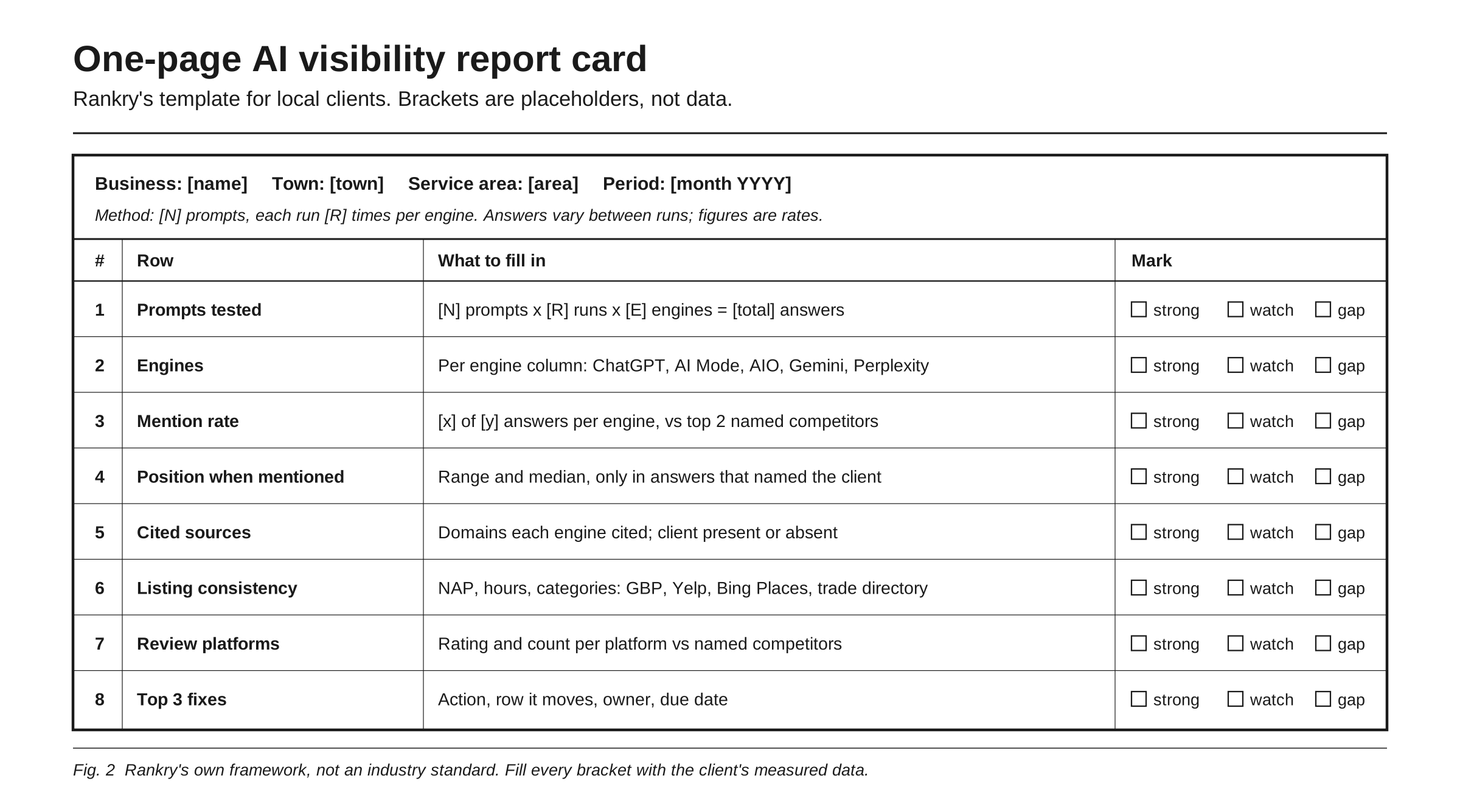
This is our framework, not an industry standard. Every bracket is a placeholder for the client’s measured data.
The header carries business, town, period and a method note: “[N] prompts, each run [R] times per engine, [dates]. AI answers vary between runs; figures are rates, not fixed positions.” Then eight rows:
- Prompts tested. The fixed list, with the town in the text, such as “best emergency plumber in [Town].” Show the arithmetic: [N] prompts x [R] runs x [E] engines = [total] answers.
- Engines. One column per engine customers use, such as ChatGPT, AI Mode, AI Overviews, Gemini and Perplexity. Never merge them.
- Mention rate. “[x] of [y] answers” per engine, beside the two competitors named most. This is the headline.
- Position when mentioned. Range and median, counted only in answers that named the client. Never a single “rank.”
- Cited sources. Domains each engine cited, marked present or absent for the client.
- Listing consistency. Name, address, phone, hours and categories on Google Business Profile, Yelp, Bing Places and the trade’s key directory, each marked match or mismatch.
- Review platforms. Rating and count per platform, against the named competitors.
- Top 3 fixes. Each tied to the row it should move, with an owner and a date: “Complete Yelp categories and service area (rows 6, 7), owner [name], due [date].”
Mark each row strong, watch or gap. Letter grades imply precision a few dozen answers cannot support.
How to show variability honestly
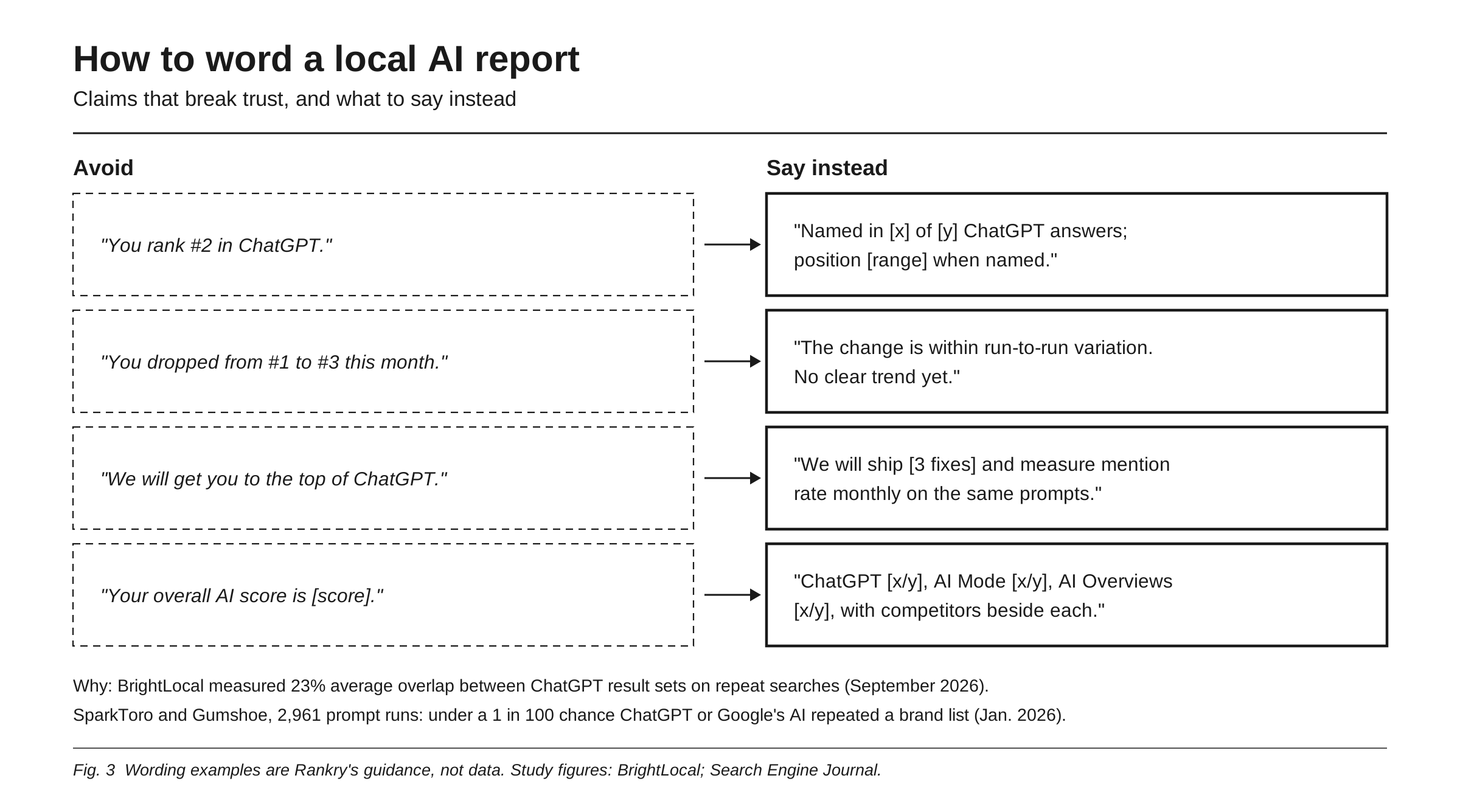
The fastest way to lose a client’s trust is a ranking that vanishes next week. BrightLocal measured 23% average overlap between ChatGPT result sets on repeat searches, although a business that appeared once came back in about half of later attempts. SparkToro and Gumshoe, a company that sells AI tracking tools, ran 12 brand recommendation prompts, not local-specific, 60 to 100 times per platform, 2,961 prompt runs in all, and found a less than 1 in 100 chance that ChatGPT or Google’s AI returned the same brand list across repeated runs. The researchers said visibility percentage across many runs is more consistent than ranking position.
Four reporting rules follow:
- Show the denominator. “Named in [x] of [y] ChatGPT answers” is honest; a bare percentage hides the sample.
- Call small moves noise. A shift of one or two answers is “no clear change.”
- Report position as a range. A median across many answers beats the best screenshot.
- Put the no-guarantee line in writing. Google’s own guidance says “No one can guarantee a #1 ranking on Google.” Commit to work and measurement, not placements.
Using the card to win, and keep, the retainer
Demand exists. In AgencyAnalytics’ 2026 benchmarks, a February to April survey of 494 agency professionals (all agency types, not local agencies specifically) by a company that sells agency reporting software, 66% reported increased client demand for AEO/SEO for AI search, and 41% reported new challenges measuring ROI. Only 11% named AI-driven search results as a source of new business for the agency itself. Tracking is becoming expected: 92% of the 171 search professionals in SEOFOMO’s August 2026 survey track AI visibility and citations, up from 78% in the 2025 edition.
As a sales tool, the first card audits the prospect and two named competitors on the prospect’s own prompts. It persuades because it is specific: which competitor gets named, on which engine, from which source. If the prospect already appears often, say so; a card that always shows a crisis stops being believed.
As a deliverable, the card makes the retainer visible. The risk is giving it away. Lauren Edvalson, CEO of Edvalson Marketing, told AgencyAnalytics her agency has been seeing “an increase in demand for AI reporting, strategy, and implementation at no additional charge.” Write the card and the fixes into the scope.
A pricing note: we found no published pricing for local AI visibility report cards as of November 1, 2026. The nearest public anchor is a July 2026 playbook from Getspotted, an AI citation data vendor, whose suggested US price table starts monitoring retainers at $1,500 a month for up to 50 keywords in one country with monthly reporting. It gives no sample size or method and covers general GEO, not local work. Packaging options are in our guide to how agencies package and price GEO, and the go-to-market playbook is in AI visibility for agencies.
The monthly report card workflow
Our recommended process:
- Month zero: lock the prompt set. Agree a small fixed set, for example 10 to 20 prompts across core services and towns, phrased the way customers ask. Log any change.
- Choose the engines customers use, and keep the list stable.
- Run every prompt repeatedly on a fixed schedule, recording the run count.
- Score the visibility rows for the client and the two top competitors.
- Audit sources, listings and reviews across Google Business Profile, Yelp, Bing Places and the vertical directory.
- Pick three fixes that touch a source an engine demonstrably uses: a thin Yelp profile, a wrong phone number on Bing Places, a missing service and town page.
- Write one paragraph: what changed, what is run-to-run noise, what ships next.
- Review in 15 minutes and log what shipped, so later changes can be linked to work, cautiously.
Rankry handles the prompt tracking in steps 3 and 4 and the cited-sources check in step 5. It runs a stable set of buyer-intent prompts every day across ChatGPT, Claude, Gemini, Perplexity, Grok and Google AI Mode and AI Overviews, showing for a prompt with the town written in, like “best emergency plumber in [Town],” whether the client is mentioned, where it ranks, how it compares with the competitors you add, and which sources each engine cited. New prompts are answered as soon as you add them, AI traffic tracking shows the visits AI platforms send to the client’s pages, and the AI Readiness Checker runs 36 checks in 6 categories. On Pro, a custom report exports to PDF, ready to send.
FAQ
What is an AI visibility report card? A one-page monthly summary showing, per AI engine, how often a business is named on a fixed set of local prompts, where it appears when named, which sources the engines cite, how consistent its listings and reviews are, and the top three fixes. It reports rates across repeated runs, not single screenshots.
How many times should each prompt be run? There is no published standard, but one run is never enough. BrightLocal found only 23% overlap between ChatGPT result sets on repeat searches. Run each prompt several times per engine every month, keep the count constant, print the denominator on the card, and treat small changes as noise.
Can an agency guarantee a client will be recommended by ChatGPT? No. Google states that no one can guarantee a #1 ranking on Google, and AI answers vary from run to run: a SparkToro and Gumshoe study found a less than 1 in 100 chance that ChatGPT or Google’s AI returned the same brand list across repeated runs. Commit to specific fixes and honest measurement instead.
Does Google Business Profile matter for AI visibility? It depends on the engine. In BrightLocal’s 2026 study, Google Business Profile made up 28.5% of citations across the three platforms tested and matters for AI Mode and AI Overviews, but BrightLocal says it is hardly used by ChatGPT. Steady Demand found Yelp in the grounding behind ChatGPT’s business cards on 95.83% of runs. Keep every profile accurate.
How much should a local agency charge for an AI report card? We found no published pricing for local AI report cards as of November 2026. The closest public anchor is Getspotted’s suggested $1,500 a month for starter-level GEO monitoring, a vendor figure with no stated sample and not specific to local work. Price it against your local SEO retainer and write it into scope.
Sources
- Study: AI local search data, BrightLocal, September 16, 2026
- 65% of small businesses are working on AI visibility, but are they overlooking the channels that feed it, BrightLocal, October 21, 2026
- ChatGPT’s Local Results Aren’t Coming From Foursquare (And Probably Never Really Were), Steady Demand, August 21, 2026
- Exclusive: Yelp deal pushes local reviews into ChatGPT, Axios via Yahoo Finance, July 23, 2026
- In AI-Driven Discovery, Few Brands Are Chosen, Most Disappear (2026 Local Visibility Index), SOCi, January 28, 2026
- How AI Search Is Changing SEO for Agencies in 2026, AgencyAnalytics, June 30, 2026
- The State of AI Search Optimization Survey Report 2026, SEOFOMO, last updated September 3, 2026
- AI Recommendations Change With Nearly Every Query: SparkToro, Search Engine Journal, January 30, 2026
- Do you need an SEO?, Google Search Central, last updated June 5, 2026
- How agencies package and price a GEO retainer in 2026, Getspotted, July 12, 2026
Give every local client a monthly report card built on repeated runs, not screenshots. Start a free 7-day Rankry trial, no card required.