Agencies can offer AI visibility monitoring as a productized service using the same engagement structure SEO agencies have run for twenty years: a free shock report to win the pitch, a paid baseline month, a monthly fix retainer built on services you already sell, and a weekly delta report that renews it. The measurement layer runs on a multi-brand tool, Rankry’s Pro plan covers 5 brands at $249 a month ($199 annual) with Enterprise plans above it for larger rosters, so the margin math works from the first client. This guide is the full playbook.
The window matters more than the mechanics: most of your clients’ competitors are not tracking AI visibility yet, which means an agency that offers it now is selling a category, not competing in one. That lasts a year or two at most. Here is how to use it.
Why clients will pay for this
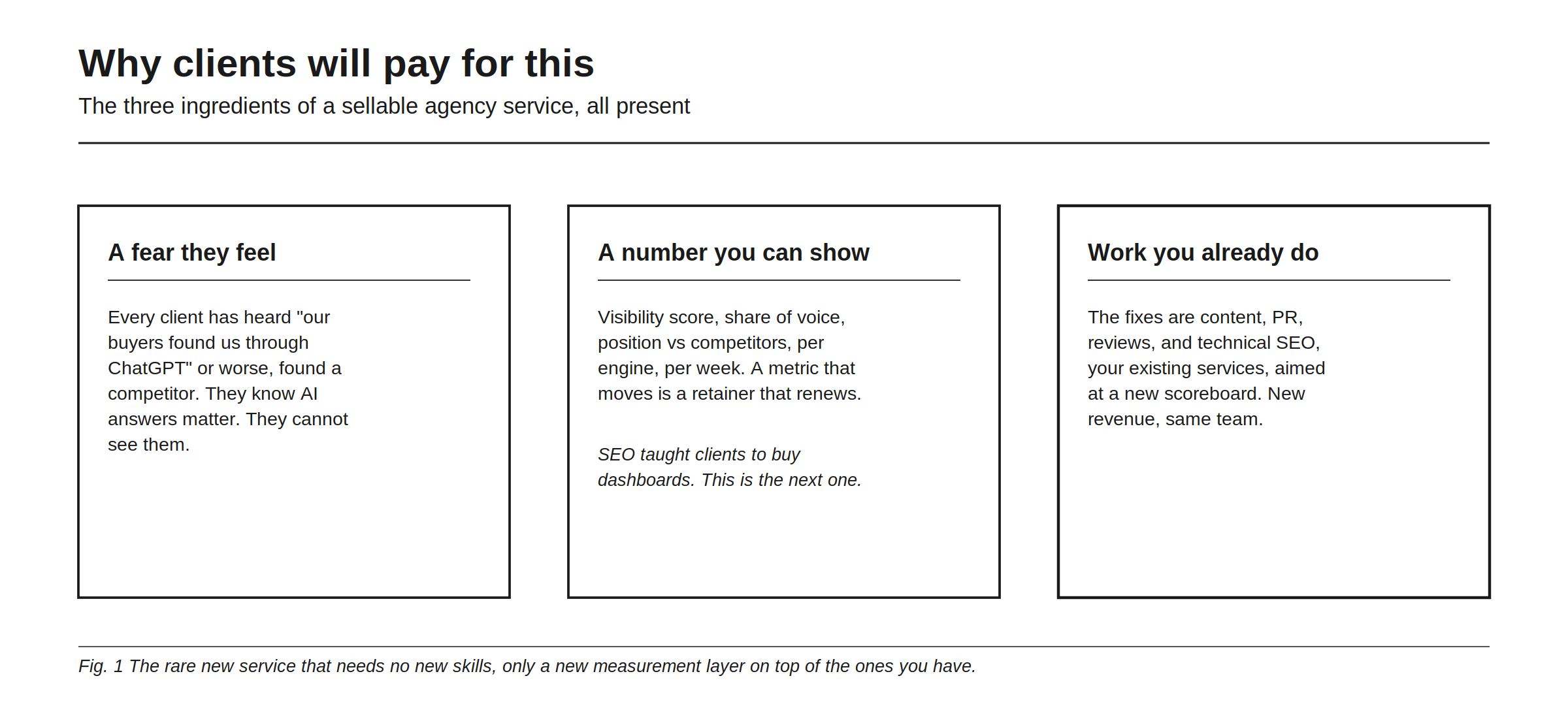
A sellable agency service needs three ingredients, and AI visibility has all of them. A fear the client already feels: every founder and CMO has heard “our buyers found us through ChatGPT”, or worse, watched a prospect arrive quoting a competitor an AI recommended. They know the channel matters and they cannot see into it. A number you can show: visibility score, share of voice, position against named competitors, per engine, per week. SEO trained clients to buy dashboards for twenty years; this is the next dashboard, and a metric that moves is a retainer that renews. And work you already do: the fixes AI visibility demands are content, digital PR, review generation, and technical SEO, your existing service lines pointed at a new scoreboard. It is the rare new revenue line that requires no new hires, only a new measurement layer.
The playbook, four steps
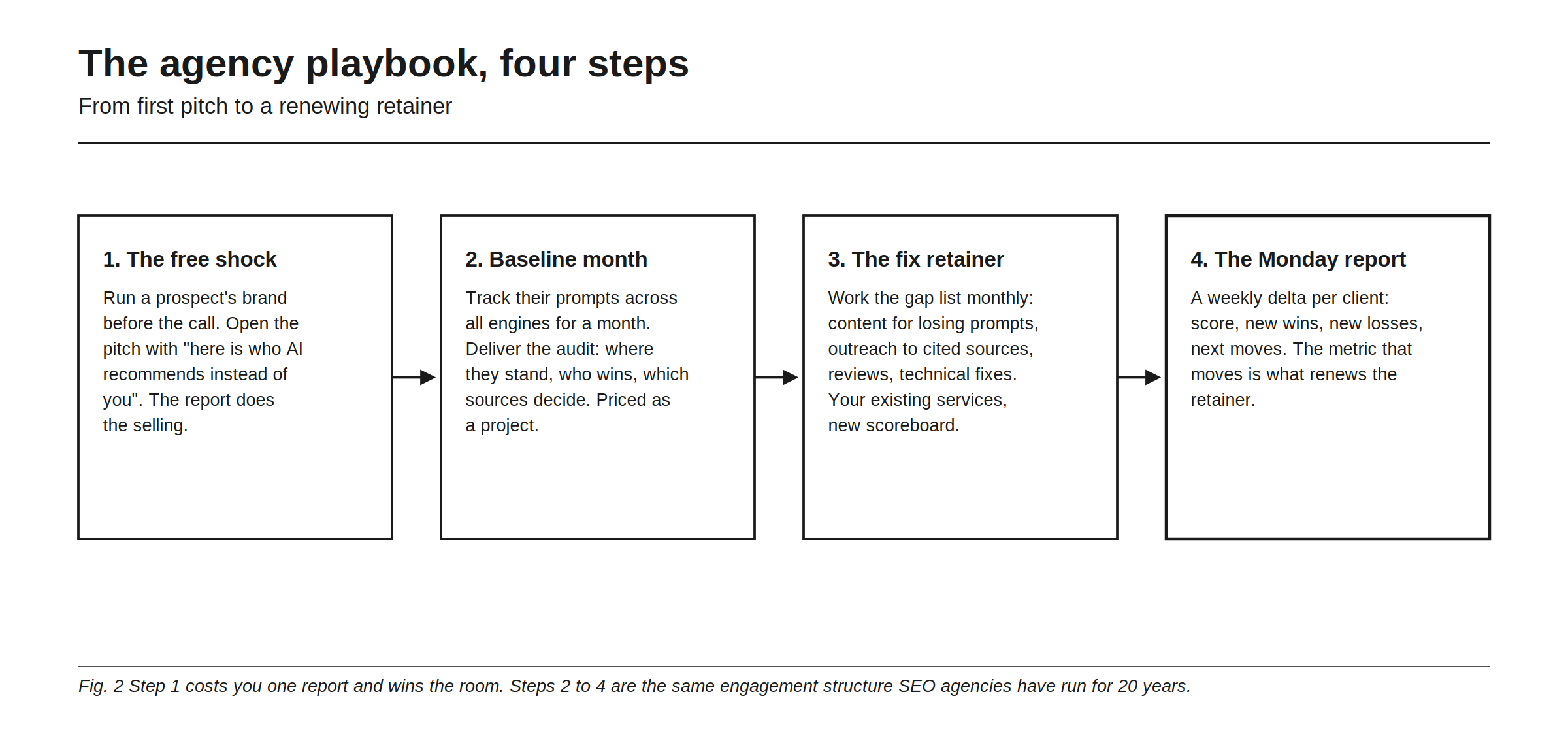
Step 1: the free shock. For clients with physical locations, the near-me version of this check is in local AI visibility. Before the pitch call, run the prospect’s brand through the five engines their buyers actually use, chosen from ChatGPT, Claude, Gemini, Perplexity, Grok, Microsoft Copilot, and Google AI Overviews, on their ten most obvious buyer prompts. Open the meeting with the report: here is who ChatGPT recommends in your category, here is where Claude ranks you, here are the three prompts where your competitor wins and the pages that convinced the AI. This costs you one report and does the selling for you, because nothing you could say lands like the client watching an AI recommend their rival by name. The full checklist for this audit is in how to run an AI visibility audit.
Step 2: the baseline month. Price the first month as a project: track the client’s full prompt set across all engines for four weekly cycles and deliver the audit. Where they stand per engine, who wins each losing prompt, which sources decide the answers, and the prioritized gap list. Four weeks matters because single runs mislead, AI answers vary, and a month of sampling separates their real position from noise.
Step 3: the fix retainer. The gap list from the baseline is the retainer’s backlog, and every item on it maps to a service you already deliver. Losing “best X for mid-market”? Content: a comparison page built answer-first. A rival cited on three listicles where the client is absent? Digital PR and outreach. Sentiment dragged by “expensive” with no pricing page? Positioning work. Thin review presence feeding weak recommendations? Review generation. Blocked bots or JavaScript-only rendering? Technical SEO. You are not learning a new craft; you are re-aiming the one you have. The lever reference for what moves AI answers is in how to improve visibility in ChatGPT.
Step 4: the Monday report. One page per client, weekly: the score and its delta, new wins, new losses, sources gained and lost, and next moves. This report is the retention engine. Clients cancel services they cannot see working; a number that moves weekly, attached to the work that moved it, is the strongest renewal argument an agency has. The underlying weekly loop, what to record and why the delta beats the raw score, is the system we describe in how to monitor your brand across AI search engines.
Pricing that works
Agencies running this today use three models. Monitoring-only: a flat monthly fee for tracking plus the Monday report, the entry product for clients who want eyes before hands. Monitoring plus retainer: the full loop, measurement and fixes, priced like an SEO retainer, this is where the margin lives. And baseline-as-a-door: the audit month sold standalone, converting to the retainer when the gap list makes the case by itself. Whichever model, anchor the price to the client’s deal size, not your hours: if one AI-driven recommendation is worth a five-figure contract to them, visibility into that channel is not a $200 line item.
The tooling and the margin math
The requirement list for an agency tool is specific: multiple brands under one roof, per-client separation, a seven-engine catalogue so each client runs the five that fit their market, white-label-friendly reporting, and evidence you can show a skeptical client. Rankry’s Pro plan covers 5 brands with 100 prompts at $249 a month ($199 annual), which puts the tooling cost per client at $50 a month at capacity, against retainers that start in the hundreds, and Enterprise plans extend brands, seats, and onboarding for larger rosters. The raw AI responses are stored as evidence, which matters the first time a client asks “how do you know this”. Peec AI is the honest alternative to evaluate, built agency-first with unlimited seats and per-client projects at a higher per-prompt cost. Test both against your actual roster on the trials; Rankry’s is 7 days with no card.
The first client is in your book
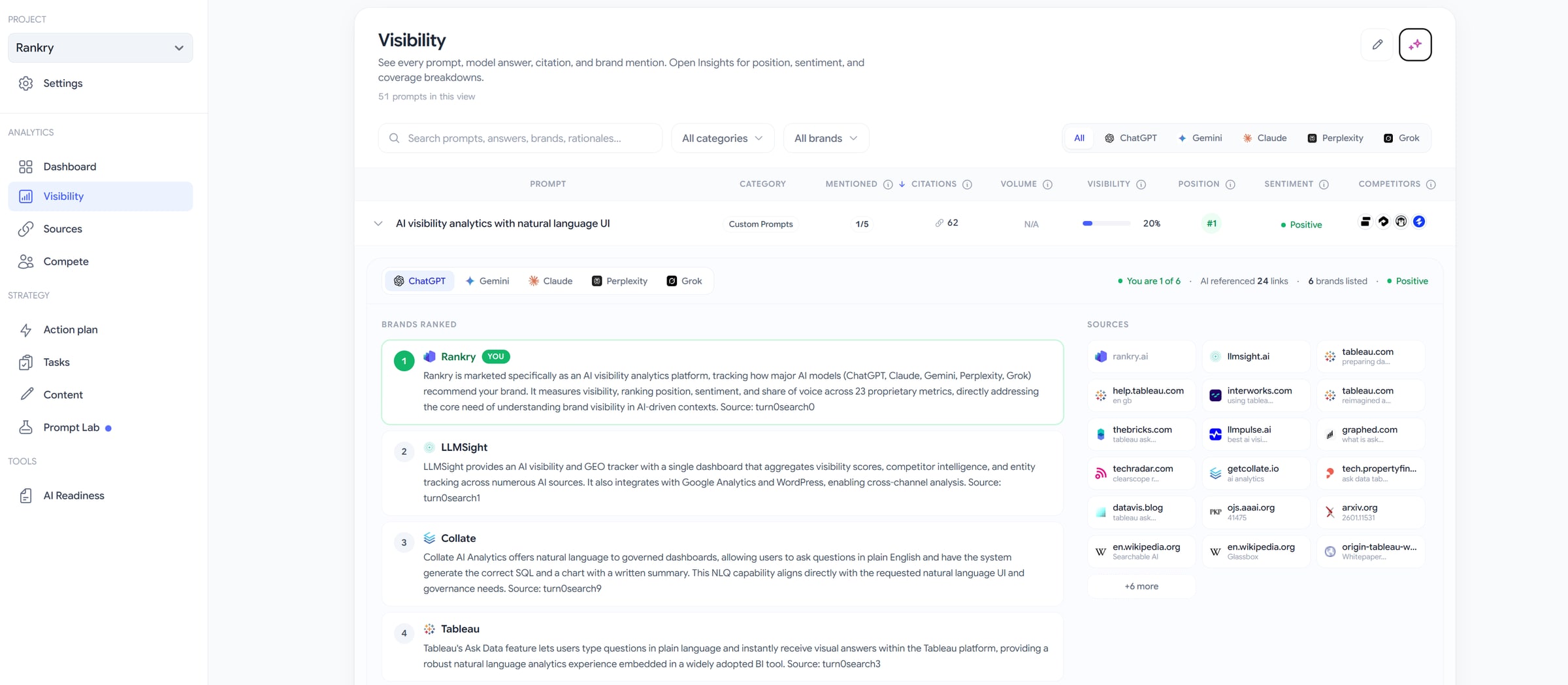
Do not launch this with outbound. Pick the three current clients whose buyers most obviously ask AI for recommendations, B2B SaaS, professional services, considered purchases, run the free shock report on each, and present it inside your existing QBR. In our experience of watching agencies onboard, the conversion moment is always the same slide: the AI recommending the competitor, verbatim, with sources. The service sells itself to people who already trust you; the reports are your case studies for everyone after.
FAQ
How can my agency offer AI visibility monitoring to clients? Productize it in four steps: a free shock report to open the pitch, a paid baseline month tracking their prompts across all engines, a monthly retainer working the gap list with services you already deliver, and a weekly delta report that drives renewal.
What is the best AI visibility tool for digital marketing agencies? Look for multi-brand support, a seven-engine catalogue you can pick from per client, per-client separation, and stored evidence. Rankry’s Pro plan covers 5 brands at $249 a month with a no-card trial; Peec AI is a strong agency-first alternative with unlimited seats at a higher per-prompt cost.
How should an agency price AI visibility services? Three working models: flat monitoring fee, monitoring plus fix retainer (the margin center), or a standalone baseline audit that converts to retainer. Anchor pricing to the client’s deal value, not your hours.
Do agencies need new skills to deliver AI visibility? No, and that is the point. The fixes are content, digital PR, reviews, and technical SEO, existing service lines aimed at a new scoreboard. The only new layer is measurement, which the tooling provides.
Is there a scalable AI visibility solution with a free trial for agencies? Yes. Rankry offers a 7-day trial with no card required, and its Pro tier covers 5 brands for multi-client work, with Enterprise plans above it for larger agency rosters.
Run the shock report on your three best-fit clients this week and watch the service sell itself. Start a free 7-day Rankry trial, no card, multi-brand from the Pro tier, first report in two minutes.