Local AI visibility is getting your business recommended when someone near you asks an AI engine “best [service] near me” or “top [category] in [city]”, and it works differently from national AI visibility because AI applies geographic context and draws on local entity data: business listings, reviews, local citations, and mentions. The path to winning it: nail your listings and NAP consistency, earn genuine local reviews, get onto local third-party pages, add clear location language to your content, and track “near me” prompts from your actual location. It is one of the least contested, highest-intent corners of AI search right now, because most local owners still watch only Google Maps.
If you run a local business and think AI search is a big-company problem, this is the opposite: local is where a small business can win AI recommendations fastest, precisely because so few are trying.
AI recommendations are getting local
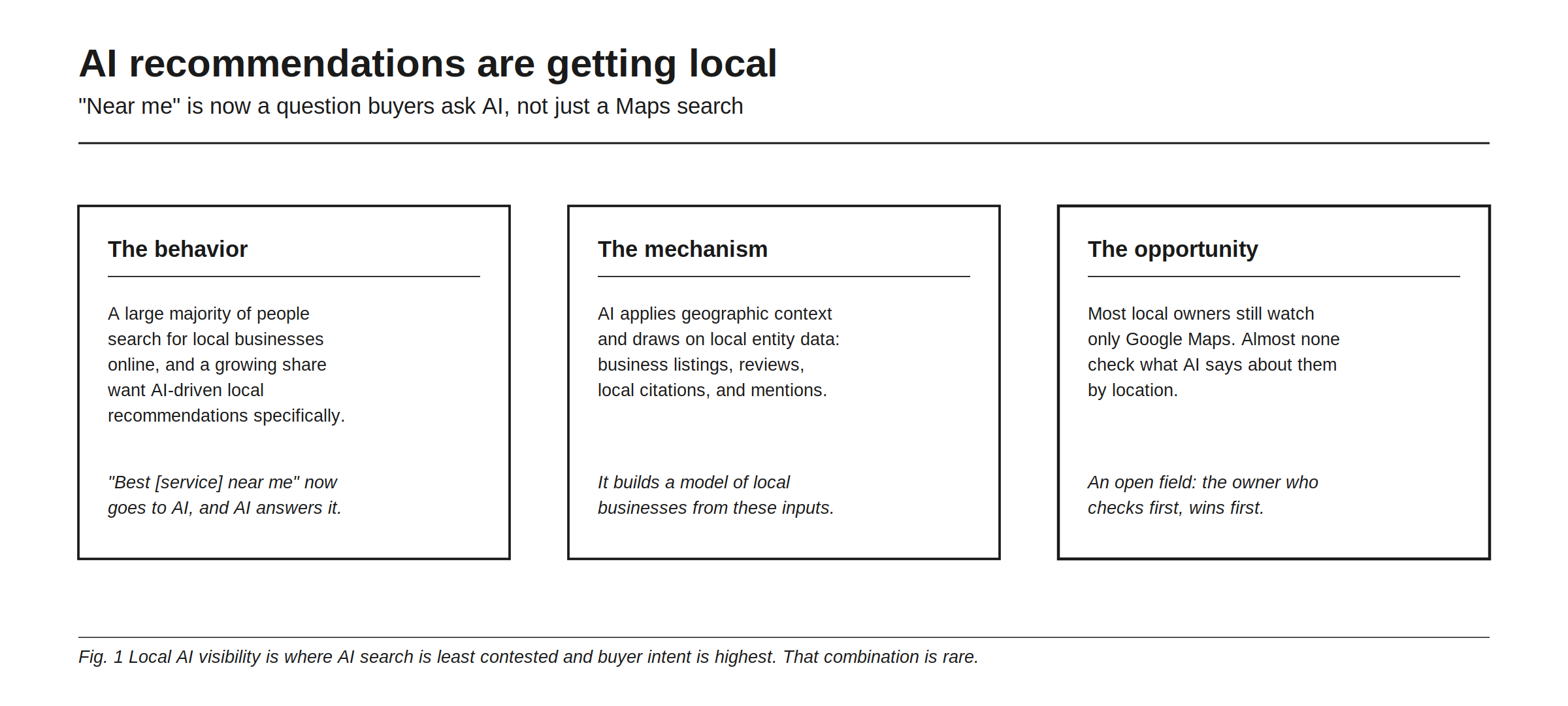
Three things define the opportunity, and note this is the near-me problem specifically: a business with no physical location still sees its ranking change by city, which is geo-variation and a different question. Here, the three: The behavior: local discovery has been online for years, and a growing share of it now starts with an assistant rather than a map, so “best [service] near me” increasingly goes to AI, and AI answers it. The mechanism: AI applies geographic context and draws on local entity data, business listings, reviews, local citations, and mentions, to build a model of local businesses and decide who to recommend. And the opportunity: most local owners still watch only Google Maps, and almost none check what AI says about them by location, which leaves an open field where the owner who checks first wins first.
That combination, least contested and highest intent, is rare in marketing. Local AI visibility has both right now, which is exactly why it is worth moving on before it gets crowded.
The local AI visibility checklist
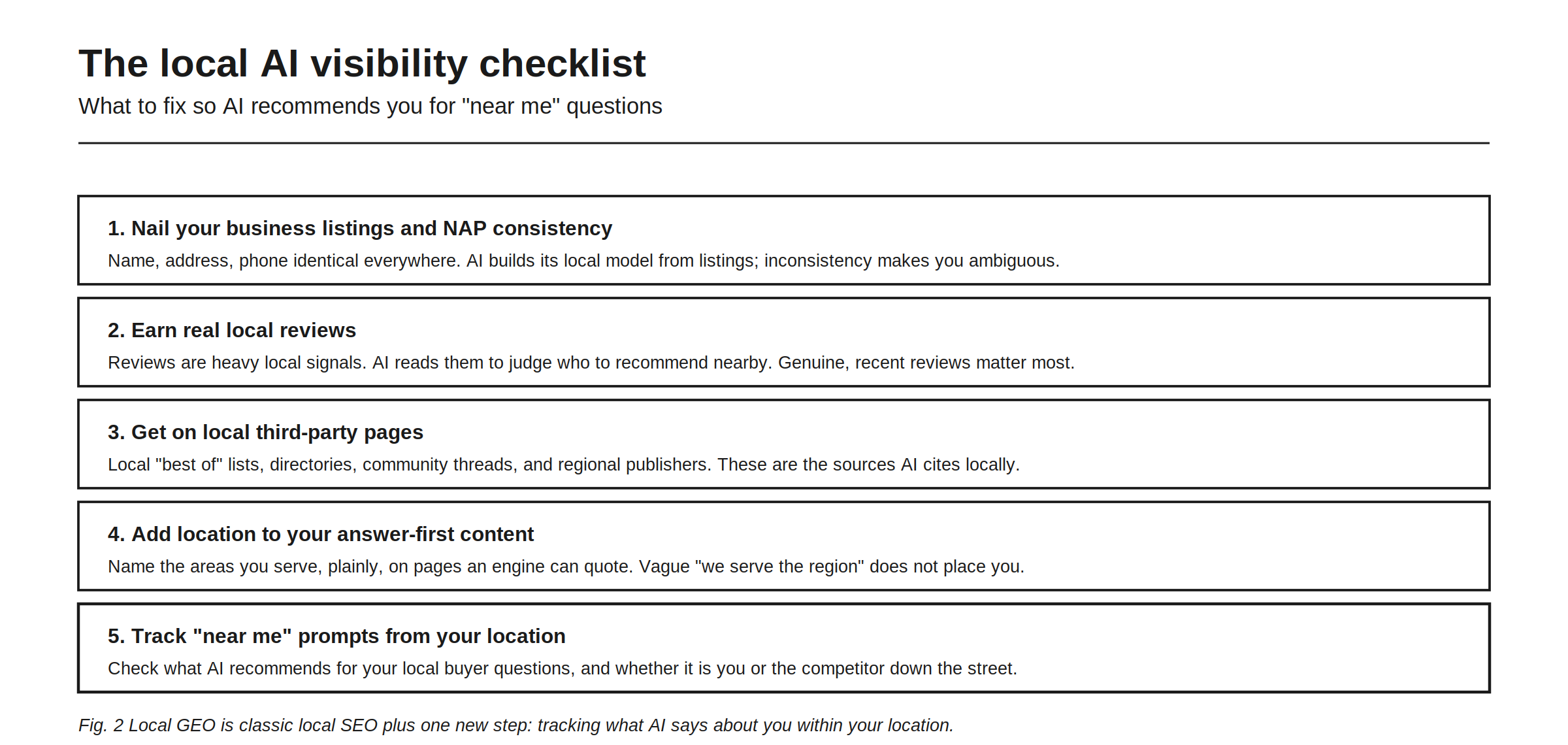
Five moves, most of which build on classic local SEO with one new step at the end. First, nail your business listings and NAP consistency: name, address, and phone identical everywhere, because AI builds its local model from listings and inconsistency makes you ambiguous. Second, earn real local reviews: reviews are heavy local signals AI reads to judge who to recommend nearby, and genuine, recent ones matter most. Third, get on local third-party pages: local “best of” lists, directories, community threads, and regional publishers, because these are the sources AI cites locally. Fourth, add location to your answer-first content: name the areas you serve plainly on pages an engine can quote, because a vague “we serve the region” does not place you. Fifth, track “near me” prompts from your location: check what AI recommends for your local buyer questions, and whether it is you or the competitor down the street.
The first four are recognizable local SEO, and that is good news, the foundation you may already have carries over. The fifth is the genuinely new step, and the one almost nobody is doing.
Why “from your location” matters
Here is the subtlety that trips people up: AI answers are geo-personalized, so what AI recommends near you is not what it recommends near your customer across town or in the next city. Checking “best [service]” from your own screen tells you what you see, not what a buyer three miles away sees. Real local AI visibility tracking checks your buyer prompts as they would appear from the locations your customers are actually in, which is the only way to know whether you are winning your service area or just your own street. This is also why national-only AI visibility tools miss the local picture, they check from one vantage point, not from your customers’.
The community-source angle matters extra here too: local Reddit threads, city subreddits, and regional forums feed local AI answers, so genuine presence there is high-leverage. The method is in how to get cited on Reddit.
Turning it into a system
Local AI visibility is a loop like any other: fix the foundations, track what AI says by location, find the gap (a local list you are missing from, a review deficit, a competitor cited nearby), close it, and re-check. Rankry supports local and geo tracking, so you can see what AI says about your business within your location, whether it recommends you or the local competitors, and which local sources decide it, across all five engines from $99 a month on a no-card trial. That turns “show up near me” from a hope into a tracked, fixable metric. The broader loop is in how to monitor your brand across AI search engines.
FAQ
What is local AI visibility? It is getting your business recommended when someone nearby asks an AI engine “best [service] near me” or “top [category] in [city]”. AI uses geographic context and local entity data, listings, reviews, local citations, to decide who to recommend locally.
How do I get AI to recommend my local business? Keep your business listings and NAP consistent, earn genuine recent reviews, get onto local third-party pages and “best of” lists, add clear location language to your content, and track what AI recommends for “near me” prompts from your location.
Is local AI visibility different from local SEO? It builds on local SEO, listings, reviews, citations, but adds one new step: tracking what AI specifically says about you by location, since AI answers are geo-personalized and differ from what Google Maps shows.
Why do AI results differ by location? Because AI applies geographic context to local queries, so “best [service] near me” returns different businesses depending on where the person is. Checking from your own screen shows your view, not your customer’s across town.
Can a small local business compete in AI search? Yes, often more easily than nationally. Local AI visibility is far less contested, most owners watch only Google Maps, and buyer intent on “near me” queries is high, so consistent listings, real reviews, and local presence can win recommendations fast.
See what AI recommends “near me” from your location, and whether it is you or the shop down the street. Start a free 7-day Rankry trial, no card, first report in two minutes.