Yes: the same prompt, asked from different cities or countries, returns a different ranked list of brands, even when nothing about your product changes. A SKU that leads the answer in one market can be absent in another; a brand that dominates in one country can be missing entirely in the next. This is not the “best near me” local-search problem, that is about physical listings and is covered separately; this is your non-local brand, a SaaS product or an online store with no storefront, being recommended differently depending on where the question is asked. How much answers move depends on the category: money and market-specific categories (payroll, accounting, payments, HR) swing hard, while commodity tools (video conferencing, cloud storage) barely move. The danger is a single national “AI visibility score” that hides this, you can look fine on average and be invisible in the cities you sell in. This guide explains the phenomenon and how to track and fix it.
Most AI visibility measurement reports one number for your brand. That number is a lie of averages if your answers fragment by location, and for a lot of categories, they do.
This is not the “near me” problem
Worth stating up front, because it is easy to conflate. Local AI visibility, the “best plumber near me” question, is about a physical business earning a spot through accurate listings, reviews, and directory presence, and it is a different topic entirely, handled in local AI visibility. Geo-variation is about a brand with no physical dependence on the searcher’s city, a SaaS tool, an e-commerce product, a national service, still getting a different ranked recommendation depending on where the prompt originates. You are not trying to show up on a map. You are discovering that “best CRM for a mid-size team,” an identical, location-neutral question, returns you first in one city and not at all in another. Same product, same prompt, different answer, driven by the location signal the engine attaches to the request.
Same prompt, different city, different answer
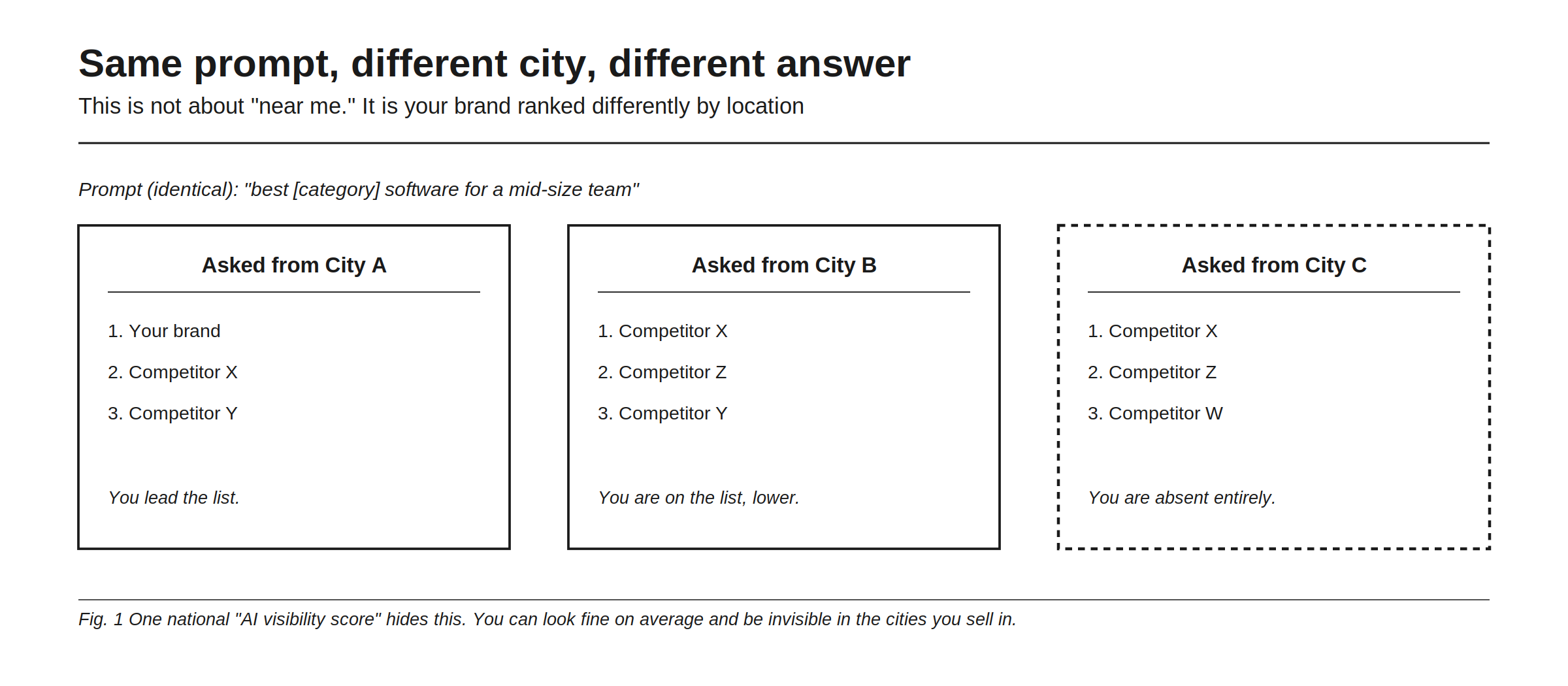
Picture the identical prompt, “best [category] software for a mid-size team,” run from three places. Asked from City A: your brand leads, then Competitor X, then Competitor Y, you lead the list. Asked from City B: Competitor X first, then Z, then Y, you are on the list but lower. Asked from City C: Competitor X, Z, W, you are absent entirely.
One national “AI visibility score” hides this. You can look fine on average and be invisible in the cities you sell in. The variation compounds with the ordinary run-to-run inconsistency of these engines, so any single check is one sample, not a fact, which is why visibility has to be read as a rate across many runs, the measurement logic in where AI actually gets its sources. Add location on top of that, and a one-city, one-run screenshot tells you almost nothing about your real footprint.
How much answers move depends on category
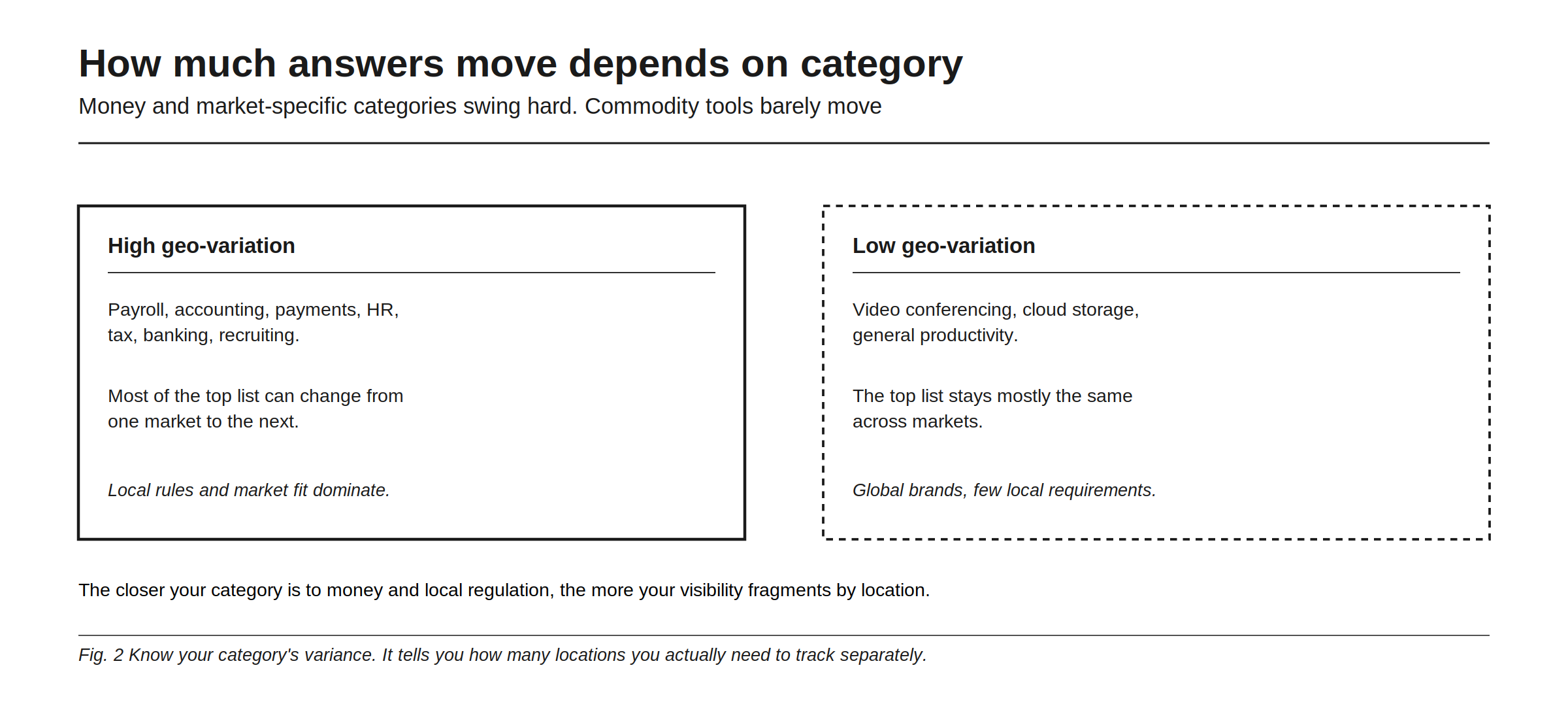
The variance is not uniform. High geo-variation: payroll, accounting, payments, HR, tax, banking, recruiting, where most of the top list can change from one market to the next, because local rules and market fit dominate. Low geo-variation: video conferencing, cloud storage, general productivity, where the top list stays mostly the same across markets, because these are global brands with few local requirements. In the highest-variance categories, nearly the entire top-five recommendation can turn over between markets; in the lowest, it barely moves.
The closer your category is to money and local regulation, the more your visibility fragments by location. Engines also differ from each other in the same city, so two assistants asked the identical local question often agree on only part of the list, which is the cross-engine spread in how AI picks between two nearly identical brands. Know your category’s variance: it tells you how many locations you actually need to track separately, one loose bucket for a commodity tool, a real per-market view for anything close to money.
How to track and fix geo-variation
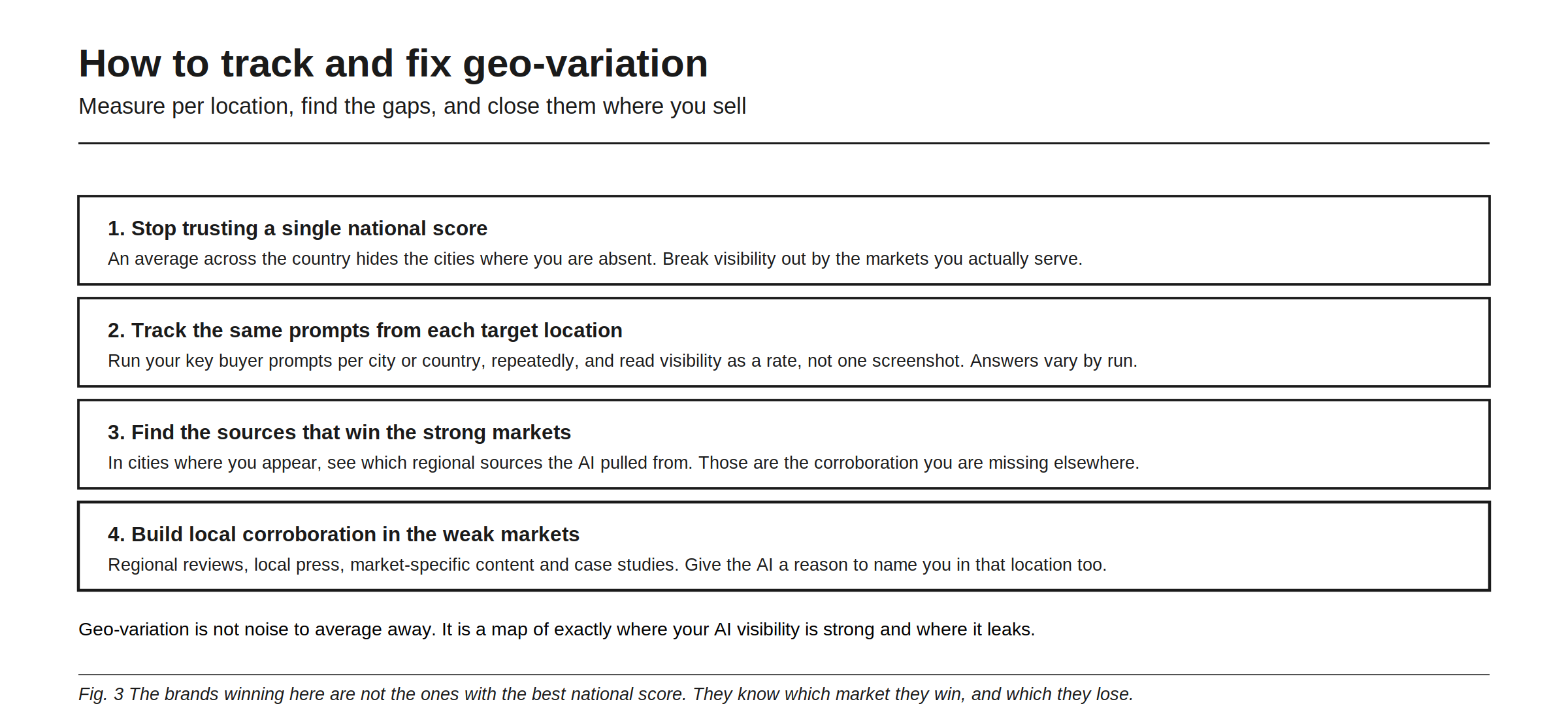
Four moves. First, stop trusting a single national score: an average across the country hides the cities where you are absent, so break visibility out by the markets you actually serve. Second, track the same prompts from each target location: run your key buyer prompts per city or country, repeatedly, and read visibility as a rate, not one screenshot, because answers vary by run, which is why choosing those prompts well matters, per choosing which buyer questions to track. Third, find the sources that win the strong markets: in cities where you appear, see which regional sources the AI pulled from, because those are the corroboration you are missing elsewhere. Fourth, build local corroboration in the weak markets: regional reviews, local press, market-specific content and case studies, giving the AI a reason to name you in that location too.
Geo-variation is not noise to average away. It is a map of exactly where your AI visibility is strong and where it leaks. The brands winning here are not the ones with the best national score; they know which market they win, and which they lose.
Why this is becoming unavoidable
Two things make geo-variation a problem you cannot keep ignoring. First, engines increasingly localize on purpose: some prioritize regional sources heavily, while others default to broad, largely US-centric content regardless of where the user is, so your outcome depends both on the city and on which engine the buyer used, a two-dimensional fragmentation the old “I rank number one, everyone sees me” model never had to handle. Second, the categories with the highest geo-variation, anything touching money, regulation, or local market norms, are exactly the categories where buyers most want a trustworthy, locally-appropriate recommendation, so the engines lean hardest on local signals precisely where it matters most to you. For a brand selling across multiple regions, the practical consequence is that national-level optimization can leave whole markets uncovered while your dashboard shows a healthy average. The fix is not more content in general; it is targeted local corroboration in the specific markets where you are weak, informed by seeing what wins in the markets where you are strong. That is a measurement problem first and a communications problem second, and both are winnable once you can see per-location. Rankry runs your prompts and can surface how visibility differs across the locations you care about, so you can find the markets where you leak and fix them deliberately, from $99 a month on a no-card trial.
FAQ
Do AI assistants give different brand recommendations by location? Yes. The same, location-neutral prompt asked from different cities or countries often returns a different ranked list of brands, even for products with no physical presence. The engine attaches a location signal to the request and weights regionally relevant sources and market fit accordingly.
Is this the same as “best near me” local SEO? No. Local AI visibility is about a physical business earning a spot through listings, reviews, and directories. Geo-variation is about a non-local brand, a SaaS product or online store, being recommended differently by location despite no dependence on the searcher’s city. They are separate problems with separate fixes.
Which categories vary most by location? Categories tied to money and local regulation vary the most: payroll, accounting, payments, HR, tax, banking, and recruiting, where most of the top recommendations can change between markets. Commodity categories like video conferencing and cloud storage vary the least, because they are global with few local requirements.
Why does a single national AI visibility score mislead me? Because it averages away the cities where you are absent. You can post a healthy national number while being invisible in specific markets you sell in. Answers also vary run to run, so a one-city, one-time check is a single sample, not a reliable read. Track per location, as a rate.
How do I improve AI visibility in a specific market? Find which regional sources the AI cites in markets where you already appear, then build the same kind of local corroboration where you are weak: regional reviews, local press, and market-specific content and case studies. Give the engine credible, location-relevant reasons to name you there.
See how your AI visibility differs across the markets you sell in, find where you leak, and fix it deliberately. Start a free 7-day Rankry trial, no card, first report in two minutes.