Choosing which prompts to track is a strategy decision, and the answer is a focused set of 30 to 50 buyer questions, not hundreds. More prompts is not better tracking, because every prompt has to be run many times to produce a reliable number, so a sprawling list is expensive to run, hard to read, and full of low-value noise. Rank your prompts by commercial value: decision-stage questions (“best X for Y,” “X vs competitor”) first, problem-aware questions next, and broad definitional questions (“what is X”) sparingly. Then freeze the set so week-to-week trends mean something, and revise it on a schedule, quarterly or when you launch or reposition, rather than constantly. This guide is about selecting and prioritizing that set. Finding the specific prompts where you should appear but do not is a separate task, covered in how to find the prompts where your brand should appear.
The instinct is to track everything, to feel thorough. In AI visibility that instinct produces a big, noisy, unreadable program that tells you less than a tight one would.
More prompts is not better tracking
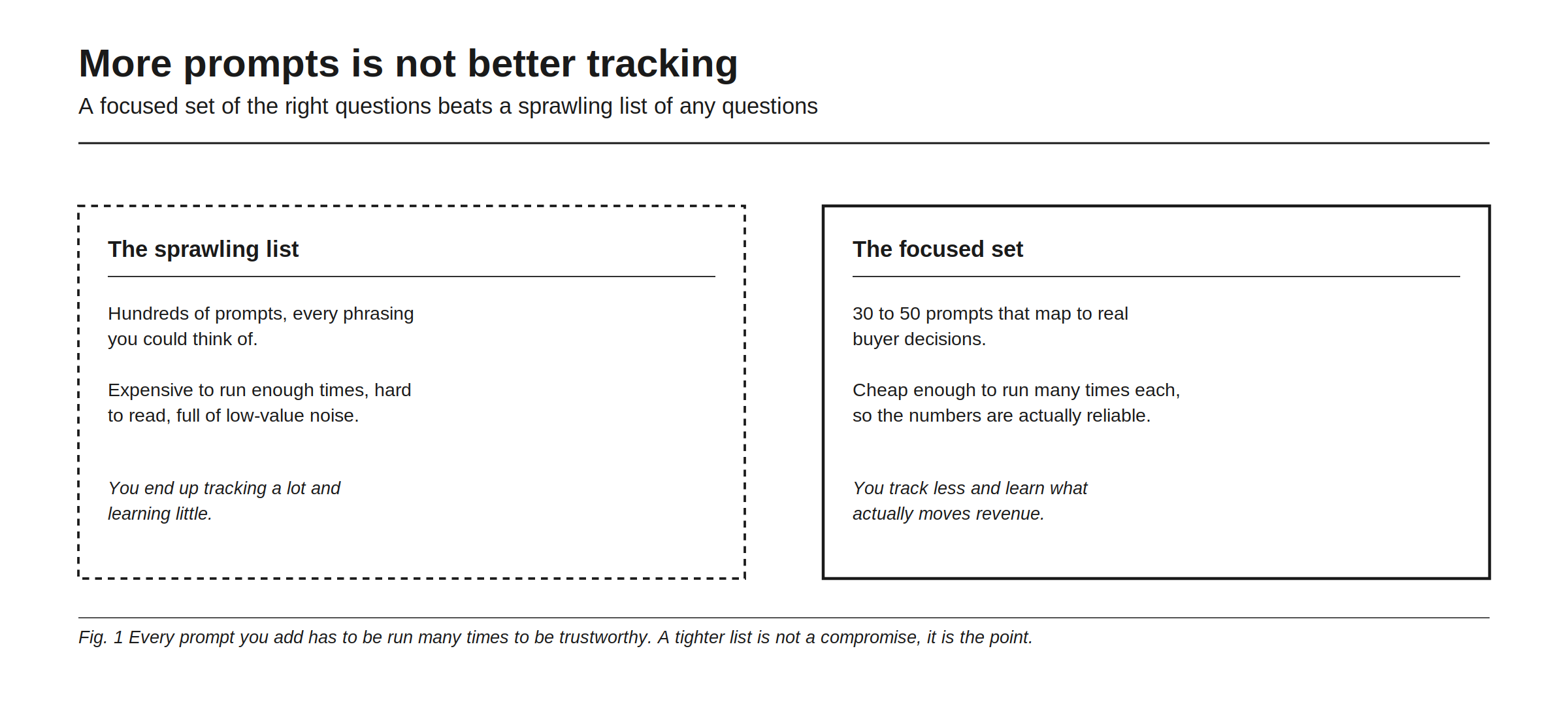
Compare the two approaches. The sprawling list: hundreds of prompts, every phrasing you could think of, expensive to run enough times, hard to read, and full of low-value noise, so you end up tracking a lot and learning little. The focused set: 30 to 50 prompts that map to real buyer decisions, cheap enough to run many times each so the numbers are actually reliable, and you track less while learning what actually moves revenue.
The reason a tighter list is not a compromise but the point comes down to statistics. A single run of a prompt is unreliable, so each prompt needs to be run many times before its number is trustworthy, which is the whole argument in how many runs a number needs before you can trust it. Every prompt you add multiplies the runs you owe. Two hundred prompts run properly is an enormous, costly job; fifty prompts run properly is achievable and honest. So the volume question is really a reliability question: fewer prompts, sampled enough, beats more prompts, sampled too little.
Rank prompts by commercial value
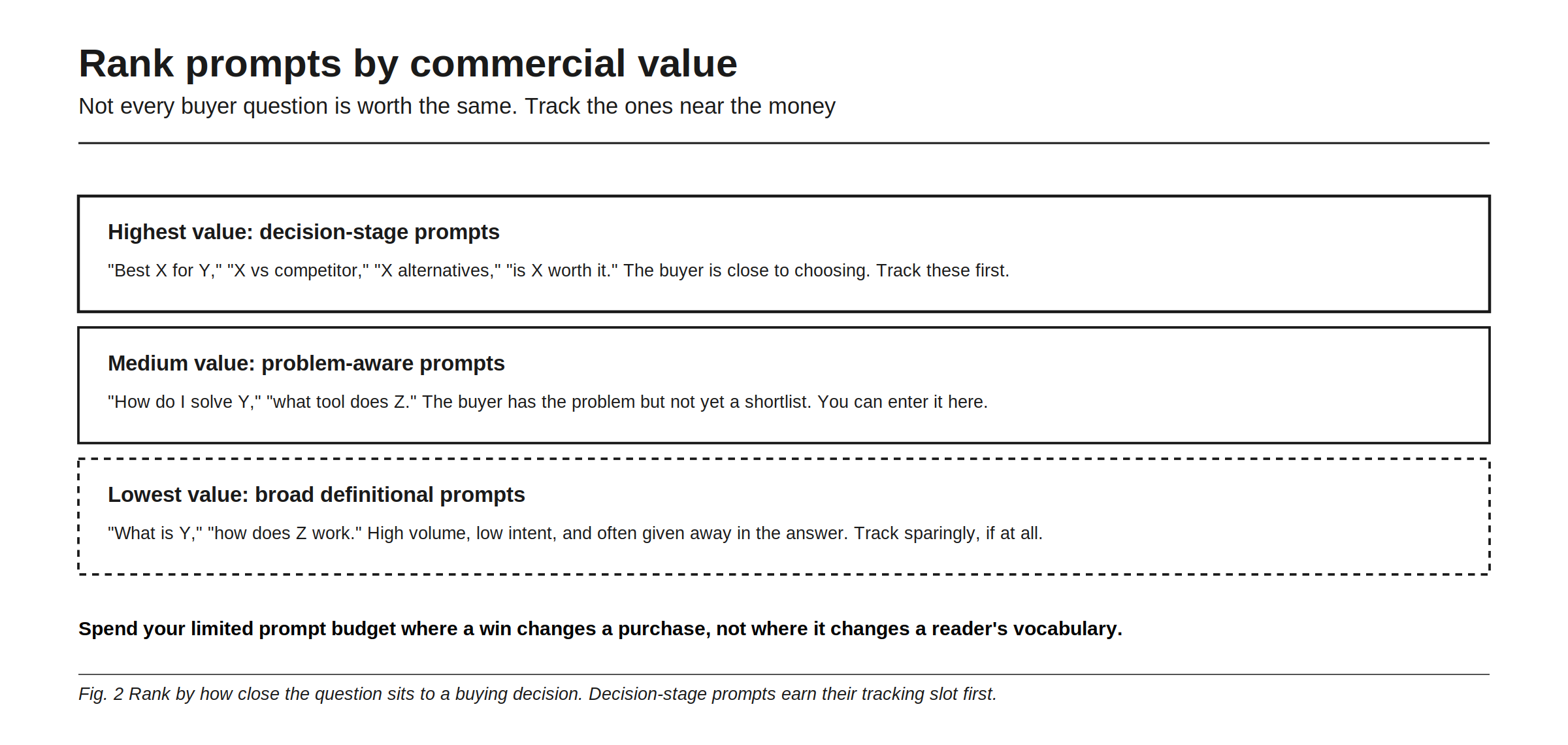
Not every buyer question is worth the same tracking slot, so rank by how close it sits to the money. Highest value, decision-stage prompts: “best X for Y,” “X vs competitor,” “X alternatives,” “is X worth it”, where the buyer is close to choosing, so track these first. Medium value, problem-aware prompts: “how do I solve Y,” “what tool does Z”, where the buyer has the problem but not yet a shortlist, so you can enter it here. Lowest value, broad definitional prompts: “what is Y,” “how does Z work”, high volume but low intent and often given away in the answer, so track sparingly if at all, a point connected to when citations do not convert.
Spend your limited prompt budget where a win changes a purchase, not where it changes a reader’s vocabulary. Being the recommended answer on “best CRM for small law firms” is worth more than appearing on “what is a CRM,” even though the second has far more volume. Why the recommendation on a decision-stage prompt matters so much is in the mention-versus-recommendation gap.
Building and maintaining the set
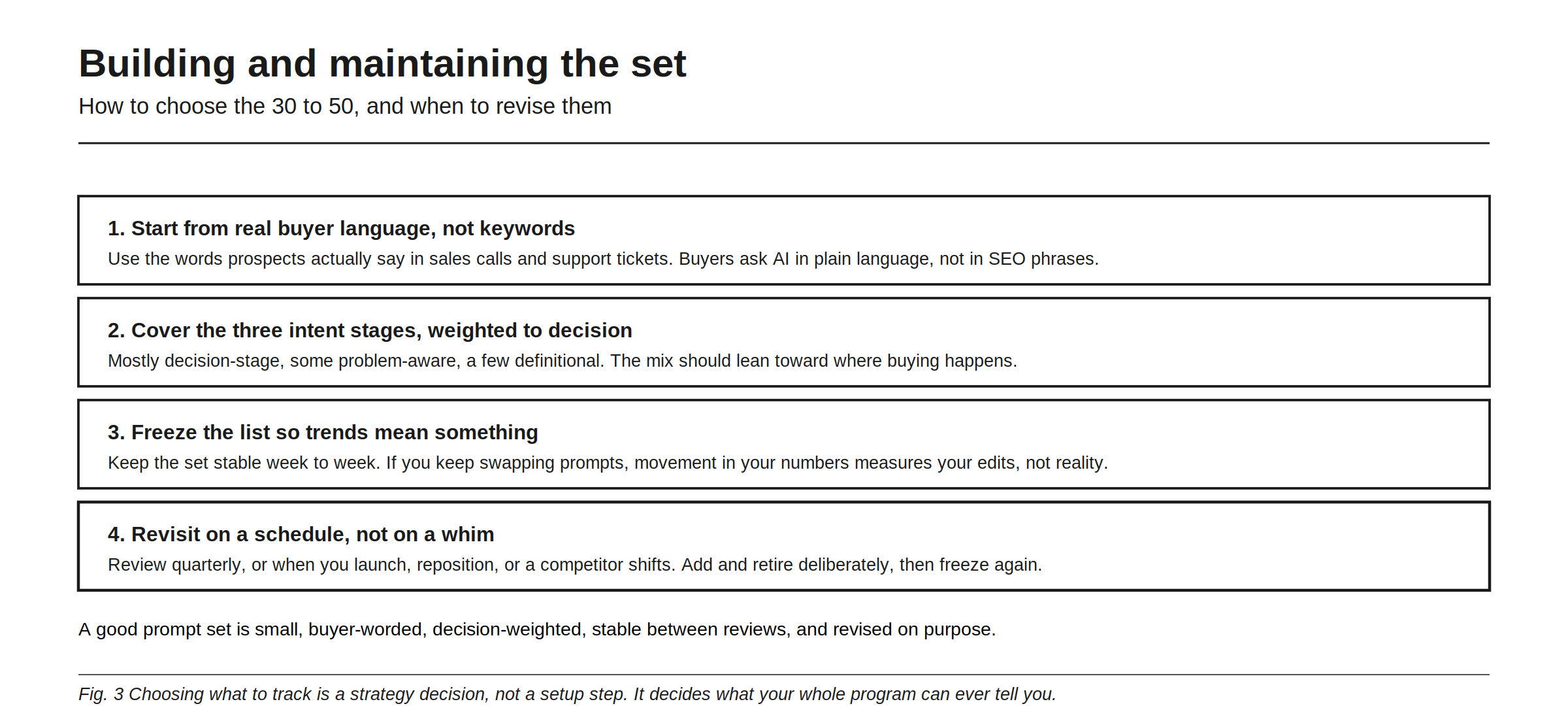
Four steps to choose the 30 to 50 and keep them useful. First, start from real buyer language, not keywords: use the words prospects actually say in sales calls and support tickets, because buyers ask AI in plain language, not in SEO phrases. Second, cover the three intent stages, weighted to decision: mostly decision-stage, some problem-aware, a few definitional, with the mix leaning toward where buying happens. Third, freeze the list so trends mean something: keep the set stable week to week, because if you keep swapping prompts, movement in your numbers measures your edits, not reality. Fourth, revisit on a schedule, not on a whim: review quarterly, or when you launch, reposition, or a competitor shifts, adding and retiring deliberately, then freezing again.
A good prompt set is small, buyer-worded, decision-weighted, stable between reviews, and revised on purpose. Choosing what to track is a strategy decision, not a setup step, and it decides what your whole program can ever tell you. The audit that puts this set to work is in how to run an AI visibility audit.
The mistake almost everyone makes first
The most common failure is starting with keyword lists from SEO tools and treating them as prompts. Keywords and prompts are different species: a keyword is a compressed search token (“crm software”), while a prompt is a full, natural buyer question (“what’s the best CRM for a small law firm that needs client intake”). Buyers type the second into AI, and it is the second that decides which brands the answer names. So importing a keyword list gives you a set that is technically large and practically wrong, missing the specific, natural, decision-stage phrasings where recommendations actually happen. Start instead from how your real buyers talk, narrow to the questions nearest a purchase, and keep the set small enough to run honestly. That discipline, few prompts, real language, decision-weighted, stable, is what separates a program that guides decisions from one that just generates a dashboard. Rankry lets you define and freeze your prompt set, then samples each one enough to give you a reliable trend, from $99 a month on a no-card trial.
FAQ
How many prompts should I track for AI visibility? A focused set of about 30 to 50 buyer questions is right for most brands. More is not better, because each prompt must be run many times to be reliable, so a large list becomes expensive and noisy while a tight one stays trustworthy and readable.
Which prompts are most worth tracking? Decision-stage prompts first: “best X for Y,” “X vs competitor,” “X alternatives,” “is X worth it.” These sit closest to a purchase. Problem-aware prompts come next, and broad definitional prompts like “what is X” are lowest value despite high volume.
Should I use my SEO keywords as prompts? No. Keywords are compressed search tokens; prompts are full, natural buyer questions. Buyers ask AI in plain language, so a keyword list misses the specific, decision-stage phrasings where recommendations happen. Start from how your buyers actually talk.
How often should I change my prompt set? Keep it frozen week to week so trends reflect reality, not your edits. Revise on a schedule, quarterly, or when you launch, reposition, or a competitor shifts, adding and retiring prompts deliberately, then freezing the set again.
Why does a smaller prompt set give better data? Because each prompt needs many runs to be statistically reliable. A smaller set lets you run every prompt enough times to trust the number, while a large set forces too few runs per prompt, leaving each result too noisy to act on.
Define and freeze your buyer-question set, then get a reliable trend on each one, across every engine. Start a free 7-day Rankry trial, no card, first report in two minutes.