To find the prompts where your brand should appear but does not, start from buyer intent rather than keywords: list the real questions a buyer in your category asks an AI, run them across the engines, and flag every prompt where a competitor is named and you are not. Those gaps, high-intent questions you are absent from, are your priority list. The point is not to track every possible prompt. It is to find the small set where being invisible is actively costing you deals.
Most teams get this backwards. They either track a handful of obvious prompts and miss the ones that matter, or they track hundreds and drown in noise. The useful middle is a focused set built around how buyers actually decide, scored by whether your absence is expensive.
Start from buyer intent, not keywords
A keyword is a fragment. A prompt is a full question with context, and that context changes everything about which brands get named. How many of those questions to carry, and how to rank them by commercial value, is in the prompt volume problem. “CRM” is a keyword. “What is the best CRM for a ten-person B2B startup that needs a free tier” is a prompt, and the answer to it names a very different set of companies. Your job is to write the prompts your buyers would actually type, in their words, with their constraints.
Build your set across five types, so you cover the whole buying conversation.
![Five kinds of buyer-intent prompts to build your tracked set from, in buyers' own words rather than keywords. Category and best-of prompts like "best [category] tool". Comparison prompts like "[you] vs [competitor]". Use-case prompts like "best [category] for a specific audience, job, or industry". Problem prompts like "how do I solve the problem your product solves". Alternative prompts like "alternatives to [competitor]". Cover all five types; the prompts where buyers are closest to choosing are the ones you most need to win.](/blog/images/prompts-fig1-types.png)
- Category and best-of prompts, like “best [category] tool” or “top [category] software 2026.” These are broad and competitive, and being absent here means you are not in the consideration set at all.
- Comparison prompts, like “[you] vs [competitor]” or “[competitor A] or [competitor B].” These catch buyers late in the decision, and they are some of the highest-intent prompts you can track.
- Use-case prompts, like “best [category] for [a specific audience, job, or industry].” These are where a smaller brand can win, because the broad answer and the niche answer are often different.
- Problem prompts, like “how do I [the problem your product solves].” The buyer has not named your category yet, so being recommended here means catching demand early.
- Alternative prompts, like “alternatives to [competitor].” These are pure intent: someone is actively looking to switch.
Aim for a focused set that covers all five types for your core categories. Quality and specificity beat volume.
Run them, then look for the gaps
Once you have the set, run each prompt across the engines your buyers use, ChatGPT, Claude, Gemini, Perplexity, Grok, Microsoft Copilot, and Google AI Overviews, because the same prompt returns a different shortlist on each. For every prompt, record three things: whether you are named, where you rank if you are, and which competitor is named when you are not. That third column is where the value lives.
Now sort the results. Not every gap is worth fixing, so weigh each prompt on two axes: how much buyer intent it carries, and whether you are present or absent.
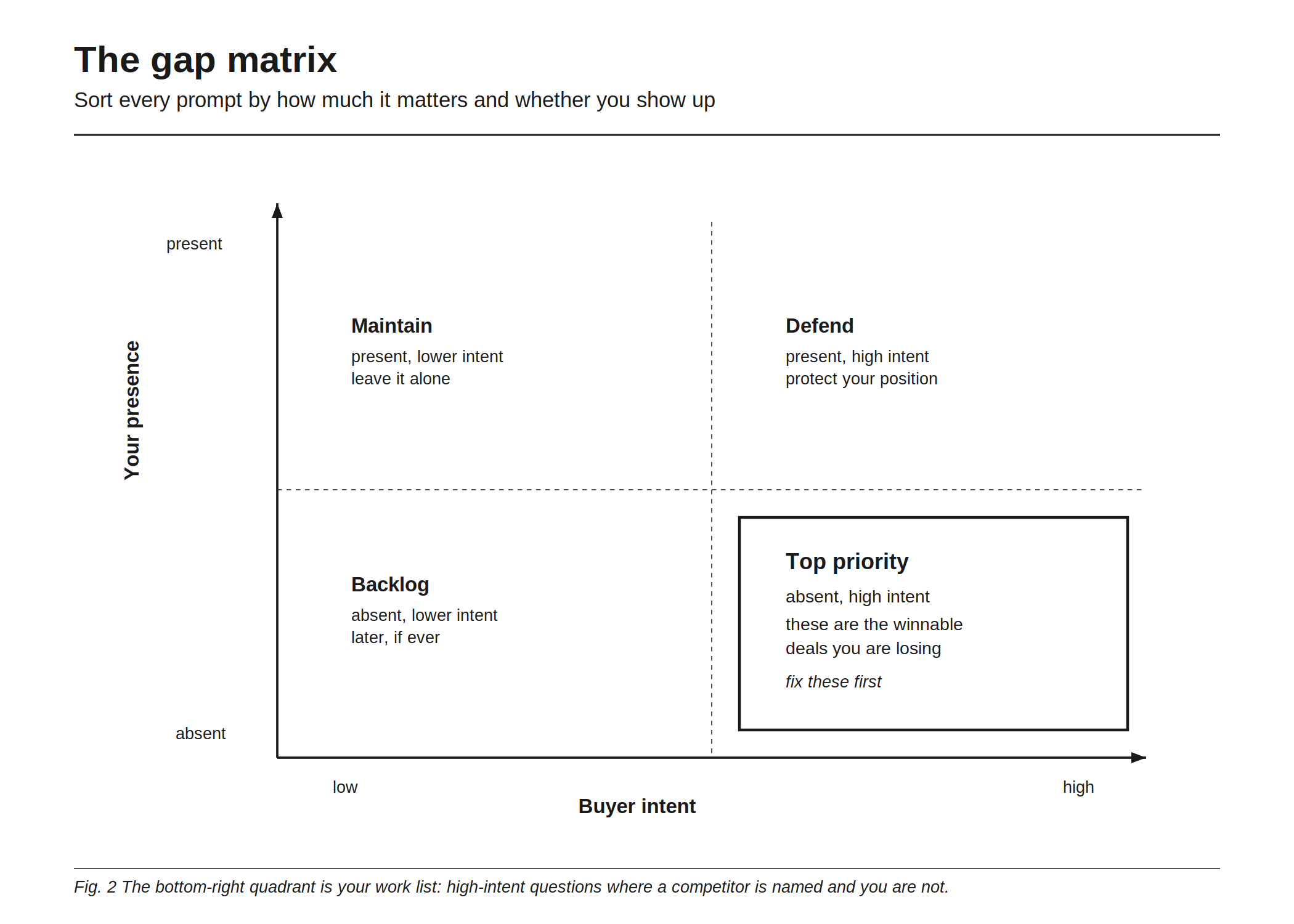
The bottom-right quadrant is your work list. These are high-intent prompts where a competitor is named and you are not, which means you are losing winnable buyers in the exact moment they are choosing. Fix these first. High-intent prompts where you are already present go in the defend pile, worth protecting but not urgent. Low-intent gaps go to the backlog. And low-intent prompts where you are present need nothing at all.
Why each gap happens, and what it points to
A gap is a symptom, and the cause tells you the fix. If you are absent from a comparison prompt, you usually lack a strong comparison page or third-party comparison that names you. If you are absent from a use-case prompt, the sources AI trusts do not connect you to that specific scenario. If you are absent from a category prompt, you are missing from the listicles and roundups that feed those broad answers. In almost every case, the fix traces back to third-party sources rather than your own blog, which is why measuring the gap per prompt is what makes the work concrete. For the diagnosis behind this, see why ChatGPT recommends competitors instead of you.
Automating the hunt
You can do the first pass of this by hand, and you should, because reading the raw answers teaches you how AI talks about your category. But you cannot keep it current manually, because answers shift and your set grows. A tool runs the prompts on a schedule, tracks presence and rank per engine, and surfaces the gaps for you. Rankry, for example, generates buyer-intent prompts for your category, runs them across your selected engines, and flags exactly where a competitor wins a prompt you should own, with the cited source behind the pick.
FAQ
How do I choose which prompts to track for AI visibility? Start from real buyer questions, not keywords, and cover five types: category, comparison, use-case, problem, and alternative prompts. Keep the set focused on your core categories rather than tracking everything.
How do I find prompts where my competitor appears but I do not? Run your buyer-intent prompts across the AI engines and record, for each one, whether you are named and which competitor is named when you are not. The prompts where a rival appears and you are absent are your gaps.
How many prompts should I track? A focused set that covers your core buying questions across the five prompt types beats a huge list. Depth and specificity matter more than volume, because noise hides the gaps that actually cost you deals.
What is a prompt gap? A prompt gap is a buyer-intent question where an AI engine names a competitor and not you. High-intent gaps are the most valuable to fix, because they are winnable deals you are currently losing.
Should I track the same prompts on every AI engine? Yes, because the same prompt returns different shortlists on ChatGPT, Claude, Gemini, Perplexity, Grok, Microsoft Copilot, and Google AI Overviews. A gap on one engine may not exist on another, and you want to see all of them.
Find the high-intent prompts where a competitor wins and you are missing, across every engine you track. Start a free 7-day Rankry trial, no card, first report in two minutes.