An AI visibility audit measures how AI engines see, rank, and describe your brand, and turns the result into a list of fixes. Run it in five steps: build a set of buyer-intent prompts, run them across the major engines and record presence, rank, and sentiment, capture the sources cited behind each answer, check your technical readiness, and prioritize the gaps into a fix list. You can do a first pass by hand in an afternoon, and automate it after that.
The reason to audit, rather than guess, is that your intuition about AI is almost always wrong. Brands that assume they are visible often are not, and brands that fear the worst sometimes rank fine. An audit replaces the assumption with evidence, and the evidence tells you exactly what to do next.
The five steps
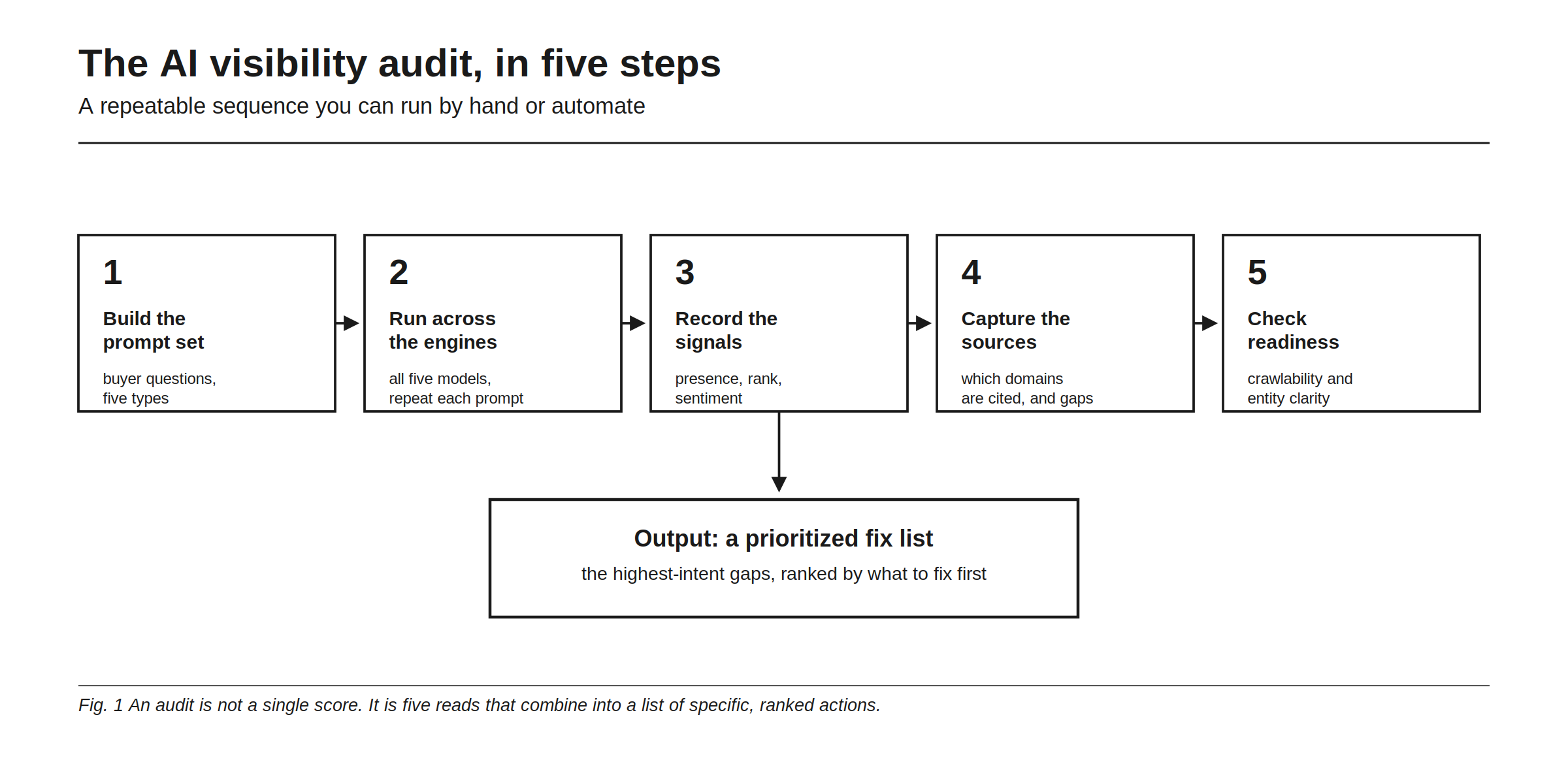
An audit is not a single score. It is five reads that combine into a ranked list of specific actions. Here is each step in order.
Step 1: build the prompt set
List the real questions a buyer in your category would ask an AI, in their words, with their constraints. Cover five types: category and best-of, comparison, use-case, problem, and alternative prompts. Keep it focused on your core categories rather than trying to cover everything. This set is the spine of the whole audit, so spend real time on it. For the full method, see how to find the prompts where your brand should appear.
Step 2: run them across the engines
Run every prompt across the engines your buyers actually use, ChatGPT, Claude, Gemini, Perplexity, Grok, Microsoft Copilot, and Google AI Overviews, because the same question returns a different shortlist on each. Run from clean, non-personalized sessions, and repeat each prompt a few times, because AI answers vary between runs and a single response can mislead you.
Step 3: record the signals
For each answer, capture three things: whether you are named at all, where you rank when you are, and how the model talks about you. Presence tells you if you are in the game. Position tells you if you are winning or buried. Sentiment tells you whether the description helps or hurts, and what objection keeps coming up.
Step 4: capture the sources
This is the step most casual audits skip, and it is the most actionable. For each answer, note which domains the engine cited. Those cited domains are the pages that carry weight in your category. When a competitor is cited and you are not, that page is a specific gap to close. Without this step, you know your score but not how to move it.
Step 5: check your technical readiness
Finally, confirm the basics that gate everything else. Can AI bots crawl your pages, or are you blocking them? Does your content render without requiring scripts? Is your entity clear, with a consistent name and category the model can file you under? A brand can fail in AI answers purely because its content is invisible to the bots, and no amount of content work fixes that until the gate is open.
What a complete audit measures
Put together, those steps cover five dimensions. Drop any one and the audit lies to you.
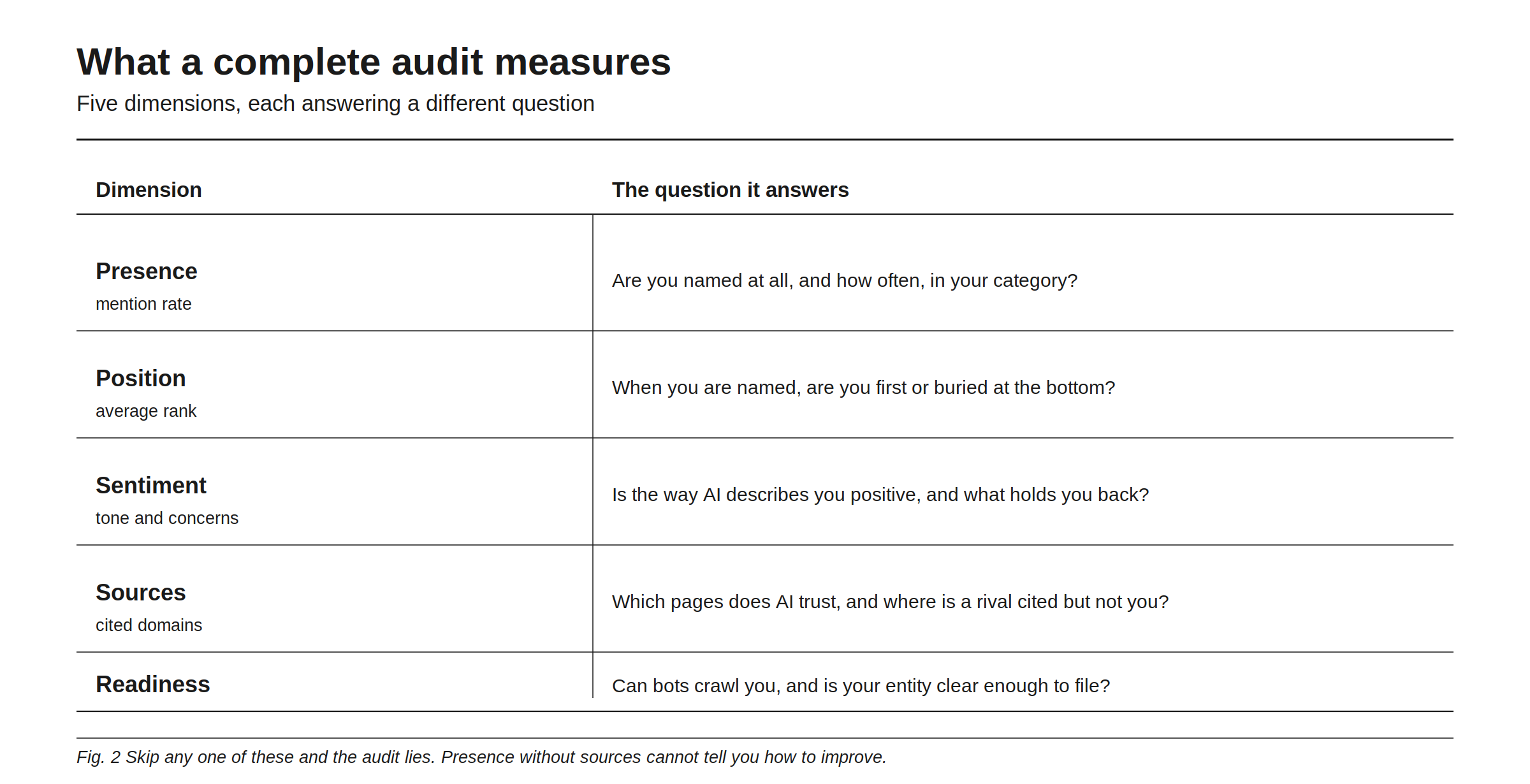
Presence answers whether you are named and how often. Position answers whether you are first or last when you are named. Sentiment answers whether the description is positive and what holds you back. Sources answer which pages AI trusts and where a rival is cited but not you. Readiness answers whether bots can crawl you and whether your entity is clear. Presence alone feels like an audit but cannot tell you how to improve, because the how lives in sources and readiness.
Turning the audit into action
The output is a prioritized fix list, not a report you file away. Rank the gaps by buyer intent, and start with the high-intent prompts where you are absent, because those are winnable deals you are losing right now. For each, the cause usually traces to one of a few things: missing third-party mentions, an ambiguous entity, thin comparison content, or a crawl block. Fix the cause, not the symptom, then re-run the audit and watch the same prompts change. For why these gaps happen, see why ChatGPT recommends competitors instead of you.
Doing it by hand vs automating it
A manual audit is genuinely worth doing once, because reading the raw answers teaches you how AI talks about your category in a way no dashboard can. The limit is that it is slow, it cannot stay current as answers shift, and capturing sources across five engines by hand is tedious. A tool runs the whole sequence on a schedule and keeps the history. Rankry runs your prompts across your selected engines, scores presence, position, and sentiment, captures cited sources with gap flags, checks your AI readiness, and hands you the prioritized fix list, which is the same five-step audit, run continuously. You can see the readiness check on the features overview.
FAQ
What is an AI visibility audit? It is a structured check of how AI engines see your brand: whether they mention you, where you rank, how they describe you, which sources they cite, and whether your site is technically ready to be found. The output is a prioritized list of fixes.
How do I audit my brand’s presence in AI results? Build a set of buyer-intent prompts, run them across ChatGPT, Claude, Gemini, Perplexity, Grok, Microsoft Copilot, and Google AI Overviews, and record presence, rank, sentiment, and cited sources, then check your crawlability and entity clarity. Prioritize the high-intent gaps.
How often should I run an AI visibility audit? A full audit each quarter is a good baseline, with lighter monthly checks on your highest-priority prompts. AI answers shift gradually, so continuous tracking catches drops sooner than a one-time audit.
Can I run an AI visibility audit for free? Yes, a first pass. Asking the engines directly costs nothing, and free audit tools give a quick snapshot. A paid tool adds repeated sampling, source capture across engines, and tracking over time.
What should an AI visibility audit measure? Five dimensions: presence, position, sentiment, cited sources, and technical readiness. Measuring presence alone is not enough, because it cannot tell you how to improve. The sources and readiness reads are what make the audit actionable.
Run a full multi-engine audit on your brand this week, with sources and a prioritized fix list. Start a free 7-day Rankry trial, no card, first report in two minutes.