Affiliate publishers do supply a large share of the pages AI engines cite on buying questions, but the data does not support calling them a shortcut. In an OtterlyAI vendor study of 617,985 citations from September 2026, commission-declaring publishers accounted for 36.6% of citations whose publisher could be identified, and 44.8% of identified citations to listicles, comparisons and guides. Suff Digital, an agency, found at least one affiliate review site cited in 70% of 17,524 AI answers to “best product” questions. Yet when Semrush checked its own affiliate program, only about 22% of 2,850 partner pieces were cited in any tracked AI answer over roughly three weeks, and about 1% in ChatGPT. The most-cited affiliates are large, established publishers such as Forbes, Bankrate and NerdWallet, not partners you can sign this month. Treat a partner program as a slow, disclosed way to earn honest third-party coverage, and measure it by citations as well as sales.
The pitch is tempting: AI engines read affiliate content, so pay affiliates and AI will recommend you. The first half holds up. The second half needs work, and it carries legal and search risk if you rush it.
What the studies actually measure
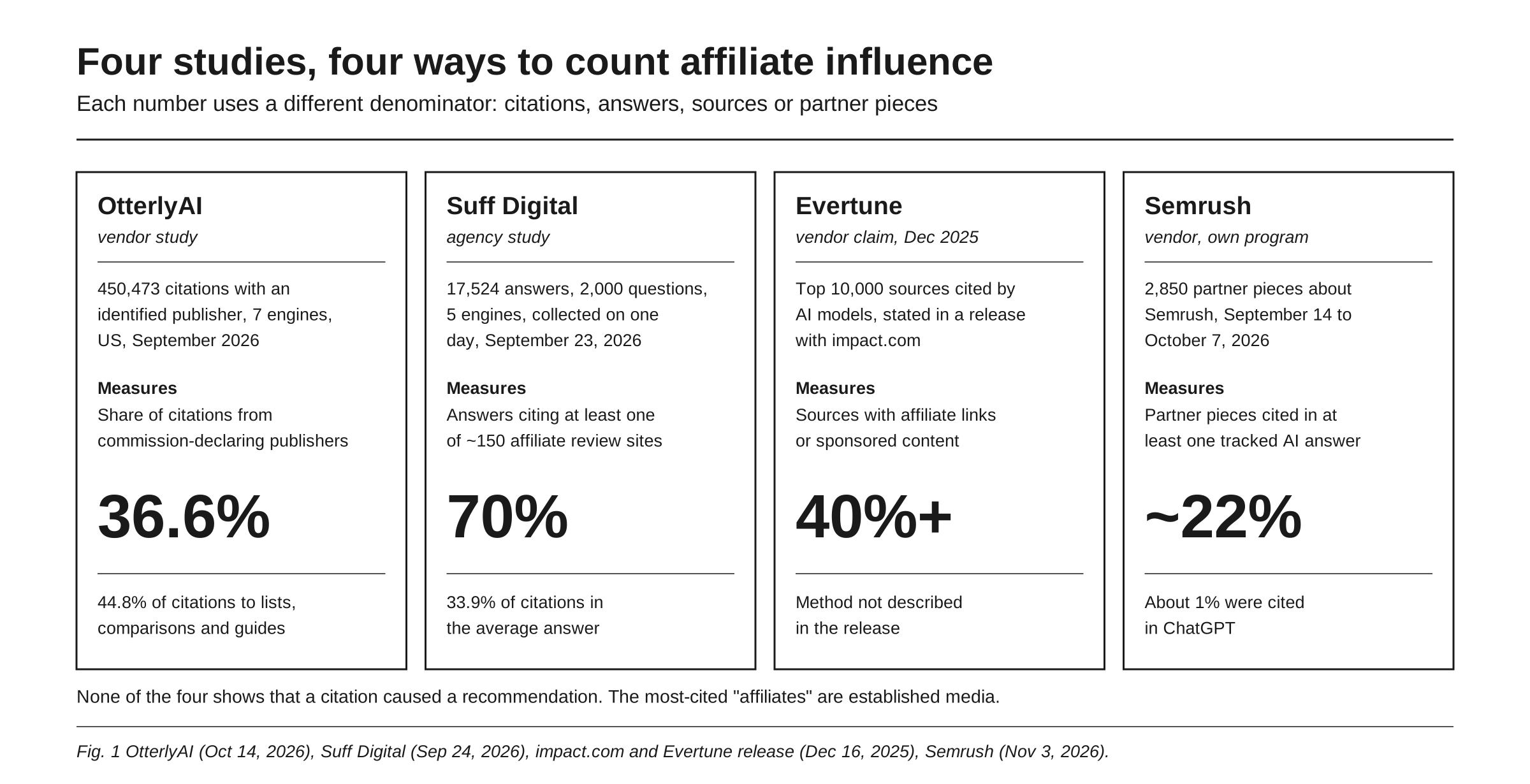
Each study counts something different, so the numbers are not interchangeable.
OtterlyAI sells AI visibility tracking. Its study used five US brand reports, each sending 100 buyer questions a day to seven engines from September 1 to 30, 2026. Otterly identified the publisher for 72.9% of citations. Brands published 38.9% of those, and sites that publicly state they may earn a commission on what they recommend published 36.6%. Editorial sites were 11.7%, an upper bound, since “editorial” only means no commercial disclosure was found. Among identified citations to listicles, comparisons and guides, the commission-declaring share rose to 44.8%. By sector, that share was 53.1% in finance, 51.4% in sports, 50.7% in technology, 46.4% in retail and 27.8% in education. Otterly discloses a commercial partnership with Getfluence, which connects brands with publishers for paid placements.
Suff Digital, a Nashville marketing agency, asked 2,000 “best product or service” questions across 20 shopping categories on ChatGPT, Gemini, Perplexity, Google AI Mode and AI Overviews, collecting 17,524 answers on a single day, September 23, 2026. It counted an answer as citing an affiliate site if any source came from a list of about 150 review publishers. By that test, 70% did, and those sites made up 33.9% of citations in the average answer. Perplexity was highest at 99.4%, Gemini lowest at 54.7%. Finance hit 90.2%; electronics was the lowest category named, at 43.7%.
Evertune, an AI visibility vendor, said through its CEO in a December 2025 release with impact.com that in its analysis of the top 10,000 sources cited by AI models, “over 40% of content either contains affiliate links or is sponsored.” The release did not describe the method.
Two cautions apply to all three. First, the most-cited “affiliates” are established media. Otterly’s ten most-cited commission-declaring publishers, led by forbes.com and bankrate.com, carried 5.8% of all citations on their own; in Suff’s data Forbes appeared in 14.4% of answers and NerdWallet in 8.7%. Second, these studies count presence. None shows that a citation caused a recommendation.
Why “shortcut” overstates it
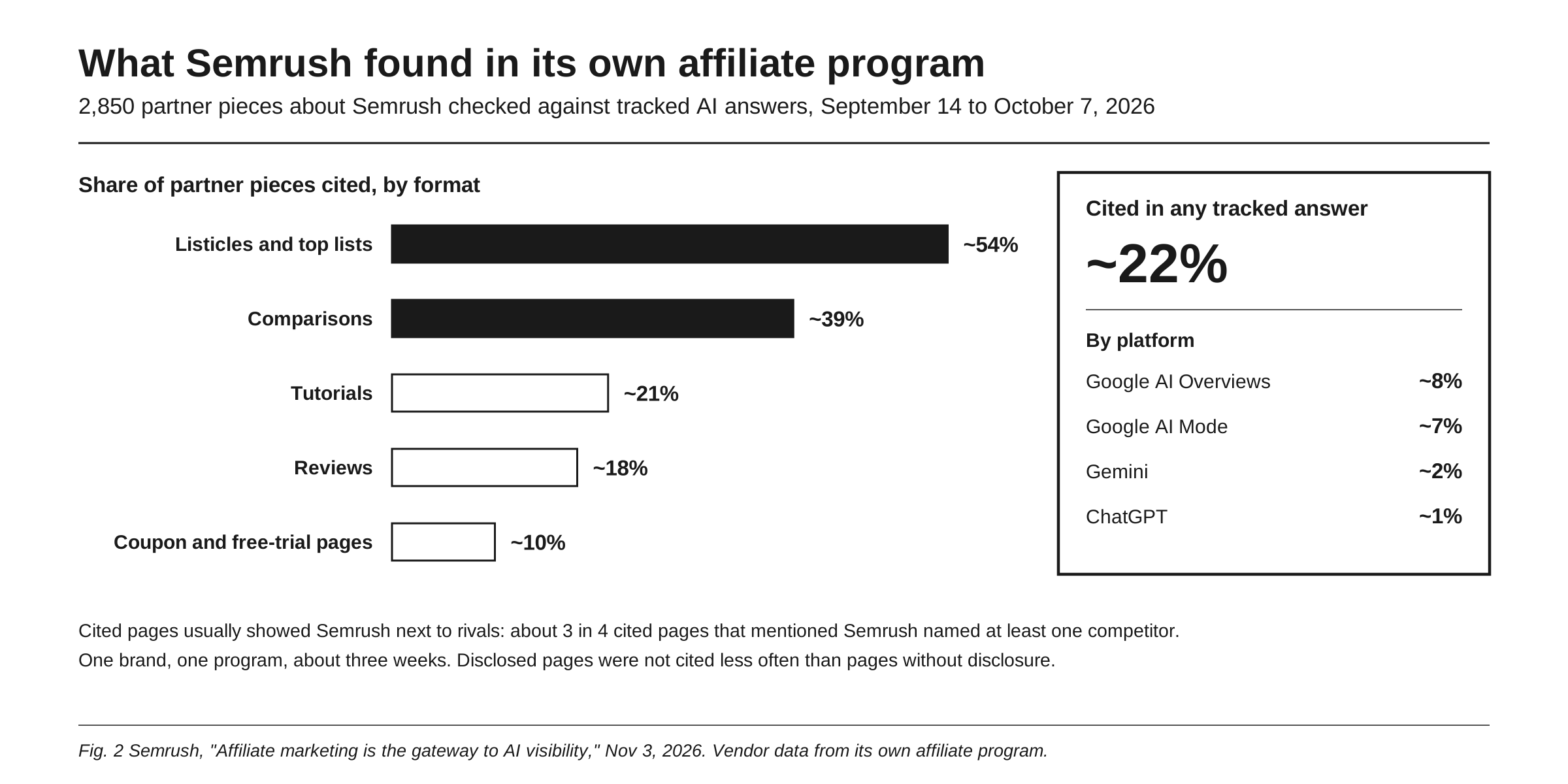
The best direct test we found comes from Semrush, a vendor of AI visibility tools that runs its own affiliate program. In a study published November 3, 2026, it checked 2,850 partner pieces about Semrush against the AI answers it tracks, from September 14 to October 7, 2026. About 22% were cited in at least one tracked answer. By platform: about 8% in Google AI Overviews, 7% in AI Mode, 2% in Gemini and 1% in ChatGPT. It is one brand, one program and about three weeks, but it is real partner content, not a model.
Within the program, citation rates varied sharply by format. About 54% of listicles and top lists were cited, 39% of comparisons, 21% of tutorials, 18% of reviews and 10% of coupon and free-trial pages. Semrush’s advice is blunt: do not count coupon partners toward AI visibility.
Three things keep this from being a shortcut.
Concentration. The most-cited affiliate publishers are established media brands. Otterly calls affiliate and sponsored publishing “a mature market with established players and published rates.” Getting onto those pages costs money and time.
Commission pays for the wrong thing. Affiliate payouts reward sales, while AI visibility comes from coverage that may never close a sale itself. impact.com, which sells affiliate software, argues that “recruiting on conversion history alone systematically filters out the partners who matter most for GEO.” That is vendor opinion, but it matches Semrush’s coupon data.
Cited is not recommended. About three in four cited pages that mentioned Semrush also named at least one competitor. A partner list puts you next to rivals, and the engine still chooses. How it picks between close options is covered in how AI picks between similar brands.
It comes closest where, in Otterly’s data, commission-declaring publishers supply over half of list, comparison and guide citations, and on Perplexity, which cited affiliate review sites in 99.4% of Suff’s answers.
The risks: disclosure, Google policy and quality
FTC disclosure. If you pay a partner, the relationship needs clear disclosure. The FTC’s guidance warns that consumers “might not understand that ‘affiliate link’ means that the person placing the link is getting paid,” while “Paid link” right next to the link “should be an adequate disclosure.” Advertisers “need to have reasonable programs in place to train and monitor members of their network,” and “your company is ultimately responsible for what others do on your behalf.” This is general information, not legal advice; have counsel review your program.
Disclosure did not cost citations in Semrush’s sample. Of 302 cited web pages Semrush read, 74% contained affiliate links and about 40% tagged those links sponsored or nofollow; of 283 cited videos, 88% carried a disclosure. Pages with a disclosure or an affiliate link were not cited less often than pages without them.
Google’s site reputation policy. The policy targets third-party content published on a host site “mainly because of that host’s already-established ranking signals.” In November 2024 Google said “no amount of first-party involvement alters the fundamental third-party nature of the content.” The policy page, updated August 28, 2026, says its rare human reviews check whether content was created with “sufficient input, editorial oversight, or contribution from the host site.” Search Engine Journal reported that from August 30, 2026, a manual action under this policy no longer affects rankings shown to users in the EEA; outside the EEA it still affects only the violating section. Google lists “using affiliate links throughout a page, with links treated appropriately” among examples that are not inconsistent with the policy. Buying a page in an unedited “partner” section of a big domain fits the pattern the policy describes.
Thin affiliation. Google’s spam policies say affiliate pages “can be considered thin if they are a part of a program that distributes its content across a network of affiliates without providing additional value.” Sending fifty partners the same copy invites that label.
Engines changing course. We found no published statement from OpenAI, Anthropic, Perplexity or Google saying their AI answers discount affiliate pages as a class, and current data shows heavy citation. That can change without notice, which is why you track it.
Rankry’s partner framework: select, brief, disclose, track
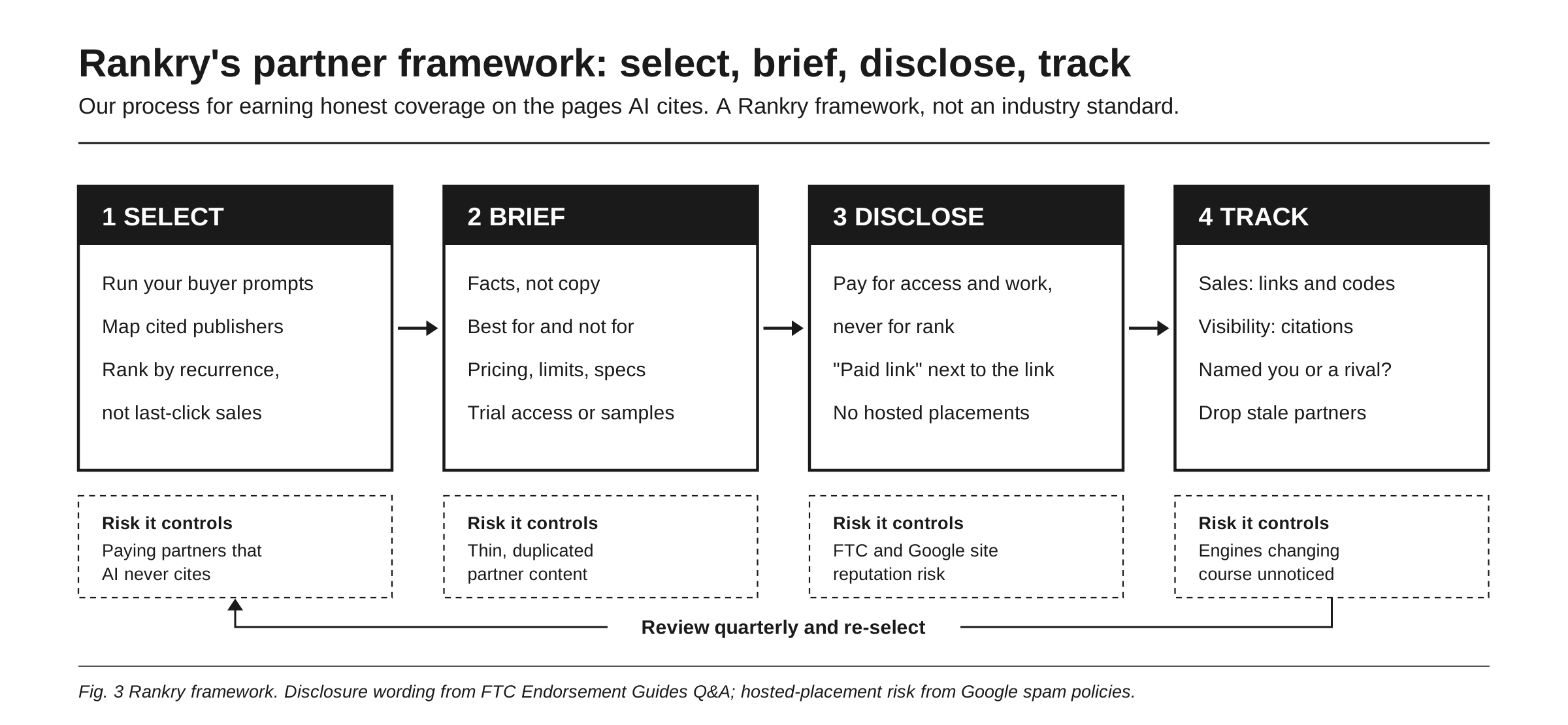
This is the process we recommend for B2B SaaS and ecommerce brands. It is Rankry’s framework, not an industry standard, and it builds on the listicle outreach checklist in why listicles get most AI citations.
- Start from buyer prompts. List the “best X,” “X vs Y” and “X alternatives” questions that decide your deals or carts.
- Map who gets cited. Run those prompts across engines, record cited URLs and label each source: commission-declaring, editorial, brand or community. Methods are in how to track citations and sources in AI search.
- Select by citation recurrence, not last-click revenue. Semrush suggests this order: cited publishers that name rivals but not you, cited publishers that name you but are not partners, then uncited publishers of lists, comparisons and tutorials.
- Check fit. Same buyer, same job, similar price band. If you do not fit a list, pitch a narrower one.
- Send a fact brief, not copy. One-line positioning, honest “best for” and “not for,” pricing model with a public link, plan limits or specs, integrations, shipping and returns for ecommerce, trial accounts or samples, and a customer reference. Google’s review guidance says that when recommending something as the best, reviewers should “include why you consider it the best, with first-hand supporting evidence.”
- Pay for access and work, never for rank. If content takes real effort, a stipend plus commission is reasonable. Never ask a partner to drop competitors or hide the relationship.
- Contract the disclosure. Plain wording such as “Paid link” or “We earn a commission,” placed next to the link. Check live pages on a schedule.
- Skip hosted placements. Do not buy pages in sections of large domains that the host does not edit.
- Track two ledgers. Use partner links or codes for sales, and track citations separately: which partner pages get cited, and whether answers citing them name you or a rival.
- Review quarterly. Refresh briefs when pricing or features change, and drop partners whose pages go stale or copy your merchant text.
Measuring what partners do for your AI visibility
Affiliate reporting is built around the first ledger, sales. Networks are starting to add the second: in June 2026 Awin announced an AI Visibility feature and a partnership with ScalePost, which it says uses first-party data to measure AI citations. You still need a view of your own prompts. Rankry runs a stable set of buyer-intent prompts every day across ChatGPT, Claude, Gemini, Perplexity, Grok and Google AI Mode and AI Overviews, and records which sources each engine cites. That shows which partner pages appear, whether answers that cite them name you, and how you compare with named competitors. The AI traffic tracking script shows AI referrals reaching your site, and a new prompt is answered as soon as you add it, so you can check it before you pitch a publisher. Why engines lean on third-party sources at all is covered in where AI actually gets its answers.
FAQ
Are affiliates a shortcut to AI visibility? No. Commission-declaring publishers supply a large share of AI citations on buying questions, 36.6% of citations with an identified publisher in one OtterlyAI study. But in Semrush’s own program, only about 22% of 2,850 partner pieces were cited in any tracked answer over three weeks, and about 1% in ChatGPT. The most-cited affiliates are large, established publishers. Treat partners as a slow coverage channel.
Do affiliate disclosures hurt AI citations? Not in the data we found. In Semrush’s review of 302 cited web pages and 283 cited videos, 74% of the pages contained affiliate links, about 40% tagged them sponsored or nofollow, and 88% of the videos carried a disclosure. Pages with a disclosure were not cited less often than pages without one. The FTC expects clear disclosure anyway, so there is no visibility reason to drop it.
Does Google’s site reputation policy ban affiliate content? No. Google’s spam policies list affiliate links treated appropriately among examples that are not inconsistent with the policy. The policy targets third-party content placed on a host site mainly to borrow its ranking signals. Buying an unedited page on a large domain fits that pattern. Separately, Google treats affiliate pages built on merchant descriptions copied without added value as thin affiliation.
Which affiliate partners matter most for AI visibility? Publishers whose pages AI already cites on your buyer prompts, especially those naming competitors but not you. In Semrush’s data, listicles and comparisons were cited most and coupon and free-trial pages least, at about 10%. Judge partners by citation recurrence across prompts and engines, not by last-click sales alone.
Does this work for B2B SaaS as well as ecommerce? Partly. In OtterlyAI’s data, commission-declaring publishers supplied 50.7% of list, comparison and guide citations in technology and 46.4% in retail, and Semrush’s partner data comes from a SaaS program. Neither study isolates B2B buying prompts. Briefs differ: SaaS partners need trial accounts and plan limits, while ecommerce partners need samples, specs, shipping and returns details.
Sources
- What Content Do AI Engines Cite? A Study of 617,985 Citations Across 7 Engines and 5 Industries, OtterlyAI, October 14, 2026
- 70% of AI Product Recommendations Cite Sites That Earn Affiliate Commissions, Suff Digital, September 24, 2026
- Affiliate marketing is the gateway to AI visibility, Semrush, November 3, 2026
- impact.com and Evertune Partnership Helps Brands Influence AI Search Results, Supported by Strategic impact.com Investment, impact.com, December 16, 2025
- Affiliate programs are your biggest GEO asset in AI search, impact.com, May 21, 2026
- Awin expands discovery intelligence as AI reshapes how consumers find brands, Awin, June 30, 2026
- FTC’s Endorsement Guides: What People Are Asking, Federal Trade Commission, last updated July 15, 2025
- Spam policies for Google web search, Google Search Central, last updated August 28, 2026
- Updating our site reputation abuse policy, Google Search Central Blog, November 19, 2024
- Google Updates Site Reputation Abuse (Parasite SEO) Policy, Search Engine Journal, August 28, 2026
- Write high quality reviews, Google Search Central, last updated December 10, 2025
See which partner pages AI cites on the prompts that decide your deals, and whether those answers name you or a rival. Start a free 7-day Rankry trial, no card required.