When AI builds an answer about your category, it does not weight all sources equally, and most brands optimize the one that matters least. The rough hierarchy, most to least influential, is: reference sources like Wikipedia, then community discussion like Reddit and forums, then third-party reviews and comparison pages, and last your own website. Your site tells the AI you exist and what you do, but it is the weakest of the four for winning a recommendation, because AI trusts what others say about you over what you say about yourself. This means the highest-leverage visibility work is usually off-site: getting your reference entry right, earning genuine community presence, and appearing on the review and comparison pages that decide your category. This guide maps the hierarchy and shows how to find your category’s real sources.
If your GEO strategy is “publish more blog posts,” you are pouring effort into the bottom of this hierarchy. The leverage is higher up, and off your own domain.
The source hierarchy AI actually uses
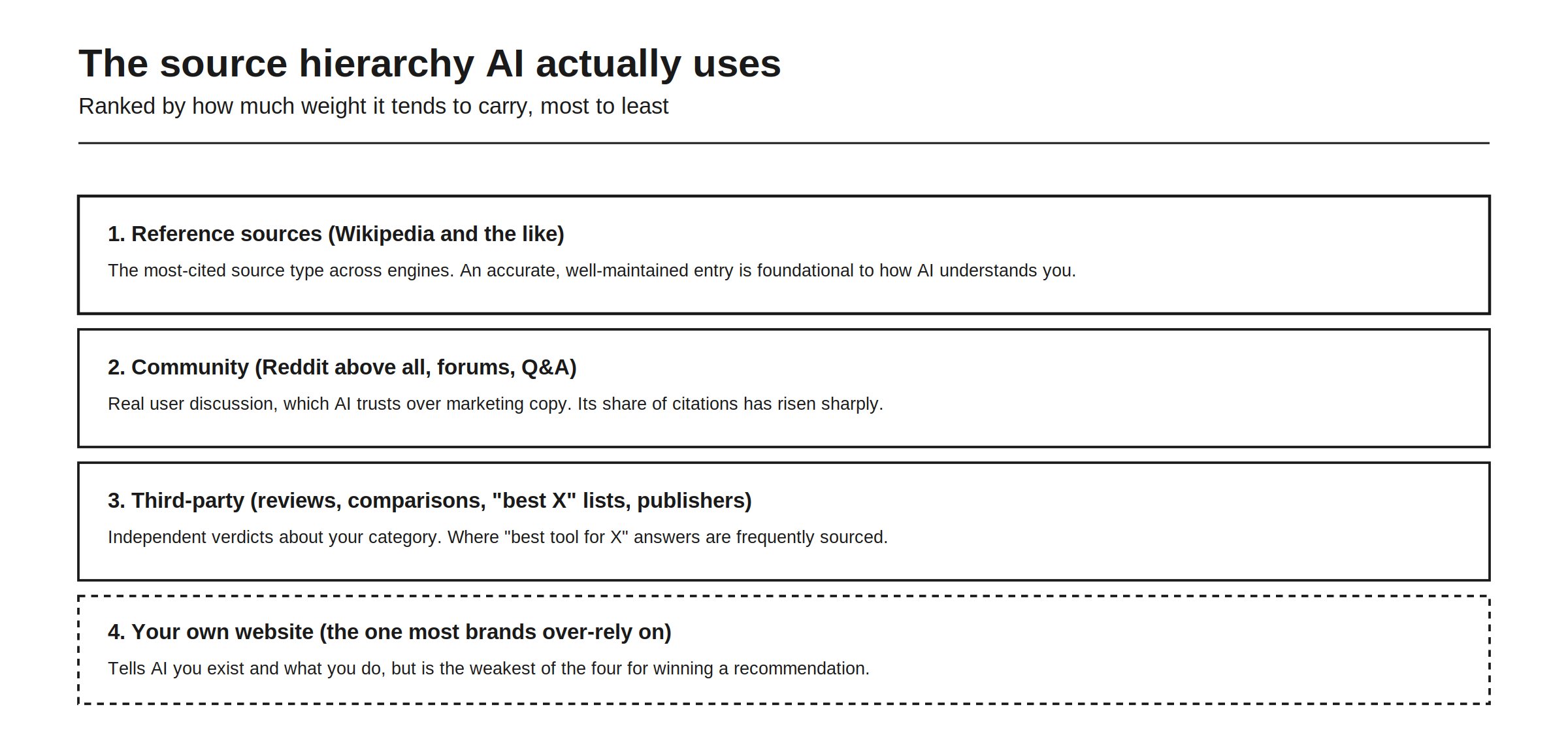
Ranked by how much weight it tends to carry, the order runs like this. First, reference sources such as Wikipedia and similar: the most-cited source type across engines, where an accurate, well-maintained entry is foundational to how AI understands you. Second, community, Reddit above all, plus forums and Q&A sites: real user discussion, which AI trusts over marketing copy, and whose share of citations has risen sharply. Third, third-party sources, reviews, comparisons, “best X” lists, and publishers: independent verdicts about your category, and where “best tool for X” answers are frequently sourced. Fourth, your own website: it tells AI you exist and what you do, but is the weakest of the four for winning a recommendation.
The order is the strategy. Effort spent at the top, a correct reference entry, a real community presence, moves your recommendation more than the same effort spent publishing your tenth comparison page on your own domain. Why community sources in particular carry weight is covered in how to get cited on Reddit.
Most of your visibility is off-site
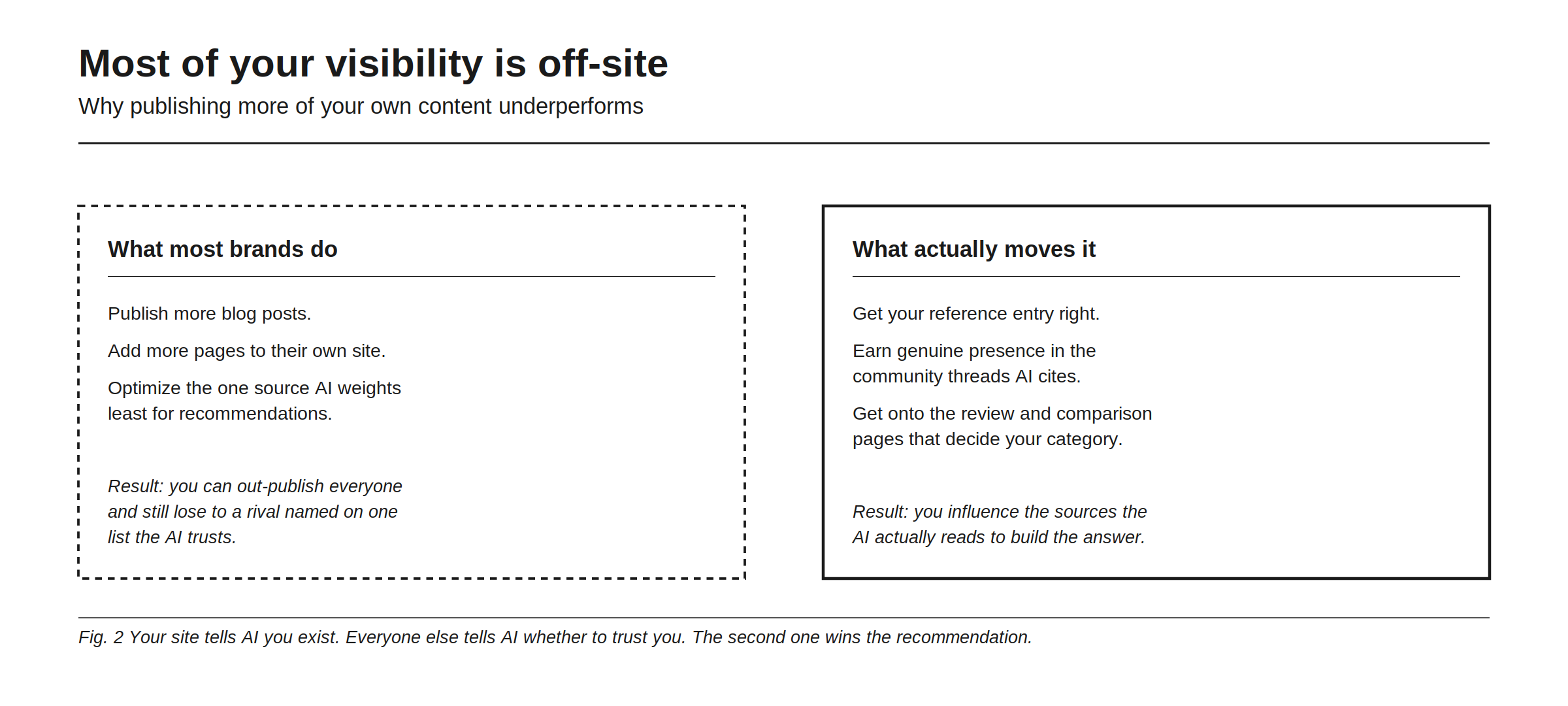
Here is the gap between habit and leverage. What most brands do: publish more blog posts, add more pages to their own site, and optimize the one source AI weights least for recommendations. The result is that you can out-publish everyone and still lose to a rival named on one list the AI trusts. What actually moves it: get your reference entry right, earn genuine presence in the community threads AI cites, and get onto the review and comparison pages that decide your category. The result is that you influence the sources the AI actually reads to build the answer.
Put simply, your site tells AI you exist, everyone else tells AI whether to trust you, and the second one wins the recommendation. This is the same mechanism behind the mention-versus-recommendation gap in the mention-versus-recommendation gap: you get mentioned from your own pages, but recommended based on third-party proof.
Find your category’s real sources
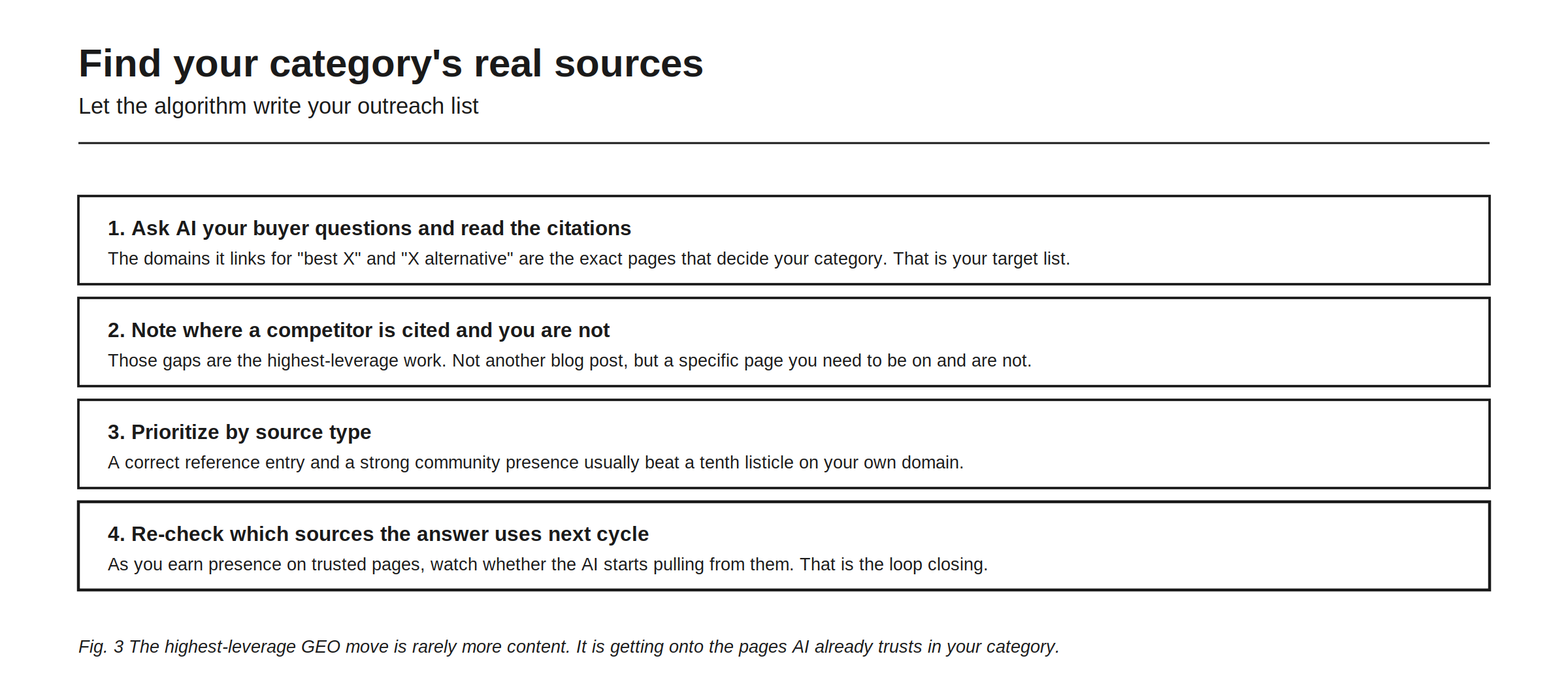
You do not have to guess which sources matter, the AI will tell you. First, ask AI your buyer questions and read the citations: the domains it links for “best X” and “X alternative” are the exact pages that decide your category, and that is your target list. Second, note where a competitor is cited and you are not: those gaps are the highest-leverage work, not another blog post, but a specific page you need to be on and are not. Third, prioritize by source type: a correct reference entry and a strong community presence usually beat a tenth listicle on your own domain. Fourth, re-check which sources the answer uses next cycle: as you earn presence on trusted pages, watch whether the AI starts pulling from them, which is the loop closing.
The highest-leverage GEO move is rarely more content. It is getting onto the pages AI already trusts in your category. Which pages those are differs by engine, since the source overlap between engines is famously low, a point covered in why two trackers never show the same number. Rankry shows the exact sources each engine cites for your prompts, and flags where a competitor is cited and you are not, from $99 a month on a no-card trial.
Why this feels wrong to marketers (and is still right)
Everything about this hierarchy runs against a decade of “own your content” instinct. You control your website; you do not control Wikipedia, Reddit, or a reviewer’s comparison page. It feels safer and more measurable to publish on your own domain, so that is where budgets go. But AI visibility rewards corroboration over self-description, precisely because a model has learned that independent sources are more reliable than marketing. The uncomfortable implication is that you have to earn your standing on properties you do not own, through genuine merit rather than publishing volume, which is slower and harder and exactly why competitors neglect it. That neglect is your opening. The citation mechanics underneath all of this are in LLM citation tracking.
FAQ
Where does AI get its information about my brand? From a rough hierarchy: reference sources like Wikipedia first, then community discussion like Reddit, then third-party reviews and comparison pages, and last your own website. AI weights independent sources above your own marketing content.
Why does my own website not help my AI visibility much? Because AI trusts what others say about you over what you say about yourself. Your site establishes that you exist and what you do, but recommendations are built from reference, community, and third-party sources that corroborate your claims independently.
How do I find which sources AI uses for my category? Ask AI your buyer questions and read the citations it provides. The domains it links for “best X” and “X alternative” queries are the pages that decide your category. Where a competitor is cited and you are not is your target list.
Is publishing more content a good AI visibility strategy? Usually not the best use of effort. Your own content is the lowest-weighted source type. Getting your reference entry right and earning genuine community and third-party presence typically moves recommendations more than adding pages to your own site.
Do all AI engines use the same sources? No. Source overlap between engines is low, so the pages that decide your category can differ by engine. This is why you check citations per engine rather than assuming one source list works everywhere.
See the exact sources each engine cites for your prompts, and where a competitor is cited and you are not. Start a free 7-day Rankry trial, no card, first report in two minutes.