Before an AI evaluates your content, it decides whether it recognizes your brand as a distinct, real entity, and if it cannot resolve you, it can skip you regardless of how good your content is. AI systems understand “things, not strings”: they treat your brand as an entity with a category, a founding, people, and relationships, not as characters on a page. This recognition step, entity disambiguation, happens before content quality is even weighed, which is why a brand can publish excellent pages and still watch the AI cite a weaker competitor, it was never recognized as a candidate. You become a resolved entity by giving the AI one consistent, corroborated definition of who you are: a canonical description used everywhere, a presence in the reference databases AI relies on, Organization schema with sameAs links, and every source telling the same story. This guide explains the recognition step and how to pass it.
Most GEO advice starts at content. This starts one step earlier, at the question the AI asks before it reads a word you wrote: do I know who this is?
Things, not strings
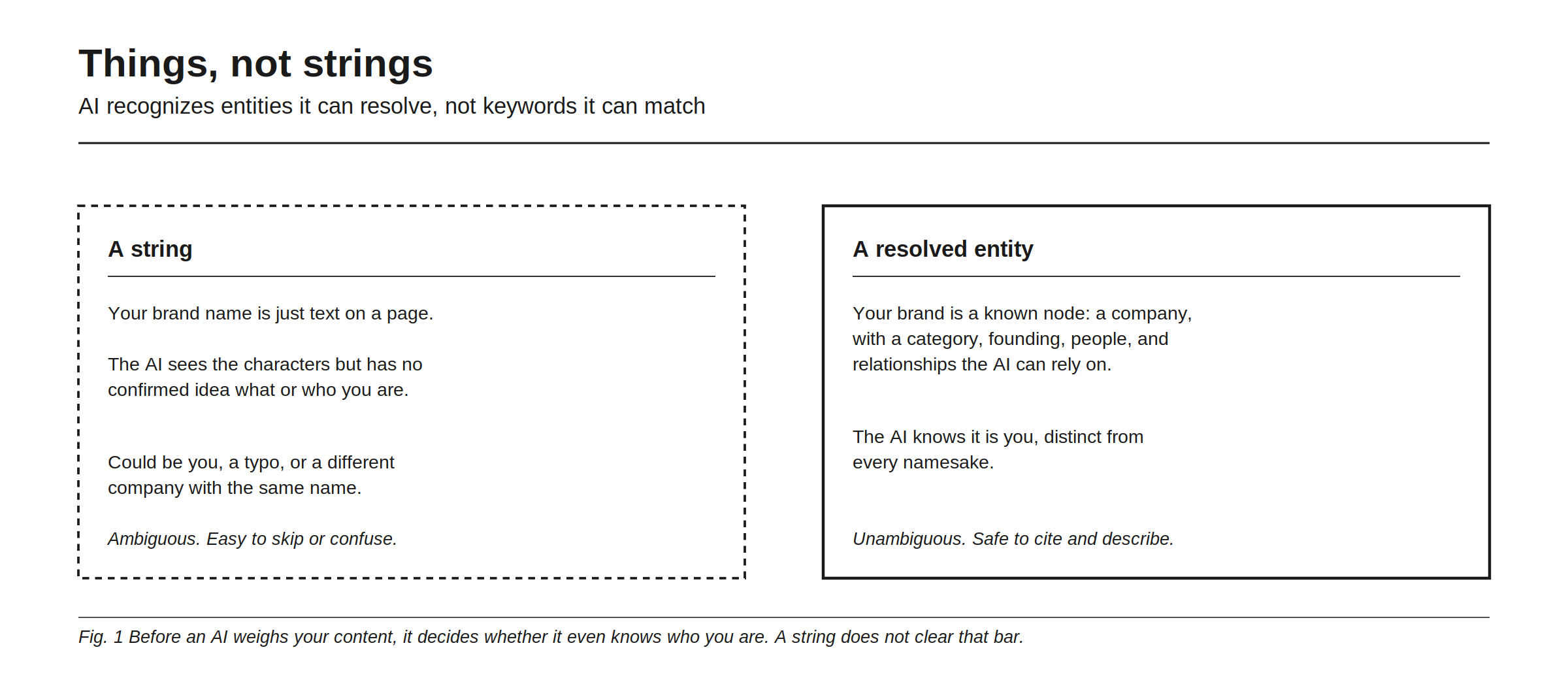
The mental shift is from text to entity. A string: your brand name is just text on a page, so the AI sees the characters but has no confirmed idea what or who you are, could be you, a typo, or a different company with the same name, ambiguous and easy to skip or confuse. A resolved entity: your brand is a known node, a company with a category, founding, people, and relationships the AI can rely on, so the AI knows it is you, distinct from every namesake, unambiguous and safe to cite and describe.
Before an AI weighs your content, it decides whether it even knows who you are, and a string does not clear that bar. This is the root cause behind a surprising share of visibility problems, including being described wrong, because an unresolved or thin entity is one the model fills in by guessing, the mechanism in when AI describes your brand wrong. Identity comes before content, always.
Recognition happens before content
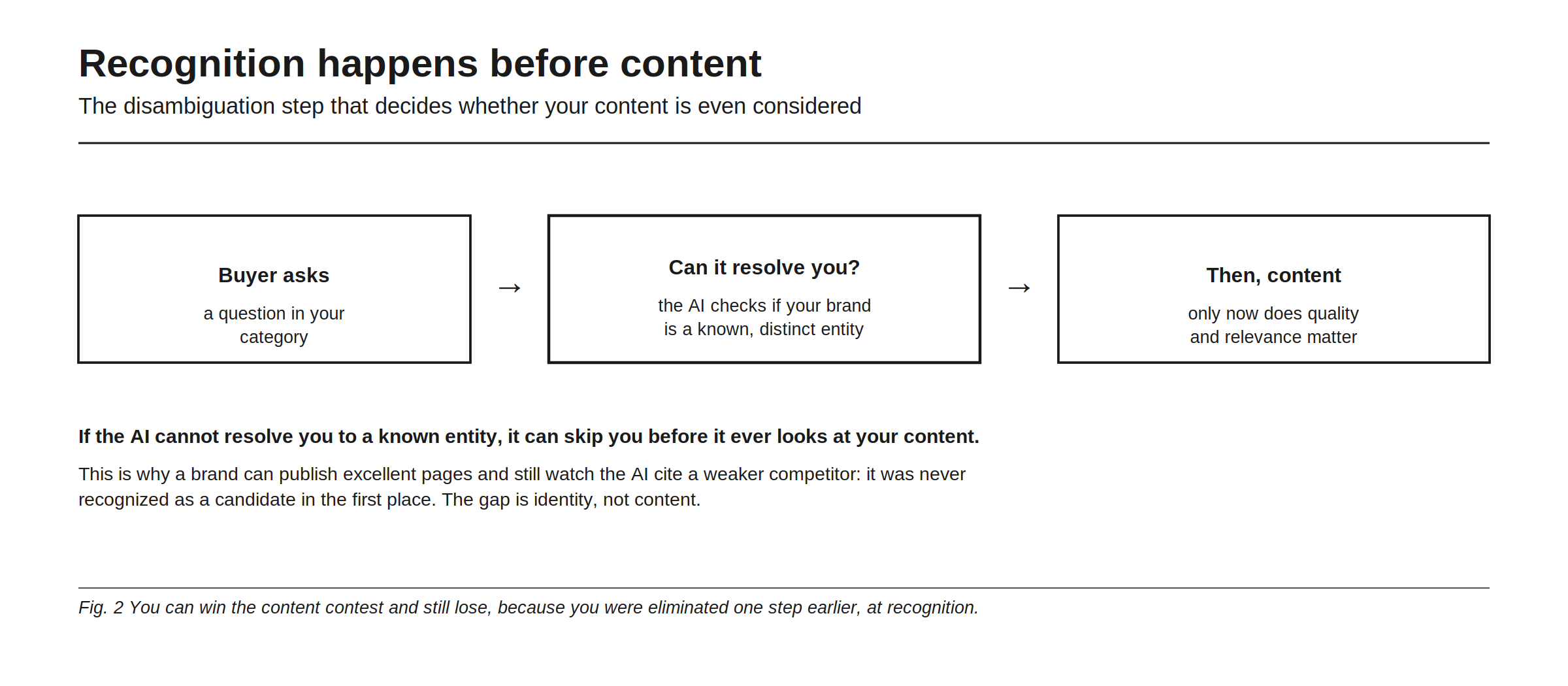
Follow the sequence. A buyer asks a question in your category. The AI checks whether it can resolve you, whether your brand is a known, distinct entity. Only then does content quality and relevance matter. If the AI cannot resolve you to a known entity, it can skip you before it ever looks at your content.
This is why a brand can publish excellent pages and still watch the AI cite a weaker competitor: it was never recognized as a candidate in the first place, so the gap is identity, not content. You can win the content contest and still lose, because you were eliminated one step earlier, at recognition. It also explains a finding that puzzles people, that the large majority of AI-cited pages sit outside the top of traditional search rankings: recognition and corroboration, not classic ranking, decide candidacy, which reframes the source logic in where AI actually gets its sources.
How to become a resolved entity
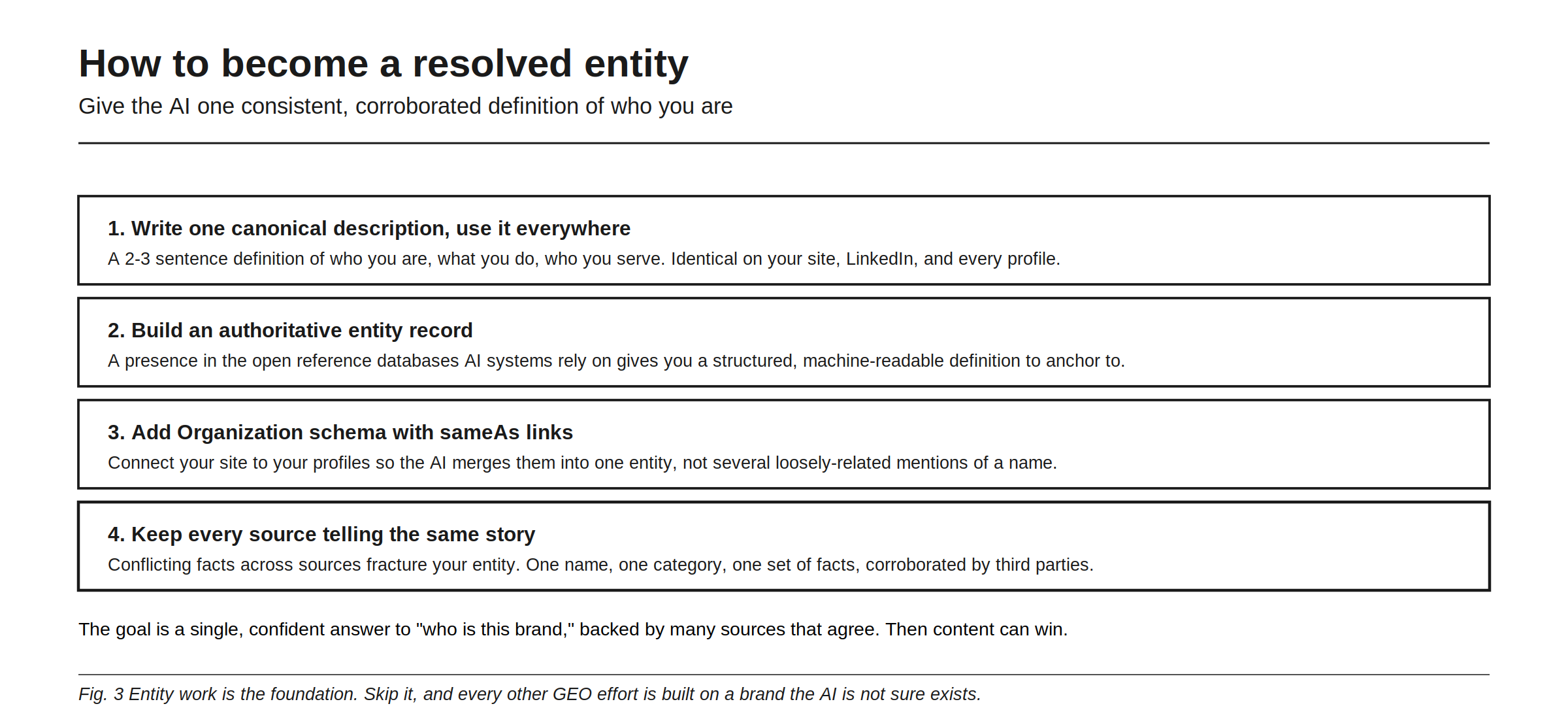
Four moves give the AI one confident definition of you. First, write one canonical description and use it everywhere: a 2-3 sentence definition of who you are, what you do, and who you serve, identical on your site, LinkedIn, and every profile, because consistency signals that all these profiles refer to the same entity. Second, build an authoritative entity record: a presence in the open reference databases AI systems rely on gives you a structured, machine-readable definition to anchor to. Third, add Organization schema with sameAs links: connect your site to your profiles so the AI merges them into one entity rather than several loosely-related mentions of a name, the schema foundation in what structured data actually does for AI visibility. Fourth, keep every source telling the same story: conflicting facts across sources fracture your entity, so one name, one category, one set of facts, corroborated by third parties.
The goal is a single, confident answer to “who is this brand,” backed by many sources that agree. Then content can win. Entity work is the foundation; skip it, and every other GEO effort is built on a brand the AI is not sure exists. How entity clarity then becomes a tiebreaker between similar brands is the subject of how AI picks between two nearly identical brands.
Two failure modes, opposite sizes
It helps to know the two ways entity recognition fails, because they hit different brands. Small and newer brands suffer invisibility: with a thin entity, weak structured data, and little presence in reference databases, the AI simply does not resolve them, and citation probability approaches zero no matter how good the content, a particular trap for early-stage companies convinced their problem is content when it is identity. Large, familiar brands suffer the opposite, a kind of overconfidence: the model is so familiar with the name that it generates plausible but wrong details, false attributions and invented specifics, because familiarity creates a strong surface for confident completion. So entity work is never “done”, the small brand builds recognition to exist, and the large brand maintains a tight, corroborated record to prevent confident errors. Both are solved the same way: one consistent, well-sourced definition of who you are, everywhere the AI looks, kept current. This is the layer beneath answer engine optimization generally, per answer engine optimization, and it is where a stalled GEO program most often turns out to be stuck. Rankry shows how each engine describes your brand, so you can see whether you are being recognized correctly, confused with a namesake, or filled in with invented facts, from $99 a month on a no-card trial.
FAQ
What is brand entity recognition in AI? It is the step where an AI identifies your brand as a distinct, real-world organization, a “thing” with a category, founding, people, and relationships, rather than as a string of text. AI systems resolve references to known entities before evaluating content, so recognition is a prerequisite for citation.
Why does AI cite my competitor even though my content is better? Often because the AI resolved your competitor to a known entity and could not resolve you. Recognition happens before content quality is weighed, so an unrecognized brand can be skipped as a candidate entirely, regardless of how strong its pages are. The gap is identity, not content.
How do I make AI recognize my brand as an entity? Give it one consistent, corroborated definition: a canonical 2-3 sentence description used identically across your site and profiles, a presence in the reference databases AI relies on, Organization schema with sameAs links connecting your profiles, and consistent facts across every source.
Why is a small brand invisible to AI even with good content? Because with a thin entity, weak structured data, and little presence in reference databases, the AI cannot confidently resolve who the brand is, so citation probability approaches zero regardless of content quality. Building entity recognition, not more content, is the fix.
Can a well-known brand have entity problems too? Yes, a different kind. Familiarity can make a model generate plausible but wrong details about a big brand, false attributions and invented specifics. Large brands need a tight, corroborated entity record to prevent confident errors, just as small brands need one to be recognized at all.
See whether each AI engine recognizes you correctly, confuses you with a namesake, or invents facts, so you can fix your entity. Start a free 7-day Rankry trial, no card, first report in two minutes.