When AI describes your brand incorrectly, it is worse than being left out, because a confident wrong fact does active damage while absence only loses a chance. The errors come in four types: outdated facts (a price or plan that changed), feature conflation (merging your tiers or mixing you with another product), fabricated details (an invented founding date or headquarters), and competitive misattribution (your feature credited to a rival). To fix it you detect it by asking each engine your own brand questions, trace each wrong fact to the source the model read, correct it at that source, and confirm by re-running the prompts until the answer changes, because a correction is done when the model returns the right fact, not when you publish. This guide walks through all four steps, and why speed matters.
Most AI visibility advice is about being seen. This is about being seen wrongly, which is the problem that quietly kills deals your analytics will never explain.
Four ways AI gets your brand wrong
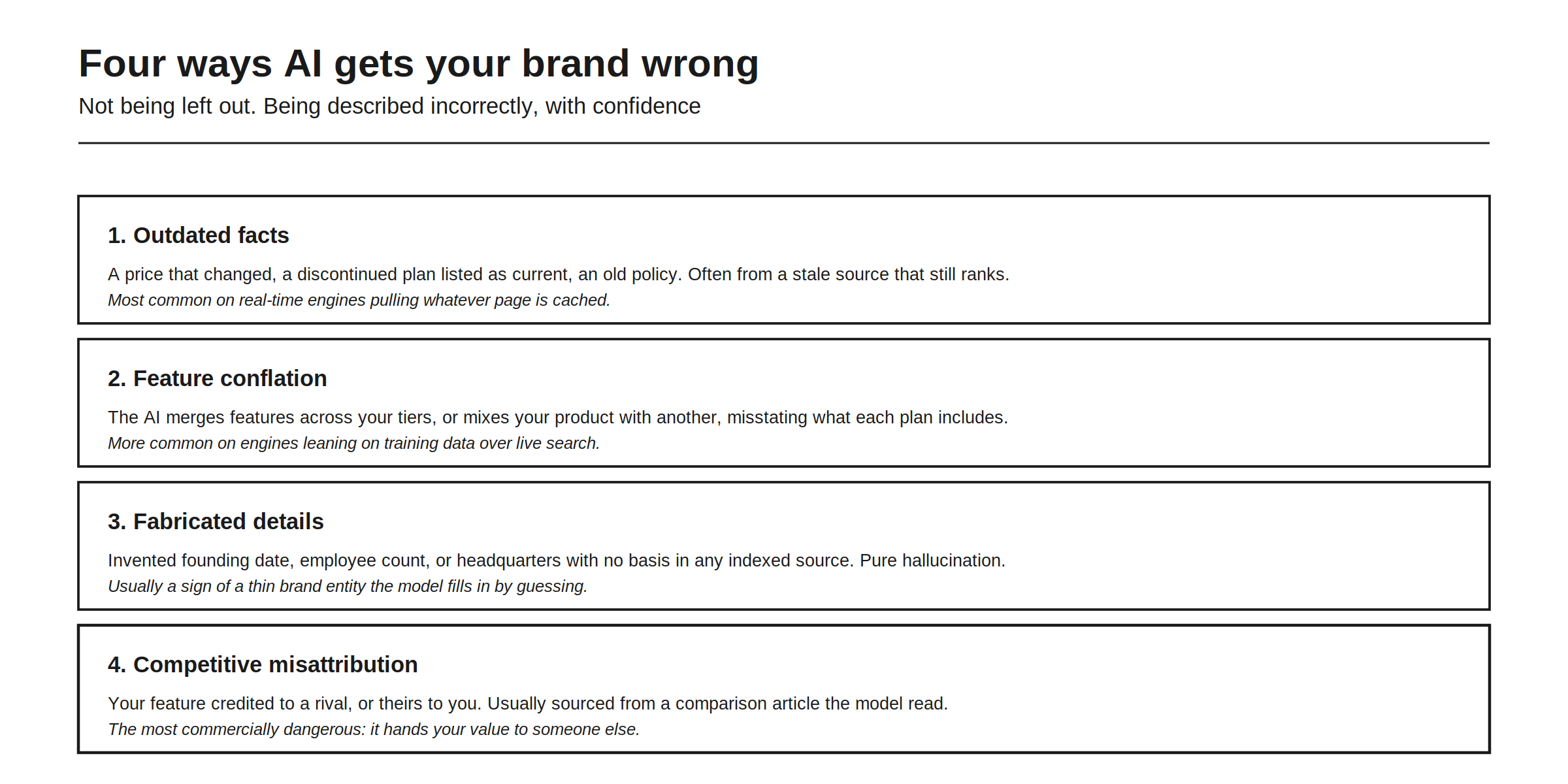
The errors are not random; they cluster into four recognizable types. Outdated facts: a price that changed, a discontinued plan listed as current, an old policy, often from a stale source that still ranks, most common on real-time engines pulling whatever page is cached. Feature conflation: the AI merges features across your tiers, or mixes your product with another, misstating what each plan includes, more common on engines leaning on training data over live search. Fabricated details: an invented founding date, employee count, or headquarters with no basis in any indexed source, pure hallucination, usually a sign of a thin brand entity the model fills in by guessing. And competitive misattribution: your feature credited to a rival, or theirs to you, usually sourced from a comparison article the model read, and the most commercially dangerous because it hands your value to someone else.
Knowing the type matters, because each has a different fix. An outdated fact means a stale source to update; a fabricated detail means a thin entity to strengthen; a misattribution means a comparison page to correct. The mechanics of how these errors form connect to answer engine optimization basics in answer engine optimization.
Why wrong is worse than invisible
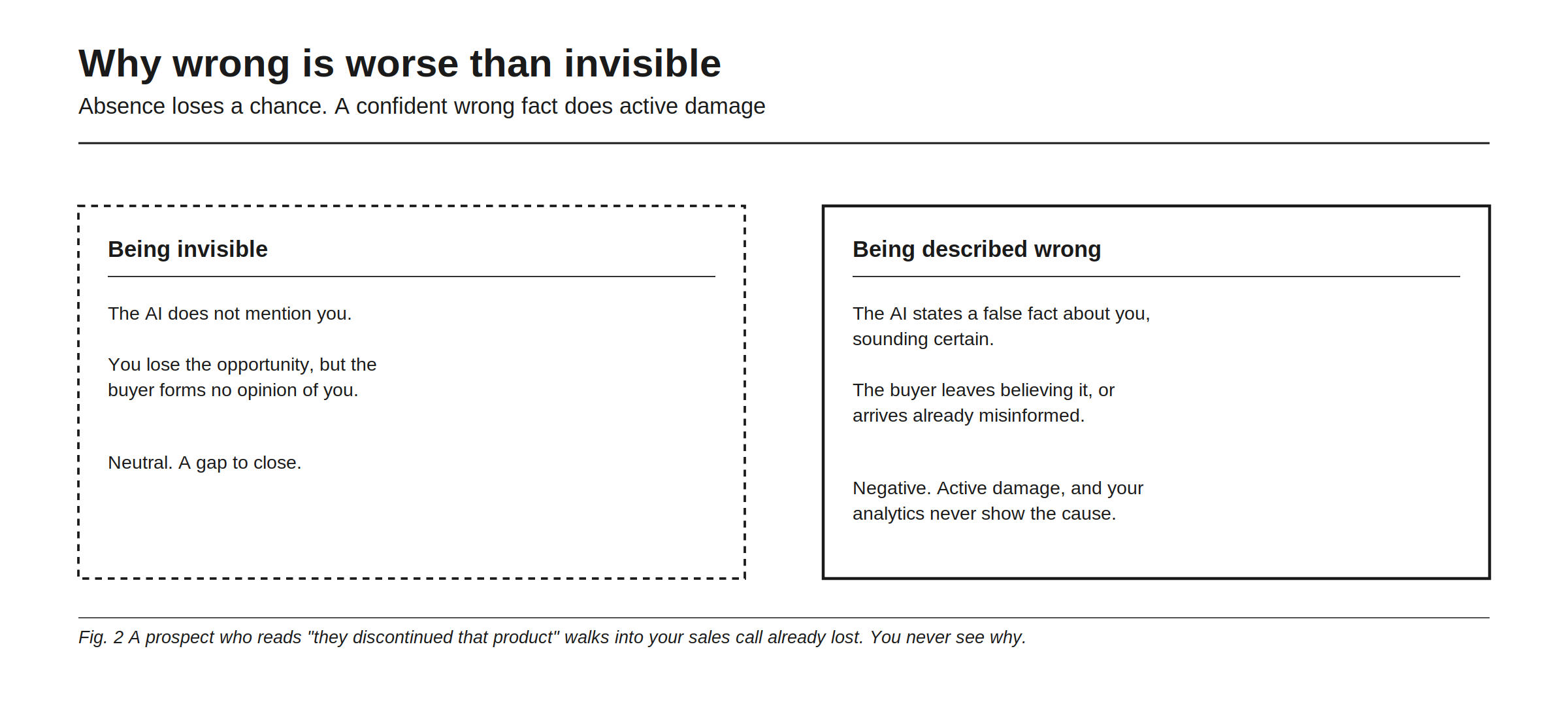
Put the two failure modes side by side. Being invisible: the AI does not mention you, so you lose the opportunity, but the buyer forms no opinion of you, a neutral gap to close. Being described wrong: the AI states a false fact about you sounding certain, so the buyer leaves believing it or arrives already misinformed, a negative outcome that does active damage while your analytics never show the cause.
The commercial version of this is brutal and real: a prospect types your name into ChatGPT before a call, reads that you discontinued your flagship product two years ago (you did not, it just won an award), and walks into the meeting already lost, an impression no demo fully reverses. That is why a wrong fact outranks invisibility on urgency. You are not missing from the conversation, you are actively misrepresented in it, and the buyer never tells you why they walked. The related but distinct problem of the AI recommending a competitor is in why ChatGPT recommends competitors.
Find it, trace it, fix it, confirm it
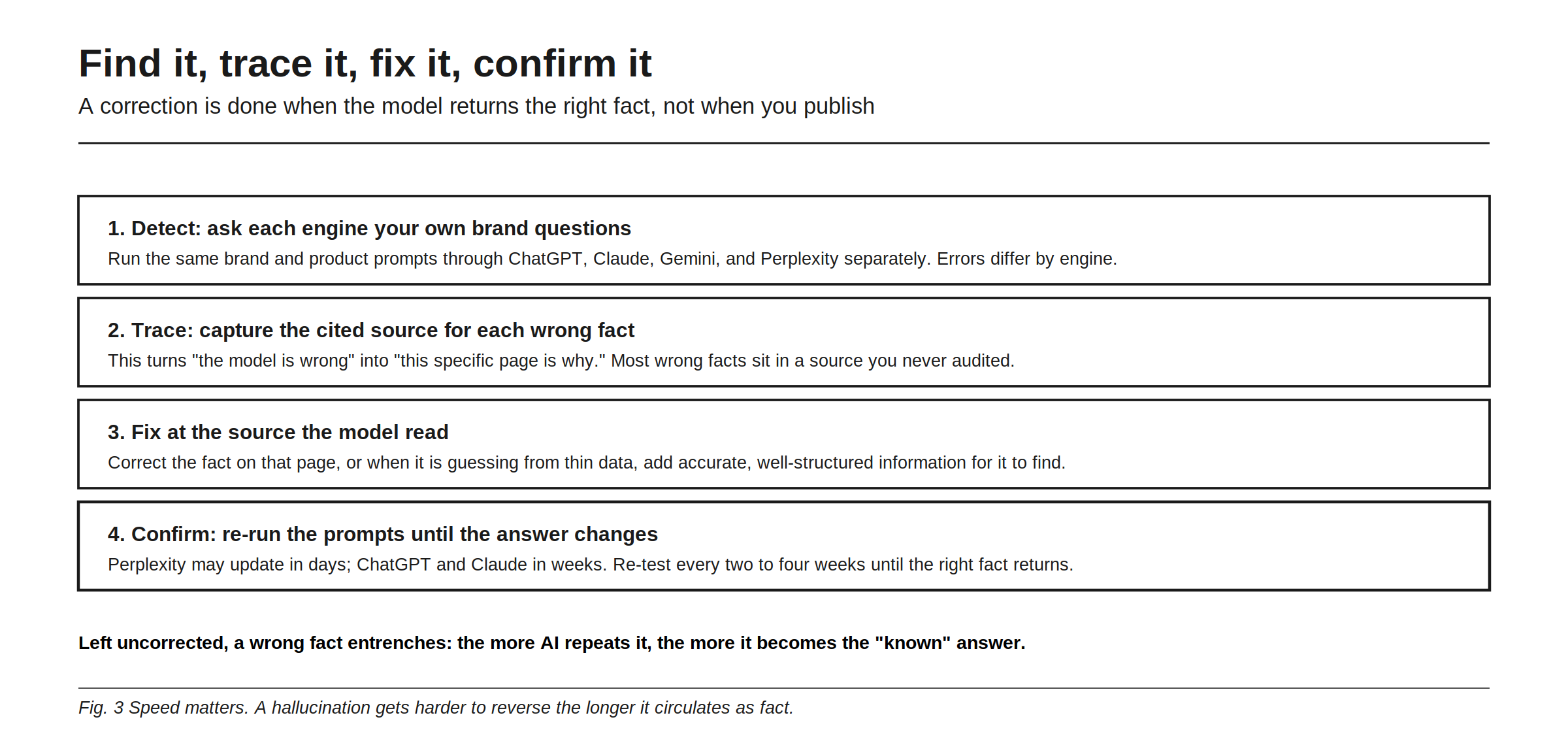
Four steps turn a vague worry into a closed loop. First, detect: ask each engine your own brand questions, running the same brand and product prompts through ChatGPT, Claude, Gemini, and Perplexity separately, because errors differ by engine. Second, trace: capture the cited source for each wrong fact, which turns “the model is wrong” into “this specific page is why,” since most wrong facts sit in a source you never audited. Third, fix at the source the model read: correct the fact on that page, or when the model is guessing from thin data, add accurate, well-structured information for it to find. Fourth, confirm: re-run the prompts until the answer changes, because Perplexity may update in days while ChatGPT and Claude take weeks, so re-test every two to four weeks until the right fact returns.
The reason the fourth step is non-negotiable: left uncorrected, a wrong fact entrenches, and the more AI repeats it, the more it becomes the “known” answer across systems, harder to reverse the longer it circulates. Speed matters. The tracing step, source-per-claim, is the same discipline as a full audit, covered in how to run an AI visibility audit.
Why the wrong fact usually isn’t on your site
Here is the part that surprises brands: your own website is only a small fraction of what a model reads about you, on the order of 5 to 10 percent. So when the AI states something wrong, the source is usually a page you do not control and have never audited, an old review, a stale comparison, a directory listing with last year’s pricing. This is why “we updated our website” often fails to fix the hallucination: you corrected 5 percent of the model’s evidence and left the 90 percent that caused the error untouched. The fix has to happen where the model actually read the wrong fact, which is why tracing the cited source is the whole game. That off-site source hierarchy is mapped in where AI actually gets its sources. Rankry captures the cited source behind each answer, so you can see exactly which page is telling the AI the wrong thing, across every engine you run, from $99 a month on a no-card trial.
FAQ
What is an AI brand hallucination? It is an AI model stating something false about your brand as if it were fact, an outdated price, a discontinued feature listed as current, an invented detail, or a competitor’s feature attributed to you. The model sounds certain, which is what makes it dangerous.
Why is AI describing my brand incorrectly? Usually because it read a stale or wrong source, merged details across products, or filled a thin brand entity by guessing. Your own site is only a small share of what the model reads, so the wrong fact often comes from a source you do not control.
Is being described wrong by AI worse than not appearing? Yes. Invisibility loses an opportunity but forms no opinion. A confident wrong fact actively misleads the buyer, who leaves or arrives misinformed, and your analytics never show the cause. It does damage rather than just missing a chance.
How do I fix wrong information AI has about my brand? Detect it by asking each engine your brand questions, trace each wrong fact to the source the model cited, correct it at that source, and re-run the prompts until the answer changes. Updating only your own website usually is not enough.
How long does it take to correct an AI hallucination? It varies by engine. Perplexity, which searches in real time, may reflect corrections within days. ChatGPT and Claude, which rely on periodically updated knowledge, can take weeks to months. Re-test every two to four weeks until the right fact returns.
See exactly which source is telling the AI the wrong thing about you, across every engine, so you can fix it where it lives. Start a free 7-day Rankry trial, no card, first report in two minutes.