Answer Engine Optimization (AEO) is the practice of optimizing your brand and content so that AI answer engines, like ChatGPT, Claude, Gemini, Perplexity, Grok, Microsoft Copilot, and Google AI Overviews, mention, cite, and recommend you in the answers they give. Where traditional SEO works to rank your page among a list of links, AEO works to make your brand part of the single synthesized answer the engine hands the user. It is the same goal, getting found, applied to a new kind of search where there is often no list to climb.
The reason this matters is simple. A growing share of buyers no longer scroll a page of results. They ask an assistant and act on the answer. If that answer names three companies and you are not one of them, you lost the buyer before they ever reached a search result. AEO is how you show up in that answer.
How AEO is different from SEO
The shift is bigger than it looks, because the unit of competition changed.
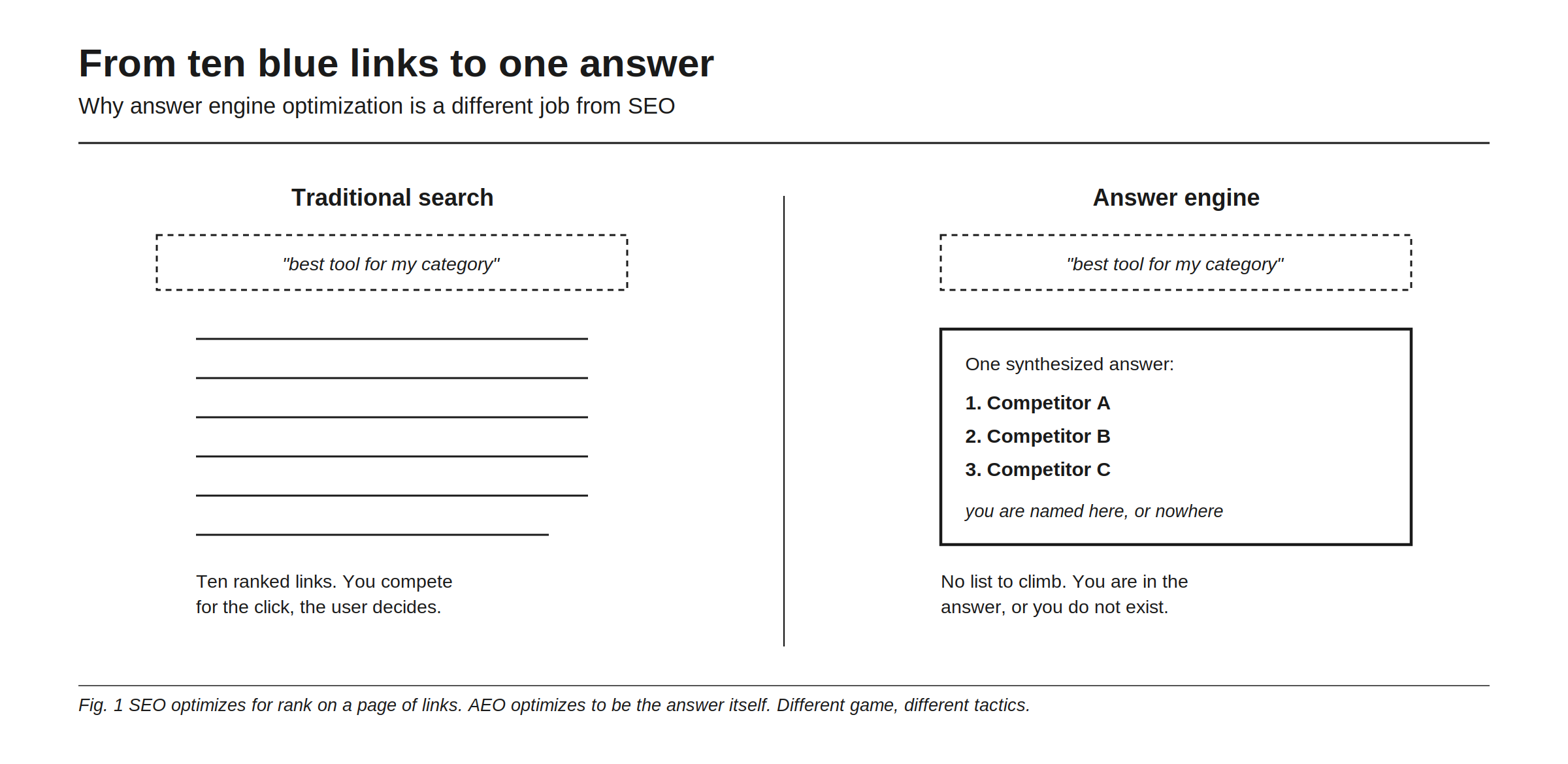
In traditional search, the engine returns ten ranked links and the user picks one. Your job is to rank high enough to earn the click, and you compete position by position. In an answer engine, the engine reads many sources and returns one answer, naming a few brands. There is no list to climb. You are in the answer or you are invisible, and being on page one of Google does nothing for you if the question moved to ChatGPT.
So AEO and SEO are not the same job. SEO optimizes a page to rank. AEO optimizes your whole presence, on your site and across the web, to be the answer. The skills overlap, but the target is different.
AEO, GEO, and SEO: the terms, briefly
These labels get used loosely, so here is the honest version. SEO (Search Engine Optimization) is the older discipline of ranking pages in search results. AEO (Answer Engine Optimization) and GEO (Generative Engine Optimization) are newer terms for the same emerging practice: getting cited and recommended inside AI-generated answers. Some people prefer one term over the other, but they describe the same work. If you want the deeper version, see what is generative engine optimization (GEO).
The four levers of AEO
When you optimize for answer engines, you are pulling four levers at once.
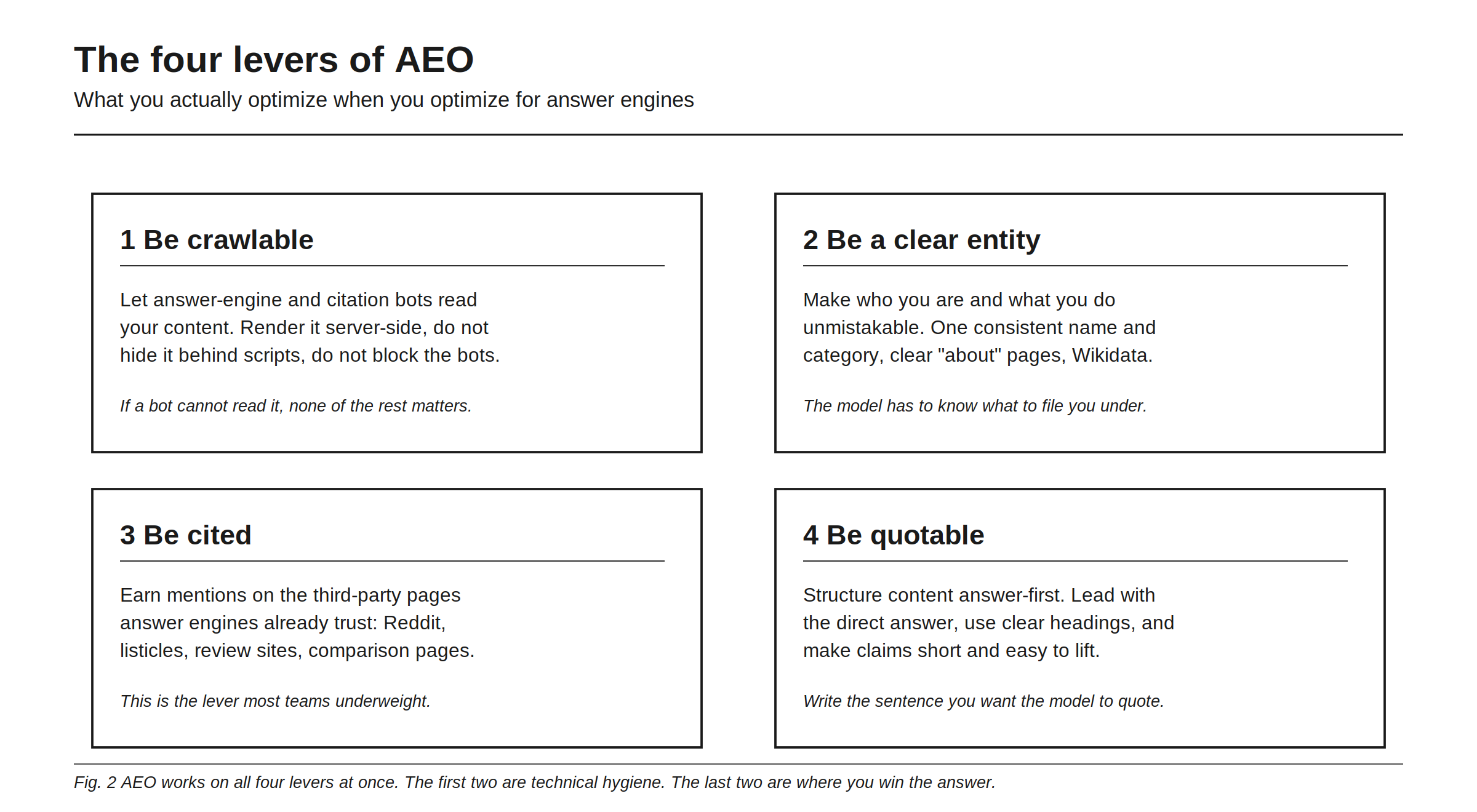
- Be crawlable. Let answer-engine and citation bots read your content. Render it server-side, do not hide it behind scripts, and do not block the bots that feed AI answers. If a bot cannot read your page, nothing else on this list matters.
- Be a clear entity. Make who you are and what you do unmistakable. Use one consistent name and category everywhere, write clear “about” content, and establish identity signals like a Wikidata entry. The model has to know what to file you under before it can recommend you.
- Be cited. Earn mentions on the third-party pages answer engines already trust, like Reddit, listicles, review sites, and comparison pages. This is the lever most teams underweight, because it lives off their own website. We go deeper on it in how to get cited by AI.
- Be quotable. Structure your content answer-first. Lead with the direct answer, use clear headings, and keep claims short and easy to lift. Write the sentence you want the model to quote back.
The first two levers are technical hygiene. The last two are where you actually win the answer.
Who needs AEO?
Any business where buyers compare options before they buy, which is most of them. B2B SaaS, e-commerce, local services, agencies, financial and healthcare brands, education. If a prospect might ask an AI assistant “what is the best option for X,” and your category is one where they would, you have an AEO problem whether you are measuring it or not.
How to start with AEO
Begin by measuring, not guessing. Pick the real questions your buyers would ask an assistant, run them across the major engines, and see whether you are named, where you rank, and which sources are cited. That baseline tells you which lever you are failing. From there, the work is concrete: fix crawlability, sharpen your entity, earn the missing third-party mentions, and rewrite key pages answer-first. Then re-measure.
That measurement loop is what an AI visibility tool automates. Rankry runs your category prompts across every engine you track, shows where you stand and which sources win the answers you lose, and turns it into a prioritized plan. You can see how it works on the features overview.
FAQ
What is Answer Engine Optimization in simple terms? It is the work of getting your brand mentioned, cited, and recommended inside AI-generated answers from tools like ChatGPT and Perplexity, instead of only ranking in traditional search results.
Is AEO the same as GEO? Effectively yes. AEO (Answer Engine Optimization) and GEO (Generative Engine Optimization) are two names for the same practice of optimizing for AI answers. People use them interchangeably.
How is AEO different from SEO? SEO ranks your page among a list of links. AEO makes your brand part of the single answer an AI engine gives. SEO competes for a click, AEO competes to be named in the answer itself.
Do I still need SEO if I do AEO? Yes. The two reinforce each other. Crawlability, clear content, and authority help both. AEO adds the third-party citation and entity work that AI answers specifically depend on.
How do I measure AEO? Run your buyer-intent prompts across the major AI engines and track whether you are mentioned, your position, and which sources are cited, then watch those metrics over time. An AI visibility tool does this automatically.
See how answer engines describe and rank your brand today. Start a free 7-day Rankry trial, no card, first report in two minutes.