Structured data (schema markup) helps AI visibility by making your facts machine-legible, it labels your price, brand, rating, and identity so an engine reads them without guessing, but it does not guarantee a citation, replace real content, or rescue a page an AI cannot crawl. The evidence is genuinely mixed: some studies find most AI-cited pages carry structured data, while others find no significant citation lift from adding JSON-LD alone, and Google states no special markup is required for generative search. The honest reading is that schema raises the floor rather than the ceiling: it makes you unambiguous and correct, which never hurts, but the citation is still won by substance, authority, and crawlability. One technical catch matters most: direct-fetch engines like ChatGPT, Claude, and Perplexity read only visible HTML, so schema injected by JavaScript may never be seen. This guide separates what schema does from what it doesn’t.
There is a lot of “add schema and dominate AI search” advice out there. The reality is quieter and more useful: schema is table stakes you should get right, not a lever you can pull for visibility.
What schema does, and what it doesn’t
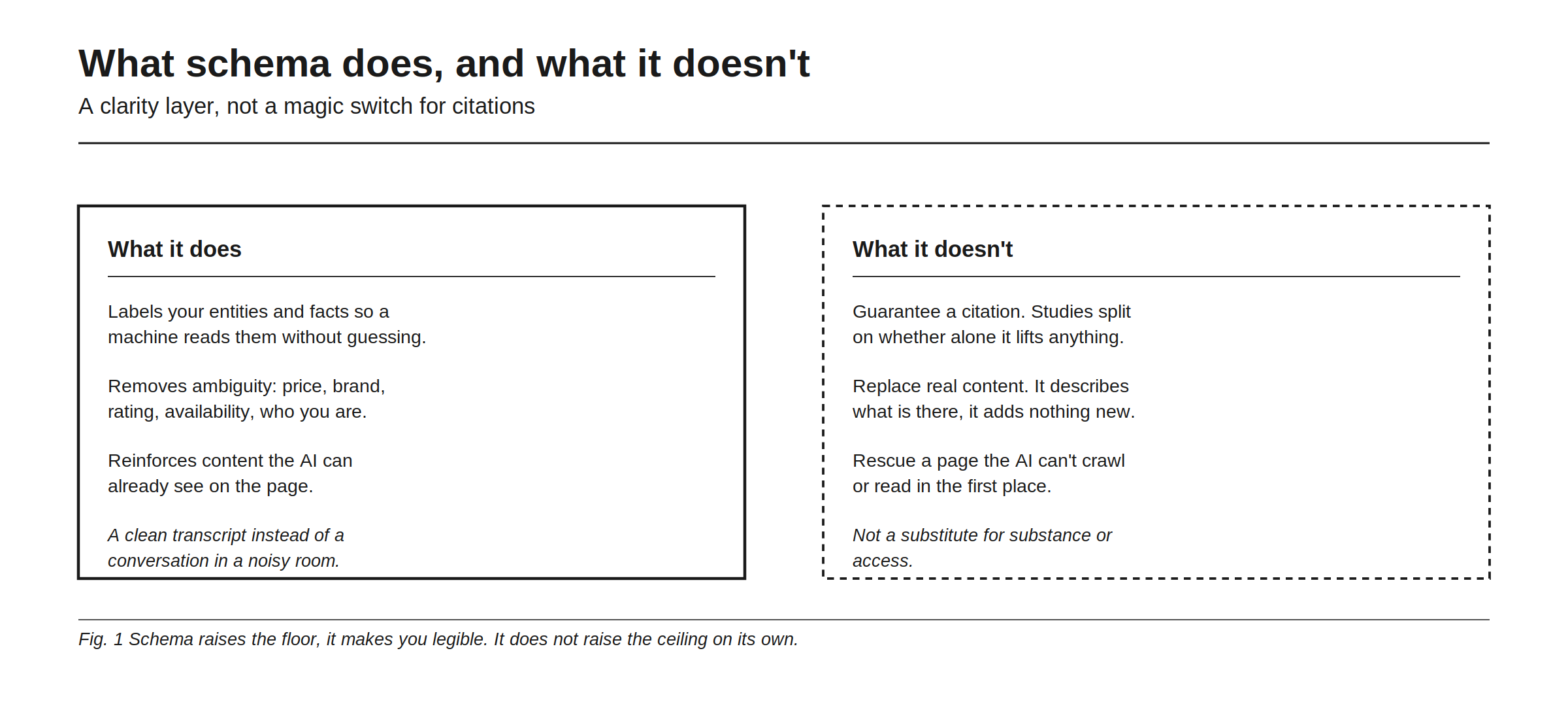
Split the claim in two. What it does: labels your entities and facts so a machine reads them without guessing, removes ambiguity around price, brand, rating, availability, and who you are, and reinforces content the AI can already see on the page, a clean transcript instead of a conversation in a noisy room. What it doesn’t: guarantee a citation, since studies split on whether it lifts anything alone; replace real content, because it describes what is there and adds nothing new; or rescue a page the AI cannot crawl or read in the first place. It is not a substitute for substance or access.
That framing resolves the contradictory studies. Schema correlates with citation because good, legible, well-maintained pages tend to have both schema and the qualities that earn citations, not because the markup itself is the cause. So do schema for legibility and correctness, the way it connects to answer engine optimization in answer engine optimization, and keep your expectations honest about what a script block can do on its own.
Two ways engines read your markup
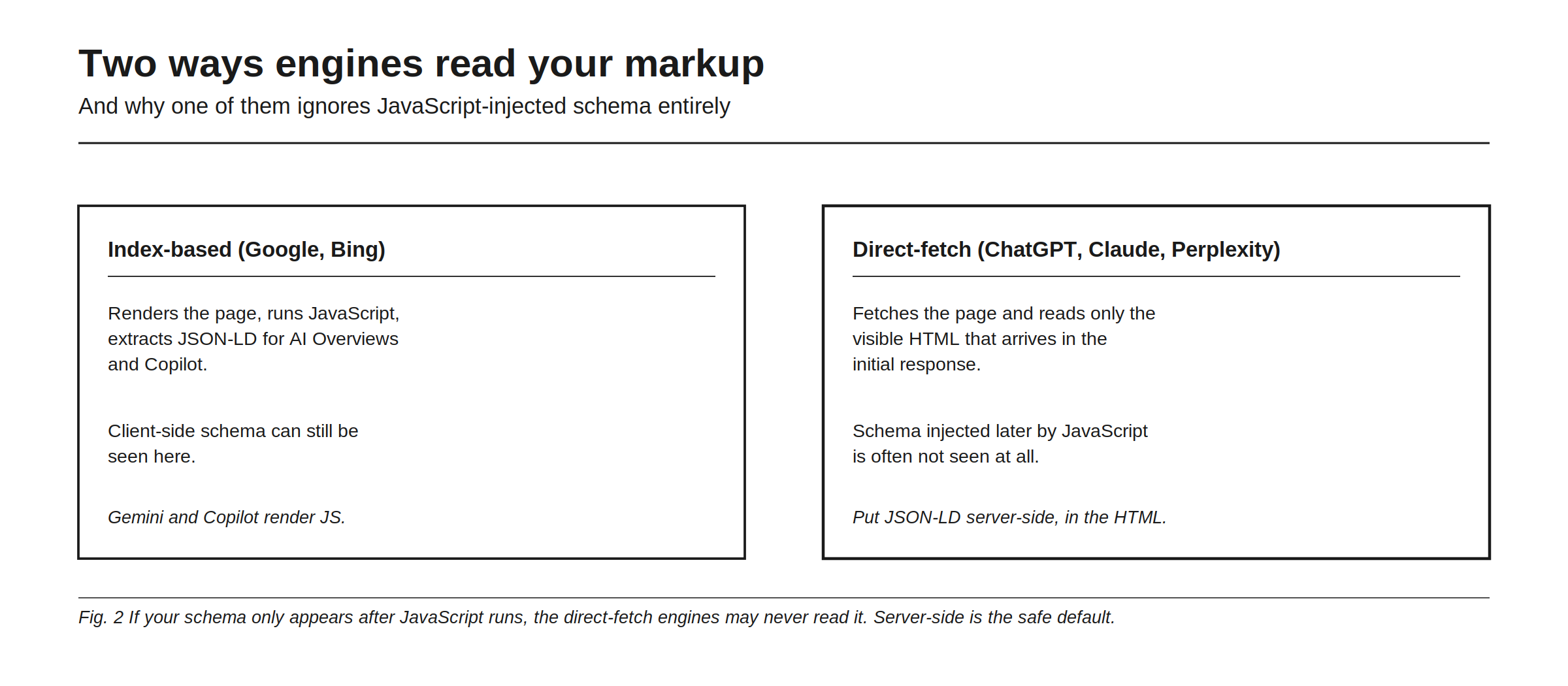
Here is the technical detail that decides whether your schema is even seen. Index-based engines (Google, Bing) render the page, run JavaScript, and extract JSON-LD for AI Overviews and Copilot, so client-side schema can still be seen there, and Gemini and Copilot render JS. Direct-fetch engines (ChatGPT, Claude, Perplexity) fetch the page and read only the visible HTML that arrives in the initial response, so schema injected later by JavaScript is often not seen at all, which is why you put JSON-LD server-side, in the HTML.
If your schema only appears after JavaScript runs, the direct-fetch engines may never read it, so server-side is the safe default. This is the same rendering split that can hide your entire page from those engines, not only your schema, which is the subject of why your pricing page is invisible to AI. Getting schema right is pointless if the engine cannot read the page it sits on.
How to use schema well
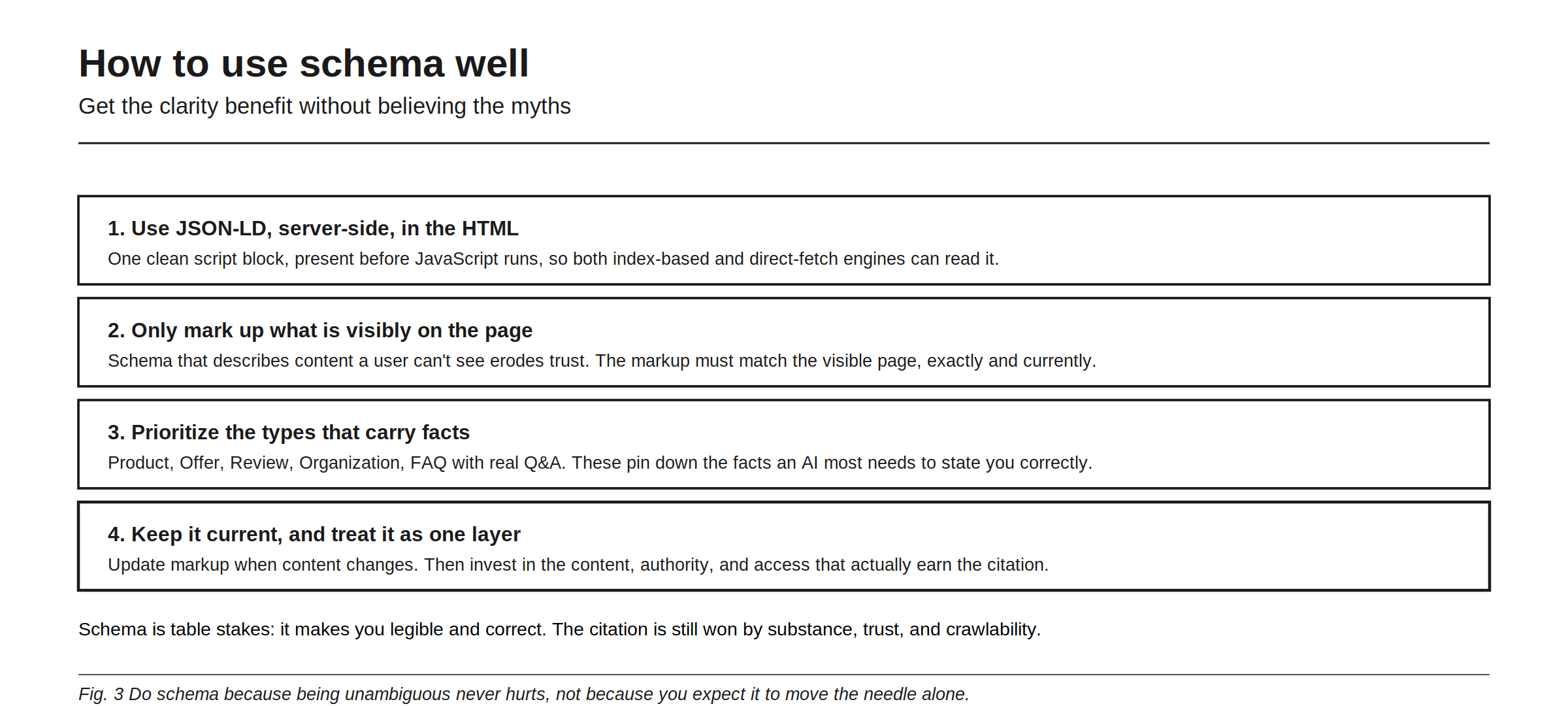
Four rules capture the benefit without the myths. First, use JSON-LD, server-side, in the HTML: one clean script block, present before JavaScript runs, so both index-based and direct-fetch engines can read it. Second, only mark up what is visibly on the page: schema describing content a user cannot see erodes trust, so the markup must match the visible page, exactly and currently. Third, prioritize the types that carry facts: Product, Offer, Review, Organization, and FAQ with real question-and-answer content, because these pin down the facts an AI most needs to state you correctly, which is how you avoid being described wrong, per when AI describes your brand wrong. Fourth, keep it current and treat it as one layer: update markup when content changes, then invest in the content, authority, and access that actually earn the citation, the source hierarchy in where AI actually gets its sources.
Schema is table stakes: it makes you legible and correct. The citation is still won by substance, trust, and crawlability. Do schema because being unambiguous never hurts, not because you expect it to move the needle alone.
The right mental model
The cleanest way to hold this is: schema is how you avoid being misunderstood, not how you get chosen. An AI that reads clean Product and Offer markup is far less likely to state your price wrong, mix up your variants, or confuse you with another brand, and that alone is worth the effort, because a confident wrong fact does real damage. But being understood correctly is the starting line, not the finish. Plenty of page-one Google results with perfect markup are ignored by AI engines because the content is thin, the authority is weak, or the crawler is blocked. So the sequence that works is: make sure the engine can reach and read your page, add server-side schema so it reads you accurately, then win the citation with genuinely useful content and real third-party trust. Skip the middle step and you risk being described wrong; treat the middle step as the whole job and you will wonder why flawless markup produced no visibility. Rankry shows whether engines are actually citing you and how they describe you, so you can tell whether your problem is legibility, which schema fixes, or something deeper it cannot, from $99 a month on a no-card trial.
FAQ
Does schema markup help with AI search visibility? It helps by making your facts machine-legible, so engines read your price, brand, and identity without guessing, and it reduces the risk of being described wrong. But evidence is mixed on whether schema alone lifts citations, and Google says no special markup is required for generative search. Treat it as a clarity layer, not a growth lever.
Which schema format should I use for AI? JSON-LD. It lives in a single script block separate from your HTML, which AI engines parse most cleanly, whereas Microdata and RDFa embed inside tags and can create parsing conflicts. Place the JSON-LD server-side so it is present before JavaScript runs.
Why might AI engines not see my structured data? Because direct-fetch engines like ChatGPT, Claude, and Perplexity read only the visible HTML in the initial response and often do not run JavaScript. If your schema is injected client-side by JavaScript, those engines may never see it. Server-side rendering avoids this.
Which schema types matter most for AI visibility? The ones that carry hard facts: Product, Offer, Review, and Organization, plus FAQ schema backed by real question-and-answer content on the page. These pin down the specific facts an AI needs to describe you accurately.
Will adding schema get me cited by ChatGPT? Not on its own. Schema makes you legible and correct, which supports citation, but studies are split on any direct lift, and citations depend on content quality, authority, and crawler access. Add schema as one layer, then invest in the substance and trust that actually earn the mention.
See whether AI engines cite you and describe you correctly, so you know if your gap is legibility or something schema can’t fix. Start a free 7-day Rankry trial, no card, first report in two minutes.