AI visibility works differently in regulated industries because healthcare, legal, and finance are “Your Money or Your Life” (YMYL) categories, where an AI raises its bar before citing anyone, leaning on credentialed, institutional, and heavily-vetted sources rather than whatever is merely useful and findable. Each vertical has its own set of default trusted sources the AI already reaches for, major medical institutions in healthcare, large personal-finance publishers in finance, legal directories and trade press in legal, so you are not competing for a blank slot, you are trying to be cited alongside institutions the engine defaults to. What earns a citation here is trust the machine can verify: named authors with checkable credentials, regulatory facts kept current (stale content gets filtered out, especially in finance), and presence on the institutional surfaces the AI already trusts. In regulated verticals, trust is not a tiebreaker, it is the entry requirement. This guide explains the differences and what to do.
If you run GEO for a regulated brand with a generic playbook, you will underperform, because the rules that govern who gets cited are stricter, and classic SEO position transfers poorly, especially in legal.
Why regulated verticals play differently
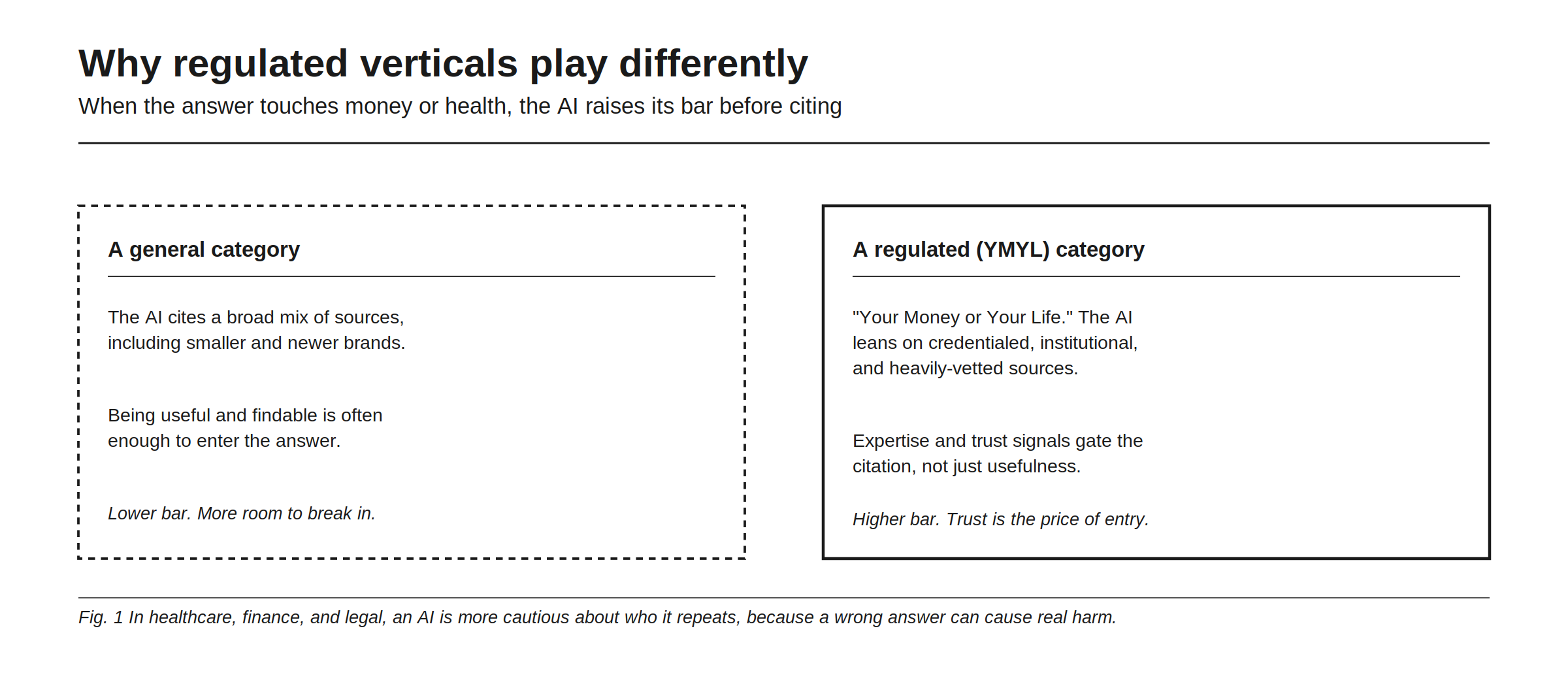
The contrast is structural. In a general category, the AI cites a broad mix of sources, including smaller and newer brands, and being useful and findable is often enough to enter the answer, a lower bar with more room to break in. In a regulated (YMYL) category, “Your Money or Your Life,” the AI leans on credentialed, institutional, and heavily-vetted sources, so expertise and trust signals gate the citation rather than usefulness alone, a higher bar where trust is the price of entry.
The reason is harm. In healthcare, finance, and legal, a wrong answer can cause real damage, so the engine is more cautious about who it repeats. This is the same source-hierarchy logic that governs all AI citation, from where AI actually gets its sources, but with the trust threshold turned up. Understanding that turned-up threshold is the whole difference between general and vertical GEO.
Who the AI already trusts, by vertical
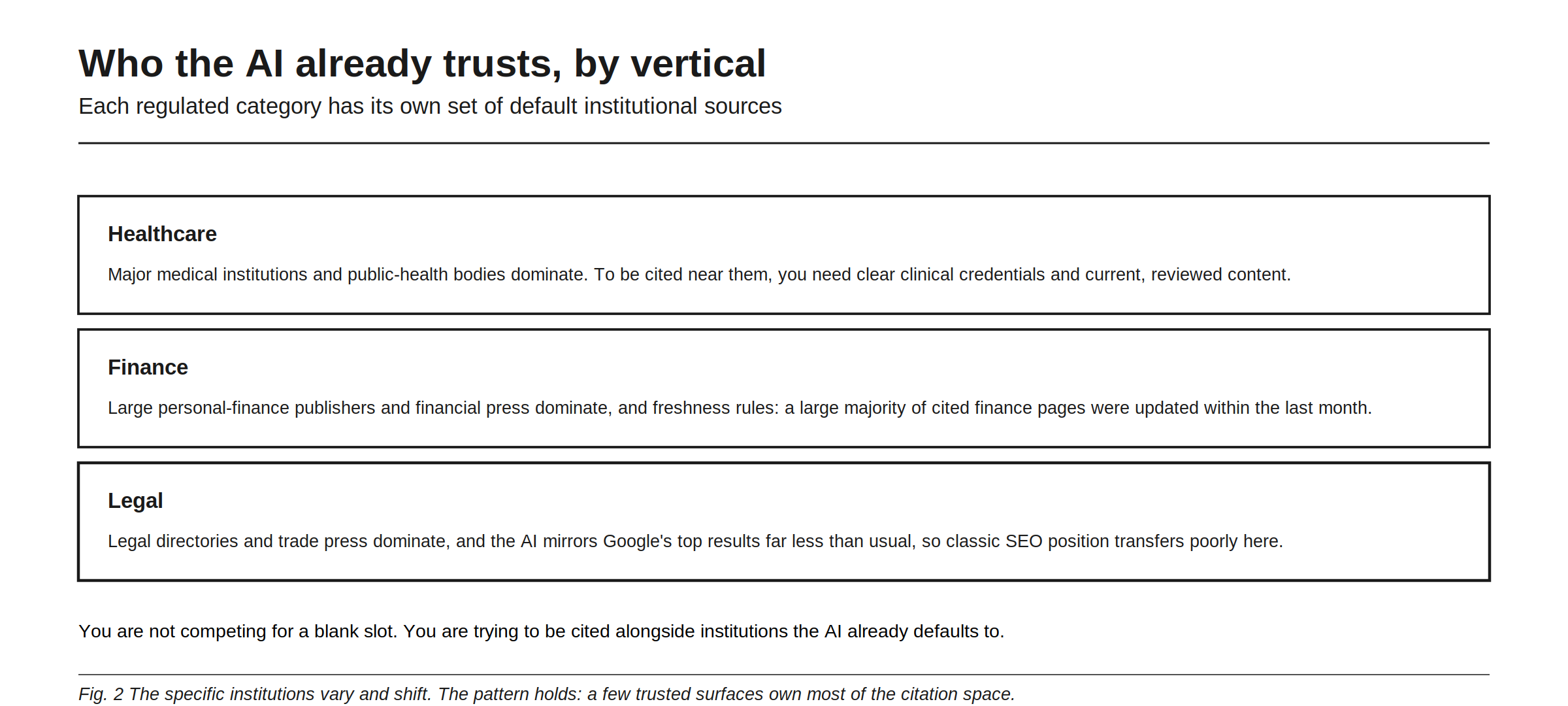
Each category has its own defaults. Healthcare: major medical institutions and public-health bodies dominate, so to be cited near them you need clear clinical credentials and current, reviewed content. Finance: large personal-finance publishers and financial press dominate, and freshness rules, with a large majority of cited finance pages updated within the last month. Legal: legal directories and trade press dominate, and the AI mirrors Google’s top results far less than usual, so classic SEO position transfers poorly here.
You are not competing for a blank slot; you are trying to be cited alongside institutions the AI already defaults to. The specific institutions vary by category and shift over time, but the pattern holds: a few trusted surfaces own most of the citation space. That concentration is exactly why breaking in requires the trust signals below, and why how an engine like Claude weighs source authority, in how Claude finds and cites sources, matters even more in these verticals.
Earning trust the AI can verify
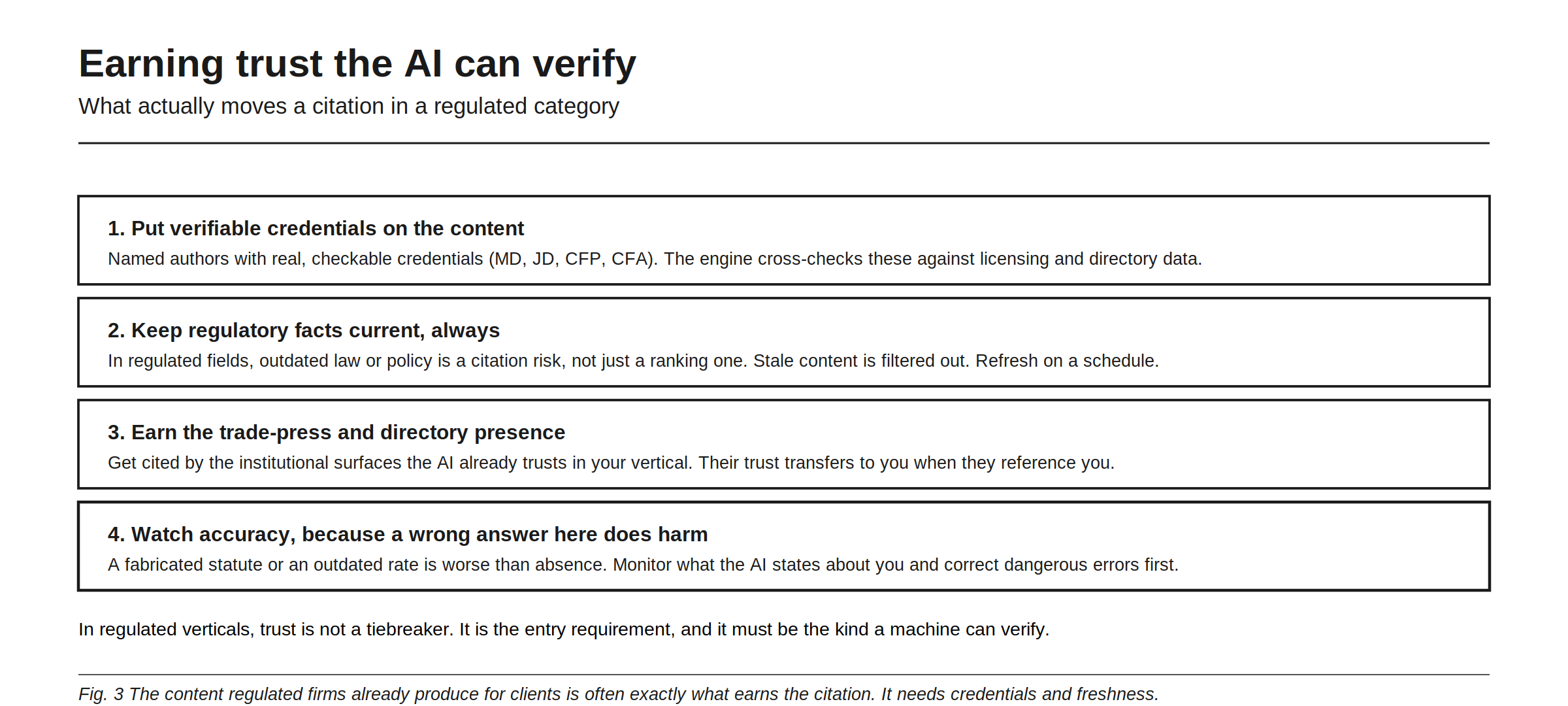
Four moves, all about verifiable trust. First, put verifiable credentials on the content: named authors with real, checkable credentials (MD, JD, CFP, CFA), because the engine cross-checks these against licensing and directory data. Second, keep regulatory facts current, always: in regulated fields, outdated law or policy is a citation risk, not just a ranking one, so stale content gets filtered out and you refresh on a schedule, the freshness discipline in the 3-month citation cliff. Third, earn the trade-press and directory presence: get cited by the institutional surfaces the AI already trusts in your vertical, because their trust transfers to you when they reference you. Fourth, watch accuracy, because a wrong answer here does harm: a fabricated statute or an outdated rate is worse than absence, so monitor what the AI states about you and correct dangerous errors first, per when AI describes your brand wrong.
In regulated verticals, trust is not a tiebreaker, it is the entry requirement, and it must be the kind a machine can verify. The good news: the content regulated firms already produce for clients, accurate, structured, expert, is often exactly what earns the citation. It mainly needs credentials attached and freshness maintained.
The reframe that makes vertical GEO winnable
It is easy to look at a citation space dominated by household-name institutions and conclude there is no room. That is the wrong read. The institutions win the broad, generic queries, “what is a Roth IRA,” “symptoms of X,” but buyers researching a specific provider, product, or firm ask narrower questions where the giant publishers have nothing specific to say. That is your opening: the specific, credentialed, current answer to the exact question your buyer asks during vendor or provider research. And because these categories reward verifiable expertise over marketing polish, a smaller regulated firm with genuine credentials and disciplined freshness can out-cite a larger competitor that relies on hedged, undated marketing copy. The framing the AI uses about you also matters more here, “trusted and credentialed” versus “unproven” is a life-or-livelihood decision for the reader, which ties into how AI frames your brand. The work is narrower and stricter than general GEO, but it is winnable precisely because most competitors in regulated fields are still publishing uncredentialed, undated content. Rankry tracks how AI engines cite and describe your regulated brand, per engine, and flags where the answer is stale or wrong, so you can fix the highest-risk errors first, from $99 a month on a no-card trial.
FAQ
Why is AI visibility harder in regulated industries? Because healthcare, legal, and finance are YMYL (“Your Money or Your Life”) categories, where a wrong answer can cause real harm. AI engines raise their bar, favoring credentialed, institutional, and heavily-vetted sources, so expertise and trust signals gate the citation rather than usefulness alone.
What are YMYL and E-E-A-T, and why do they matter for AI? YMYL flags topics affecting money, health, or safety, held to stricter quality standards. E-E-A-T (Experience, Expertise, Authoritativeness, Trustworthiness) is the framework for judging that quality. AI engines apply both before citing in regulated fields, so demonstrable, verifiable expertise is required to be trusted as a source.
How do author credentials affect AI citations in regulated fields? Strongly. A byline with real credentials (MD, JD, CFP, CFA) signals professional authority, and engines can cross-check those credentials against licensing and directory data. Adding verifiable credentials to content in healthcare, finance, and legal is one of the more direct trust signals you can provide.
Does normal SEO ranking transfer to AI visibility in these verticals? Poorly, especially in legal, where the AI mirrors Google’s top results far less than usual. Being on page one of search does not guarantee AI citation in regulated categories, because the engine weights credentialed and institutional trust signals differently from classic ranking factors.
Why does content freshness matter so much in finance? Because financial facts change and outdated information is risky, AI engines filter stale finance content out aggressively, with a large majority of cited finance pages updated within the last month. Regularly refreshing rates, rules, and regulatory references is close to mandatory to stay citable.
See how AI engines cite and describe your regulated brand, and catch stale or wrong answers before they do harm, per engine. Start a free 7-day Rankry trial, no card, first report in two minutes.