AI brand sentiment is not usefully measured as positive or negative, because roughly 80% of AI brand mentions are neutral and openly negative framing is rare, so a “mostly neutral” score tells you almost nothing. What matters is the framing: the specific words the AI uses, reliable, expensive, niche, complex, “best for beginners,” “great for enterprise.” And framing can be commercially mismatched: a positive-sounding description aimed at the wrong buyer costs you more than a neutral one aimed at the right buyer. So the real question is not “does the AI sound positive,” it is “does this framing help the right buyer choose me.” This guide explains why binary sentiment fails, how framing quietly steers buyers, and how to track and shift the exact wording.
Most sentiment tools give you a green or red dot. That dot is nearly useless here, because the thing steering your buyers is not polarity, it is phrasing.
Positive/negative misses the point
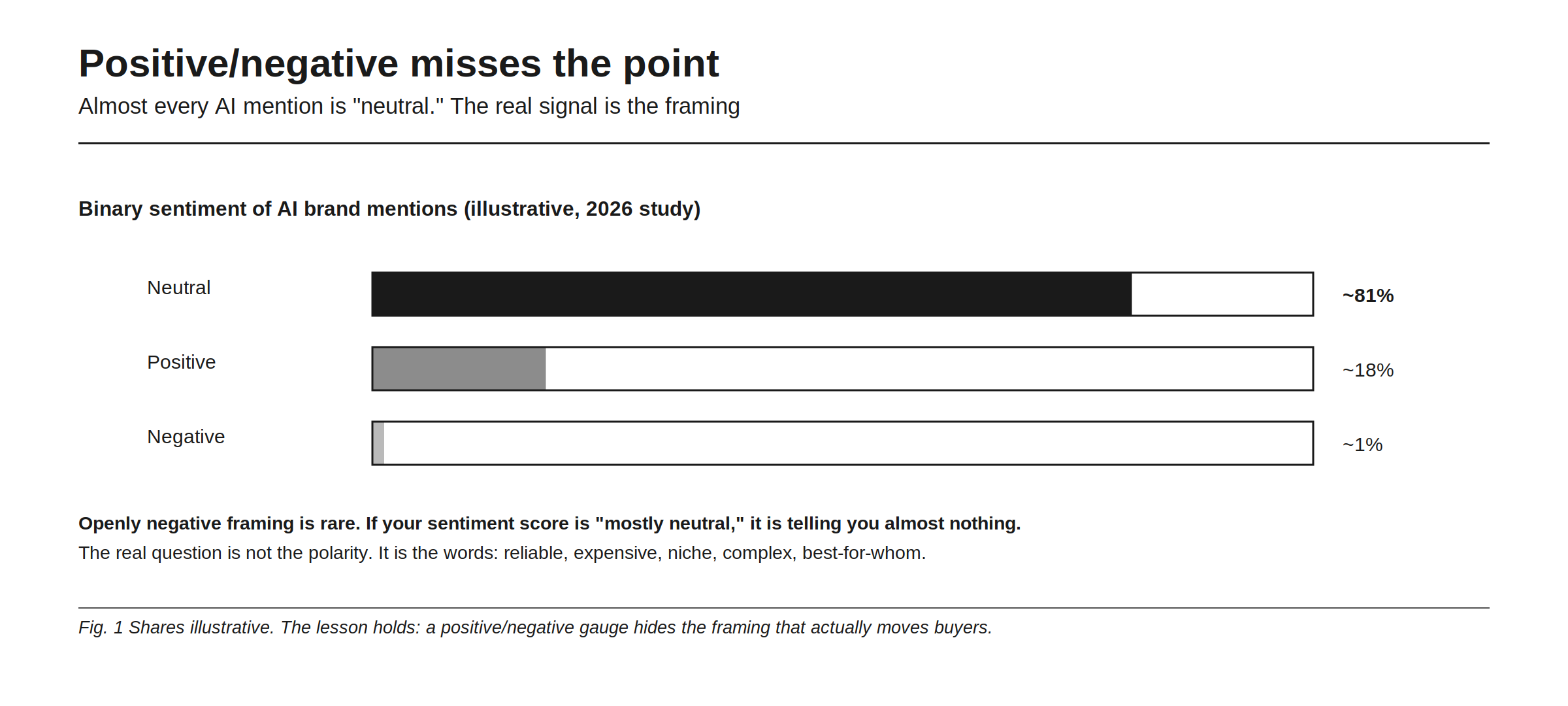
Look at the distribution and the problem becomes obvious. In 2026 analyses of AI brand mentions, roughly 81% are neutral, about 18% positive, and around 1% negative. Openly negative framing is rare, so if your sentiment score reads “mostly neutral,” it is telling you almost nothing, because almost everyone’s does. The real question is not the polarity, it is the words: reliable, expensive, niche, complex, and the “best for whom” phrasing that decides whether the right buyer shortlists you.
This is why a binary gauge is the wrong instrument. It compresses the one thing that carries meaning, the qualitative characterization, into a dot that is green for nearly everyone. The distinction between a mention existing and what that mention does for you is the same axis as brand mentions versus citations, taken one level deeper into the language itself.
Positive can still be wrong for you
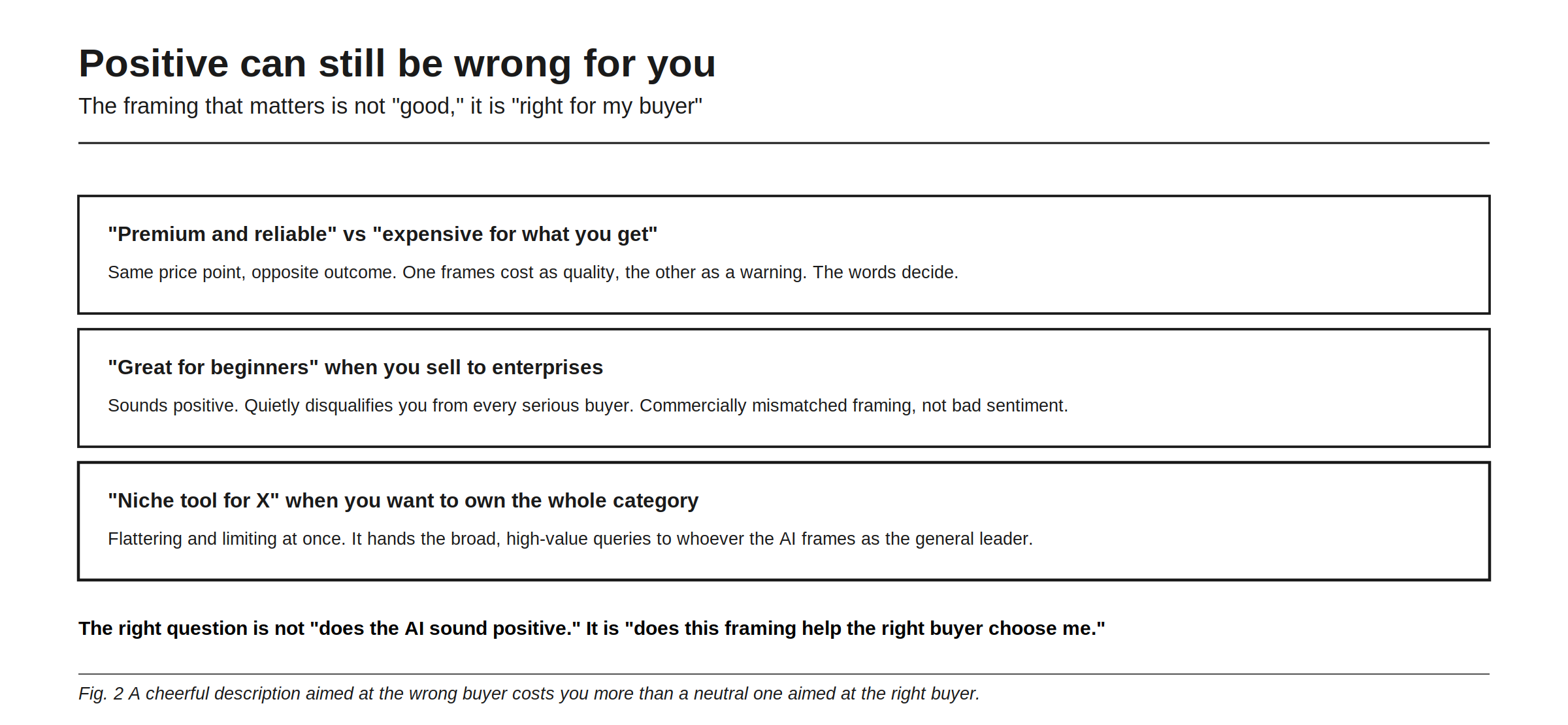
Here is the counterintuitive core: a positive description can actively hurt you. “Premium and reliable” versus “expensive for what you get”, same price point, opposite outcome, because one frames cost as quality and the other as a warning, and the words decide. “Great for beginners” when you sell to enterprises sounds positive but quietly disqualifies you from every serious buyer, commercially mismatched framing rather than bad sentiment. “Niche tool for X” when you want to own the whole category is flattering and limiting at once, handing the broad, high-value queries to whoever the AI frames as the general leader.
The right question is not “does the AI sound positive,” it is “does this framing help the right buyer choose me.” A cheerful description aimed at the wrong buyer costs you more than a neutral one aimed at the right buyer. This is where sentiment connects directly to revenue, because framing determines whether you even enter the consideration set, which is the mechanism behind the mention-versus-recommendation gap.
How to track and shift your framing
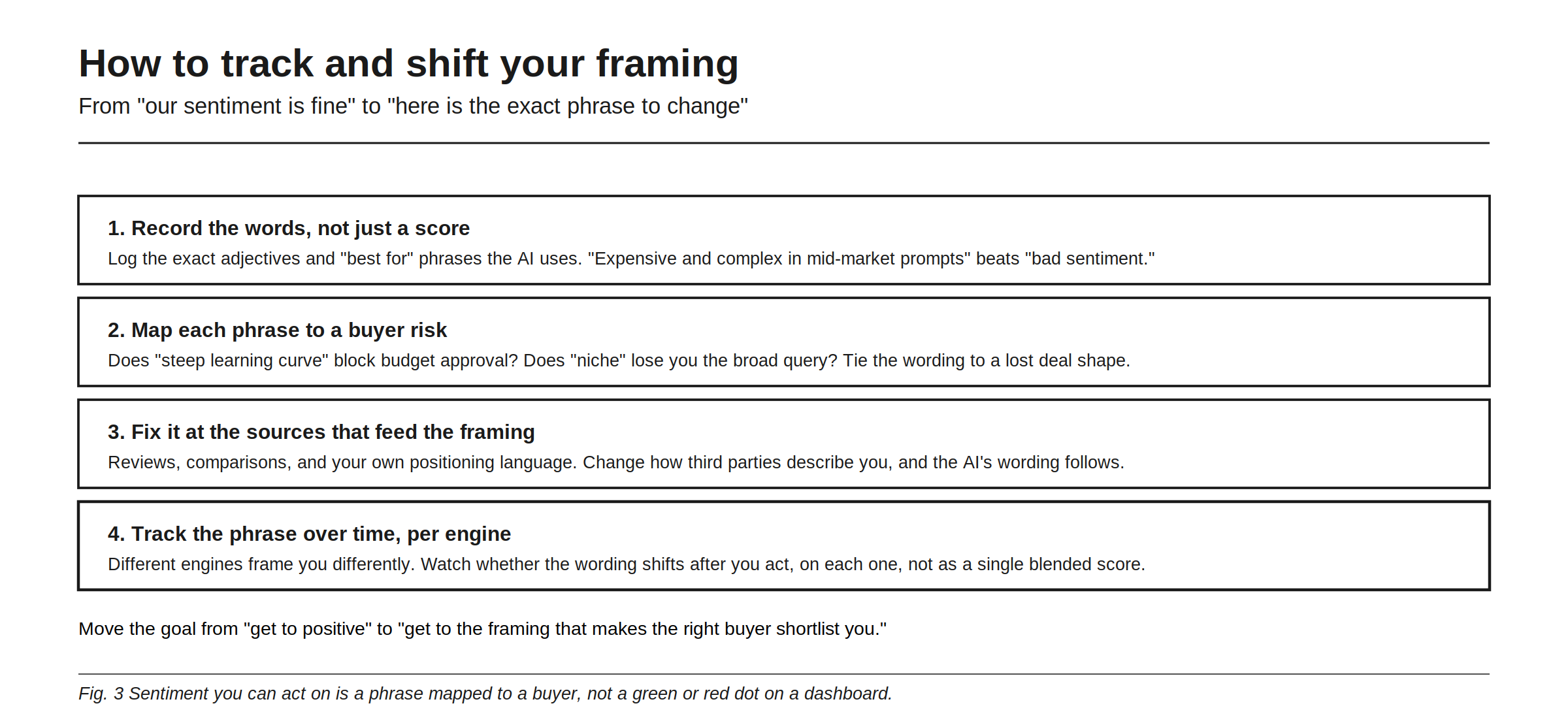
Four steps turn “our sentiment is fine” into “here is the exact phrase to change.” First, record the words, not just a score: log the exact adjectives and “best for” phrases the AI uses, because “expensive and complex in mid-market prompts” is actionable while “bad sentiment” is not. Second, map each phrase to a buyer risk: does “steep learning curve” block budget approval, does “niche” lose you the broad query, so you tie the wording to a lost deal shape. Third, fix it at the sources that feed the framing: reviews, comparisons, and your own positioning language, because when you change how third parties describe you, the AI’s wording follows, which is the source-hierarchy point from where AI actually gets its sources. Fourth, track the phrase over time, per engine, because different engines frame you differently, so watch whether the wording shifts after you act on each one rather than as a single blended score.
Move the goal from “get to positive” to “get to the framing that makes the right buyer shortlist you.” Sentiment you can act on is a phrase mapped to a buyer, not a green or red dot on a dashboard. Tracking it per engine is part of the broader monitoring discipline in how to monitor your brand across AI search engines.
Why framing sticks harder than a review
There is a reason AI framing deserves more attention than traditional sentiment. When a model blends many sources into one coherent characterization, buyers rarely cross-check it, so the framing in a single answer carries outsized weight compared with any one review. A skeptical reader discounts a single bad review; almost nobody discounts the AI’s synthesized verdict, because it reads as objective fact rather than opinion. And that characterization can persist across millions of queries until the model updates, compounding in a way a social post never does. So a mismatched frame is not a passing PR issue, it is a standing position in how your category is described to every buyer who asks. That is why the work is not “improve sentiment” but “own the words,” continuously, per engine. Rankry captures the actual language each engine uses about you, so you can see the framing, not just a polarity score, from $99 a month on a no-card trial.
FAQ
What is AI brand sentiment? It is the tone and qualitative characterization an AI assistant uses when describing your brand, whether it frames you as reliable, expensive, niche, complex, or “best for” a particular buyer. It reflects how the model synthesized its sources into a coherent verdict about you.
Why is positive/negative sentiment not enough? Because roughly 80% of AI brand mentions are neutral and openly negative framing is rare, so a polarity score reads “neutral” for almost everyone and tells you almost nothing. The meaning lives in the specific words, not the positive-or-negative label.
Can a positive AI description still hurt my brand? Yes. “Great for beginners” when you sell to enterprises, or “niche tool” when you want the whole category, sounds positive but disqualifies you from the buyers you want. Framing can be commercially mismatched even when the tone is favorable.
How do I change how AI frames my brand? Record the exact phrases the AI uses, map each to a buyer risk, and fix it at the sources that feed the framing, reviews, comparisons, and your own positioning language. When third-party descriptions change, the AI’s wording tends to follow.
Does AI framing differ between engines? Yes. ChatGPT, Claude, Gemini, Perplexity, and Grok can describe the same brand in different words because they weigh sources differently. Track the framing per engine rather than as a single blended sentiment score.
See the actual words each engine uses about your brand, not just a polarity score, so you can fix the framing that matters. Start a free 7-day Rankry trial, no card, first report in two minutes.