To monitor your brand across AI search engines, run a fixed set of real buyer prompts through ChatGPT, Claude, Gemini, Perplexity, Grok, Microsoft Copilot, and Google AI Overviews on a weekly schedule, and record four signals for each: whether you are mentioned, your position, how you are described, and which sources the engine cites. Then read the week-over-week delta, not the raw score, and fix the worst new loss each cycle. You can run this loop manually in two to three hours a week for one engine, or automate it across the five that matter with a tool like Rankry from $99 a month.
This guide covers the full system: what to track, how often, how to do it by hand, when to automate, and the mistakes that make monitoring data worthless. It is the ongoing practice that follows a one-time audit, and the difference between the two is where most teams go wrong first.
An audit is a photo. Monitoring is a movie.
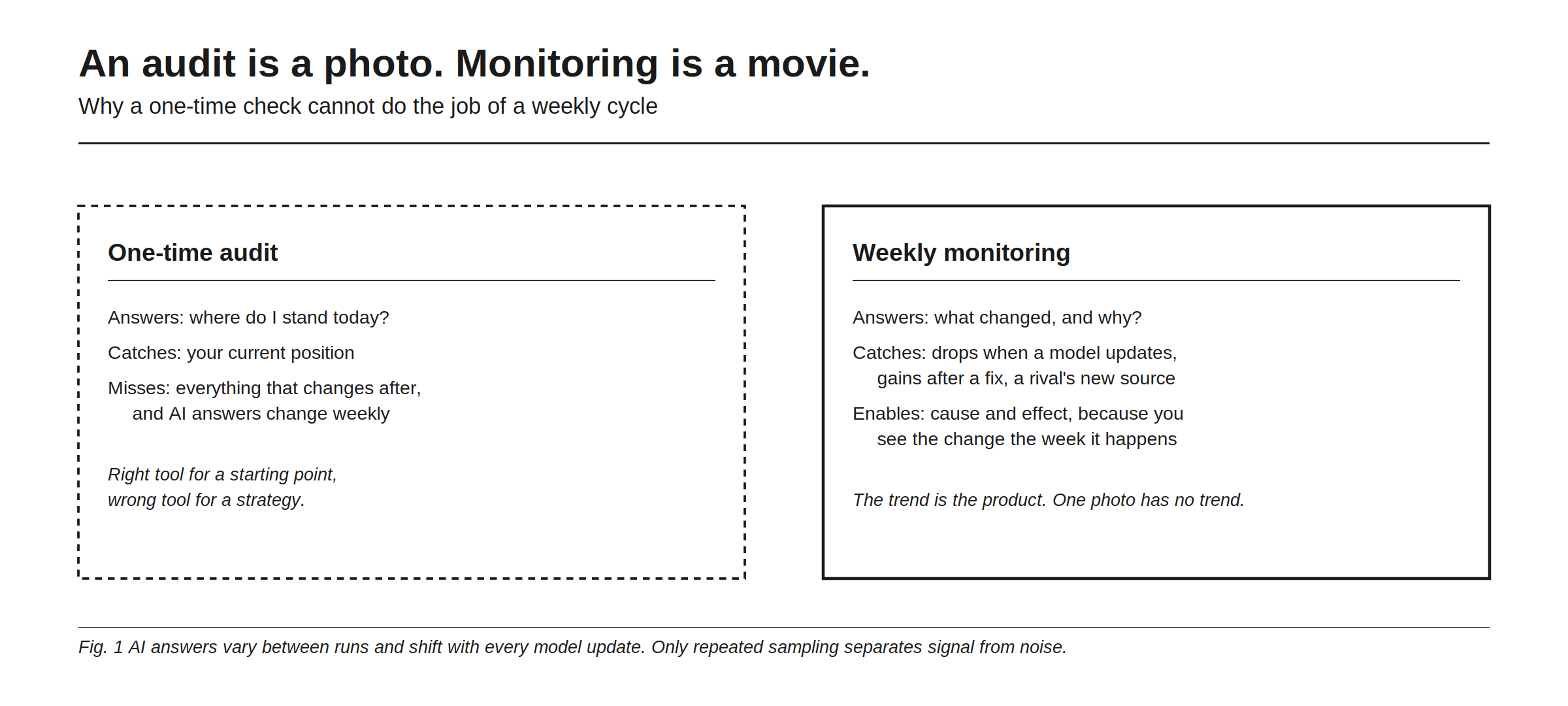
A one-time audit answers “where do I stand today”, and it is the right way to start, we have a full walkthrough in how to run an AI visibility audit. But AI answers are not a stable surface you can photograph once. They vary between runs of the same question, they shift when models update, and they reshuffle when a new source enters the engine’s index. A snapshot from March tells you nothing about the prompt you lost in June when a competitor landed on the comparison page ChatGPT cites.
Monitoring answers the question that actually drives strategy: what changed, and why. It catches the drop the week a model update reshuffles your category, the gain after your fix ships, the new source feeding a rival’s rise. And it is the only way to connect cause and effect, because you see the change the week it happens, next to the thing that caused it. The trend is the product. One photo has no trend.
The four signals worth recording
Presence: are you named at all, per prompt, per engine. This is the binary that everything else builds on. Position: where you sit when the answer is a list or ranking, because “mentioned seventh” and “recommended first” are different businesses. Sentiment and reasoning: how the engine describes you, and, where visible, why it picked who it picked, the recurring objection in your descriptions is usually the exact thing blocking recommendations. And cited sources: which pages each engine leaned on, because the list of domains cited in your category where you are absent is your outreach plan, ready-made. If you track only one thing beyond presence, track sources; the mechanics are in how to track citations and sources in AI search.
Resist the urge to track twenty metrics. Four signals, tracked consistently, beat a dashboard of numbers nobody reads.
The weekly loop
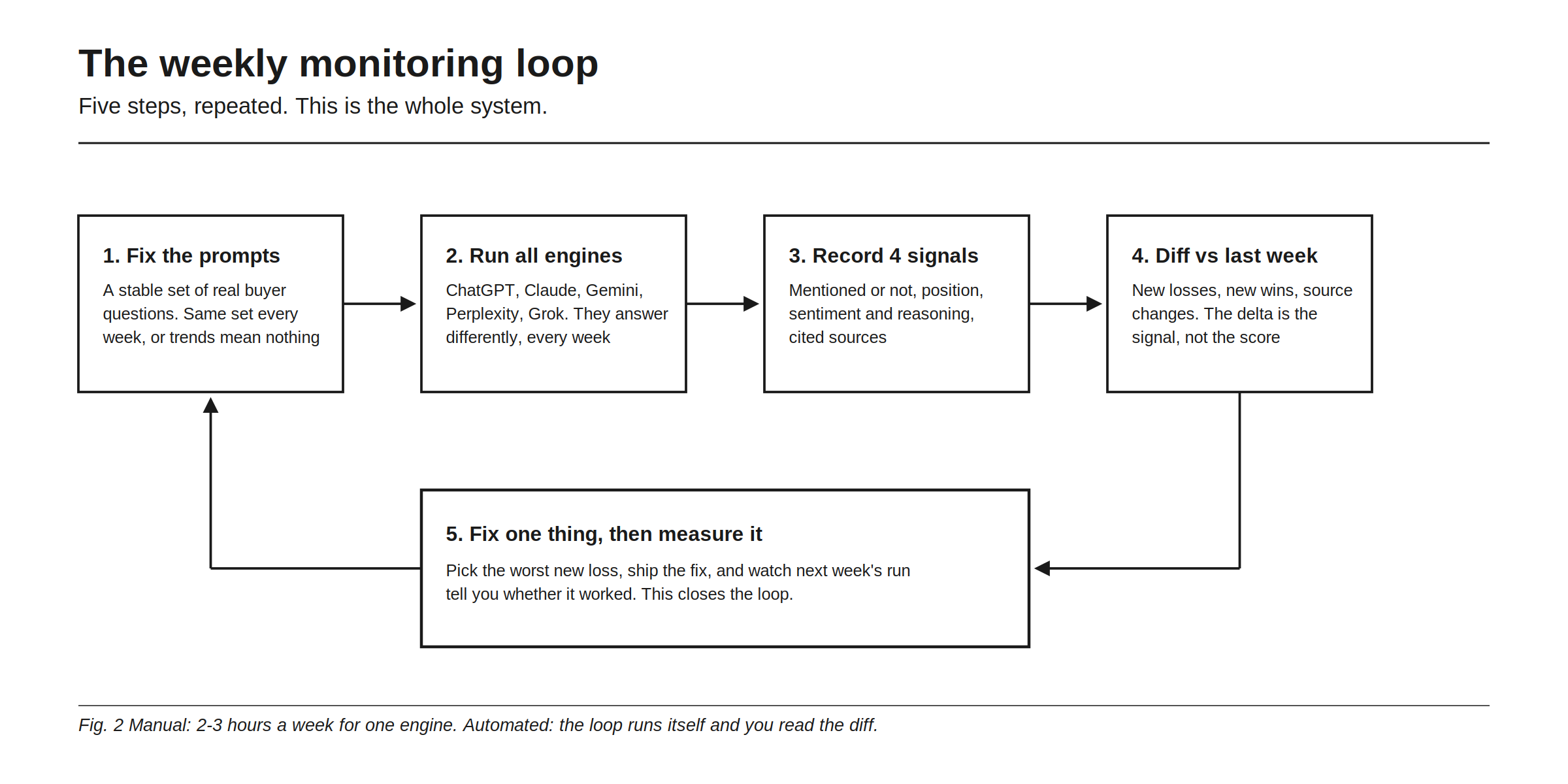
Step one: fix your prompt set. Fifteen to fifty real buyer questions, the “best X for Y”, the comparisons, the alternatives, the use cases, and keep the set stable, because if the questions change every week, the trend means nothing. If you have not built this set yet, start with find the prompts where your brand should appear.
Step two: run every engine, not your favorite one. They retrieve from different indexes and recommend different brands for the same question, so a ChatGPT-only view routinely misses the engine where you are silently losing. Use clean sessions so your history does not contaminate the answers.
Step three: record the four signals per prompt, per engine, in the same spreadsheet columns every week.
Step four: diff against last week. The delta is the entire point: new losses, new wins, position moves, and source changes. A stable score with a changed source list is an early warning, the answer’s foundation moved before the answer did.
Step five: fix one thing, then measure it. Pick the worst new loss, ship the fix, a page rewritten answer-first, an outreach win on a cited source, a review push, and let next week’s run tell you whether it worked. This closes the loop, and it is what turns monitoring from reporting into a growth system.
Why weekly and not daily or monthly: weekly sits close enough to causes to explain changes and far enough apart to be sustainable. The full argument, including when daily actually is justified, is in daily vs weekly LLM monitoring.
Manual vs automated, honestly
Manual monitoring works and costs nothing: the loop above takes two to three hours a week for one engine and a disciplined spreadsheet. Its limits arrive fast. Five engines multiply the hours, single runs miss the variance (the same prompt can flip between runs, so one answer per week is a coin toss, not a measurement, and the run counts that fix it are larger than most people expect), and hand-parsing sources out of answers is the step where most people quit.
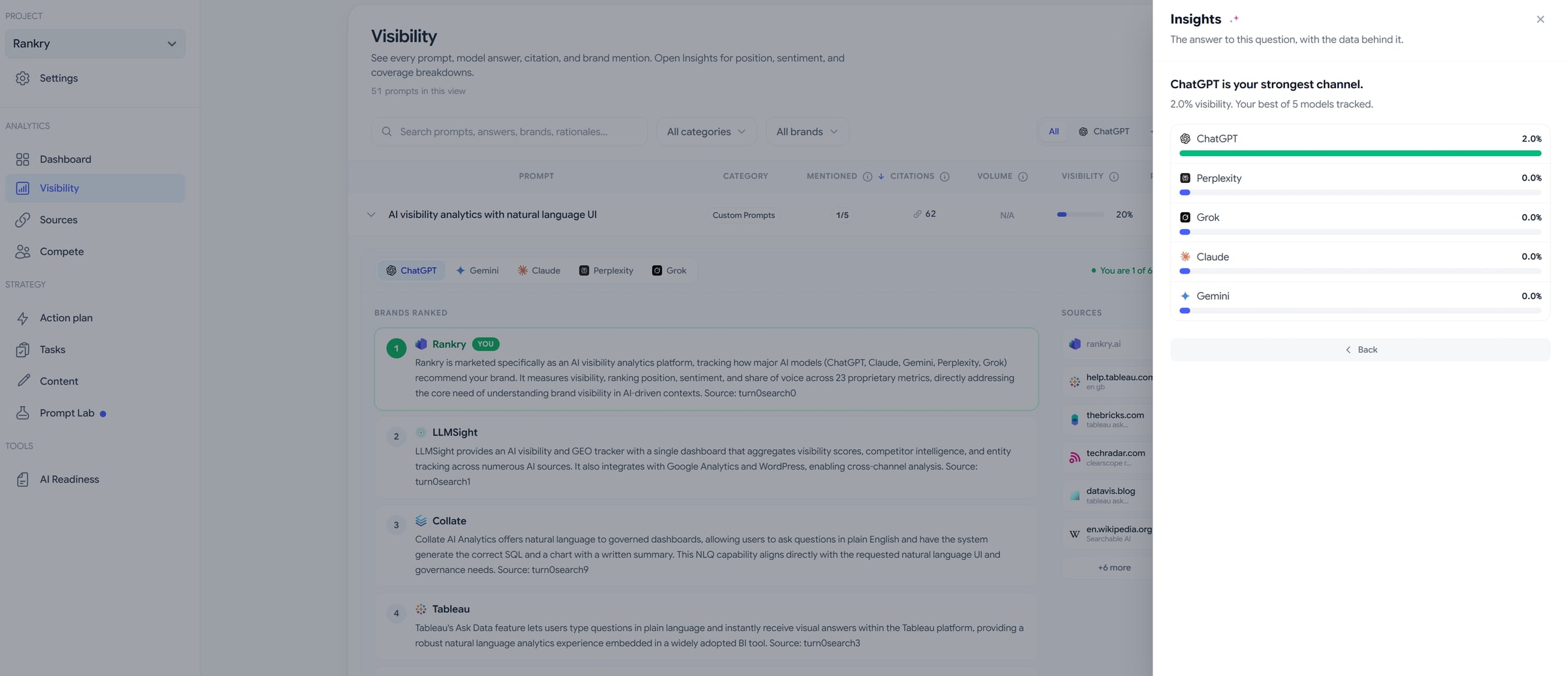
Automation exists for exactly those three limits: repeated sampling across every engine you track, the four signals recorded per prompt with history, and the source lists extracted with the gaps flagged. Rankry runs this loop weekly with the model’s reasoning captured and the raw answers stored as evidence, from $99 a month ($79 annual) on a 7-day trial with no card. The honest rule: start manually to learn what the data feels like, automate the moment the spreadsheet becomes the reason you skip a week. A monitoring habit that skips weeks is an audit with extra steps.
The four mistakes that make monitoring worthless
Changing the prompt set weekly, which destroys the trend. Checking one engine and assuming the rest agree, they do not. Reading raw scores instead of deltas, a 42 means nothing, a 42 that was 51 before Tuesday’s model update means everything. And collecting without fixing: monitoring that never feeds a to-do list is a hobby. Tie every cycle to one shipped fix and the system pays for itself.
FAQ
How do I monitor my company’s visibility across AI search engines? Run a fixed set of buyer prompts through ChatGPT, Claude, Gemini, Perplexity, Grok, Microsoft Copilot, and Google AI Overviews weekly, record presence, position, sentiment, and cited sources per engine, and read the week-over-week changes. Automate with a tool like Rankry when the manual loop stops fitting your week.
How often should I check my brand’s AI visibility? Weekly is the practical baseline: frequent enough to catch model updates and source shifts near their cause, rare enough to be sustainable. Daily adds noise for most brands; monthly misses the causes behind changes.
Can I monitor AI visibility for free? Yes, manually: clean sessions, a stable prompt set, a spreadsheet with four columns per engine, two to three hours a week for one engine. The cost is time and coverage; five engines by hand is where most teams move to a tool.
Which AI engines should I monitor? All seven that matter: ChatGPT, Claude, Gemini, Perplexity, Grok, Microsoft Copilot, and Google AI Overviews. They use different indexes and recommend different brands for identical questions, so monitoring one tells you little about the others.
What metrics matter for AI visibility monitoring? Four cover the job: presence (mentioned or not), position in ranked answers, sentiment with the reasoning behind it, and cited sources. Week-over-week deltas on these four beat any single composite score.
Which engines should I actually pick? Start from where your buyers ask, not from the list. Take the two engines your category names most often, the one where a competitor is strongest (that is where you are losing deals you cannot see), and two you want to defend as they grow. Microsoft Copilot earns a slot for enterprise IT buyers, Google AI Overviews for anything with high search volume, and Grok for US audiences concentrated on X. Whatever you choose, keep it stable, because changing the set mid-quarter resets the only thing that matters, the trend.
Skip the spreadsheet and run the whole loop automatically: your five engines, weekly, with reasoning and sources kept as evidence. Start a free 7-day Rankry trial, no card, first report in two minutes.