The “3-month citation cliff” describes a pattern that AI citation data now measures directly: roughly half of all AI citations point to content published or updated within the last 13 weeks, and the median citation half-life is about 4.5 weeks, so a page that is never refreshed fades out of AI answers within about a quarter. In practice, a page that ChatGPT or Perplexity cited when you published it can quietly stop being cited a few months later, not because it got worse, but because it got older and the engines started preferring newer sources. The fix is a refresh system: track which of your pages AI actually cites, update them on a roughly quarterly cycle, prioritize by citation value, and watch the trend after each refresh. This guide explains the cliff and how to beat it.
Most content strategies are built on a publish-and-forget assumption inherited from classic SEO, where a strong page could rank for years. AI search breaks that assumption, and the citation cliff is why.
What the cliff looks like
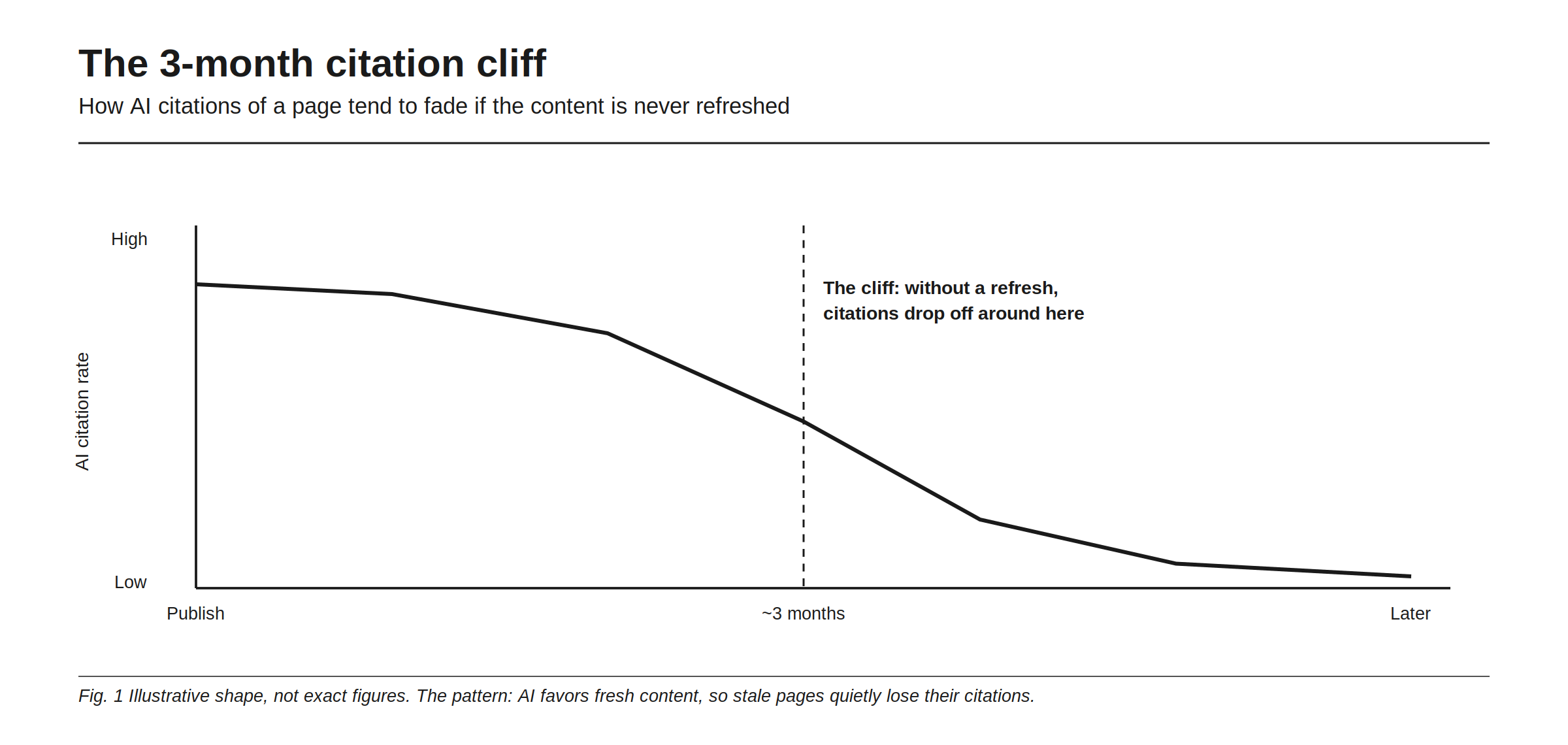
The shape is consistent even where the exact numbers vary: AI citation of a page starts strong after publication, holds for a while, then falls off around the three-month mark if the content is never refreshed. The figure above is illustrative, not precise, the point is the pattern, not the exact slope, but the underlying behavior is well documented. AI engines favor fresh, recently updated content, so a static page gradually loses ground to newer material covering the same topic, and its citations decay accordingly.
This is different from a Google ranking, which can hold for a long time on the strength of authority and links. In AI search, recency is weighted more heavily, which means freshness has shifted from a nice-to-have into something closer to a ranking factor. A page you published six months ago and never touched is, by default, decaying in AI answers right now.
Why AI favors fresh content
The logic is reasonable from the engine’s side. AI answers are supposed to be current, so an engine that keeps citing a two-year-old page when a newer, better-sourced one exists is giving worse answers. To avoid that, engines lean toward recently published or updated material, especially in fast-moving categories. Add the re-crawl dynamic, engines re-fetch and re-evaluate sources over time, and a page that has not changed since the last crawl offers no new signal, while a freshly updated one does. The result is a systematic preference for freshness that produces the cliff.
For fast-changing topics, the cliff is steeper; for evergreen ones, gentler. But almost no topic is fully immune, because “newer coverage exists” is true eventually for nearly everything.
Beating the cliff: a refresh system
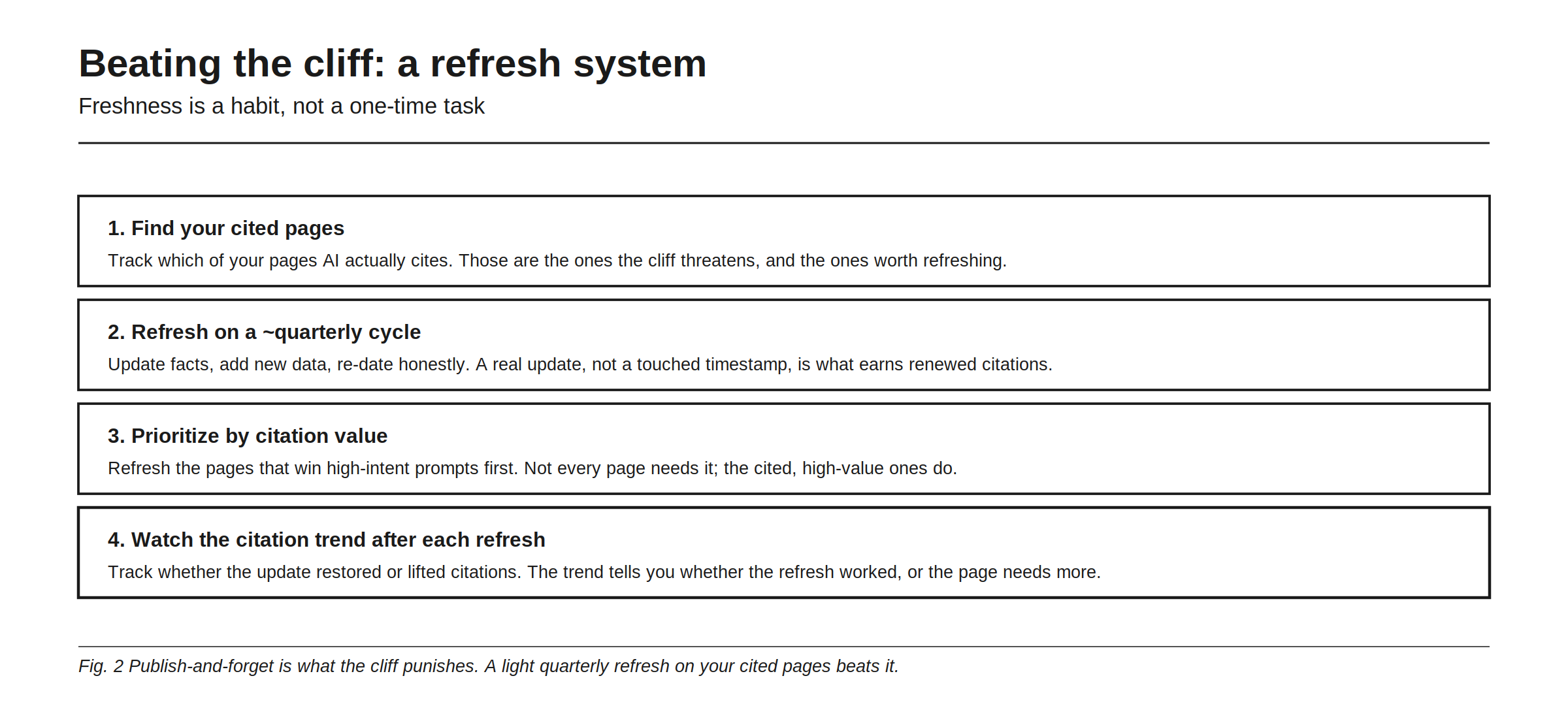
Freshness is a habit, not a one-time task, and a light system beats the cliff without rewriting your whole site. First, find your cited pages: track which of your pages AI actually cites, because those are the ones the cliff threatens and the ones worth refreshing; the method is in LLM citation tracking. Second, refresh on a cycle matched to the decay rate. Quarterly is the floor, and for pages that win high-intent prompts it is too slow: with a median half-life near 4.5 weeks, and ChatGPT churning fastest at roughly 3.4 weeks against Perplexity’s 5.7, a monthly touch on your top cited pages tracks the actual curve. Update facts, add new data, and re-date honestly, because a real update earns renewed citations while a touched timestamp does not. Third, prioritize by citation value: refresh the pages that win high-intent prompts first, since not every page needs it but your cited, high-value ones do. Fourth, watch the citation trend after each refresh: track whether the update restored or lifted citations, because the trend tells you whether the refresh worked or the page needs more.
The mindset shift is the hard part. Publish-and-forget is exactly what the cliff punishes, so the teams that win in AI search treat their best pages as living documents on a maintenance schedule, not as finished artifacts.
What “a real refresh” means
Re-dating a page without changing it does not beat the cliff, and can hurt trust if engines detect the pattern. A real refresh adds genuine value: new data or statistics, updated examples, a fresh section addressing what changed, corrected or expanded answers, and a re-date that reflects actual editing. The goal is to give the engine a legitimate reason to treat the page as current, because it is. Pair this with the answer-first structure engines quote from, leading with your most citable material, and each refresh does double duty. The structural side is in AI search ranking strategies.
How this fits your monitoring
The cliff is invisible without tracking, which is the trap: your citations decay silently, and the first visible symptom is an unexplained drop in AI-referred traffic months later. Monitoring your cited pages turns the cliff from a silent decay into a scheduled task, refresh due, refresh done, citations recovered. Rankry tracks which pages are cited across all five engines and how those citations trend over time, so you see the cliff coming and refresh before you fall off it, from $99 a month on a no-card trial. The full loop is in how to monitor your brand across AI search engines.
FAQ
What is the 3-month citation cliff? A measured pattern in AI citation data: about half of all AI citations point to content published or updated in the last 13 weeks, and the median citation half-life is roughly 4.5 weeks, so an unrefreshed page fades out of AI answers within about a quarter. A page cited at publication can quietly stop being cited a few months later.
Why does AI stop citing older content? AI answers are meant to be current, so engines lean toward recently published or updated material and re-evaluate sources over time. A page that has not changed offers no new signal, so newer coverage gradually displaces it in citations.
How often should I refresh content for AI visibility? Monthly for the handful of pages that win your high-intent prompts, quarterly for the rest. The median AI citation half-life is about 4.5 weeks, so a quarterly-only cycle lets your best pages decay between refreshes. Fast-moving topics may need more frequent updates; evergreen ones less. Prioritize the pages that win high-intent prompts.
Does just changing the date beat the citation cliff? No. A re-date without real editing does not give engines a genuine freshness signal and can erode trust if detected. A real refresh adds new data, examples, or sections, with a re-date that reflects actual changes.
How do I know if my content is hitting the citation cliff? Track which of your pages AI cites and how those citations trend over time. A steady decline in citations for a page you have not updated is the cliff. Monitoring makes it visible before it shows up as lost traffic.
Track which pages AI cites and catch the citation cliff before your content falls off it. Start a free 7-day Rankry trial, no card, first report in two minutes.