To improve your brand’s visibility in AI answers across ChatGPT, Claude, Gemini, Perplexity, Grok, Microsoft Copilot, and Google AI Overviews, work five levers in order of impact: retrievability (be in the indexes AI searches, with bots allowed and content rendered), corroboration (independent sources telling the same story about you), answer-fit content (pages that directly answer buyer questions), entity clarity (one consistent identity everywhere), and freshness and structure. Do the shared foundation once, then tilt toward each engine’s specifics. The single biggest mistake is starting with content while skipping retrievability and corroboration, which is why most brands’ pages never get cited.
“AI search ranking” is a slight misnomer, there is no fixed ranking to climb, there is an answer you are in or out of. But the strategies that get you into that answer are learnable and ordered, and most of your competitors are working them in the wrong sequence.
The five levers, in order of impact
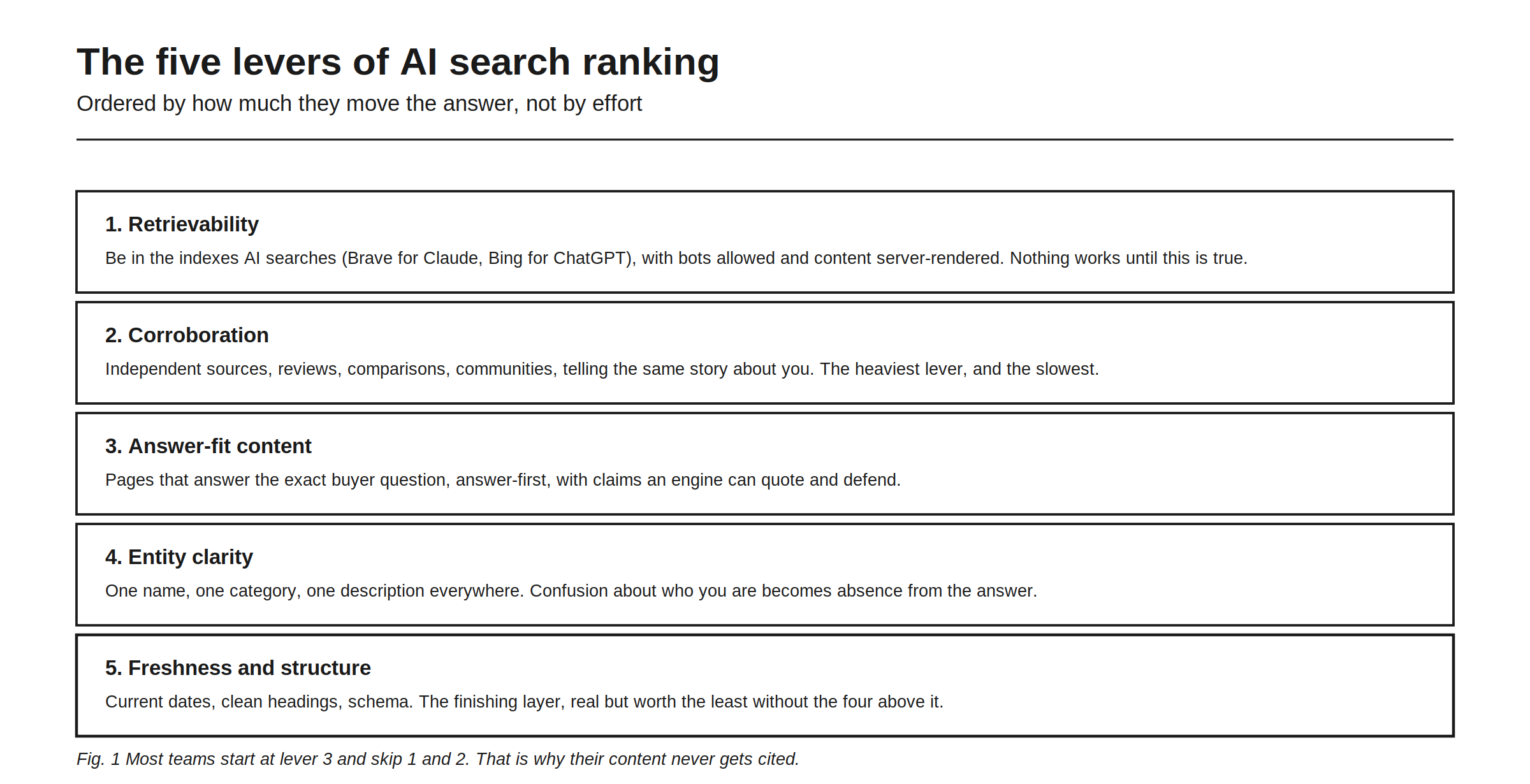
Lever 1: retrievability. If AI cannot fetch and read you, nothing else matters. Be present in the indexes each engine searches, Brave for Claude, Bing for ChatGPT, allow the AI crawlers in robots.txt, and render your content server-side so a bot sees text, not an empty JavaScript shell. This is the floor, and a surprising number of funded companies fail here without knowing it. The mechanics per engine are in how Claude finds and cites sources.
Lever 2: corroboration. This is the heaviest lever and the slowest. AI builds recommendations from consensus, so what independent sources say about you, reviews, comparison pages, community threads, matters more than what you say about yourself. One page you wrote is a weak signal; the same story across sources you do not control is a strong one. Most of your AI visibility lives on pages you do not own, which is why this lever outweighs your own content.
Lever 3: answer-fit content. Now your own pages matter. Build them around the exact questions buyers ask, answer-first, with specific claims an engine can quote and defend. A vague thought-leadership post gives AI nothing to lift; a page that states plainly what you do, for whom, at what price, with what trade-offs, is citation material.
Lever 4: entity clarity. AI has to know who you are before it can recommend you. One name, one category, one description, consistent across your site, your profiles, and third-party listings. Confusion about your identity, three different taglines, an ambiguous category, becomes absence from the answer, because an engine that cannot place you cleanly leaves you out.
Lever 5: freshness and structure. The finishing layer: current dates, clean headings, valid schema. Real, but worth the least without the four levers above it. Perfect structure on an unretrievable, uncorroborated page changes nothing.
The order is the strategy. Most teams start at lever 3, pour budget into content, and never touch 1 and 2, which is exactly why the content never gets cited.
Shared foundation, then per-engine tilt
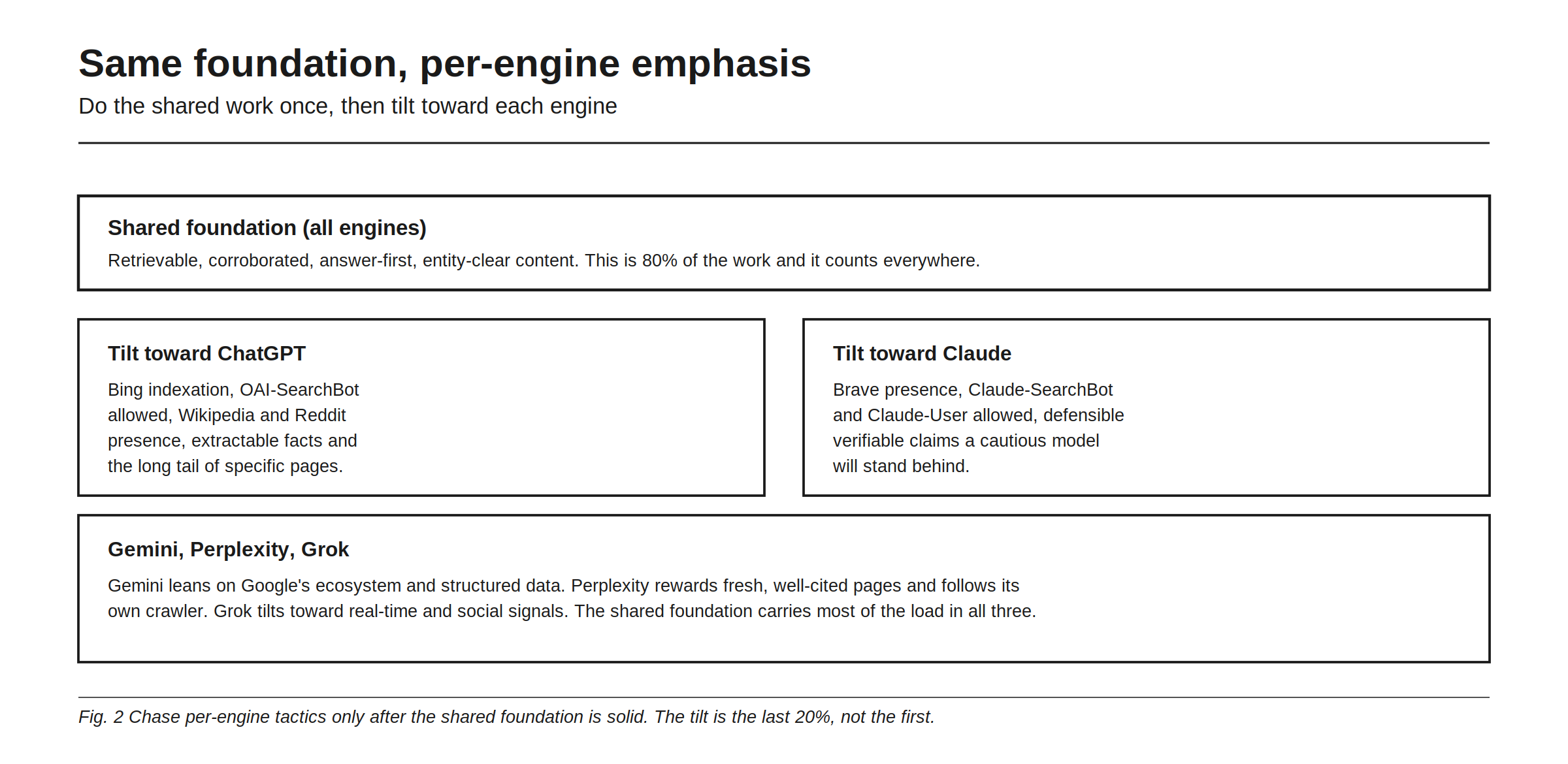
Roughly 80% of the work is shared across every engine: retrievable, corroborated, answer-first, entity-clear content counts everywhere. Do that first. Then tilt the last 20% toward each engine’s specifics.
For ChatGPT, weight Bing indexation, OAI-SearchBot access, Wikipedia and Reddit presence, and extractable facts, because its citations favor a long tail of specific pages; the full playbook is in how to improve visibility in ChatGPT. For Claude, weight Brave presence, Claude-SearchBot and Claude-User access, and defensible, verifiable claims, because it is the more cautious citer. For Gemini, lean on Google’s ecosystem and structured data. For Perplexity, prioritize fresh, well-cited pages, it rewards recency and clear sourcing, the full mechanics are in how Perplexity picks the sources it cites. For Grok, real-time and social signals carry more weight. But the tilt is the finish, not the start: chase per-engine tactics only after the shared foundation is solid, or you are decorating a house with no floor.
How to turn this into a plan
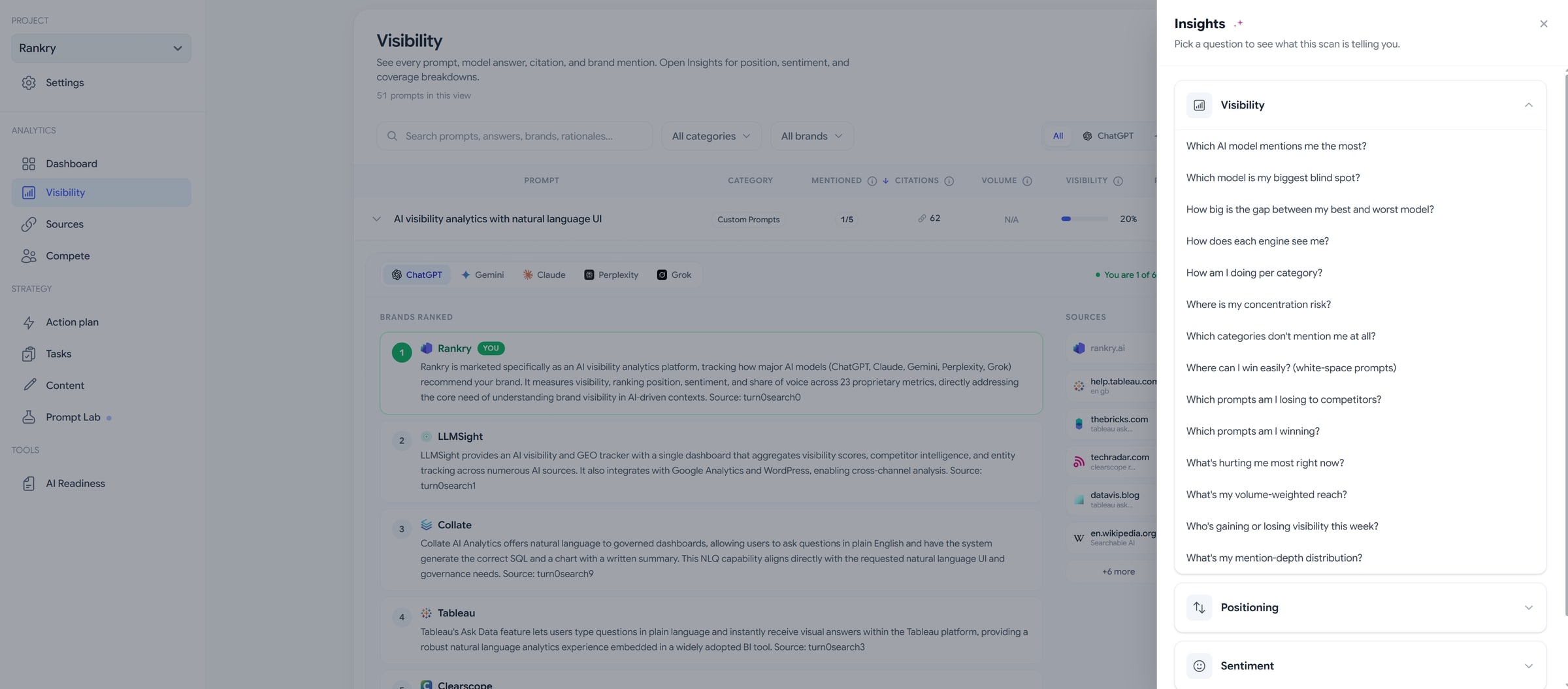
Sequence beats intensity. Week one, fix retrievability: robots.txt, rendering, Bing and Brave presence. Weeks two to four, start corroboration (the long pole, begin early) and rewrite your highest-value pages answer-first. Then fix entity clarity in a single pass across every profile. Then, and only then, tune per-engine. Throughout, track a fixed set of buyer prompts across your tracked engines weekly so you can see which lever moved which answer, because a strategy you cannot measure is a guess. The measurement loop is in how to monitor your brand across AI search engines.
The mindset shift that makes it click
Stop thinking “rank my page” and start thinking “be the source the answer is built from”. Ranking is about your page’s position on a list; AI visibility is about whether your claims, your reviews, your comparisons, are the raw material an engine reaches for when it composes a recommendation. That shift changes what you build: fewer pages arguing you are great, more pages and mentions that give an engine something specific, checkable, and corroborated to cite. Optimize to be quoted, not to be ranked, and the full craft of earning citations is in how to get cited by AI.
FAQ
How do I improve my brand’s visibility in AI answers? Work five levers in order: retrievability (indexes, bots, rendering), corroboration (independent sources), answer-fit content, entity clarity, and freshness. Do the shared foundation first, then tilt toward each engine. Starting with content while skipping retrievability is the common mistake.
What are the best AI search ranking strategies? There is no fixed ranking, but the strategies that get you into AI answers are: be retrievable in the right indexes, earn third-party corroboration, publish answer-first content, keep a consistent entity, and finish with structure. Sequence matters more than effort.
Why isn’t my content showing up in AI answers? Usually a lower lever is broken: you are not in the index the engine searches, your bots are blocked, your content needs JavaScript to render, or no independent source corroborates you. Content quality (lever 3) cannot compensate for failures at levers 1 and 2.
Do different AI engines need different strategies? The foundation is shared, about 80% of the work counts everywhere. The remaining tilt differs: ChatGPT weights Bing and a long tail, Claude weights Brave and defensible claims, Gemini structured data, Perplexity freshness, Grok real-time signals, Copilot your Bing index position, and Google AI Overviews your classic Google ranking. Tilt only after the foundation is solid.
How do I measure if my AI ranking strategy is working? Track a fixed set of buyer prompts across your tracked engines weekly, and watch presence, position, and cited sources change after each fix. Week-over-week deltas tell you which lever moved which answer.
See which lever is holding you back, per engine, and watch your fixes move the answer. Start a free 7-day Rankry trial, no card, first report in two minutes.