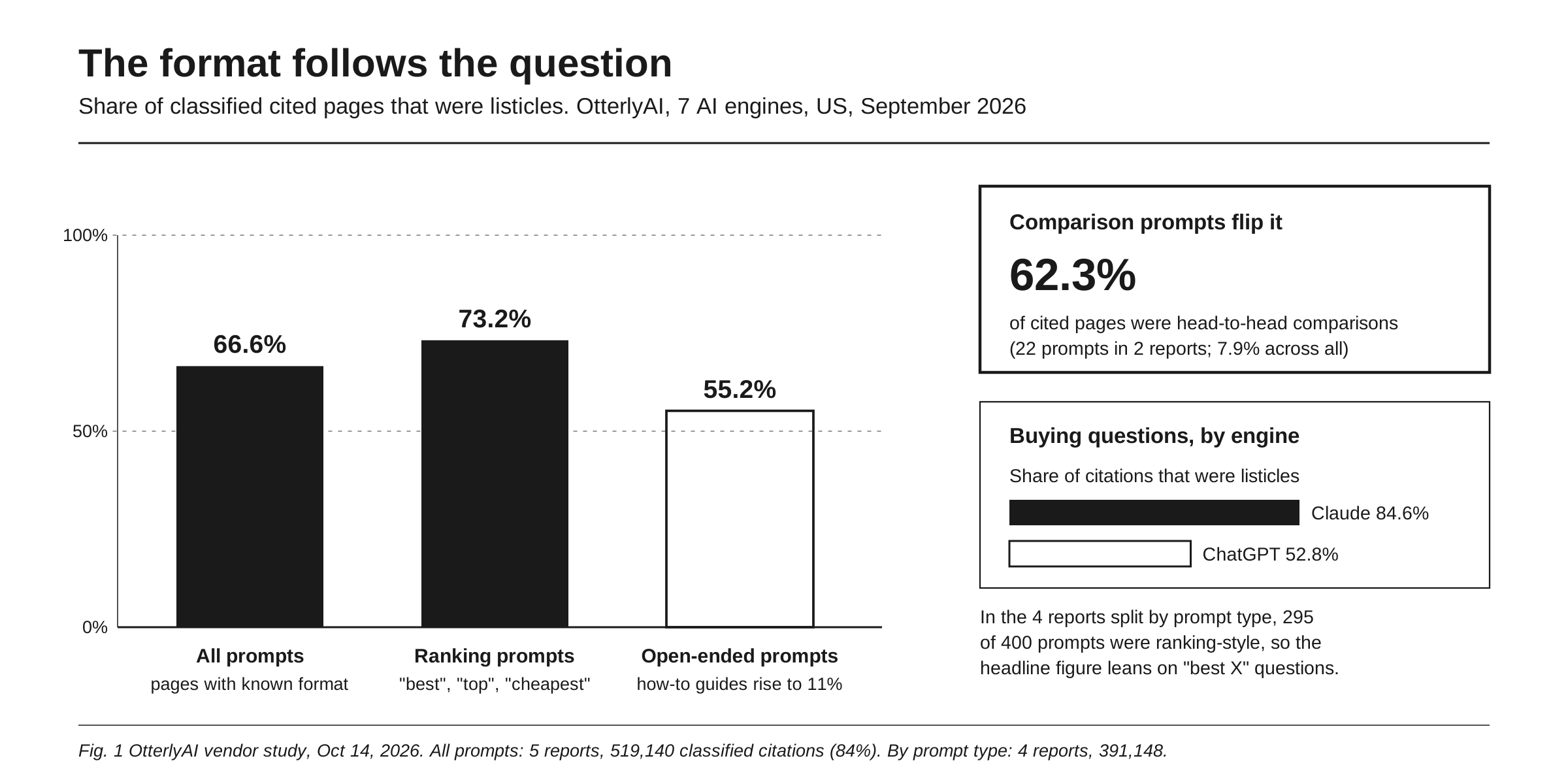
In an OtterlyAI vendor study published October 14, 2026, listicles made up 66.6% of cited pages whose format Otterly could identify, about two thirds. That covered 84% of 617,985 citations from seven AI engines on US buyer questions in September 2026. The figure is strongest for “best X” questions: when a prompt asked for a ranking, 73.2% of cited pages were listicles, and about three quarters of the prompts were ranking-style. On open-ended questions the share fell to 55.2%. Most cited listicles, comparisons and guides did not come from independent editors: commission-declaring publishers and brands supplied 44.8% and 37.4% of those whose publisher could be identified. So the useful question is not “should we write lists” but “which lists do engines already read, and how do we get on them fairly.” Our answer: earned inclusion first, an honest list of your own second, and paid placement only with clear disclosure.
“Best X” articles used to be an affiliate SEO format. In the AI studies below they show up as a main source for recommendations, and that changes who your marketing team needs to talk to.
What the Otterly study counted
OtterlyAI sells AI visibility tracking, and this is a vendor study built on its own data. It used five brand reports covering five US industries: finance and insurance, retail and e-commerce, educational platforms, technology, and sports brands. Each report sent 100 buyer questions a day to seven AI engines from September 1 to 30, 2026: ChatGPT, Claude, Perplexity, Gemini, Copilot, Google AI Overviews and Google AI Mode. The result was 617,985 citations pointing to 85,330 unique URLs.
Three details matter before you repeat “two thirds.”
The denominator. Otterly could identify the page format for 84% of citations, or 519,140. The 66.6% is a share of those, not of every citation.
The prompt mix. The split by question type covers four of the five reports (finance is not in it). There, 295 of 400 prompts used ranking words such as “best,” “top” or “cheapest.” Otterly itself says the 66.6% is most representative of “best X” questions. On comparison prompts the pattern flips: 62.3% of cited pages were head-to-head comparisons, though that rests on 22 prompts from two reports.
The engines differ. In Otterly’s per-engine split (four reports, and engines were not asked identical prompts), listicles made up 78.2% of Claude’s citations. On buying questions, Claude cited a listicle 84.6% of the time and ChatGPT 52.8%. In Google AI Overviews and AI Mode, forums and video made up about a quarter of citations, versus below 3% on other engines.
It is one month of US data, and Otterly calls it “a snapshot, not a permanent rule.” Other studies point the same way with different methods. An Ahrefs study of 750 top-of-funnel ChatGPT prompts, published December 2025, found that “best X” blog lists were 43.8% of all source page types. DerivateX, an agency that sells GEO services, ran one buyer question in each of 40 B2B SaaS categories ten times in ChatGPT with web search, a small sample, and reported that “every single page ChatGPT cited used list structure.”
Why lists win recommendation prompts
No study has isolated the mechanism, so this section is our interpretation of the data, not proof.
A “best X” prompt asks the engine to produce a shortlist. A listicle is already a shortlist: named options, a line of positioning for each, “best for” labels, often pricing. The format matches the shape of the answer the engine has to write. Otterly’s query-type split fits that reading: the listicle share rises on ranking prompts, drops on open-ended ones, and comparison prompts pull in comparison pages instead. The format follows the question.
Lists also make agreement visible. If five independent roundups all include the same three tools, an engine has an easy signal for which brands belong on a shortlist. Ahrefs reported a correlation between ranking highly in third-party lists and being more likely to appear in ChatGPT responses, weaker in lists with 10 or more items. How engines weigh that agreement between close rivals is covered in how AI picks between similar brands, and where those sources come from in where AI actually gets its answers.
One more Ahrefs finding changes your target list: in a sample of 3,000 cited best lists, 35% sat on low-authority domains. The lists that matter are the ones engines cite, not the ones with the biggest brand names.
Who writes the lists AI cites
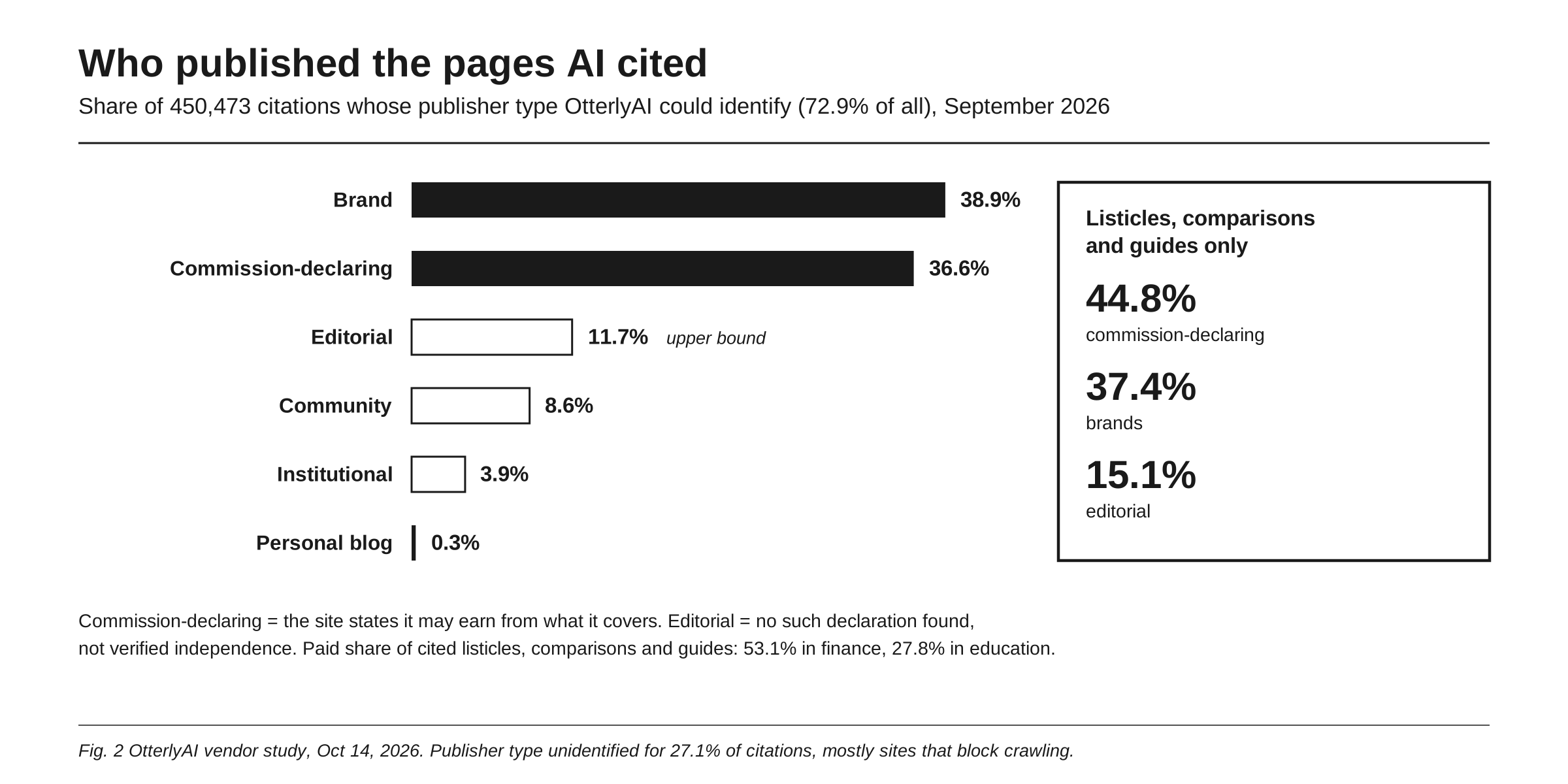
Otterly identified the publisher type for 72.9% of citations, or 450,473. Brands published 38.9% of them and commission-declaring sites, meaning sites that state they may earn from what they recommend, 36.6%. Editorial sites accounted for 11.7%, which Otterly treats as an upper bound, because “editorial” here means no commercial disclosure was found, not verified independence. Community sites made up 8.6%, institutional 3.9% and personal blogs 0.3%.
For listicles, comparisons and guides specifically, commission-declaring publishers supplied 44.8%, brands 37.4% and editorial sites 15.1%. The paid share varied by sector: 53.1% in finance, 51.4% in sports, 50.7% in technology, 46.4% in retail and 27.8% in education. Otterly notes it built its classification rules on the finance report.
In this data, the “review” an engine cites is often an affiliate page or a brand’s own page. Otterly concludes that where paid publishers supply more than half of citations, affiliate partnerships “can be an important part of GEO strategy.” Weigh that alongside its own disclosure of a commercial partnership with Getfluence, which connects brands with publishers for paid placements.
Your own list: it can work, and it can leak
Publishing your own “best X” list is the fastest route, and the evidence is mixed.
In the December 2025 Ahrefs study, a self-promotional list appeared in more than a third of ChatGPT software responses where its publisher was recommended, and the author advised SaaS companies to publish such lists. A July 2026 Ahrefs experiment complicated that. Ahrefs published 34 self-promotional pages on five domains and analyzed 9,886 answers from ChatGPT, Gemini, Perplexity and Copilot between February 7 and May 31, 2026. For Ahrefs Evolve, a new conference brand, 82% of 72 new mentions (in prompt and engine slots where it had been absent) came in answers citing one of those pages. On the Brand Radar pages, for an established brand, only 6% of new Ahrefs mentions did; 94% came from third-party content. And 43% of answers citing the conference pages never named the conference. As the author put it: “The page got the citation, but the competitor got the recommendation.”
Aloha Digital, an agency, reported the same leak in a single category, AI English-learning apps, from 268,493 answers it tracked on three engines. Among 5,428 non-branded ChatGPT answers citing a vendor’s own listicle, 67.0% named the publisher and 74.6% a rival. In Google’s AI answers (3,052) the gap was 9.2% versus 59.2%. One category and one agency’s data, but the direction matches Ahrefs.
What about Google? We found no Search Central post or spam policy aimed specifically at self-promotional lists. In February 2026, SEO consultant Lily Ray reported self-promotional list pages, mostly from SaaS companies, losing visibility after unconfirmed Google ranking updates in January. In a June 2026 analysis of 100 B2B “best software” queries in AI Overviews, checked at three dates, Ray counted 323 cited self-promotional listicles on the 80 queries that showed an AI Overview; in 69% of cases (224), the publishing brand was left out of the recommendation. What Google has published is review guidance: when calling something the best, “include why you consider it the best,” and “ensure there is enough useful content in your ranked lists for them to stand on their own.” A list that ranks its publisher first without evidence fails that test whether or not an update targets it. The wider case for owned comparison content is in whether your own comparison pages help.
Paid placements: what disclosure requires
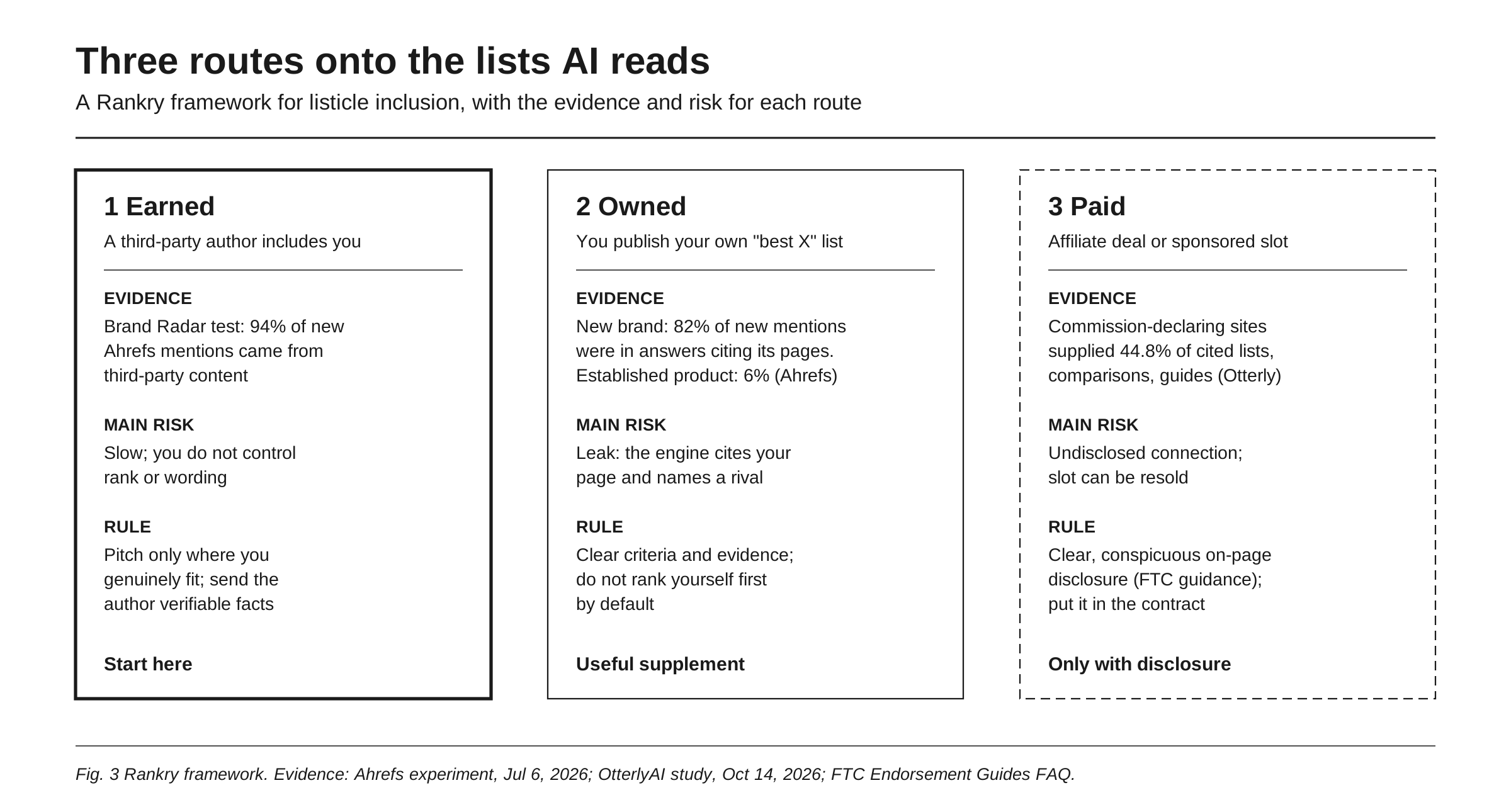
The figure above is our own framework: earned, owned and paid inclusion. Paid placement is the route with the most legal and reputational risk, and it is now openly sold as a GEO tactic.
If you pay a publisher to include or rank you, that is likely a material connection, and the FTC’s Endorsement Guides expect such connections to be clearly disclosed. The FTC’s endorsement guidance says responsibility for clearly and conspicuously disclosing a connection “rests with the influencer and the brand,” and that “your company is ultimately responsible for what others do on your behalf.” A disclosure “should catch users’ attention,” and the FTC warns that consumers “might not understand” what the label “affiliate link” means. The Endorsement Guides were revised in 2023, including a new definition of “clearly and conspicuously.” This is general information, not legal advice: have counsel review any paid program.
Paid inclusion also buys a position you do not control: the publisher can re-rank you, sell the top slot or let the page go stale. Earned inclusion is slower, but it compounds.
Listicle outreach and placement checklist
This is the checklist we suggest; it is Rankry’s framework, not an industry standard.
- Map the lists engines already cite. Run your buyer prompts across engines and record the cited URLs. Methods are in how to track citations and sources in AI search.
- Rank targets by recurrence. A list cited on many prompts and several engines beats a famous domain cited once.
- Check you are genuinely comparable. Same buyer, same job, similar price band. If not, pitch a narrower list such as “best X for small teams.”
- Build the reviewer kit. One-line positioning, honest “best for” and “not for,” pricing model with a public pricing link, plan limits, integrations, screenshots, a customer reference and a named contact.
- Pitch the gap. Tell the author which reader segment their list does not serve and why you fit it.
- Offer access to evaluate, not money for rank. Ask how the author discloses free access or any relationship.
- Request factual corrections with sources. Wrong pricing or features on a cited list spread into AI answers.
- If you pay, contract the disclosure. Specify clear on-page disclosure and never ask for an undisclosed top slot.
- If you publish your own list, follow Google’s review guidance. State criteria, show evidence and name where rivals fit better. Ahrefs’ July 2026 experiment warns against parking yourself at the top of a list you wrote.
- Keep authors updated. Send changes when pricing or features change.
- Measure over months. Track whether each list stays cited and whether answers citing it name you or a rival.
Measuring whether lists move your visibility
Rankry runs a stable set of buyer-intent prompts every day across ChatGPT, Claude, Gemini, Perplexity, Grok and Google AI Mode and AI Overviews, and records which sources each engine cites. That gives you the target list for step 1 and the scorecard for step 11: which third-party lists keep appearing on your prompts, whether you are named when they are cited, and how that compares with named competitors over time. A new “best X for Y” prompt is answered as soon as you add it.
FAQ
Do listicles really get two thirds of AI citations? In OtterlyAI’s September 2026 data, yes, with limits. Listicles were 66.6% of cited pages whose format could be identified, which covered 84% of 617,985 citations from seven engines. About three quarters of the prompts were ranking-style, and the share was 55.2% on open-ended questions. It is one vendor’s US data for one month, so read it as strong for “best X” prompts.
Why do AI engines cite listicles so much? A plausible explanation is fit: a “best X” prompt asks for a shortlist, and a listicle already is one, with named options and best-for labels. Otterly’s data supports that reading, since the listicle share rises on ranking prompts and comparison prompts pull comparison pages instead. No study has proven the mechanism.
Should I publish my own “best X” list? It can help, especially for a new or thinly covered brand: in an Ahrefs experiment, 82% of a new conference’s new mentions came in answers citing its own pages. For an established product the figure was 6%, and cited pages sometimes helped rivals. Publish an honest list with clear criteria, and do not count on it alone.
Is paying for a listicle placement allowed? Paying is not banned, but in the US the relationship generally needs clear disclosure. FTC guidance puts disclosure responsibility on both the endorser and the brand, and warns that consumers might not understand a bare “affiliate link” label. Put disclosure terms in the contract and have counsel review any paid program. This is general information, not legal advice.
How do I get into third-party listicles? Find the lists AI already cites on your buyer prompts, then pitch the authors where you genuinely fit. Send a reviewer kit with positioning, pricing, limits, integrations, screenshots and a customer reference, offer product access, and request corrections when facts are wrong. Then track whether those lists keep being cited and whether you get named.
Sources
- What Content Do AI Engines Cite? A Study of 617,985 Citations Across 7 Engines and 5 Industries, OtterlyAI, October 14, 2026
- Do Self-Promotional “Best” Lists Boost ChatGPT Visibility? Study of 26,283 Source URLs, Ahrefs, December 4, 2025
- Self-Promotional Content Works, Until It Backfires (AI SEO Experiment), Ahrefs, July 6, 2026
- B2B SaaS AI Citation Study: How ChatGPT Recommends Software, DerivateX, May 31, 2026 (updated September 22, 2026)
- Self-Promotional Listicles in AI Search: A 268K-Answer Study, Aloha Digital, August 9, 2026
- Did Google Search Hit Self-Promotional Listicles In Recent Updates, Search Engine Roundtable, February 4, 2026
- Why Calling Yourself the ‘Best’ Could Be Helping Your Competitors Win in AI Search, Lily Ray (Substack), June 17, 2026
- Write high quality reviews, Google Search Central, last updated December 10, 2025
- FTC’s Endorsement Guides: What People Are Asking, Federal Trade Commission, last updated July 15, 2025
See which lists AI cites on the prompts that decide your deals, and whether they name you or a rival. Start a free 7-day Rankry trial, no card required.