Your own “X vs Y” and “alternatives to X” pages are a weak lever for general AI visibility, but they are not useless. In a Searchable vendor study published October 8, 2026, brands whose own comparison page started being used as an AI source gained 0.2 percentage points more in non-branded mentions over four weeks than brands whose own guide page started being used, a gap Searchable calls small enough to be chance. The same study found that comparison questions pull in comparison pages 3 to 11 times as often as other questions, and that third parties wrote about three in four of the comparison pages AI used. So the format clearly matters on comparison questions, but most of the comparison pages AI uses come from someone else. Build your own comparison pages for accuracy, branded comparison prompts and buyers who are already deciding, and put real effort into the third-party comparisons that supply most of the sources.
Comparison pages have become a default GEO tactic, often sold with a simple story: if you do not publish “you vs competitor,” an affiliate will get cited instead. The data now lets you test that story, and it holds only in part.
What the Searchable study measured
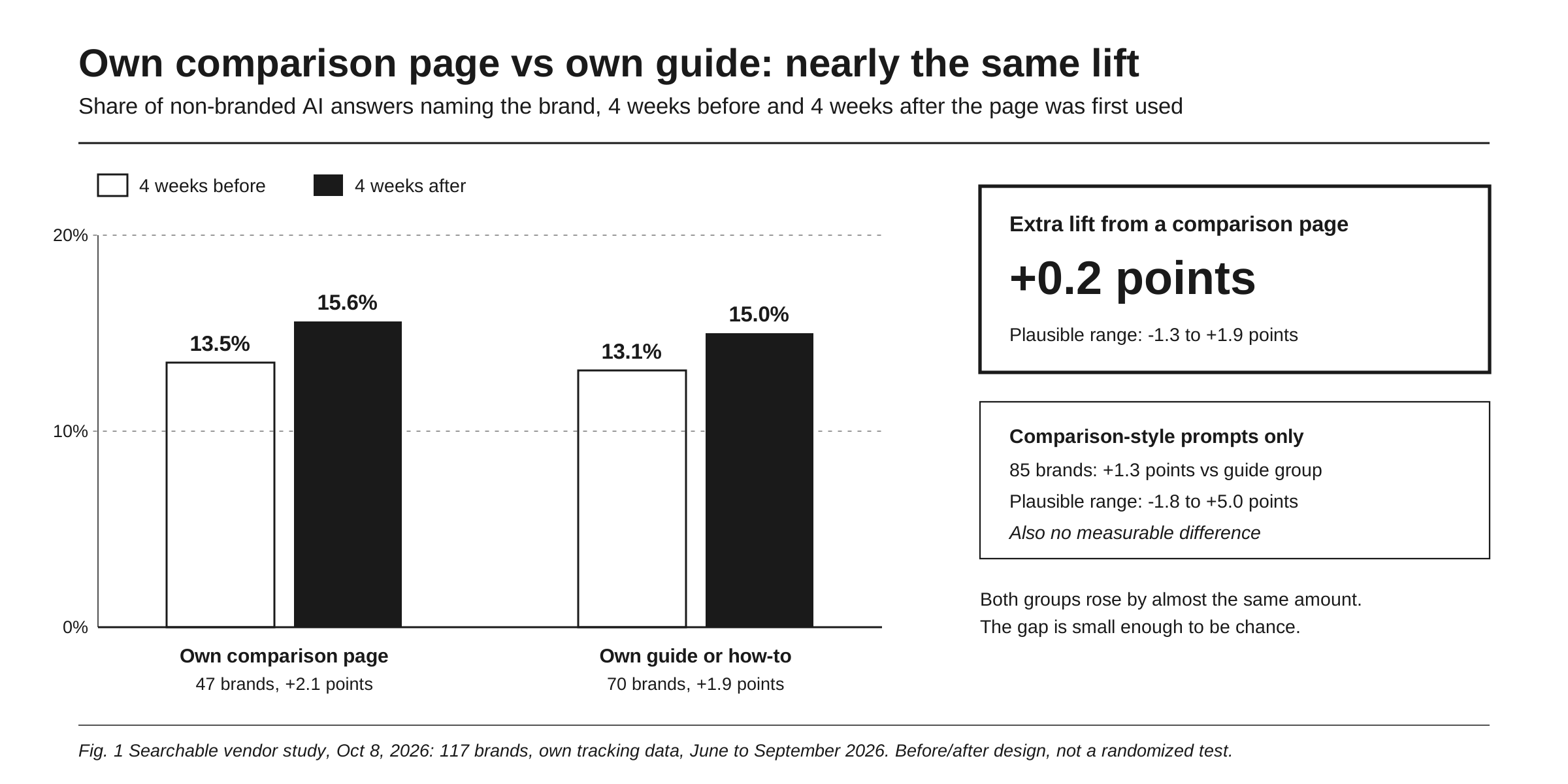
Searchable sells AI visibility tracking, and this is a vendor study built on its own platform data. For the key test, it followed 117 brands whose own site started being used as a source by AI engines between July and August 2026. For 47 brands, the newly used page was a comparison page. For 70, it was a guide or how-to, which served as the baseline group, because those brands also had a new page start getting used.
The researchers then compared how often each brand was named in answers to non-branded prompts, in the four weeks before and the four weeks after, using the same prompts on the same engines. The comparison-page group rose from 13.5% to 15.6% of answers, a gain of 2.1 points. The guide group rose from 13.1% to 15.0%, a gain of 1.9 points. Comparing only brands whose pages first appeared in the same week, the comparison-page group gained 0.2 points more than the guide group, with a plausible range of -1.3 to +1.9 points.
On comparison-style prompts only, such as “alternatives to [competitor],” the 85 brands with enough of those prompts showed a 1.3-point edge for the comparison-page group, with a range of -1.8 to +5.0 points. Also no measurable difference.
Three limits matter. First, this is a before-and-after comparison, not a randomized experiment. Second, the trigger was a page starting to be cited, not the day it was published. Third, each period was four weeks, and Searchable itself advises giving a comparison page longer than a month. The honest reading: in this sample, a newly cited comparison page did no better than a newly cited guide. That does not mean comparison pages hurt or never help.
Comparison questions want comparison pages, mostly written by others
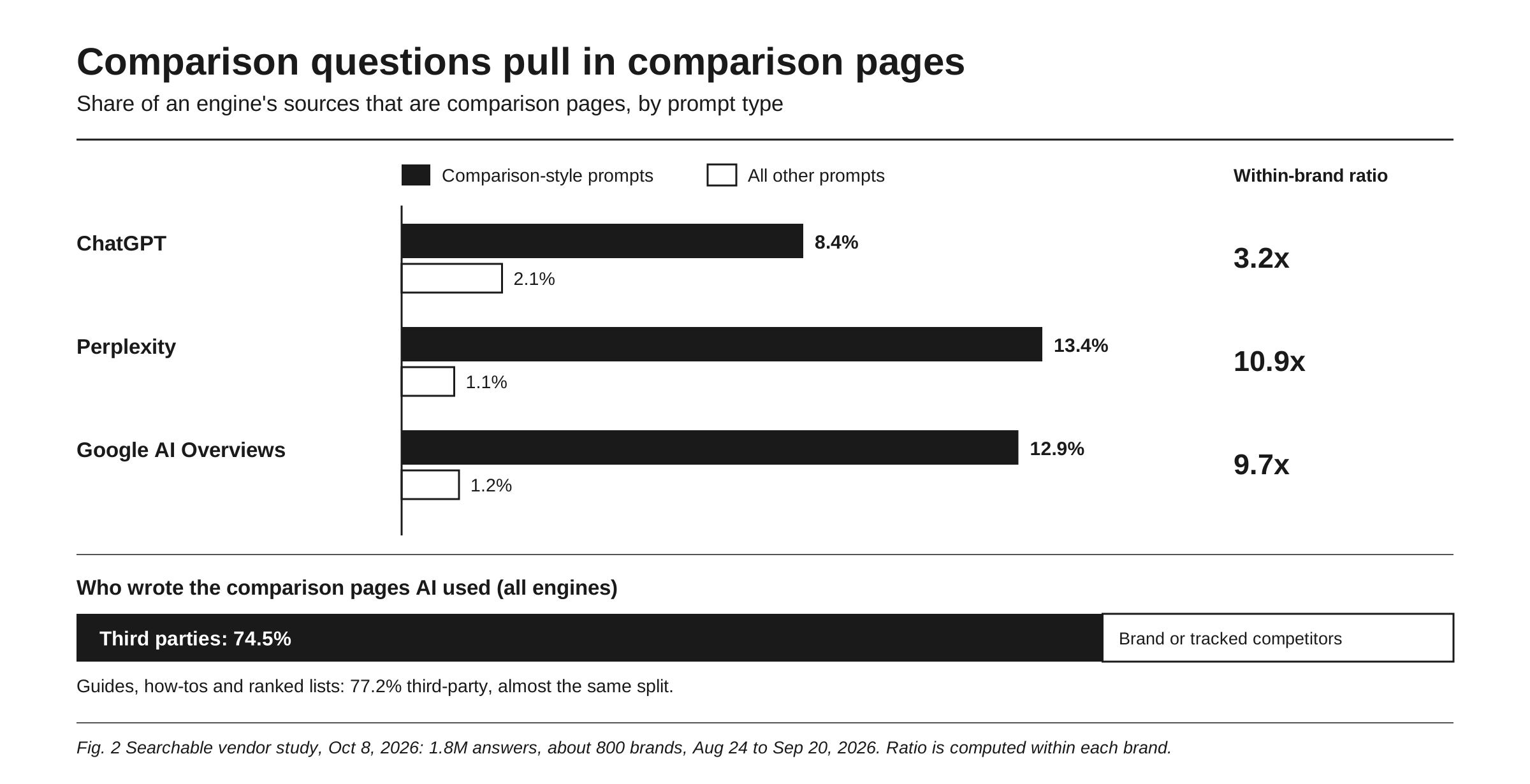
The same study looked at 1.8 million AI answers from August 24 to September 20, 2026, drawn from a random sample of about 800 tracked brands. It classed a prompt as comparison-style if it contained words such as “vs,” “compare,” “alternative(s),” or “better than.”
On those prompts, comparison pages made up 8.4% of ChatGPT’s sources versus 2.1% on other prompts, 13.4% versus 1.1% on Perplexity, and 12.9% versus 1.2% on Google AI Overviews. Measured within each brand, that is 3.2 times as often on ChatGPT, 10.9 times on Perplexity and 9.7 times on AI Overviews.
Then the ownership split. Across all engines, 74.5% of the comparison pages AI used were written by third parties, defined as anyone other than the tracked brand or its tracked competitors. Guides, how-tos and ranked lists showed almost the same split, at 77.2%. So in Searchable’s data, losing ground to outside publishers is not specific to comparisons; it is the norm across formats.
Other research points the same way. DerivateX, an agency that sells GEO services, ran one buyer prompt in each of 40 B2B SaaS categories, 10 times each, in ChatGPT with web search, and logged 233 recommendations. When ChatGPT recommended a tool, it cited that tool’s own website only 11.6% of the time; the other 88.4% credited someone else. Small sample, one engine and some internal inconsistencies make that figure directional. An Ahrefs analysis of ChatGPT responses to 750 top-of-funnel prompts found that “best X” blog lists made up 43.8% of all source page types, and noted a correlation between ranking highly in third-party lists and being more likely to appear in responses. The same study also found a self-promotional list in more than a third of software-category responses where its publisher was recommended, and its author advised SaaS companies to publish such lists. The wider pattern is covered in why ChatGPT recommends your competitors.
Why self-published comparisons underperform
No study has isolated the mechanism, so what follows is interpretation that fits the data, not proof.
A likely reason is corroboration. An answer engine building a shortlist plausibly looks for agreement across sources. A page where a vendor compares itself to a rival is one source with an obvious interest, and it says what the vendor would be expected to say. Ten independent reviews and roundups that each mention you would likely carry more weight than one page that ranks you first. That fits Searchable’s finding that third parties wrote most of the comparison pages and the guides it classified, and it fits how engines choose between close alternatives, covered in how AI picks between similar brands.
A small-scale Ahrefs experiment published July 6, 2026 adds texture. Ahrefs published 34 self-promotional pages, such as “best of” lists, on five domains and analyzed 9,886 answers from ChatGPT, Gemini, Perplexity and Copilot between February and May 2026. When Ahrefs, an established brand, appeared in answer slots where it had been absent, only 6% of those new mentions came from answers citing its pages; 94% came from third-party content. And among answers that cited one of its pages promoting a conference, 43% never named the conference at all. As the author put it: “The page got the citation, but the competitor got the recommendation.”
Ahrefs tested promotional lists, not head-to-head comparison pages, but the risk plausibly carries over. A fair, well-structured “you vs them” page is a good source of facts about both products, so an engine can read your page and still recommend the rival.
When your own comparison page still earns its keep
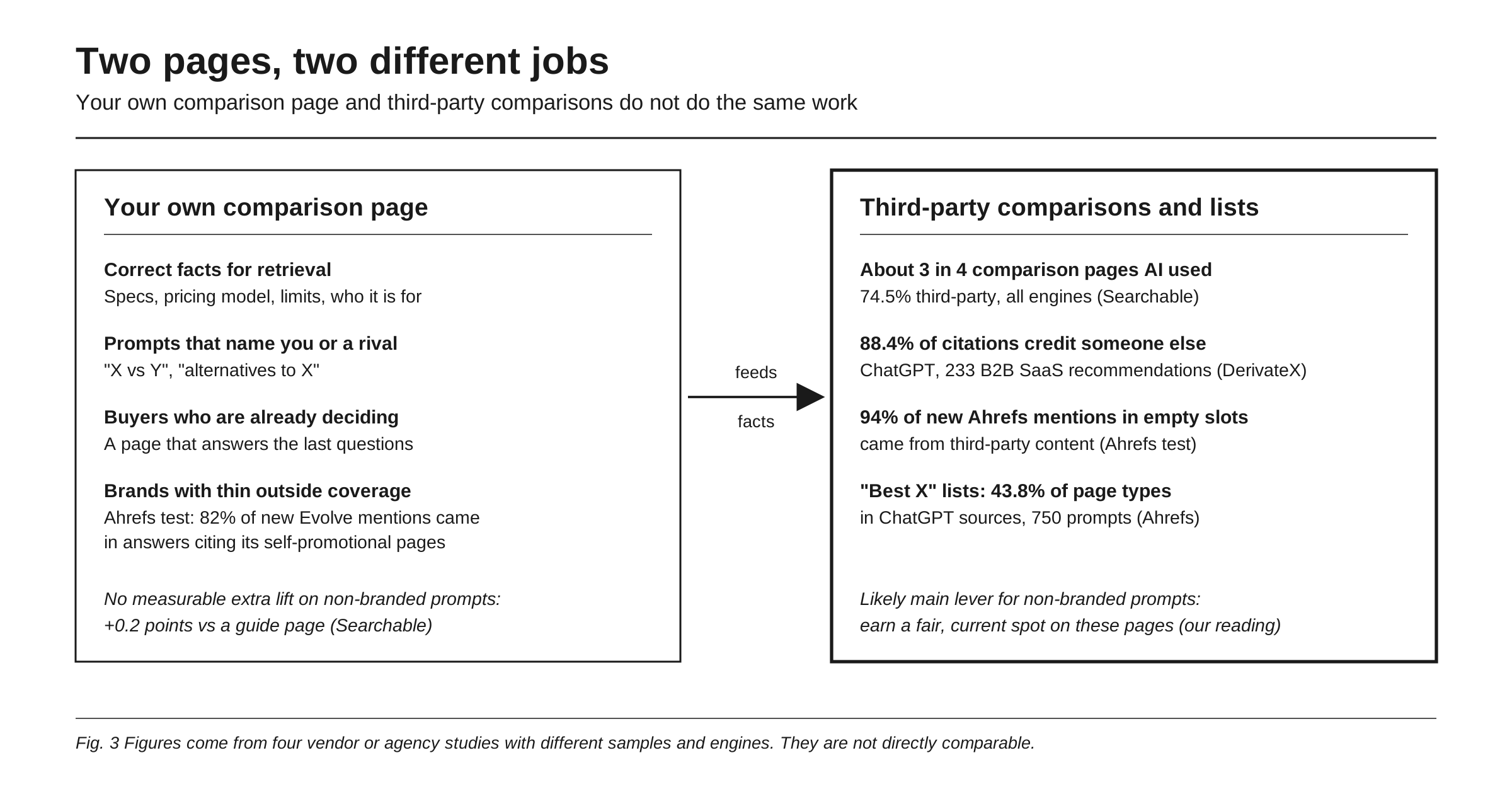
The +0.2 result is about one outcome: how often you get named on non-branded prompts. Comparison pages do other jobs that study did not measure.
Accurate facts for retrieval. If your page states pricing model, limits, integrations and best-fit use cases clearly, engines asked about you against a named rival have correct facts to draw on, not only an outdated affiliate summary.
“X vs Y” and “alternatives to X” prompts. These prompts name you or a competitor, and comparison-style prompts are where Searchable found engines pull in comparison pages most. They are also where you have the most to correct. Searchable recommends judging a comparison page on the comparison prompts it was built for, not on your overall mention rate.
Buyers who are deciding. A visitor who lands on “you vs competitor” is late in the funnel. The page’s job there is conversion: answering the last objections honestly. A mention-rate study does not capture that.
New or thinly covered brands. The Ahrefs experiment found the opposite pattern for its new conference brand, Ahrefs Evolve. When Evolve appeared in 72 answer slots that had been empty, 82% of those new mentions came in answers that cited one of the self-promotional pages. Where few independent sources exist, your own page may be the only material the engine has. DerivateX reported a related pattern: Procurify’s own “Best Procurement Software” article, which also lists competitors, was the cited source for five different brand recommendations in ChatGPT’s procurement answer.
The practical rule: a comparison page is a facts-and-conversion asset with a niche visibility role, not a shortcut to being named more often across your category.
How to build comparison pages AI can cite, and get into the ones it already cites
- Start from the prompts, not the page. List the comparison-style prompts buyers actually use in your category and check how often you appear on them today. If there are few, or you already show up, the page has less to win. Choosing those prompts is covered in how to choose which buyer questions to track.
- State verifiable facts, not adjectives. Use a table with pricing model, plan limits, integrations, deployment and support. Link to public pricing and documentation for both products where possible.
- Be fair to the competitor. Say where they are the better fit. A page that admits trade-offs reads as a source; a page that wins every row reads as an ad, to buyers and, plausibly, to engines.
- Date it and keep it current. Show a “last reviewed” date and update it when either product changes. Of the 143 cited pages DerivateX analyzed, all used list structure, 78% carried the current year in the title, 68% had a comparison table and 56% had an FAQ.
- Use plain, extractable structure. One comparison per page, clear headings, a summary at the top, a short FAQ. Make sure answer crawlers can reach it.
- Find the third-party comparisons that already get cited. Check the sources engines use on your comparison prompts. Those publishers are your real distribution list.
- Give those publishers a reason to include you accurately. Offer product access, current specs, customer references and a named contact. Ask for corrections when a list has your facts wrong. This is earned-media work, not a link purchase.
- Measure on the right prompts, for longer than a month. Track mention rate and cited sources on the comparison prompts before and after a page goes live, and compare against a control set. If a competitor keeps winning those prompts, the steps in the playbook for when AI recommends a competitor apply.
Measuring the effect yourself
You can apply the Searchable study’s before-and-after logic to your own pages. Rankry runs a stable set of buyer-intent prompts every day across ChatGPT, Claude, Gemini, Perplexity, Grok and Google AI Mode and AI Overviews, and records which sources each engine cites. If your tracked set includes the comparison prompts you care about, you can see whether your own comparison page or a third-party roundup is the cited source on them, and compare your visibility against named competitors over time. A new “X vs Y” question is one more prompt, answered as soon as you add it.
FAQ
Do my own comparison pages increase AI visibility? Not measurably, on the evidence so far. In Searchable’s study of 117 brands, those whose own comparison page started being cited gained 0.2 percentage points more in non-branded mentions than those whose own guide did, with a range of -1.3 to +1.9 points. It is a vendor study with a before-and-after design, no randomized control and a four-week window, so it shows no detectable extra lift, not proof of zero effect.
Should I stop publishing “X vs Y” pages? No. They still do useful work: they give engines accurate facts about your product on prompts that name you or a rival, and they help buyers who are already deciding. Build them for those jobs, keep them fair and current, and judge them on the comparison prompts they target rather than on your overall mention rate.
Why do AI engines cite third-party comparisons more than vendor pages? In Searchable’s sample, third parties wrote about three in four of the comparison pages AI used, and a similar share of guides and lists. A plausible explanation is that engines look for agreement across independent sources, and a vendor comparing itself carries an obvious interest. No study has isolated that mechanism, so treat it as a reasonable interpretation of the data.
Can my own comparison page help a competitor? It can. In a small Ahrefs experiment, 43% of answers that cited a page promoting Ahrefs’ conference never named that conference, and the author reports AI recommended other conferences instead. A well-built comparison page is a good source of facts about both products, so the engine can use it and still pick the rival. Fair positioning and clear best-fit claims may reduce that risk.
How do I get included in third-party comparison articles? Find the roundups and reviews engines already cite on your comparison prompts. Then contact those publishers with current specs, product access, customer references and a named contact, and request corrections when your details are wrong. Treat it as ongoing earned-media work, and track whether those sources start naming you over the following months.
Sources
- Comparison Pages in AI Search: What 1.8 Million Answers Show, Searchable, October 8, 2026
- B2B SaaS AI Citation Study: How ChatGPT Recommends Software, DerivateX, May 31, 2026 (updated September 22, 2026)
- Do Self-Promotional “Best” Lists Boost ChatGPT Visibility? Study of 26,283 Source URLs, Ahrefs, December 4, 2025
- Self-Promotional Content Works, Until It Backfires (AI SEO Experiment), Ahrefs, July 6, 2026
See whether your comparison pages, or someone else’s, are the sources AI uses on the prompts that decide deals. Start a free 7-day Rankry trial, no card required.