When AI already recommends your competitor, the fastest response is to ask the AI directly why it chose them, because it usually names a concrete reason, clearer pricing, more reviews, a specific integration, and that sentence is your to-do list. Capture the sources it cited for the recommendation, since those pages, not your homepage, are what you need to appear on or correct, and do it per engine, because you may win on Claude and lose on ChatGPT. Then run a 30-day loop: week one diagnose, week two fix the fastest source you control, week three earn the third-party proof, week four re-run and measure. Expect real-time engines to move in days and training-heavy ones in weeks. This is the tactical playbook; for why the AI favors a competitor in the first place, see why ChatGPT recommends competitors.
This is not a “why is this happening” article. It assumes it is already happening and gives you the sequence to respond, starting today.
First: ask the AI why, and record it
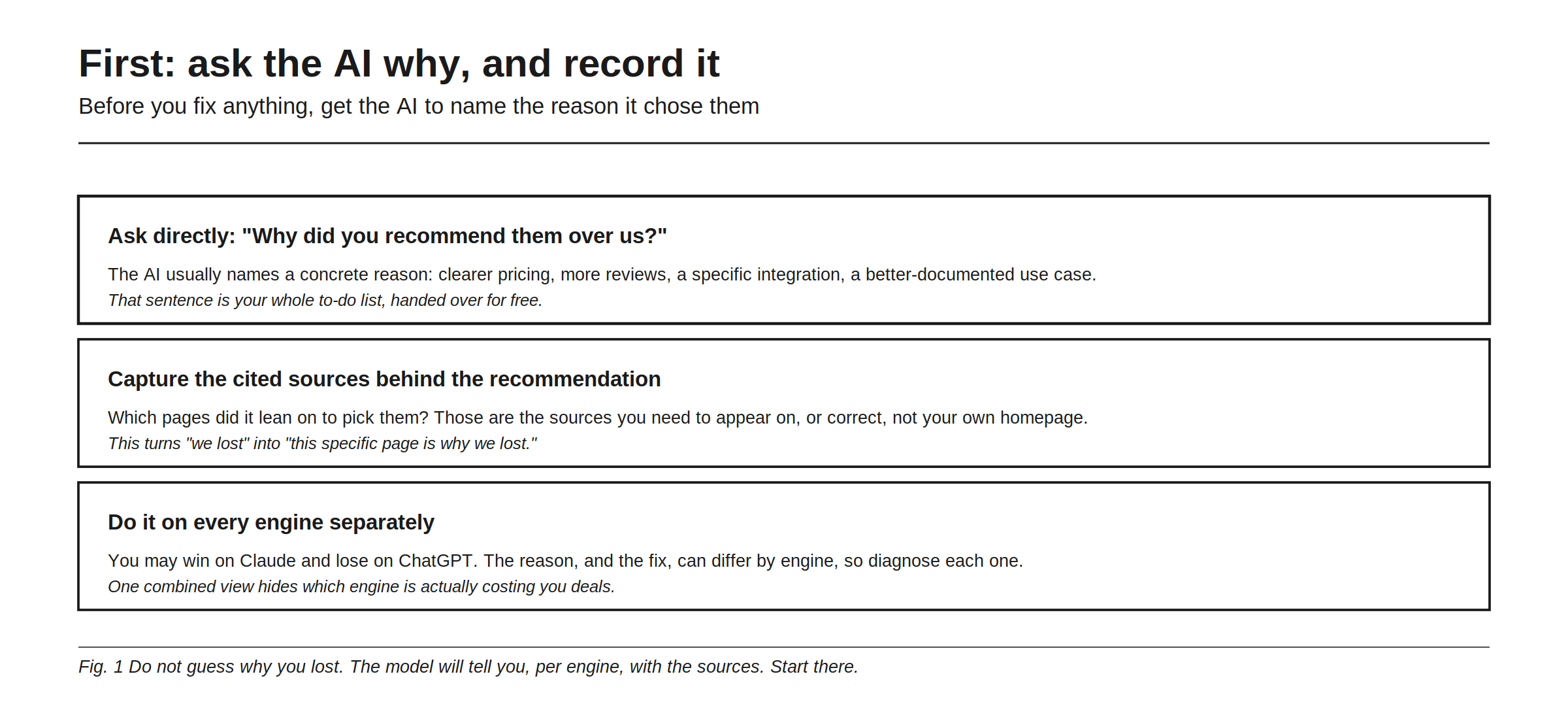
Before you fix anything, get the reason from the source. Ask directly, “why did you recommend them over us,” and the AI usually names a concrete reason: clearer pricing, more reviews, a specific integration, a better-documented use case, and that sentence is your whole to-do list handed over for free. Capture the cited sources behind the recommendation, because the pages it leaned on to pick them are the sources you need to appear on or correct, not your own homepage, which turns “we lost” into “this specific page is why we lost.” And do it on every engine separately, because you may win on Claude and lose on ChatGPT, the reason and the fix can differ by engine, and one combined view hides which engine is actually costing you deals.
Do not guess why you lost. The model will tell you, per engine, with the sources, so start there. The source-hierarchy logic behind which pages matter is in where AI actually gets its sources.
The first 30 days, by week
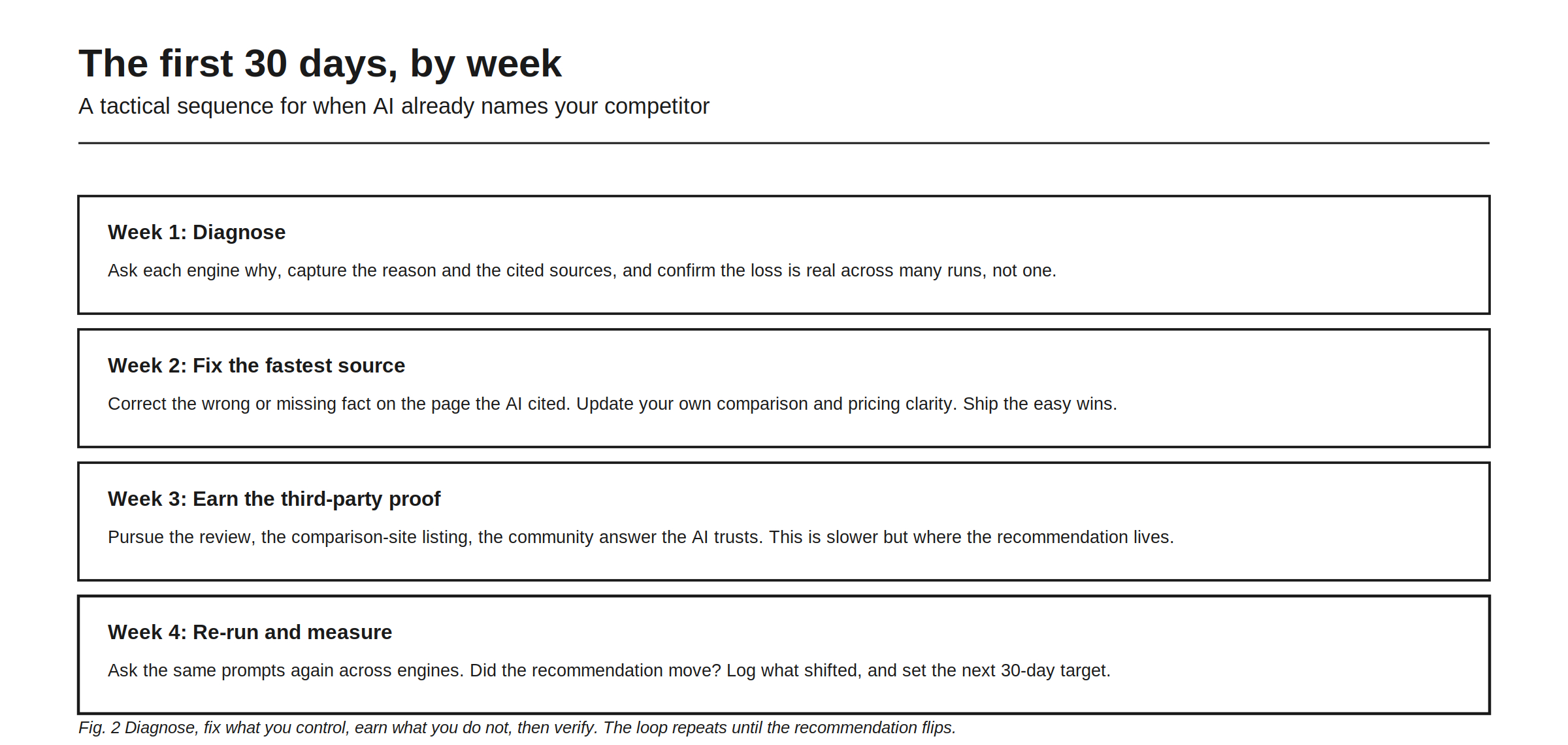
Run it as a four-week loop. Week 1, diagnose: ask each engine why, capture the reason and the cited sources, and confirm the loss is real across many runs, not one, because a single run is unreliable. Week 2, fix the fastest source: correct the wrong or missing fact on the page the AI cited, update your own comparison and pricing clarity, and ship the easy wins you fully control. Week 3, earn the third-party proof: pursue the review, the comparison-site listing, the community answer the AI trusts, which is slower but where the recommendation actually lives. Week 4, re-run and measure: ask the same prompts again across engines, see whether the recommendation moved, log what shifted, and set the next 30-day target.
Diagnose, fix what you control, earn what you do not, then verify. The loop repeats until the recommendation flips. The reason week three matters most, that recommendations rest on third-party proof, is the core of the mention-versus-recommendation gap, and the positive-direction version of this work is in how to get your brand recommended by Claude.
What to expect, and what not to
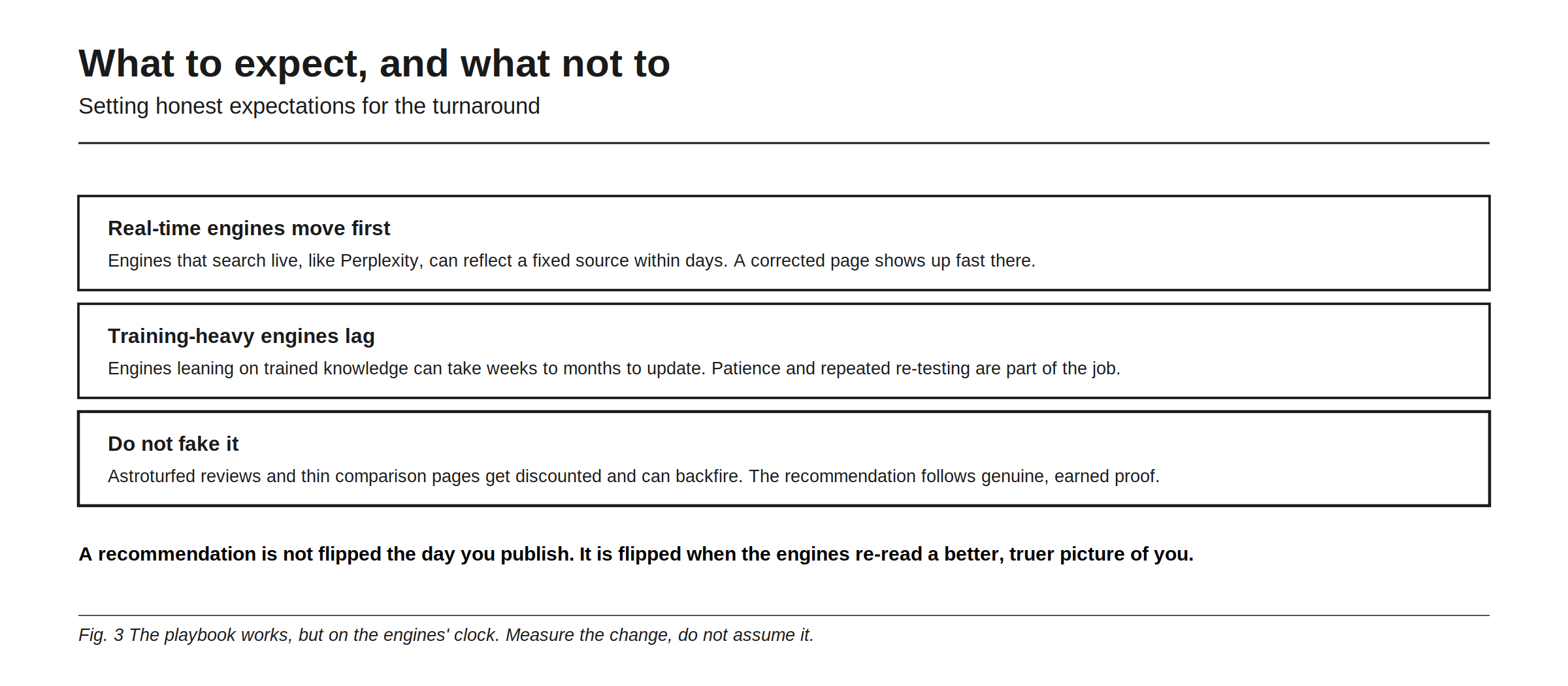
Set honest expectations for the turnaround. Real-time engines move first: engines that search live, like Perplexity, can reflect a fixed source within days, so a corrected page shows up fast there. Training-heavy engines lag: engines leaning on trained knowledge can take weeks to months to update, so patience and repeated re-testing are part of the job. And do not fake it: astroturfed reviews and thin comparison pages get discounted and can backfire, because the recommendation follows genuine, earned proof.
A recommendation is not flipped the day you publish. It is flipped when the engines re-read a better, truer picture of you. The playbook works, but on the engines’ clock, so measure the change rather than assuming it. If part of the problem is not that the AI prefers a competitor but that it states something false about you, handle that with the sibling playbook in when AI describes your brand wrong.
The one shortcut that actually works
If you only do one thing from this playbook, do the first step: ask the AI why, per engine, and write down the exact reason and the cited source. Most brands skip straight to “publish more content” and burn a month producing pages the AI never reads, because they never learned which source drove the loss. The diagnostic question collapses weeks of guessing into a specific target: this page, this missing fact, this review gap, on this engine. From there the fix is often small and fast, correcting one cited comparison page can move a recommendation more than ten new blog posts. The playbook is really just: find the exact reason, fix it where the AI reads, and verify on the engines’ timeline. Rankry captures the recommendation, the reason, and the cited source per engine, so week one of this playbook is a dashboard view instead of a manual audit, from $99 a month on a no-card trial.
FAQ
What should I do first when AI recommends a competitor? Ask the AI directly why it chose them, on each engine, and record the reason and the sources it cited. The reason is usually concrete, pricing, reviews, an integration, and it becomes your to-do list. Do this before producing any new content.
How long does it take to change an AI recommendation? It varies by engine. Real-time search engines like Perplexity can reflect a corrected source within days. Training-heavy engines can take weeks to months. Re-test the same prompts on a schedule rather than expecting an immediate flip.
Should I write more content to beat a competitor in AI answers? Not blindly. First find the exact reason and cited source behind the loss. Often a small fix to the specific page the AI read, or one earned review, moves the recommendation more than many new blog posts the AI never references.
Do I need to fix this separately on each AI engine? Yes. You can win on one engine and lose on another because they weigh sources differently. Diagnose the reason and cited sources per engine, and re-test each one, since a single blended view hides which engine is costing you deals.
Can I fake reviews or comparisons to shift the recommendation? No. Astroturfed reviews and thin comparison pages tend to get discounted and can backfire. AI recommendations follow genuine, earned third-party proof, so the durable move is to earn the review or listing, not fabricate it.
See the recommendation, the reason, and the cited source per engine, so day one of your response is a view, not an audit. Start a free 7-day Rankry trial, no card, first report in two minutes.