To get your brand recommended by Claude, work four gates in order: be findable in the index Claude searches, which by all public evidence is Brave, be fetchable by allowing Claude’s bots and rendering content server-side, be citable with pages that answer buyer questions directly, and be corroborated by independent sources that tell the same story about you. Most brands fail at the first two gates without knowing it, then spend their whole budget on content, which is gate three. Diagnose in order and the work becomes obvious.
Claude is worth this effort for a specific reason: its users skew professional, technical, and high-intent, and when Claude recommends a product it does so with cited reasoning a buyer can check. A Claude recommendation is not a banner impression. It is a trusted shortlist placement at the exact moment someone is choosing. Here is how to earn it, based on how Claude actually finds and evaluates brands.
Which engines this applies to. The four gates below (findable, fetchable, citable, corroborated) are the same on ChatGPT, Gemini, Perplexity, Grok, Microsoft Copilot, and Google AI Overviews. Only gate one changes, and it changes completely: each engine searches a different index, so “findable” means Brave for Claude, Bing for Copilot, Google for AI Overviews, and each engine’s own crawl for the rest. Gates two, three, and four are shared work that pays off everywhere at once, which is the argument for doing them first and tuning per engine after. The cross-engine version of this plan is in how to monitor your brand across AI search engines.
First, understand what you are optimizing
Claude’s picture of your brand comes from two layers. Training knowledge is what the model learned before its cutoff, and you cannot edit it on any useful timeline. Live retrieval is what Claude finds when it searches the web mid-answer, and that is fully shapeable. When Claude recommends brands in a category, retrieval usually does the heavy lifting: it searches, reads the sources it finds, and builds the shortlist from their consensus. So the practical target is not “change Claude’s mind.” It is “change what Claude finds when it looks.” For the full mechanics, see how Claude finds and cites sources.
The four gates
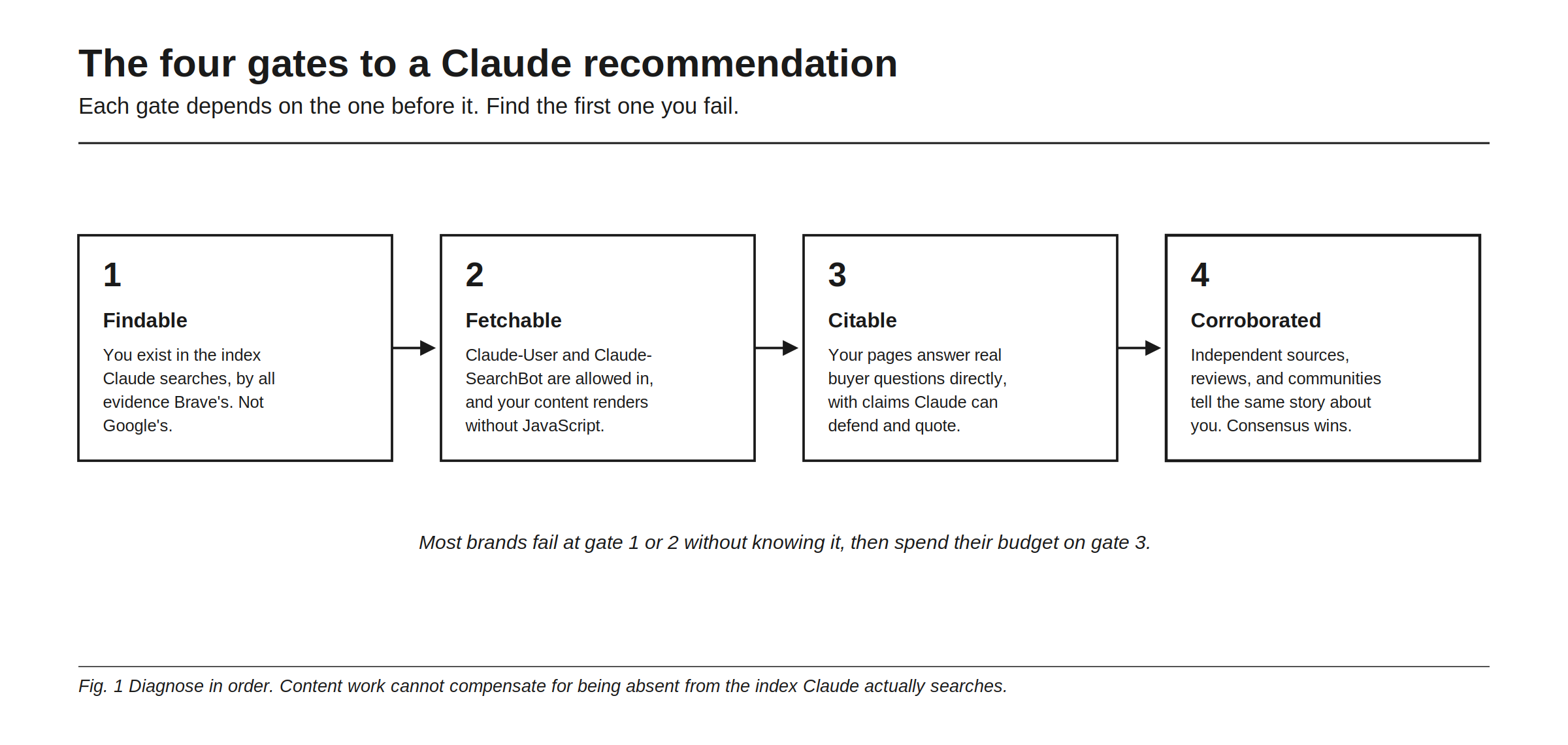
Gate 1: be findable in the index Claude searches
Claude’s live view of the web comes from an external index, and every public signal, Anthropic’s own subprocessor list, exposed API parameters, independent overlap tests, points at Brave Search. Brave runs its own independent index, separate from Google’s. The consequence catches teams off guard: your Google rankings do not transfer. A brand can own page one of Google and be thin in Brave, which makes it thin for Claude.
So the first check costs nothing: search your category and your brand on search.brave.com and look at what comes back. If your site and the pages that mention you are weak there, that is a Claude problem regardless of anything else you do. Brave builds its index by crawling the open web, so the fixes are familiar, crawlable pages, real inbound links, presence on the pages that already rank there, but the scoreboard to watch is Brave’s, not Google’s.
Gate 2: be fetchable when Claude comes looking
Two of Anthropic’s crawlers decide whether Claude can read you at all. Claude-SearchBot indexes content to improve Claude’s search results, and Claude-User fetches your page live at the moment a user’s question needs it. Both respect robots.txt, and both are commonly blocked by accident, because thousands of sites added blanket “block AI bots” rules in 2024 and never revisited them. Blocking the training bot, ClaudeBot, is a legitimate choice that does not hurt your visibility. Blocking Claude-SearchBot or Claude-User removes you from answers.
Check your robots.txt today, and then check rendering: Claude’s fetchers do not reliably execute JavaScript, so content that only appears after scripts run may as well not exist. Server-side rendering for your key pages is the fix. A Claude-User hit in your server logs is the success signal here, it means a live answer pulled your page in.
Gate 3: be citable
Claude cites pages that resolve the question, and it favors claims it can defend, because every citation is a link a skeptical user can click. That shapes what “good content” means here: lead with the direct answer, use clear headings and clean structure, keep claims specific and checkable, and cover the exact questions buyers ask, comparisons, use cases, alternatives, pricing. A vague thought-leadership post gives Claude nothing to quote. A page that says plainly what you do, for whom, at what price, with what trade-offs, is citation material.
Gate 4: be corroborated
Claude does not take your word for who you are. When it builds a category shortlist, it leans on independent sources, review sites, community threads, comparison pages, and looks for agreement. One glowing page you wrote about yourself is a weak signal. The same story told by several sources you do not control is a strong one. This is the slowest gate and the most decisive: earn genuine reviews, be useful in the communities where your buyers compare options, and get named on the listicles and comparisons Claude already cites in your category. The way to find those exact pages is to track which sources Claude cites for your buyer prompts, and close the gaps where a rival is named and you are not.
The checklist, sequenced by payoff speed
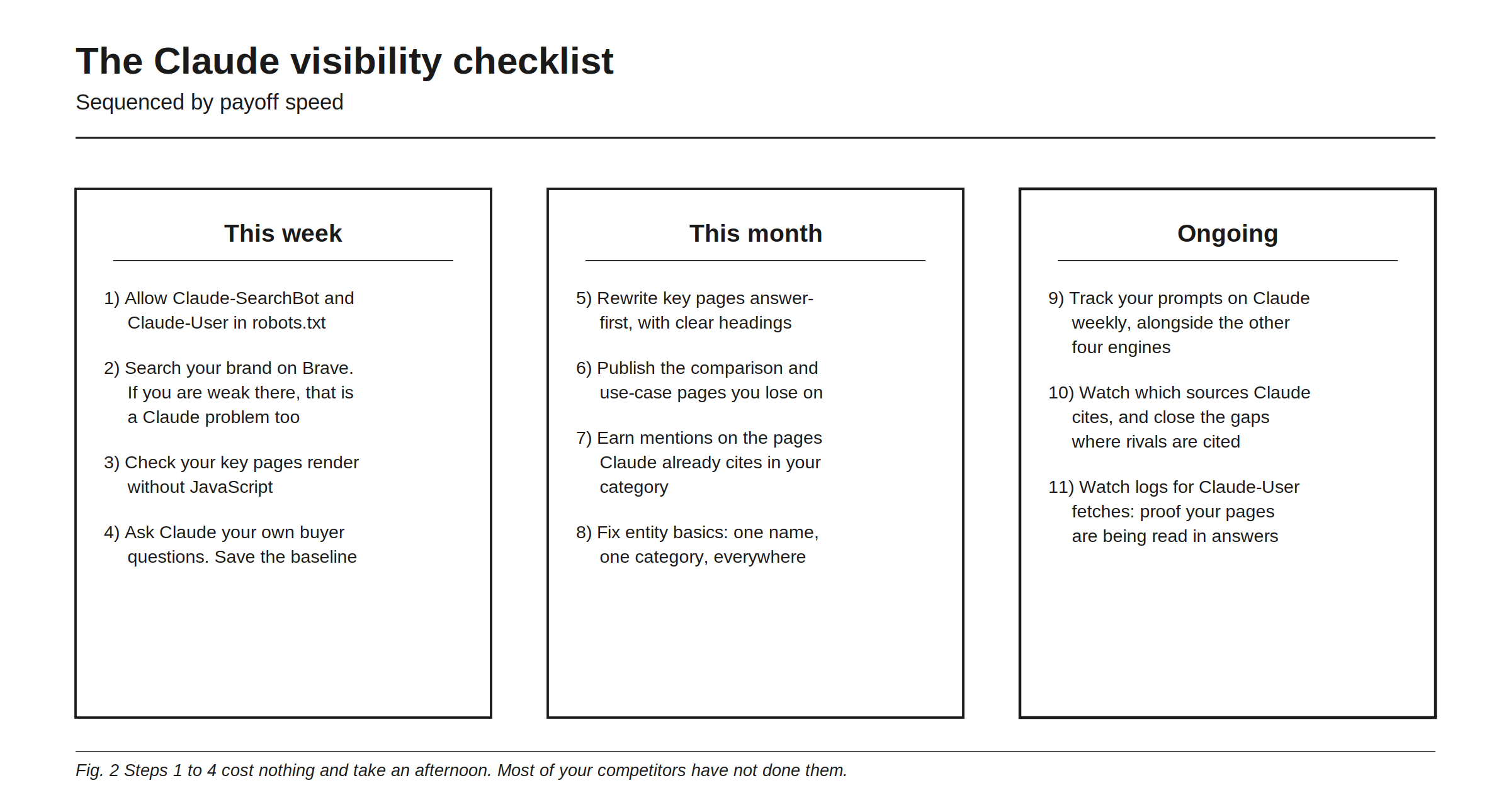
This week, do the free afternoon’s work: allow Claude-SearchBot and Claude-User in robots.txt, search your brand and category on Brave, confirm your key pages render without JavaScript, and ask Claude your own buyer questions from a clean session, saving the answers as a baseline. This month, do the content and entity work: rewrite key pages answer-first, publish the comparison and use-case pages for the prompts you lose, earn mentions on the pages Claude already cites, and fix entity basics so you are one name and one category everywhere. Ongoing, run the measurement loop: track your prompts on Claude weekly alongside the other engines, watch which sources it cites and close the gaps, and watch your logs for Claude-User fetches as ground-truth proof your pages are being read.
Steps one through four cost nothing, and most of your competitors have not done them. That is the honest edge available right now.
Measure it, or you are guessing
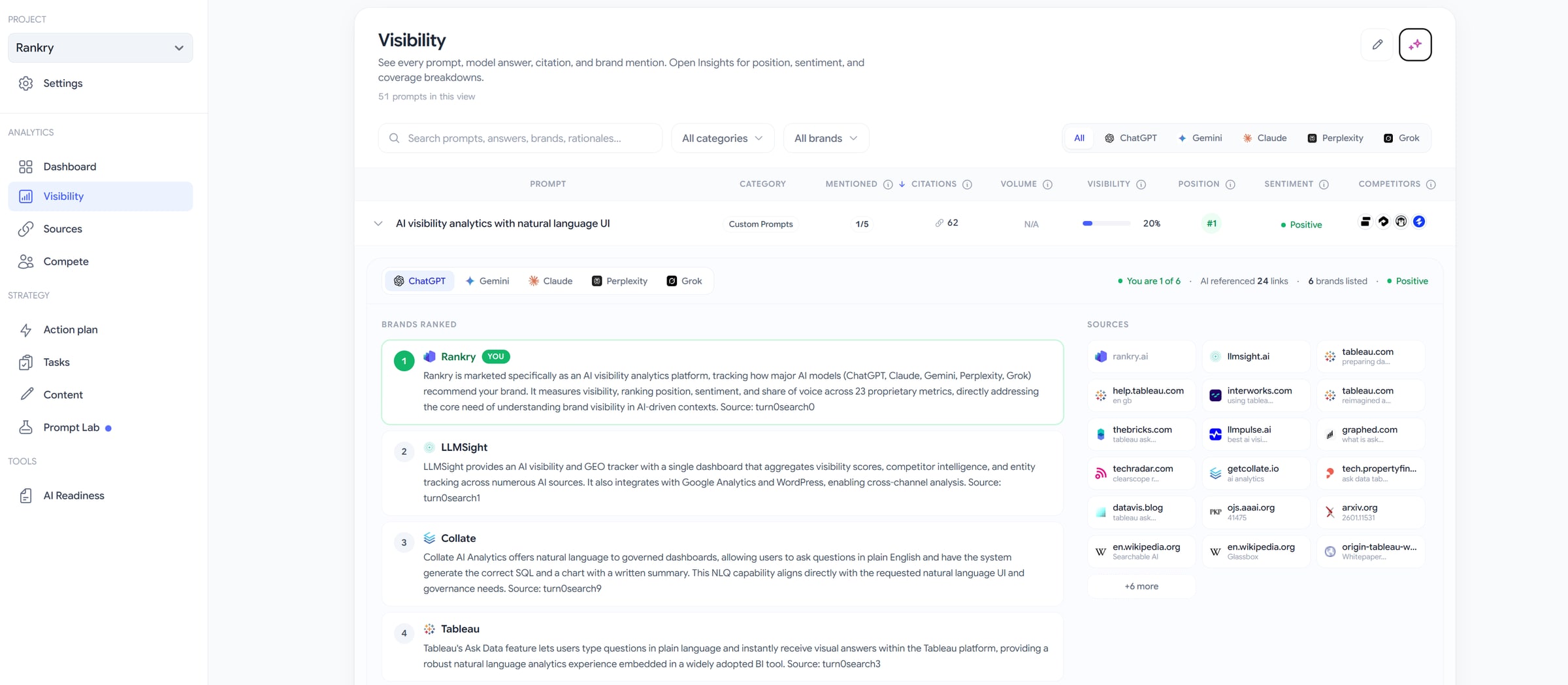
Claude’s answers vary between runs, its index is not Google’s, and its shortlists shift as sources change. A one-time manual check tells you almost nothing about your real position. The durable approach is tracking a fixed set of buyer-intent prompts on a schedule, recording whether Claude names you, where you rank, how it describes you, and which sources it cites. Rankry runs exactly that for Claude, alongside ChatGPT, Gemini, Perplexity, Grok, Microsoft Copilot, and Google AI Overviews, with the raw Claude responses kept as evidence and the cited-source gaps flagged as your outreach list. You can see how Claude specifically treats your category on the Claude visibility tracker page.
FAQ
How do I get Claude to recommend my product? Work four gates in order: be present in the index Claude searches (by all evidence Brave), allow Claude-SearchBot and Claude-User and render content server-side, publish pages that answer buyer questions directly, and earn corroboration from independent sources like reviews and community threads.
Does my Google ranking help me in Claude? Not directly. Claude’s live retrieval runs on an independent index, so a strong Google position does not transfer. Check your presence on Brave Search, because that is the view of the web Claude most likely sees.
Which robots.txt settings matter for Claude visibility? Allow Claude-SearchBot (indexing) and Claude-User (live fetches). Blocking ClaudeBot only opts you out of model training and does not hurt visibility. Each bot needs its own directive, blocking one does not block the others.
How long does it take to show up in Claude’s recommendations? The technical gates, robots.txt and rendering, take effect as soon as your pages are re-fetched, often days. Corroboration, reviews, community presence, and third-party mentions, compounds over weeks to months. Plan a quarter for visible movement on competitive prompts.
How do I know if Claude is reading my site? Check your server logs for Claude-User and Claude-SearchBot user-agents. A Claude-User fetch means a live answer pulled your page. Also run your buyer prompts on Claude on a schedule and track whether you appear and which sources it cites.
Do these four gates work for the other AI engines? Yes, with one substitution. Fetchable, citable, and corroborated are shared across ChatGPT, Gemini, Perplexity, Grok, Microsoft Copilot, and Google AI Overviews, so that work compounds everywhere. Findable is engine-specific, because each one searches a different index: Brave for Claude, Bing for Copilot, Google for AI Overviews, and their own crawls for the rest. Do the three shared gates first, then fix findability per engine.
Track exactly which prompts Claude recommends you on, who wins the ones it does not, and which sources decide it. Start a free 7-day Rankry trial, no card, first report in two minutes.