Being cited by AI is usually good, but there is a hidden cost worth naming: when the AI answers the question so completely in the reply that no reason to visit you remains, you get the credit and give away the value, with no click, no session, and no lead. This is not a knock on AI traffic, the visits that do arrive are excellent and convert well above organic. The problem is the visits that never happen, because a page whose entire value an AI can restate becomes a citation that replaces the visit instead of driving it. The fix is not to hoard information, it is to be cited for content that draws people in, comparisons, tools, demos, proprietary data, rather than content fully consumed in the answer. This guide separates the two and shows how to design for it.
Most GEO advice treats “get cited” as the finish line. For some of your pages it is, and for others it quietly means the AI just did your job and kept your customer.
When a citation gives your value away
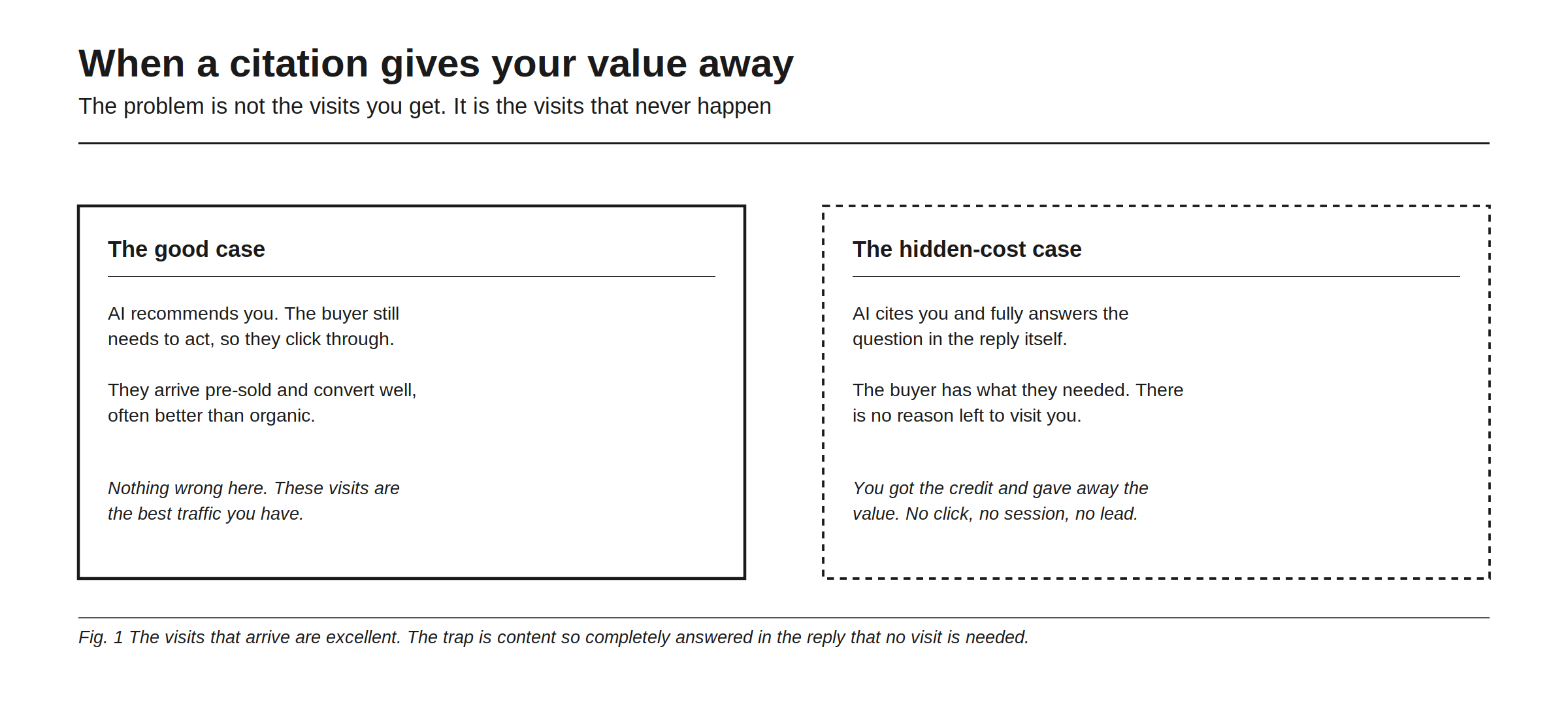
Hold the two cases apart, because they are opposite outcomes wearing the same “we got cited” label. The good case: AI recommends you, the buyer still needs to act so they click through, and they arrive pre-sold and convert well, often better than organic. Nothing is wrong here, these visits are the best traffic you have, which is the whole argument in the business case for AI visibility. The hidden-cost case: AI cites you and fully answers the question in the reply itself, the buyer has what they needed, and there is no reason left to visit you, so you got the credit and gave away the value, with no click, no session, no lead.
The distinction is not “AI traffic is bad.” The visits that arrive are genuinely excellent. The trap is a specific kind of content: the page so completely answered in the reply that no visit is needed. That is where a citation stops being a win and becomes an unpaid content license.
Which content gets given away
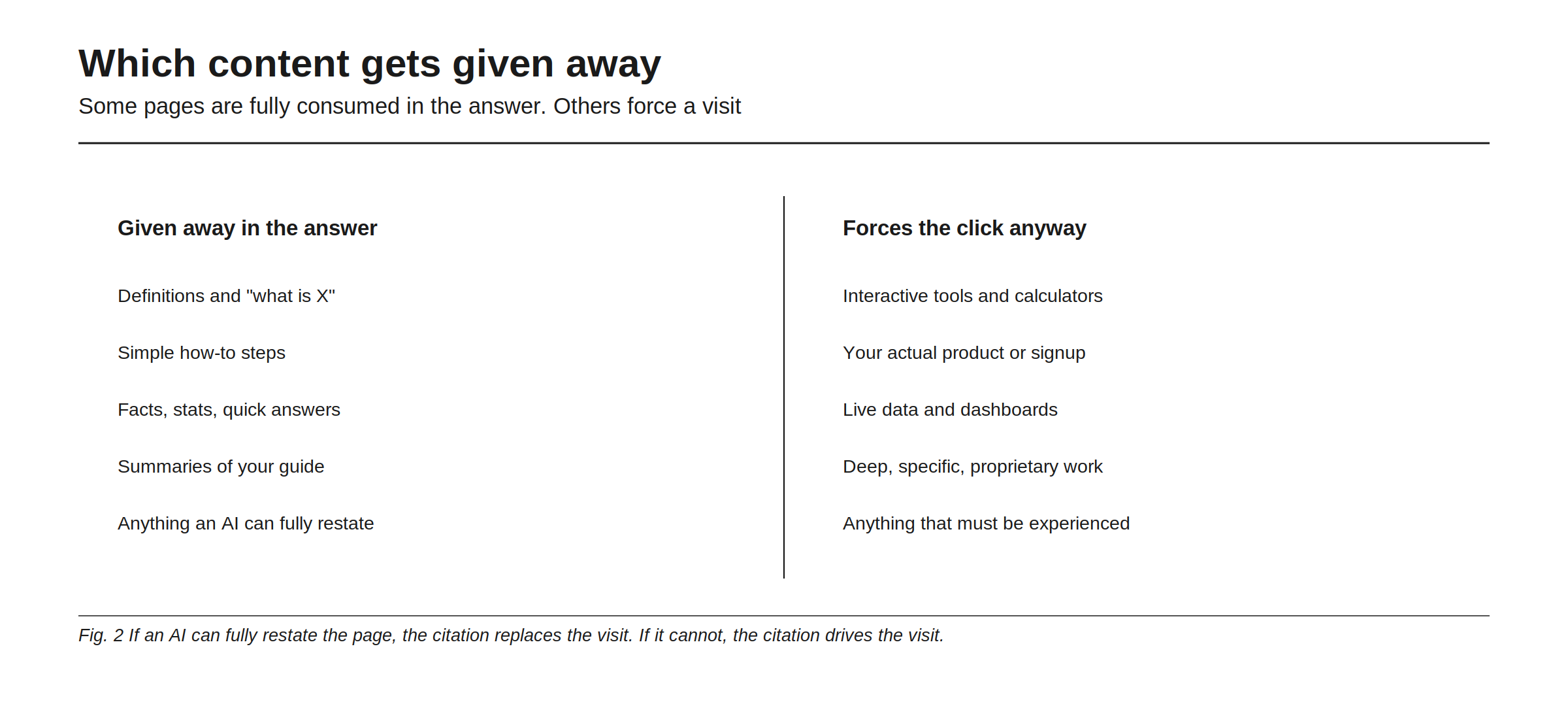
The line runs cleanly between content an AI can fully restate and content it cannot. Given away in the answer: definitions and “what is X”, simple how-to steps, facts and quick stats, summaries of your guide, anything an AI can fully restate. Forces the click anyway: interactive tools and calculators, your actual product or signup, live data and dashboards, deep and specific proprietary work, anything that must be experienced rather than described. If an AI can fully restate the page, the citation replaces the visit; if it cannot, the citation drives the visit.
This is why the same citation strategy produces opposite results on different pages. Getting cited for your definitional blog post may generate recognition but no traffic, while getting cited for your comparison tool sends a ready buyer straight to you. Knowing which of your cited pages fall on which side is the whole exercise, and it connects to the mention-versus-recommendation point in the mention-versus-recommendation gap, because a recommendation toward a click-forcing page is worth far more than one toward a fully-consumed page.
Get cited without giving it all away
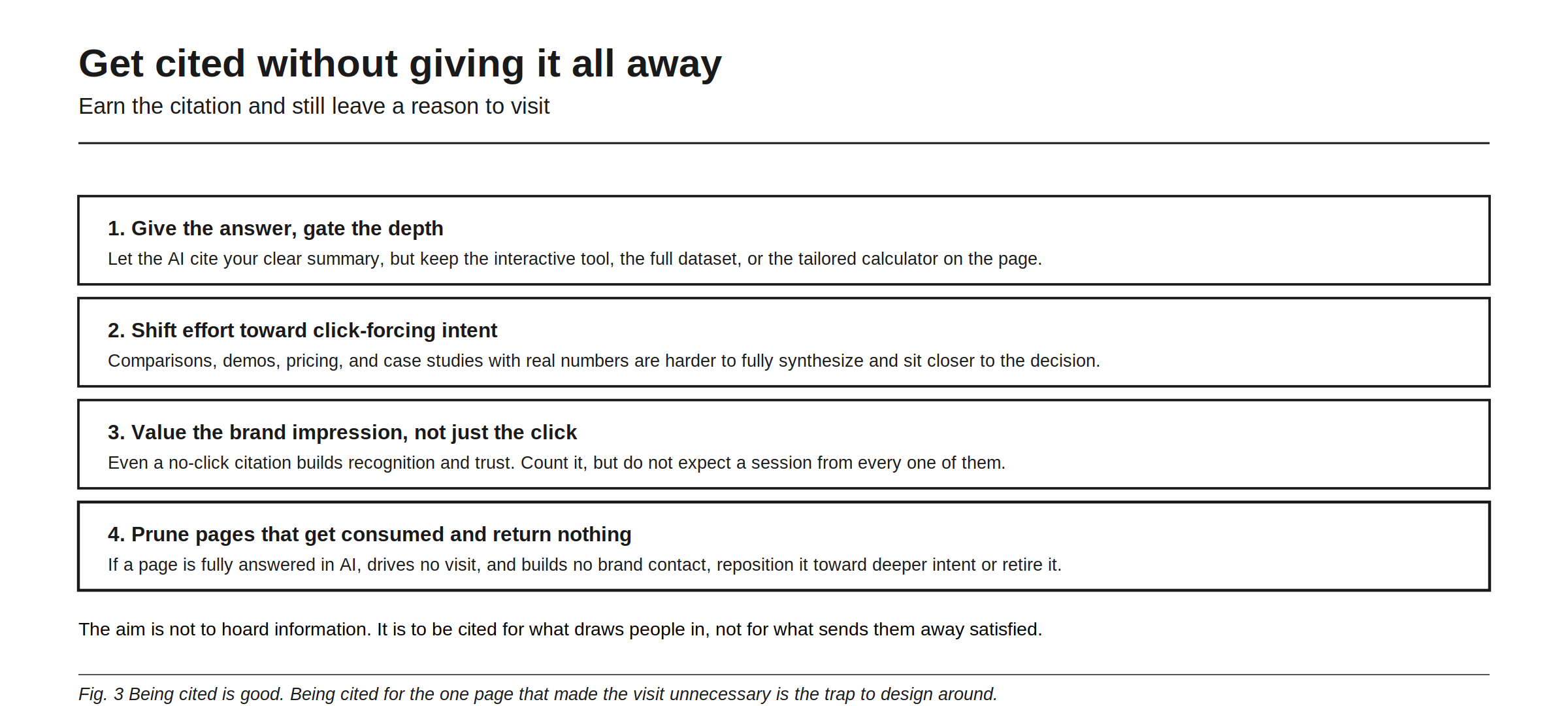
Four moves keep the citation and the reason to visit. First, give the answer, gate the depth: let the AI cite your clear summary, but keep the interactive tool, the full dataset, or the tailored calculator on the page. Second, shift effort toward click-forcing intent: comparisons, demos, pricing, and case studies with real numbers are harder to fully synthesize and sit closer to the decision. Third, value the brand impression, not just the click: even a no-click citation builds recognition and trust, so count it, but do not expect a session from every one. Fourth, prune pages that get consumed and return nothing: if a page is fully answered in AI, drives no visit, and builds no brand contact, reposition it toward deeper intent or retire it.
The aim is not to hoard information; it is to be cited for what draws people in, not for what sends them away satisfied. Being cited is good. Being cited for the one page that made the visit unnecessary is the trap to design around. The broader question of when AI answers actually drive traffic and revenue is in the honest data on whether AI answers drive revenue.
The nuance that keeps this honest
It would be easy to over-correct into “stop giving AI good answers,” and that would be a mistake. You cannot get cited without being genuinely useful, and a no-click citation still does real work: it builds brand recognition, it seeds trust for the next, higher-intent query, and in agentic search it may be the moment a machine decides you are the answer, per agentic search versus zero-click. So the goal is not to withhold value, it is to be strategic about which value lives fully in a citable summary and which requires coming to you. The definitional content earns your entity recognition; the deep, interactive, proprietary content earns the visit and the lead. A mature strategy wants both, and simply stops measuring the first by a metric it was never going to move. Rankry shows which pages get cited and lets you pair that with what actually converts, so you can tell a value-giving citation from a value-capturing one, from $99 a month on a no-card trial.
FAQ
Can being cited by AI actually hurt my business? Not the citation itself, but a specific pattern can cost you: when the AI fully answers the question in the reply, the buyer has no reason to visit, so you get credit but no click, session, or lead. It is the fully-consumed page, not AI traffic in general, that is the problem.
Isn’t AI traffic supposed to convert better? Yes, and it does. The visits that arrive from AI are typically high-intent and convert above organic. The hidden cost is not those visits, it is the visits that never happen because your page’s entire value was restated in the answer.
Which pages are at risk of being given away in AI answers? Content an AI can fully restate: definitions, simple how-tos, quick facts, and summaries. Content that forces a visit, interactive tools, your product, live data, deep proprietary work, is safer, because it cannot be fully consumed in a reply.
How do I get cited without losing the visit? Give a clear, citable summary but keep the depth on the page: the tool, the full dataset, the tailored result. Shift effort toward comparisons, demos, and pricing that sit closer to the decision and are harder for an AI to synthesize completely.
Should I stop publishing definitional content? No. It earns brand recognition and entity understanding that help you get recommended later. Just stop measuring it by traffic it was never going to drive, and make sure your click-forcing, high-intent pages are also strong.
See which cited pages actually drive visits versus which get consumed in the answer, so you optimize for the right ones. Start a free 7-day Rankry trial, no card, first report in two minutes.