The business case for AI visibility is not volume, it is value per visitor: AI-referred visitors have been found to convert several times better than typical organic traffic, and brands that AI engines cite earn meaningfully more organic and paid clicks than brands that are not cited. AI referrals are still a small share of most sites’ traffic today, which makes them easy to dismiss, but they are both compounding and high-converting, because the visitor arrives having already read a summary that vetted you against alternatives. So the right way to judge AI visibility is on quality, not size: on volume it is a rounding error, on value it is often your best traffic. This guide gives you the argument, and how to make it to someone who controls budget.
If you have ever had “AI traffic is tiny, why bother” thrown at you, this is the answer. The number that matters is not how many, it is how good.
Small channel, high value
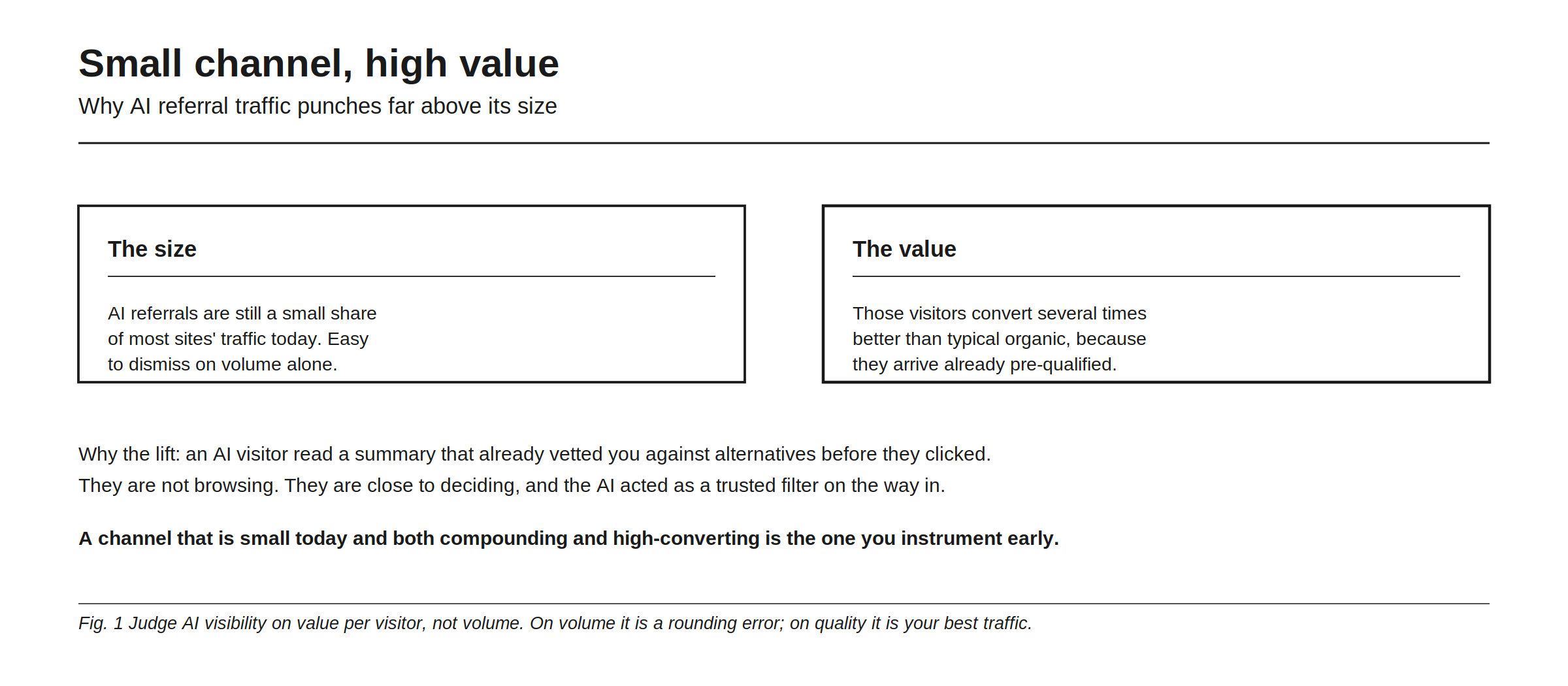
Hold two facts side by side. The size: AI referrals are still a small share of most sites’ traffic today, easy to dismiss on volume alone. The value: those visitors convert several times better than typical organic, because they arrive already pre-qualified. Why the lift exists is straightforward, an AI visitor read a summary that already vetted you against alternatives before they clicked, so they are not browsing, they are close to deciding, and the AI acted as a trusted filter on the way in.
A channel that is small today but both compounding and high-converting is precisely the one you instrument early. Judge AI visibility on value per visitor, not volume: on volume it is a rounding error, on quality it is your best traffic. The mechanics of measuring that traffic are in Introducing AI Traffic.
AI as a trust signal
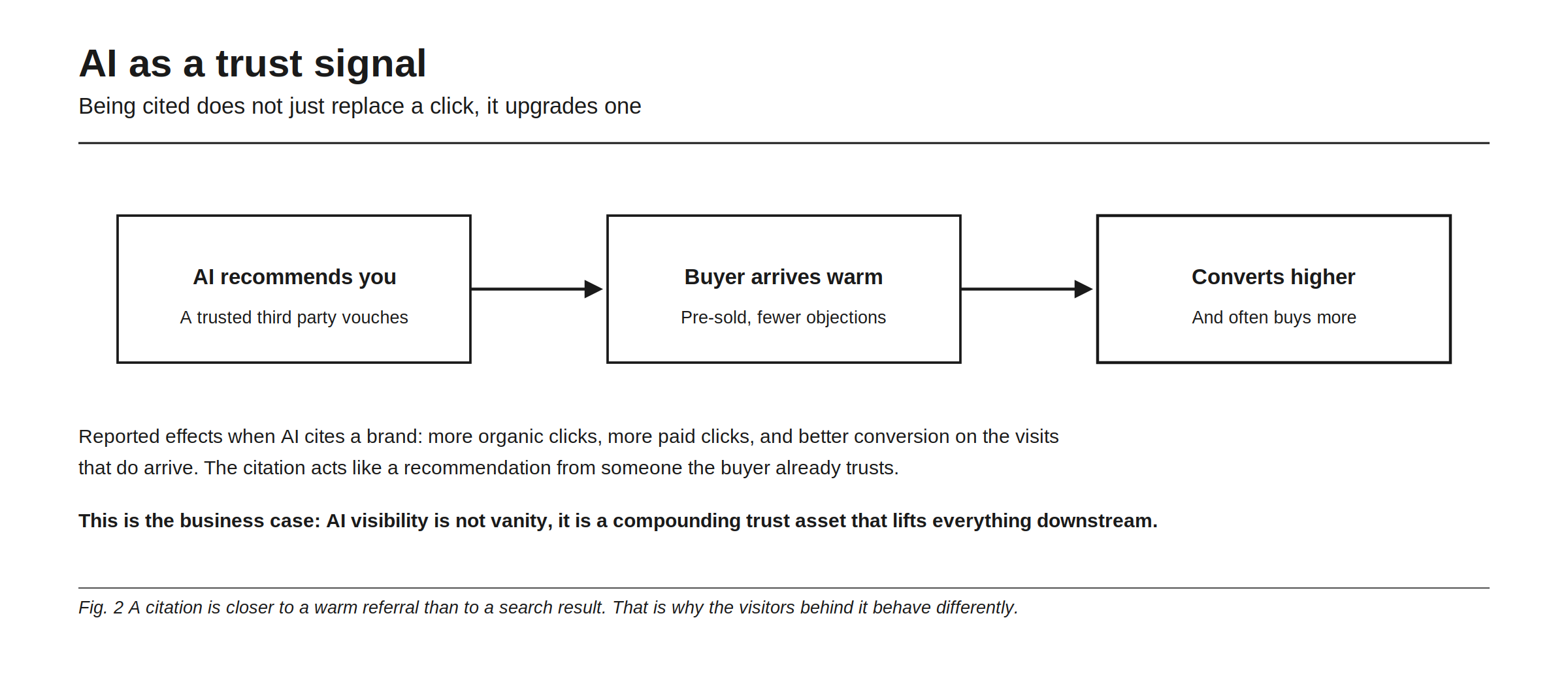
The deeper reason AI visitors behave differently is that a citation functions like a recommendation from someone the buyer already trusts. The chain is simple: AI recommends you, so a trusted third party has vouched for you; the buyer arrives warm, pre-sold and with fewer objections; and they convert higher, often buying more. Reported effects when AI cites a brand include more organic clicks, more paid clicks, and better conversion on the visits that do arrive, because the citation carries the weight of a vouch rather than a mere listing.
This is the business case in one line: AI visibility is not vanity, it is a compounding trust asset that lifts everything downstream. A citation is closer to a warm referral than to a search result, which is exactly why the visitors behind it behave better than raw organic. And the effect is not confined to the AI channel itself, being cited appears to lift your ordinary clicks too, because the same authority that earns the citation earns trust everywhere.
Making the case to a decision-maker
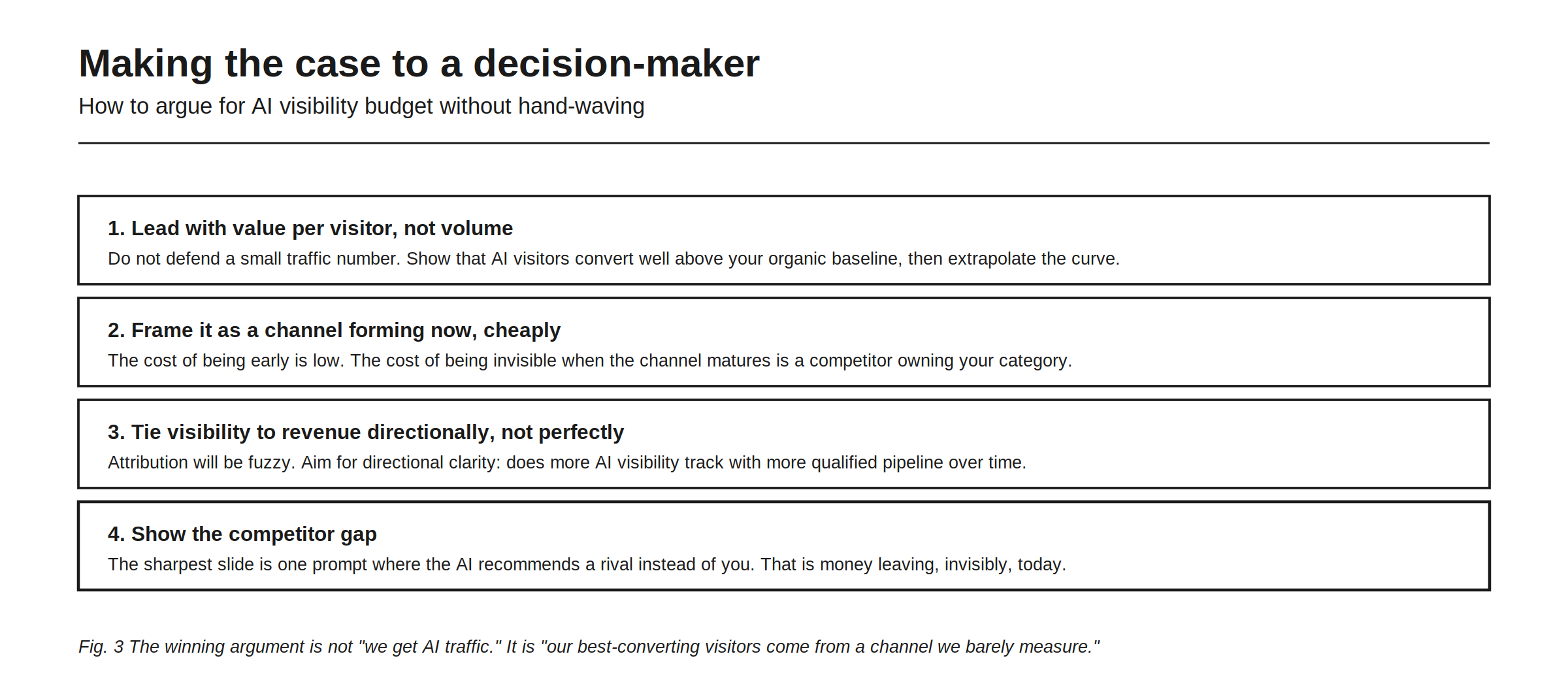
Four moves win the budget argument. First, lead with value per visitor, not volume: do not defend a small traffic number, show that AI visitors convert well above your organic baseline, then extrapolate the growth curve. Second, frame it as a channel forming now, cheaply: the cost of being early is low, while the cost of being invisible when the channel matures is a competitor owning your category. Third, tie visibility to revenue directionally, not perfectly: attribution will be fuzzy, so aim for directional clarity on whether more AI visibility tracks with more qualified pipeline over time. Fourth, show the competitor gap: the sharpest slide is one prompt where the AI recommends a rival instead of you, because that is money leaving, invisibly, today.
The winning argument is not “we get AI traffic.” It is “our best-converting visitors come from a channel we barely measure, and a competitor is being recommended in our place while we do not watch.” The distinction that makes this land, being recommended versus merely mentioned, is in the mention-versus-recommendation gap.
Why the small number is the wrong objection
The “it is only a few percent of traffic” objection misreads the trend and the value at once. It misreads the trend because AI referral traffic has been growing at rates that turn a few percent into a meaningful share fast, and it misreads the value because those few percent convert at a multiple of your baseline and carry a trust halo into your other channels. Judging a compounding, high-converting channel by its current volume is the same mistake as judging early paid search by its 2004 traffic. The teams that instrument it now will have the attribution, the baseline, and the head start when it stops being small. The way to see the competitor gap that makes the case concrete is to track what the AI recommends, across engines, which Rankry does from $99 a month on a no-card trial.
FAQ
Do AI-referred visitors really convert better? Analyses in 2026 found AI-referred visitors converting several times better than typical organic traffic, because they arrive having read a summary that pre-qualified them. They are closer to a decision than a general search visitor, so they convert at a higher rate.
AI traffic is small. Why should I invest in it? Because it is compounding and high-converting. Judged on volume it looks negligible; judged on value per visitor and growth rate it is often your best traffic. Instrumenting it early gives you the baseline and head start before it becomes large.
How does being cited by AI help beyond the AI channel? A citation acts as a trust signal, like a recommendation from a source the buyer trusts. Reported effects include more organic clicks and more paid clicks for cited brands, so AI visibility appears to lift performance across channels, not only within AI.
How do I justify AI visibility budget to leadership? Lead with value per visitor, not volume. Frame it as a cheap-to-enter channel forming now, tie visibility to pipeline directionally rather than demanding perfect attribution, and show a specific prompt where the AI recommends a competitor instead of you.
How do I measure the ROI of AI visibility? Track AI-referred conversion rate against your organic baseline, watch whether rising AI visibility tracks with qualified pipeline over time, and monitor the competitor gap on high-intent prompts. Aim for directional clarity, since exact attribution in this channel is rarely clean.
See where the AI recommends a competitor instead of you, the gap that makes the business case concrete. Start a free 7-day Rankry trial, no card, first report in two minutes.