Run the same set of buyer prompts across five engines and measure how concentrated each one’s recommendations are, using the share of voice held by each engine’s top three brands, where a higher share means a more concentrated, less diverse engine. In the modeled comparison used here, Perplexity spread recommendations widest (top three around 40% of mentions), followed by Gemini (~44%) and Grok (~48%), while Claude (~55%) and ChatGPT (~59%) concentrated recommendations on fewer names. The practical upshot for a smaller brand: your odds are not the same on every engine, and the diverse engines are where a single earned source most easily gets you into the recommendation set, so if you are small or new, that is where early effort pays back fastest. This is the companion study to our 500-run experiment, what 500 runs of one question look like, using the same dataset viewed across engines.
Note on the data: the figures in this guide come from an illustrative, modeled dataset, not from live runs, and they are labelled as such in every chart. The direction, which engines are more open, is stable across studies; treat the exact percentages as placeholders and measure your own category.
Which engine spreads it around
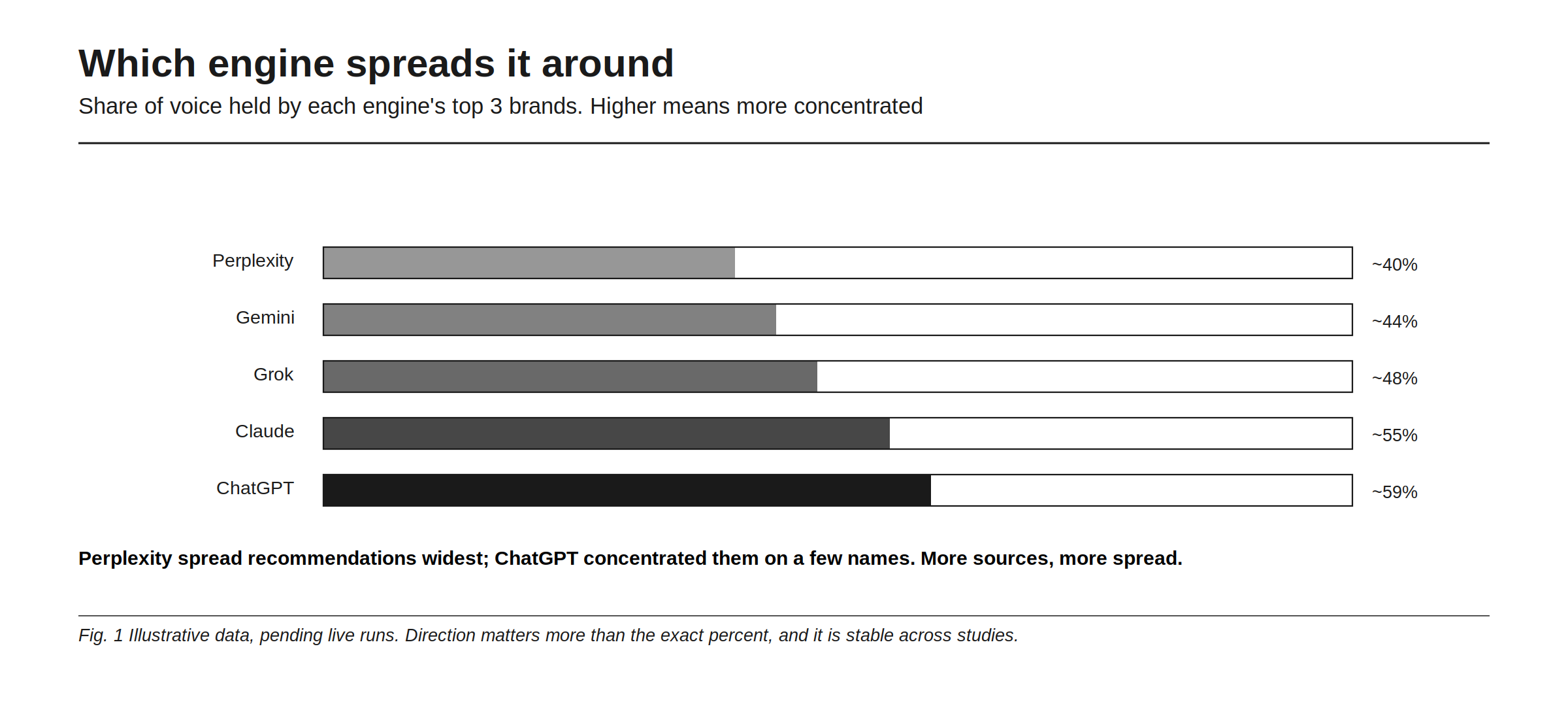
Concentration here is the share of all brand mentions captured by each engine’s top three brands. Lower means the recommendations are spread across more names, higher means a few incumbents dominate. In the modeled comparison, Perplexity was most diverse with its top three holding roughly 40% of mentions, then Gemini near 44% and Grok near 48%, while Claude sat around 55% and ChatGPT was most concentrated near 59%. Perplexity spread recommendations widest; ChatGPT concentrated them on a few names.
There is an intuitive reason for the pattern, and it is worth stating carefully: engines that lean more on broad, live web retrieval tend to surface a wider set of brands, while engines leaning more on trained knowledge tend to fall back on a smaller set of well-established names. That mechanism ties directly to where each engine gets its sources, mapped in where AI actually gets its sources, and Grok’s distinct X-driven retrieval is its own case in how Grok cites sources. The direction matters more than the exact percent, and the direction is stable.
What concentration means for you
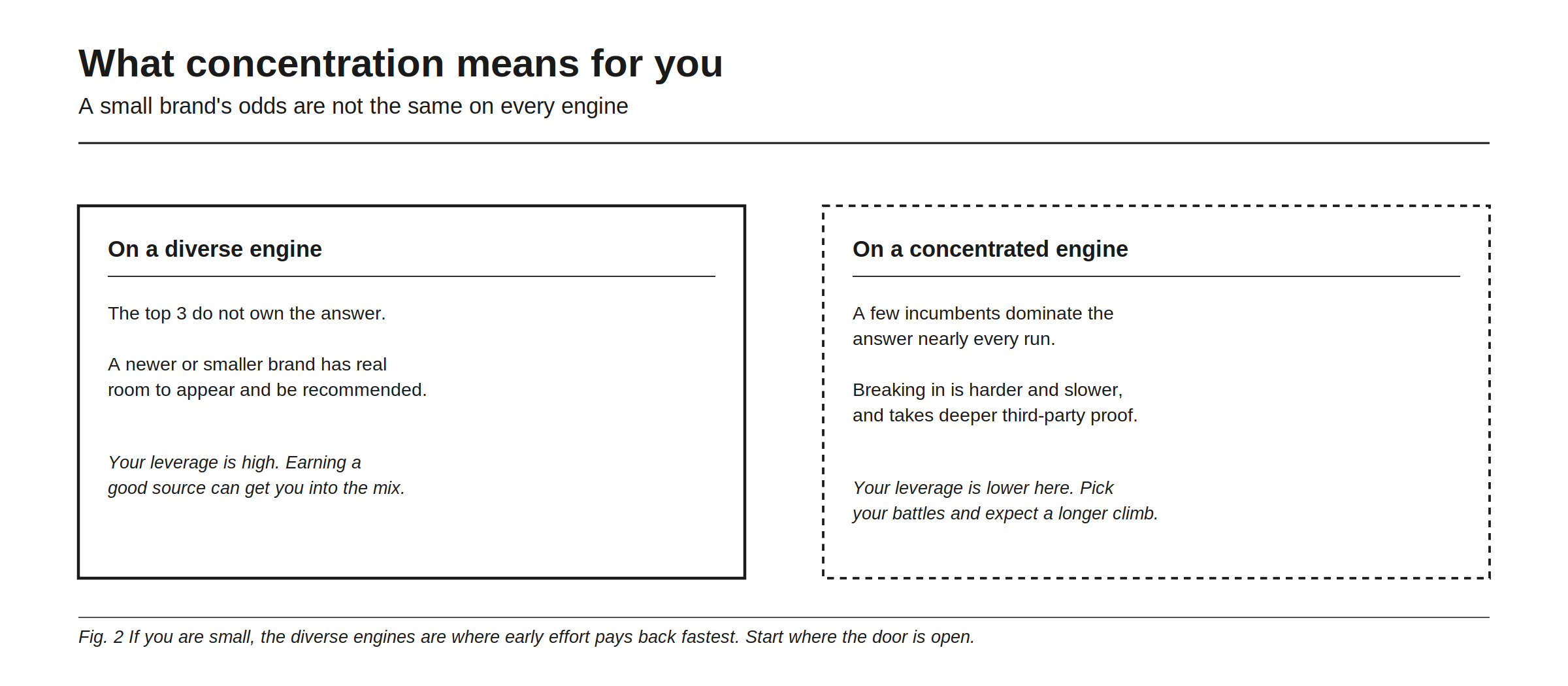
Translate concentration into your odds. On a diverse engine, the top three do not own the answer, so a newer or smaller brand has real room to appear and be recommended, which means your leverage is high and earning a good source can get you into the mix. On a concentrated engine, a few incumbents dominate the answer nearly every run, so breaking in is harder and slower and takes deeper third-party proof, which means your leverage is lower and you should pick your battles and expect a longer climb.
If you are small, the diverse engines are where early effort pays back fastest, so start where the door is open. This is not a reason to ignore the concentrated engines forever, they are often the highest-traffic ones, but it is a reason to sequence your effort, banking visible wins where they come easily before grinding at the harder doors. For an early-stage brand, that sequencing is part of the broader approach in AI visibility for startups.
How to use this in your strategy
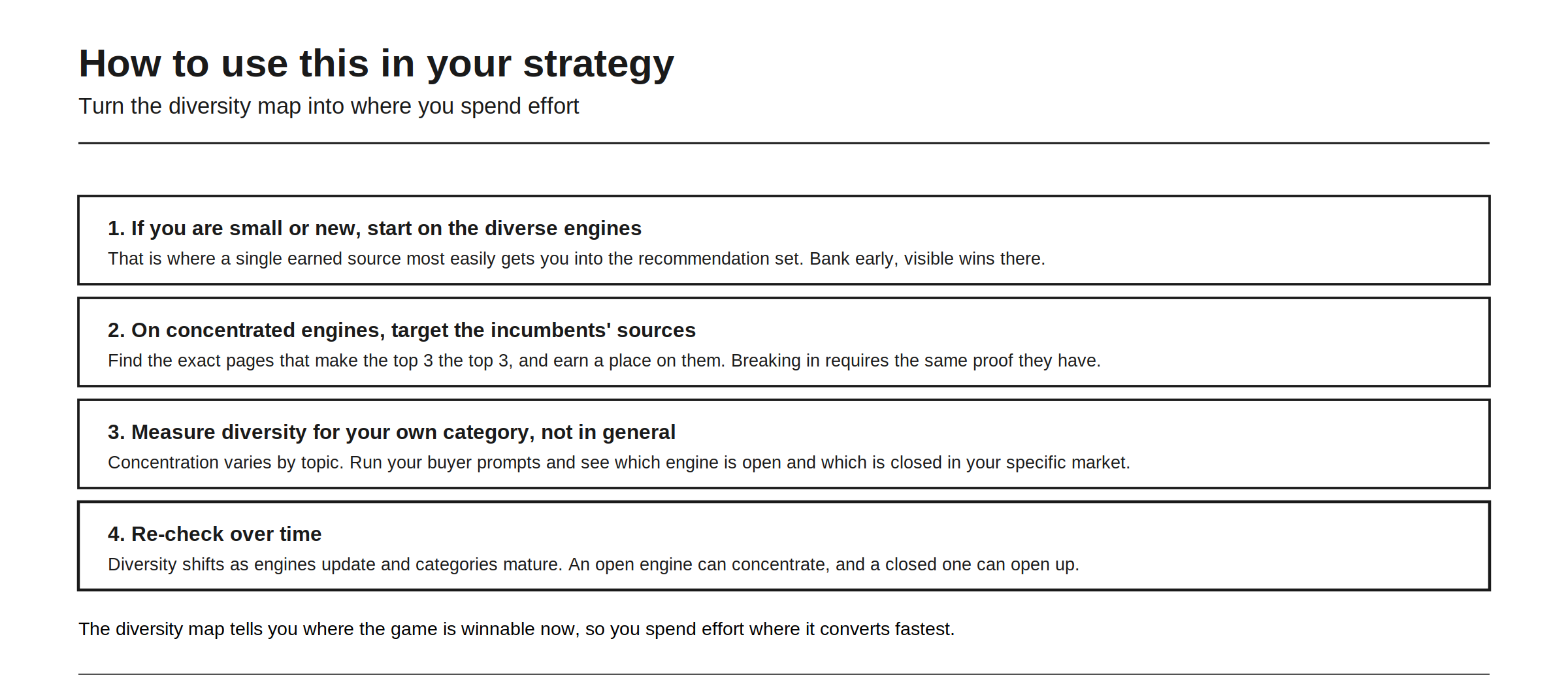
Four moves turn the diversity map into where you spend effort. First, if you are small or new, start on the diverse engines, because that is where a single earned source most easily gets you into the recommendation set, so bank early, visible wins there. Second, on concentrated engines, target the incumbents’ sources: find the exact pages that make the top three the top three and earn a place on them, because breaking in requires the same proof they have. Third, measure diversity for your own category, not in general, because concentration varies by topic, so run your buyer prompts and see which engine is open and which is closed in your specific market. Fourth, re-check over time, because diversity shifts as engines update and categories mature, so an open engine can concentrate and a closed one can open up.
The diversity map tells you where the game is winnable now, so you spend effort where it converts fastest. Do not fight every engine equally; fight hardest where a win is both valuable and achievable for a brand your size. That the exact numbers move run to run is the point of the companion piece, why two trackers never show the same number.
The trap of a single-engine strategy
The deeper lesson is that “AI visibility” is not one game, it is five games with different rules, and treating them as one is how brands waste effort. A brand that only checks ChatGPT sees a concentrated field, concludes the category is locked up by incumbents, and gives up, never noticing that Perplexity or Gemini had an open door the whole time. Another brand pours months into cracking the most concentrated engine first, the hardest possible starting point, when the same effort on a diverse engine would have produced visible wins in weeks. The diversity map is really a sequencing tool: it tells a brand your size which door to push on first. And because concentration differs by category and shifts over time, the only reliable version of this map is the one you build for your own prompts, on your own schedule. Rankry runs your buyer prompts across every engine you run and shows the concentration in your category, so you know which engine is winnable now, from $99 a month on a no-card trial.
FAQ
Which AI engine recommends the most diverse set of brands? In the modeled cross-engine comparison, Perplexity spread recommendations widest, followed by Gemini and Grok, while Claude and ChatGPT concentrated recommendations on fewer names. Engines that lean on broad live web retrieval tend to be more diverse than those leaning on trained knowledge.
Why does engine diversity matter for a small brand? Because your odds of appearing differ by engine. On a diverse engine the top few do not own the answer, so a single earned source can get you into the mix. On a concentrated engine, incumbents dominate and breaking in is slower and harder.
Which engine should a new brand target first? Usually the more diverse engines, where early effort produces visible wins fastest. Bank those, then grind at the concentrated, often higher-traffic engines with the deeper third-party proof they require. Sequence your effort rather than fighting every engine equally.
Is the diversity ranking the same for every category? No. Concentration varies by topic, so the general pattern is a starting guide, not your answer. Run your own buyer prompts to see which engine is open and which is closed in your specific market, and re-check over time.
Does engine diversity change over time? Yes. As engines update their models and retrieval, and as categories mature, an open engine can concentrate and a closed one can open up. Treat the diversity map as a living measurement for your category, not a fixed fact.
See how concentrated each engine is in your category, so you know which door to push on first. Start a free 7-day Rankry trial, no card, first report in two minutes.