Grok cites differently from every other major AI engine because it treats live X (formerly Twitter) posts as a first-class source, something ChatGPT, Claude, Gemini, and Perplexity do not. Studies in 2026 put roughly 45% of Grok’s citations as X posts, far higher than any other assistant, and most of those cited posts are under 48 hours old, so on Grok recency is a gate rather than a tiebreaker. Grok runs two documented retrieval tools, an X Search tool for real-time posts and a Web Search tool for the open web, and citations only appear when those tools fire. The practical upshot: a credible, verified, active presence on X is a citation pathway that exists nowhere else, while the web half rewards the same structured content that helps every engine. This guide explains Grok’s source logic and how to earn its citations.
If you optimize for Grok with a generic AI-search playbook, you miss the one thing that makes it different. Half of its citations come from a channel the other engines barely touch.
Grok has two source channels
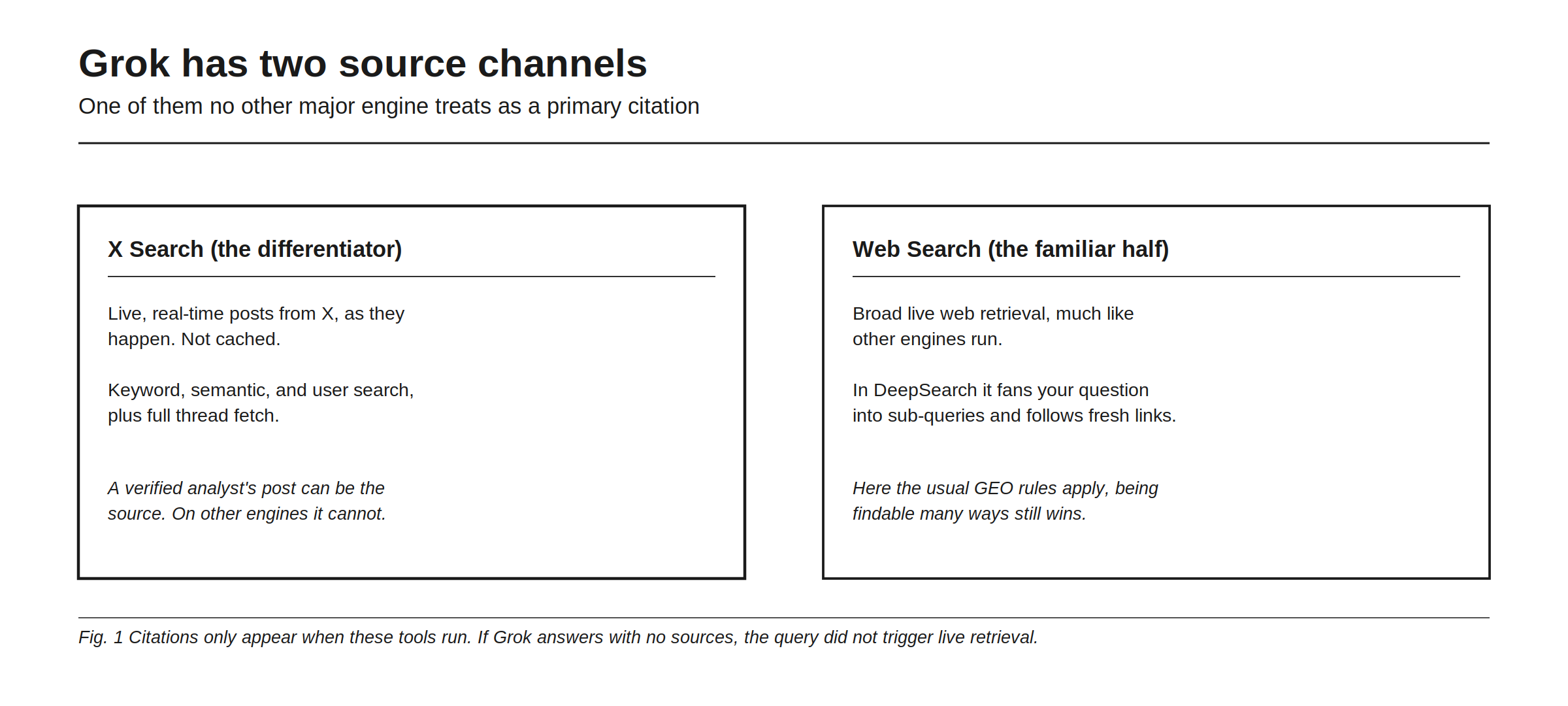
xAI documents Grok’s retrieval as two distinct tools. The X Search tool is the differentiator: live, real-time posts from X as they happen, not cached, with keyword, semantic, and user search plus full thread fetch, and here a verified analyst’s post can literally be the source, which is not true on other engines. The Web Search tool is the familiar half: broad live web retrieval much like other engines run, and in DeepSearch mode it fans your question into sub-queries and follows fresh links, so here the usual GEO rules apply and being findable many ways still wins.
One practical note that trips people up: citations only appear when these tools run, so if Grok answers with no sources, the query did not trigger live retrieval and leaned on model memory instead. Roughly one in ten answers shows no external source at all. The web-side sub-query behavior is the same mechanic behind most engines, covered for Perplexity in how Perplexity picks the sources it cites and Claude in how Claude finds and cites sources.
Where Grok’s citations come from
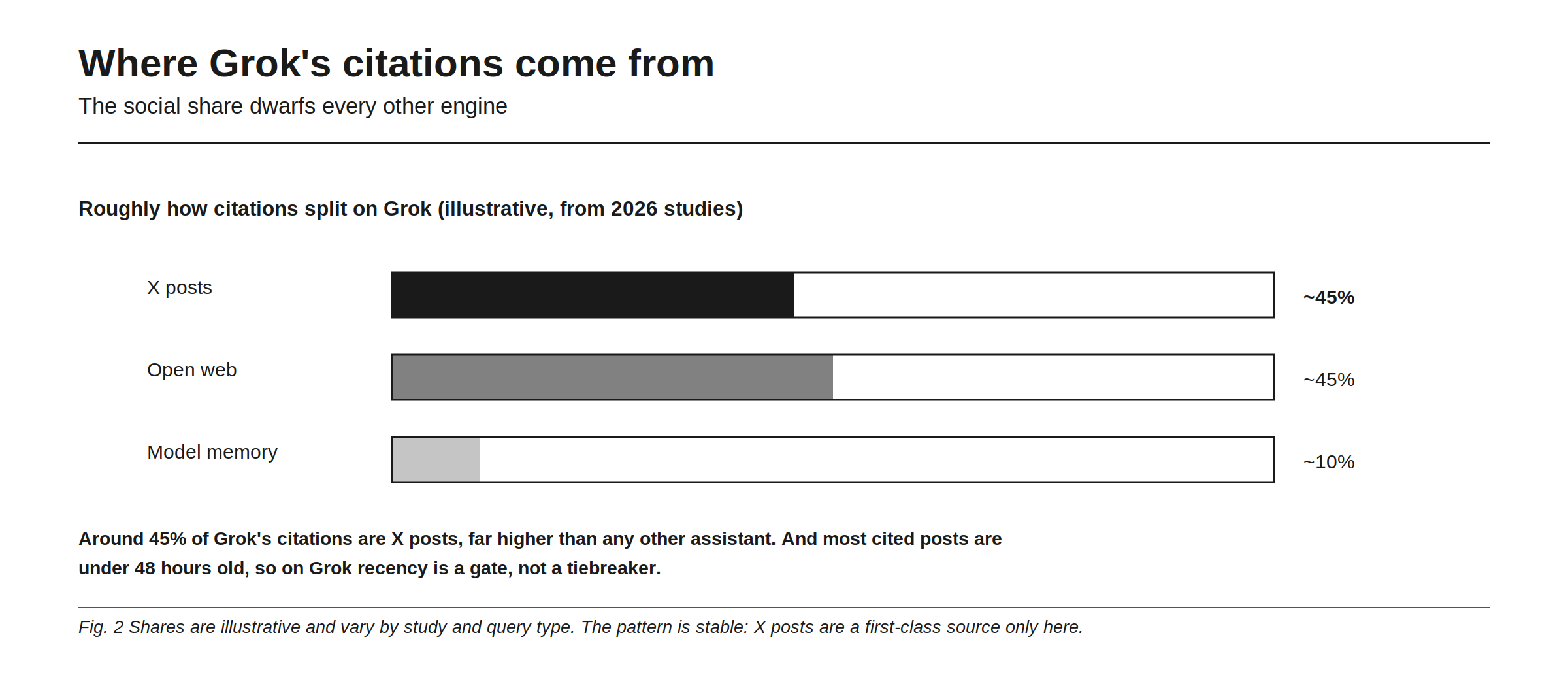
The source mix is the story. Across 2026 studies, roughly 45% of Grok’s citations are X posts, close to another 45% are the open web, and around 10% lean on model memory with no external source. That social share is far higher than any other assistant, none of which treat a social post as a primary citation. And the recency pattern is stark: a large majority of cited X posts are under 48 hours old, so on Grok recency is a gate, not a tiebreaker. Grok also cites a moderate number of sources per answer, more on current-events queries and fewer on definitional ones where trained knowledge dominates.
The shares are illustrative and vary by study and query type, but the pattern is stable: X posts are a first-class source only here. This has a second consequence, Grok’s citations overlap remarkably little with conventional search rankings, meaning the vast majority of what it cites comes from outside the top of Google. So the pages and posts that win on Grok are often not the ones winning classic SEO, which reframes the source hierarchy from where AI actually gets its sources for this one engine.
How to earn Grok citations
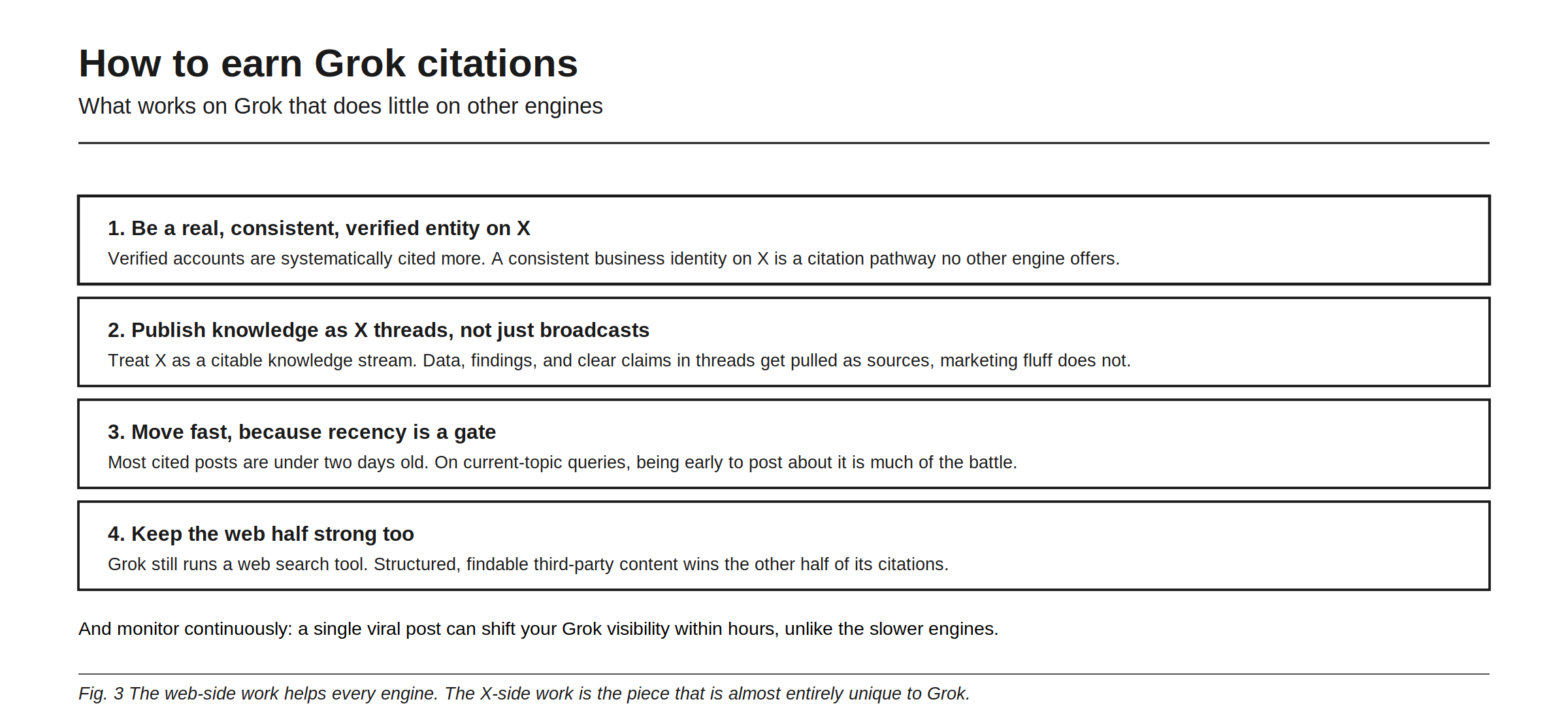
Four moves, and the first is unique to Grok. First, be a real, consistent, verified entity on X, because verified accounts are systematically cited more and a consistent business identity on X is a citation pathway no other engine offers. Second, publish knowledge as X threads, not just broadcasts, treating X as a citable knowledge stream where data, findings, and clear claims get pulled as sources while marketing fluff does not. Third, move fast, because recency is a gate, so on current-topic queries being early to post about it is much of the battle. Fourth, keep the web half strong too, because Grok still runs a web search tool and structured, findable third-party content wins the other half of its citations, the freshness angle of which is in the 3-month citation cliff.
And monitor continuously, because a single viral post can shift your Grok visibility within hours, unlike the slower engines where periodic checks suffice. The web-side work helps every engine; the X-side work is the piece almost entirely unique to Grok. Rankry tracks Grok alongside ChatGPT, Claude, Gemini, and Perplexity, so you can see when your X presence moves your Grok citations, from $99 a month on a no-card trial.
Why Grok is worth tracking separately
It would be easy to treat Grok as a minor engine and fold it into a generic strategy, but its distinctness is exactly why it deserves its own attention. Because its citations barely overlap with search rankings, a brand can be strong everywhere else and nearly invisible on Grok, or the reverse, present on Grok through X while absent from other engines. Neither shows up if you only track the mainstream engines. Grok also rewards a capability many B2B brands already have but underuse, a real presence on X, turning what they treat as a broadcast channel into a measurable citation source. And its volatility means the picture changes fast, so a quarterly audit is not enough. The way to keep an eye on all of this, per engine, is continuous monitoring, covered in how to monitor your brand across AI search engines.
FAQ
How does Grok cite sources differently from ChatGPT or Perplexity? Grok treats live X posts as a first-class citation source, which no other major engine does. Roughly 45% of its citations are X posts, and most are under 48 hours old. The other engines cite the open web and training data but not social posts as primary sources.
Does having a presence on X help my Grok visibility? Yes, significantly, and it is largely unique to Grok. xAI has direct access to X data, and Grok frequently cites posts and threads. A consistent, verified business presence on X is a citation pathway that does not exist on other engines.
Why does recency matter so much on Grok? Because Grok reads X in real time and a large majority of its cited posts are under two days old. On Grok, freshness is a gate rather than a tiebreaker, so for current-topic queries, posting early is much of what earns the citation.
Do normal SEO and GEO tactics work on Grok? Partly. Grok’s web search half rewards the same structured, findable content that helps other engines. But its citations overlap very little with conventional search rankings, and the X-post channel is unique, so a generic playbook misses roughly half of what Grok cites.
Do I need to track Grok separately from other AI engines? Yes. Grok’s citations barely overlap with other engines or with search rankings, and its visibility can change within hours from a viral post. A brand strong elsewhere can be invisible on Grok, so it needs its own continuous monitoring.
Track Grok’s X-driven citations next to every other engine, and see when your X presence moves the needle. Start a free 7-day Rankry trial, no card, first report in two minutes.