Yes, but not in the way traffic reports measure it. AI referral traffic is roughly 1% of total website visits across industries, which looks negligible, while multiple independent studies find those visitors converting 4 to 5 times better than organic search, and one vendor’s own data showed AI at 0.5% of traffic driving 12% of signups. The honest summary: AI answers are a small-volume, high-value channel whose revenue impact is real, systematically under-measured, and consistently over-claimed by single headline numbers. This guide walks through what the data supports, where it is weak, and how to measure it on your own site rather than trusting anyone’s benchmark.
If you have been skeptical that AI mentions are a vanity metric, that skepticism is healthy and this article is written for it. The answer is more interesting than either the hype or the dismissal.
The small-channel paradox
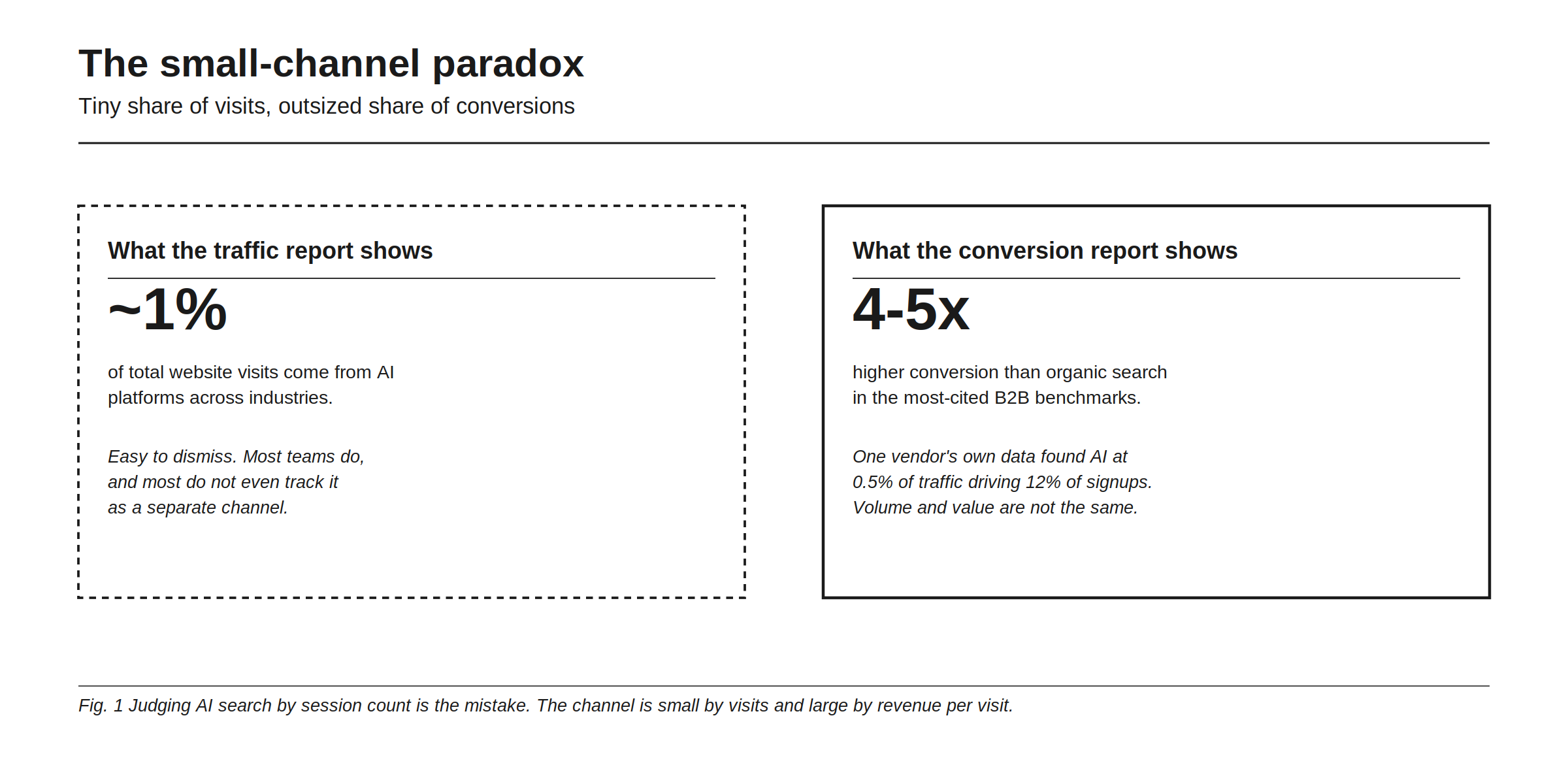
Open your analytics and AI referrals look irrelevant: about 1% of visits across industries, buried under organic and direct. Arguing for the channel on value per visitor rather than volume is the business case for AI visibility. Most teams glance at that and move on, and most do not even track AI as a separate channel at all. Then look at what those visits do. In the most-cited B2B benchmark, a study of 312 technology firms, AI-referred visitors converted at 14.2% against 2.8% for Google organic, roughly a 5x advantage, and a separate large-scale analysis arrived at the same figures independently. Semrush’s cross-industry dataset puts the average at 4.4x. The most dramatic single case comes from Ahrefs’ own traffic: AI referrals were 0.5% of sessions but drove 12.1% of signups.
Volume and value are not the same thing, and AI search is the clearest current example. Judging the channel by session count is the mistake that keeps teams from investing in it while their competitors quietly take the high-intent clicks.
Why AI visitors convert better
The mechanism is not magic, it is position in the buying journey. Someone who clicks a link in an AI answer has already had the comparison done for them: the engine filtered the options, explained the trade-offs, and effectively pre-qualified the choice. They arrive at your site to confirm pricing, check credentials, or start a trial, not to begin researching. A classic organic search click, by contrast, often lands at the start of a process that will span multiple sessions and tabs.
The behavioral data supports this reading. Adobe found AI-referred shoppers spending 48% more time on product pages and viewing 13% more pages per visit, and a separate study found AI visitors spending 68% more time on site overall. On the commerce side, Shopify reported AI-referred sessions converting roughly 50% better than organic search on product pages, with 14% higher average order values. Different datasets, same direction: these visitors are further along, and they behave like it.
Reading the data honestly
This is where most articles on this topic stop, right after the biggest number. The honest version keeps going.
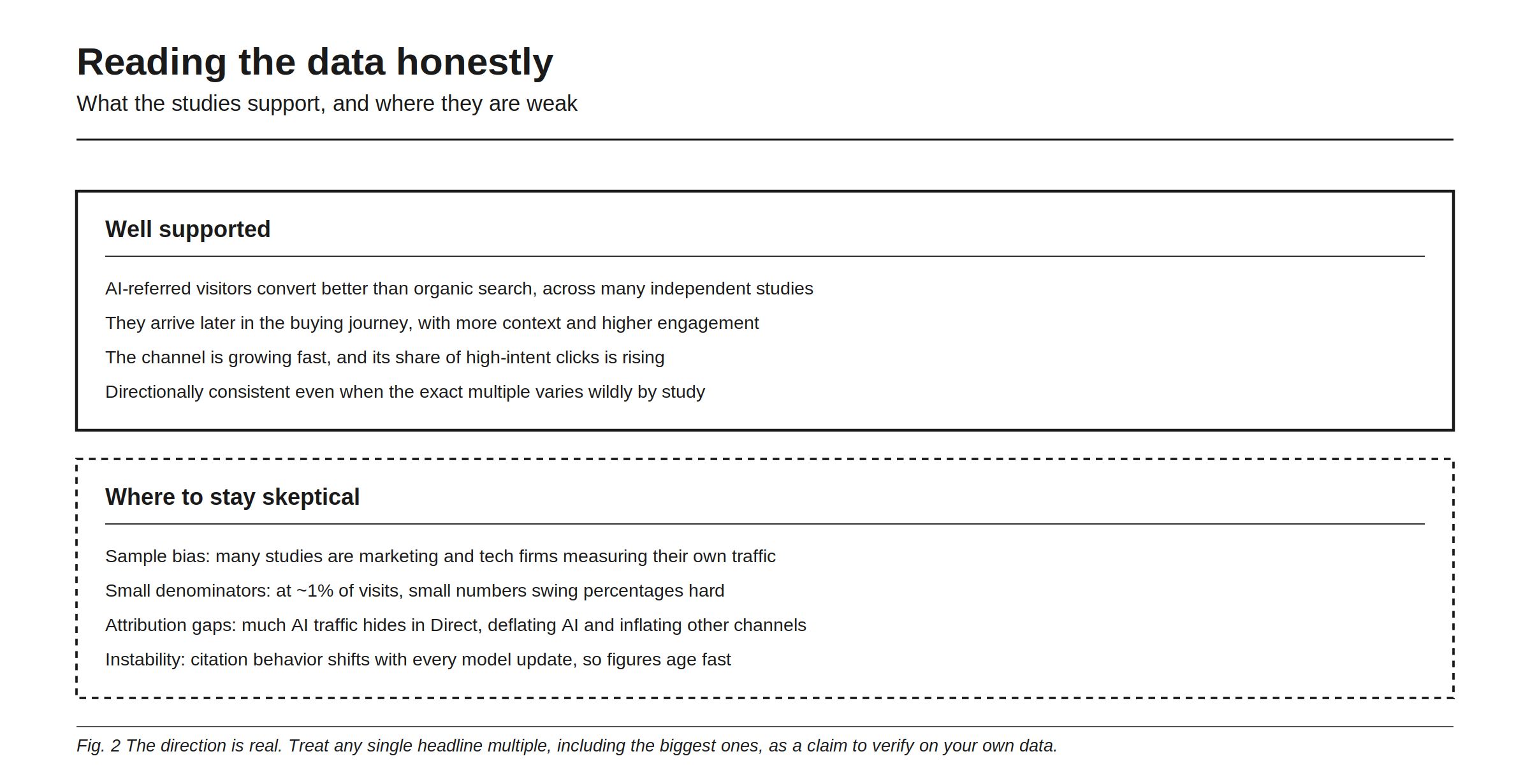
Well supported: AI-referred visitors convert better than organic search across many independent studies, they arrive later in the buying journey with more context and higher engagement, the channel is growing fast, and the direction holds even when the exact multiple varies wildly between datasets.
Where to stay skeptical: sample bias is real, because many published studies come from marketing and technology companies measuring their own traffic, exactly the audience most likely to use AI search. Small denominators mean that at 1% of visits, a handful of conversions swings the percentage dramatically. Attribution gaps cut the other way, much AI traffic arrives without a referrer and lands in Direct, which deflates measured AI performance while inflating other channels. And citation behavior shifts with every model update, so a multiple measured last quarter may not hold this one.
Note that the range across studies is enormous: from a modest 1.3x in an ecommerce study of 94 brands to 23x in one vendor’s internal data. That spread is the tell. The direction is robust; any single headline multiple, including the impressive ones, is a claim to verify against your own numbers rather than a benchmark to plan with.
How to measure it on your own site
Three steps turn this from someone else’s statistic into your own number. First, fix your attribution, because most AI traffic is mislabeled by default: Perplexity lands in Referral, AI Overviews count as Organic, and referrer-less AI app clicks fall into Direct. Until that is corrected you are measuring a fraction of the channel and probably concluding it is small. The full fix is in how to track AI referral traffic from ChatGPT and Perplexity.
Second, segment AI traffic and measure conversion rate and revenue per visit, not sessions. The whole point of this channel is that its value does not show up in volume metrics, so tracking it with volume metrics guarantees you will underrate it.
Third, connect traffic to visibility, because traffic only tells you the outcome. Visibility tells you the cause: which prompts name you, which name a competitor, and which sources feed those answers. Read together, a rise or drop in AI referrals becomes traceable to the visibility change behind it, which is what makes the channel manageable rather than mysterious. That pairing is covered in how to monitor your brand across AI search engines.
The strategic read for founders
Here is the case in one line: a channel that is 1% of your traffic and 10% of your signups is not a vanity metric, it is an underpriced acquisition channel that most of your competitors are not measuring. The other side of it, the pages so completely answered inside the reply that no visit ever happens, is in when citations do not convert. The window is the opportunity. Roughly one in seven marketers currently tracks AI search as a separate channel, which means the visibility, and the high-intent clicks that follow it, are available to whoever bothers to compete for them right now. That will not stay true.
The reasonable position is neither hype nor dismissal. Treat AI visibility as an emerging, high-intent channel worth deliberate investment and honest measurement, size it on your own data rather than on published multiples, and revisit the numbers each quarter, because in this space the facts age quickly.
FAQ
Does AI search traffic actually convert? Yes, and better than organic search in most published studies. B2B benchmarks report AI referrals converting around 14% versus under 3% for Google organic, roughly 4 to 5 times higher, because AI visitors arrive later in the buying journey with the comparison already done.
How much traffic comes from AI search? Currently around 1% of total website visits across industries, though it is growing fast and is systematically under-counted because much of it is misattributed to Direct or Referral in analytics. The share of high-value conversions is far higher than the share of visits.
Is AI visibility a vanity metric? Not if you measure it correctly. The channel is small by visits and disproportionately large by conversions and revenue per visit, so tracking it with volume metrics makes it look trivial while conversion metrics show its real value.
Which AI platform sends the best-converting traffic? Published platform breakdowns put ChatGPT highest by volume and among the highest by conversion, with Perplexity strong per session and Claude lower but still above organic averages. Gemini, Grok, and Microsoft Copilot send less measurable referral traffic today, and Google AI Overviews often send none at all because the answer resolves on the results page, which is exactly why referral traffic alone is the wrong scoreboard for them. Figures vary by study and shift with model updates, so verify on your own data.
How do I prove AI visibility drives revenue for my company? Fix your analytics attribution so AI traffic is not hidden in Direct, segment it and measure conversion rate and revenue per visit rather than sessions, and pair the traffic data with visibility tracking so you can trace changes in revenue to the prompts and sources behind them.
Measure the cause, not just the outcome: see which prompts and sources drive your AI traffic across the engines you track. Start a free 7-day Rankry trial, no card, first report in two minutes.