The GEO offers agencies publish in 2026 fall into four package shapes: a one-time AI visibility audit, a monitoring and reporting package, GEO folded into an existing SEO retainer, and a standalone retainer that adds content and off-site work. Public price points are scarce and rarely comparable, but the ones that exist sit in familiar SEO territory: First Page Sage’s provider-authored model puts monthly GEO tiers at $2,000 to $3,000, $4,000 to $7,000 and $8,000 to $12,000, and an August 2026 snapshot of Rock The Rankings’ pricing page showed starting plans of $4.5k, $7.5k and $14k a month. The budget usually comes from SEO: in SEOFOMO’s 2026 survey of 171 search professionals, 54% said AI search is funded as part of the SEO budget. The deliverables that justify the fee are a fixed prompt set, a baseline visibility report, a citation source map, content and off-site work, crawler access fixes, and a monthly report that reads visibility as a rate across runs. The two fastest ways to lose a GEO client are promising rankings in answers that change on every run and reporting a single screenshot.
Demand is not the bottleneck. In the 2026 AgencyAnalytics benchmarks of 494 agency professionals, 66% reported increased client demand for AEO/SEO for AI search. The hard part is packaging: what the client buys, what it costs, and how you prove it worked. The go-to-market playbook is in AI visibility for agencies; this guide is the pricing layer underneath it.
The four ways agencies package GEO
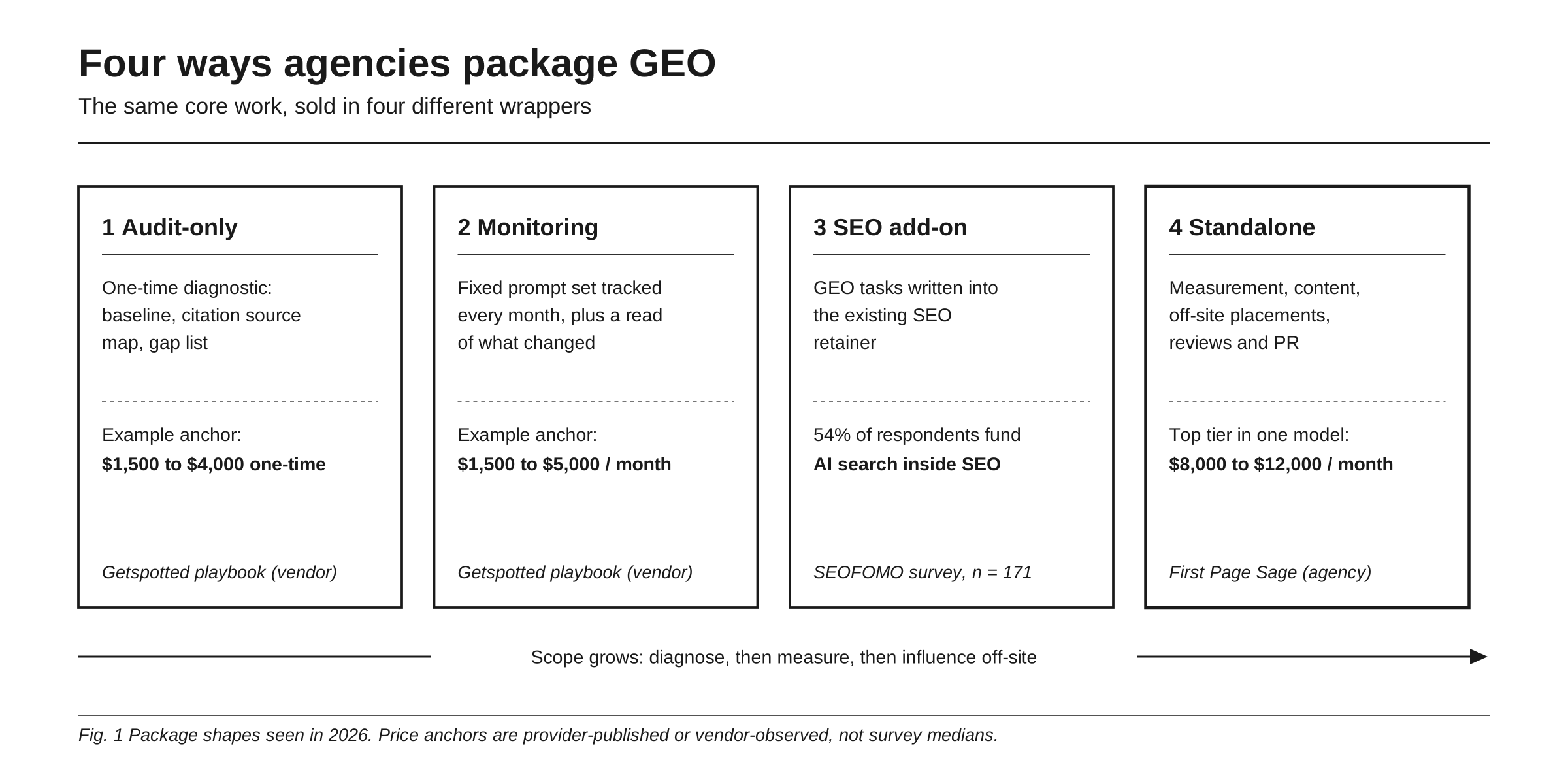
1) Audit-only. A one-time diagnostic: where the client appears, who wins the prompts they lose, and which sources the engines cite. Getspotted, a citation-data vendor, publishes a playbook that prices the audit by keyword and country count, at $1,500 to $4,000. It describes its bands as US-market GEO retainers “observed across boutique-to-mid agencies in 2026” and states no sample, so treat them as one vendor’s anchors.
2) Monitoring and reporting. Recurring tracking of a fixed prompt set, plus a read of what changed. The same Getspotted playbook puts this tier at $1,500 to $5,000 a month.
3) Add-on to SEO. In SEOFOMO’s sample, this is how most budgets flow: 54% of respondents fund AI search inside the SEO budget, and only 14% fund it as an independent channel. Orit Mutznik, quoted in that report, argues most of the work is “work SEO teams already do,” but that “three things require separate budgets”: tracking tools, PR, and a dedicated content resource.
4) Standalone retainer with off-site work. Measurement, content, and placements on the third-party pages AI engines cite. First Page Sage’s top tier, $8,000 to $12,000 a month, adds list articles, review and directory work, and PR. Digital Elevator sells national off-site “AI Visibility Mention” campaigns at $3,495 to $22,995 per 30 days, per Tenten’s August 12, 2026 pricing snapshot.
The six deliverables clients actually pay for
Whatever the wrapper, credible GEO packages ship the same six pieces of work. Name each one in the proposal.
Prompt set. A fixed list of buyer-intent prompts agreed with the client, grouped by product line and funnel stage, kept stable so monthly numbers stay comparable. Selection is covered in how to choose which buyer questions to track.
Baseline visibility report. Mention rate, position, and competitor share per engine, measured over several runs before any work starts. The audit structure is in how to run an AI visibility audit.
Citation source map. Which domains and pages the engines cite on the client’s prompts, and where the client is absent.
Content and off-site work. Comparison and answer-first pages on the client’s site, plus placements and reviews on the sources the map surfaced.
Technical crawler access. A check that answer engines can reach the site at all. OpenAI’s documentation is blunt: “Sites that are opted out of OAI-SearchBot will not be shown in ChatGPT search answers, though can still appear as navigational links.” A misfired robots.txt rule can erase months of work.
Monthly reporting. Tracking is already standard practice: 92% of SEOFOMO respondents track AI visibility and citations, up from 78% the year before. What separates agencies is how they report it.
What GEO costs: the price points you can actually attribute
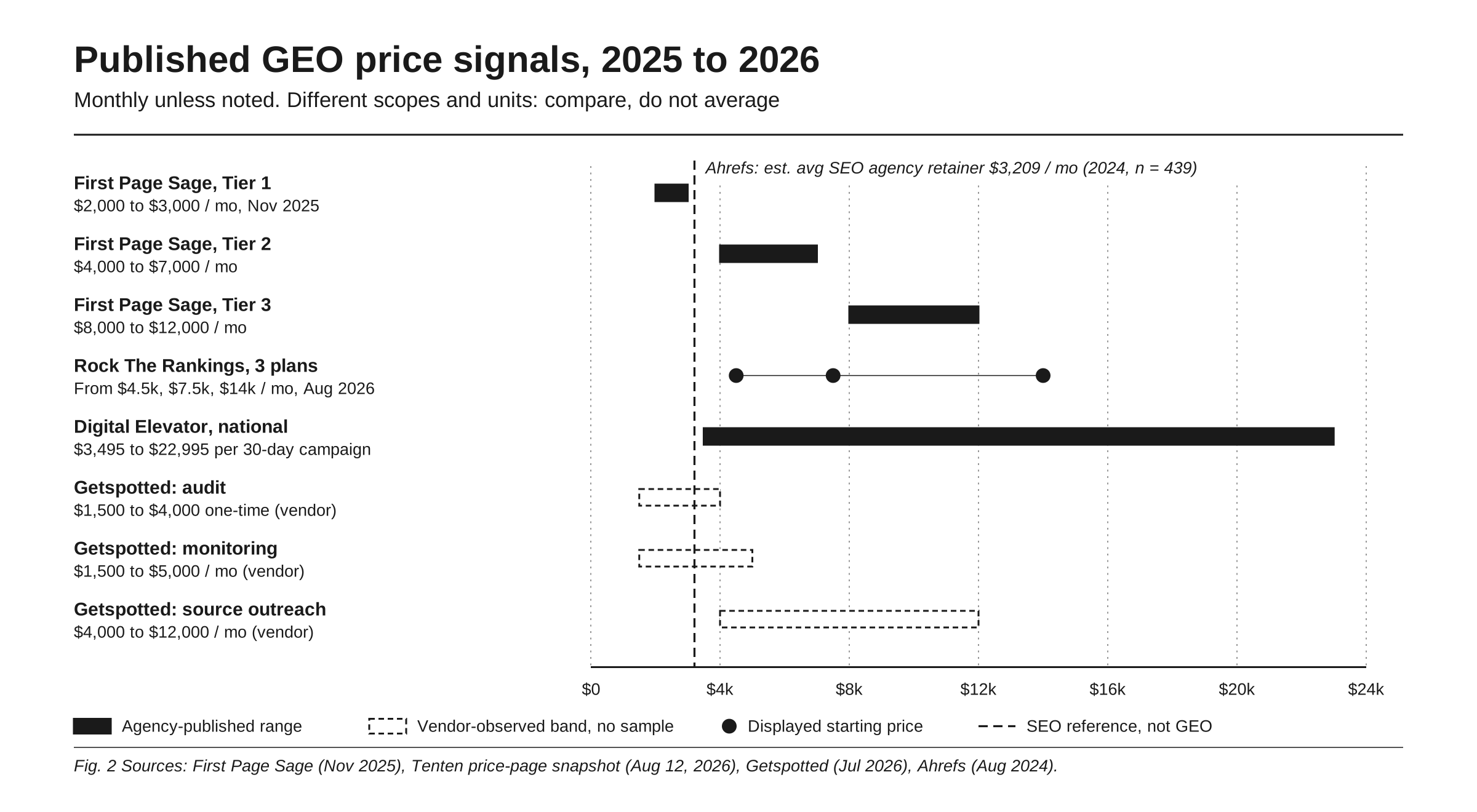
We did not find an independent, large-sample survey of GEO agency pricing published by late September 2026. What exists is a handful of provider-published numbers, and each comes with a caveat:
- First Page Sage (an agency, November 14, 2025): three monthly tiers of $2,000 to $3,000, $4,000 to $7,000 and $8,000 to $12,000, described as pricing “seen among the small number of companies formally offering GEO services.”
- Rock The Rankings (an agency’s own pricing page, as captured in Tenten’s August 12, 2026 snapshot): SEO/LLM plans with displayed starting prices of $4.5k, $7.5k and $14k a month. Tenten notes the page showed two price sets and several terms, so check the live page before quoting it.
- Digital Elevator (pricing page, same snapshot): $3,495 to $22,995 per 30-day off-site campaign, national tier.
- Getspotted (a vendor playbook, July 12, 2026): audit $1,500 to $4,000 one-time, monitoring $1,500 to $5,000 a month, source outreach $4,000 to $12,000 a month, with no stated sample.
For reference, Ahrefs’ poll of 439 SEO providers (updated August 2024) estimated an average agency SEO retainer of $3,209 a month (assuming top-of-band pricing), the budget most GEO work is carved out of.
Do not average these. Tenten, which itself sells GEO services, compiled the August 2026 snapshot and makes the same point: the set mixes software, monthly management, an off-site campaign and a market model, so “an arithmetic average would imply comparability that is not present.” Use them as anchors for scope conversations, not as a market rate.
Pricing models: fixed, tiered by scope, performance-based
Fixed retainer. One monthly fee for a defined scope. It suits the add-on model. The risk is scope creep, since “AI visibility” can expand to fill any budget.
Tiered by scope. The cleanest GEO-native model prices on the variables that drive delivery cost: number of prompts, number of engines, number of markets, and reporting frequency. Getspotted’s monitoring tiers use three of them, with keywords in place of prompts: up to 50 keywords, one country, monthly, $1,500; up to 150, up to three countries, bi-weekly, $3,000; up to 400, up to six countries, weekly, $5,000. Engine count is the natural fourth, since tracking six engines costs more than tracking two.
Performance-based. Easy to sell, hard to deliver honestly. AI answers are non-deterministic, so a fee tied to “position 1 in ChatGPT” is a fee tied to a dice roll. If you offer a performance component, tie it to a mention rate on the agreed prompt set measured over many runs, or to effort you control. Getspotted’s own advice for outreach is to commit to outreach volume, “not guaranteed placements.”
Hourly. Still common in SEO: 34.8% of providers in the Ahrefs poll charged hourly, at an average of $111. For GEO it makes invoices unpredictable and hides the deliverable.
The pitfalls that cost renewals
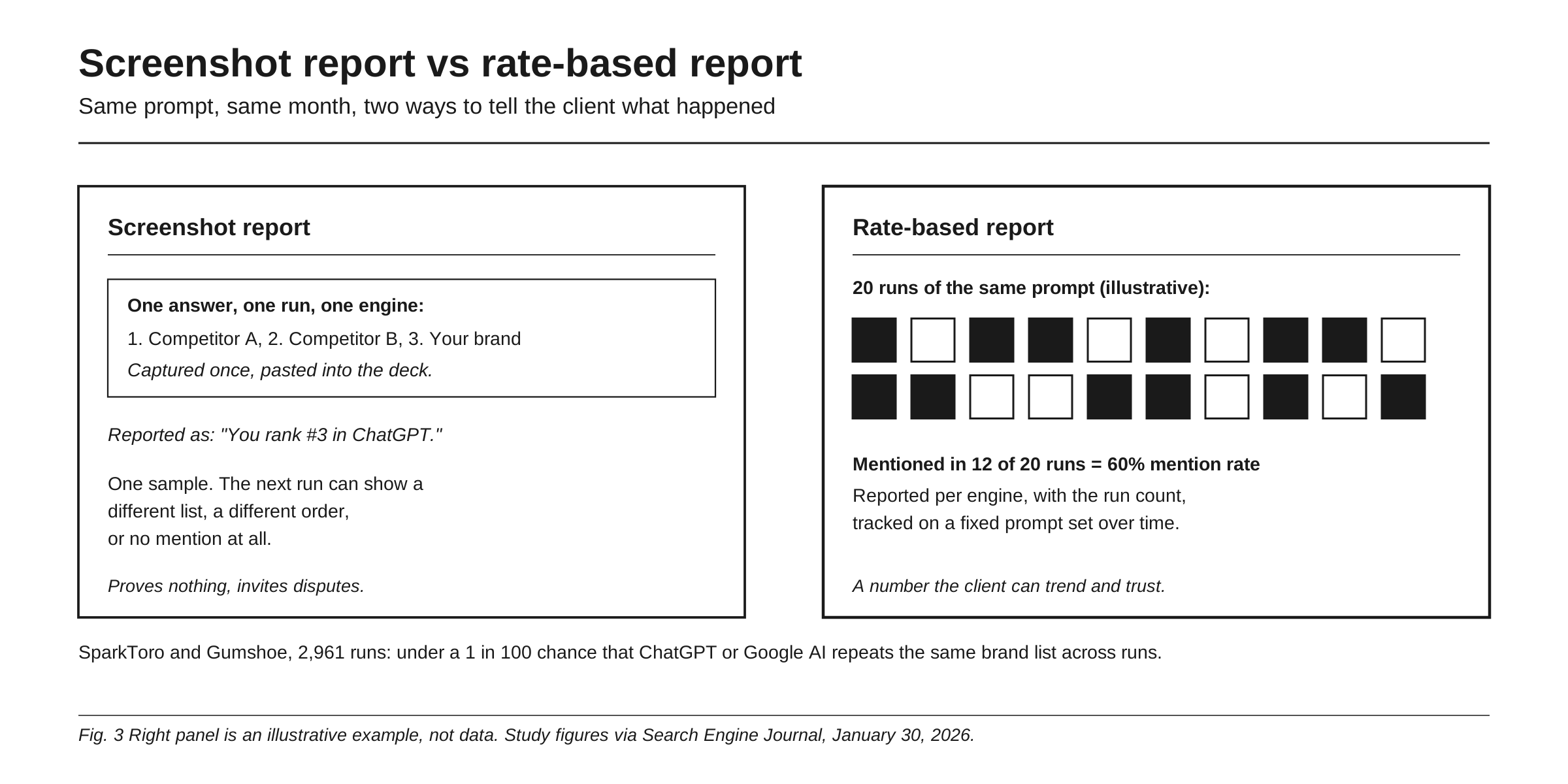
Promising rankings. Google’s guidance for hiring an SEO says “No one can guarantee a #1 ranking on Google.” Its July 2026 AI optimization guide points anyone considering third-party “AEO” or “GEO” services to its advice on evaluating SEO vendors, and its measurement section says to “be wary of third-party tools that promise ranking success.” The data agrees. SparkToro and Gumshoe ran 12 recommendation prompts 60 to 100 times per platform, 2,961 runs in total, and found a less than 1 in 100 chance that ChatGPT or Google’s AI would return the same list of brands across repeated runs. The same list in the same order appeared less than 0.1% of the time. (Gumshoe sells AI tracking tools.)
Reporting single screenshots. A screenshot is one sample. It can show a win that never repeats or a loss that was noise. Report how often the brand appears across repeated runs, and say how many runs sit behind each number. How many runs you need is covered in how many times to ask before you trust the answer.
Giving it away. Lauren Edvalson, an agency CEO quoted by AgencyAnalytics, described “an increase in demand for AI reporting, strategy, and implementation at no additional charge.” Even inside an SEO retainer, write GEO tasks into the scope, or they become unpaid work.
Overpromising attribution. In SEOFOMO’s survey, 35% could not say what AI search contributes to revenue and 46% put it at 0 to 5%. In the AgencyAnalytics data, 41% of agencies reported new challenges measuring ROI. Sell visibility, citations and AI referral traffic as leading indicators, not a clean revenue line.
A sample package, a monthly report, and how to set expectations
The structure below is an example to adapt, not market data. Price each tier against your current SEO retainer and the public anchors above.
- Baseline (one-time, about four weeks). Agree on the prompt set, run it repeatedly across the engines their buyers use, and deliver the baseline report, the citation source map, a crawler access check, and a prioritized gap list.
- Monitor tier. Monthly tracking of the fixed prompt set, competitor comparison, and a one-page written read of what changed and why.
- Monitor plus fix tier. Everything in Monitor, plus a set number of on-site pieces per month (comparison pages, answer-first rewrites, structured data) and technical fixes from the gap list.
- Full tier. Everything above, plus off-site work: a committed number of outreach targets, review generation, and directory and listicle presence on the sources the map surfaced.
- The monthly report. Mention rate per engine with the run count behind it, position and share against named competitors, citations gained and lost, AI bot and AI referral activity on the site, work shipped, and next month’s priorities.
- Expectations, in writing. State in the contract that answers vary by run and engine, that results are rates on a fixed prompt set, that placements depend on third parties, and that the first real read comes after the baseline.
Rankry is built for the measurement half of this package. It tracks how ChatGPT, Claude, Gemini, Perplexity, Grok and Google AI Mode / AI Overviews mention, rank, cite and recommend a brand on a stable set of buyer-intent prompts, every day, with competitor comparison alongside. Its AI traffic tracking shows the visits AI platforms send to a client’s site, the AI Readiness Checker runs 36 checks in 6 categories, and on Pro custom reports export to PDF for the client. The monthly report gets a rate, not a screenshot.
FAQ
How much do agencies charge for GEO in 2026? There is no reliable market average yet. Published anchors include First Page Sage’s provider-authored tiers of $2,000 to $3,000, $4,000 to $7,000 and $8,000 to $12,000 a month, and Rock The Rankings’ displayed starting plans of $4.5k, $7.5k and $14k a month in an August 2026 snapshot. These cover different scopes, so compare what each package includes before comparing the price.
Should GEO be a separate retainer or part of SEO? Most budgets sit inside SEO: in SEOFOMO’s 2026 survey, 54% of respondents fund AI search as part of the SEO budget. An add-on is easier to sell. A standalone retainer makes sense when the work includes off-site placements, PR, new tracking tools, or a dedicated content resource. Orit Mutznik, quoted in that report, names the last three as needing separate budgets.
What should a GEO audit include? A fixed prompt set agreed with the client, a baseline of mention rate, position and competitor share per engine measured over repeated runs, a citation source map showing which domains the engines rely on, a crawler access check, and a prioritized gap list. The gap list should map directly to the retainer that follows.
Can an agency guarantee rankings in ChatGPT or Google AI Overviews? No. Google states that no one can guarantee a #1 ranking and warns against tools that promise ranking success. AI answers also vary from run to run: a SparkToro and Gumshoe study found a less than 1 in 100 chance that ChatGPT or Google’s AI returns the same brand list across repeated runs. Commit to scope and effort, and report visibility as a rate.
What should a monthly GEO report show? Mention rate per engine on the fixed prompt set, with the number of runs behind it, position and share against named competitors, citations gained and lost, AI bot and AI referral traffic, work shipped that month, and next priorities. Avoid single screenshots, because one answer is one sample and rarely repeats.
Sources
- Generative Engine Optimization (GEO) Cost Breakdown, First Page Sage, November 14, 2025
- GEO Agency Pricing Benchmark 2026 (evidence reviewed August 12, 2026), Tenten GEO
- How agencies package and price a GEO retainer in 2026, Getspotted, July 12, 2026
- The State of AI Search Optimization Survey Report 2026, SEOFOMO, published August 14, 2026, last updated September 3, 2026
- How AI Search Is Changing SEO for Agencies in 2026, AgencyAnalytics, June 30, 2026, modified July 15, 2026
- SEO Pricing: How Much Does SEO Cost? 439 People Polled, Ahrefs, updated August 15, 2024
- AI Recommendations Change With Nearly Every Query: SparkToro, Search Engine Journal, January 30, 2026
- Do you need an SEO?, Google Search Central, last updated June 5, 2026
- Optimizing your website for generative AI features on Google Search, Google Search Central, last updated July 10, 2026
- Overview of OpenAI crawlers, OpenAI, n.d.
Give your GEO clients a monthly number built on repeated runs, not a screenshot. Start a free 7-day Rankry trial, no card required.