When someone asks ChatGPT for “the best plumber in [town],” the public evidence points to four steps before it names anyone: it decides where the user is, rewrites the question into one or more search queries, pulls sources from a web index plus structured local data, and then trims everything down to a short list. Location comes from the user’s IP address by default, or from the device if the user opts in to precise location. In 2026 US studies, the structured local layer leans heavily on Yelp, BrightLocal reports that Google Business Profile is hardly used, and Foursquare shows up close to zero. The final answer is small: BrightLocal measured an average of 4.1 businesses per ChatGPT response, and SOCi found ChatGPT recommended only 1.2% of the 350,000+ brand locations it studied. If you want to be one of those four names, you fix the specific sources ChatGPT reads, not your listings in general.
This is not a general local GEO guide; that lives in our local AI visibility guide. This is a look under the hood, built only on studies that published their sample sizes.
The pipeline: from one question to four names
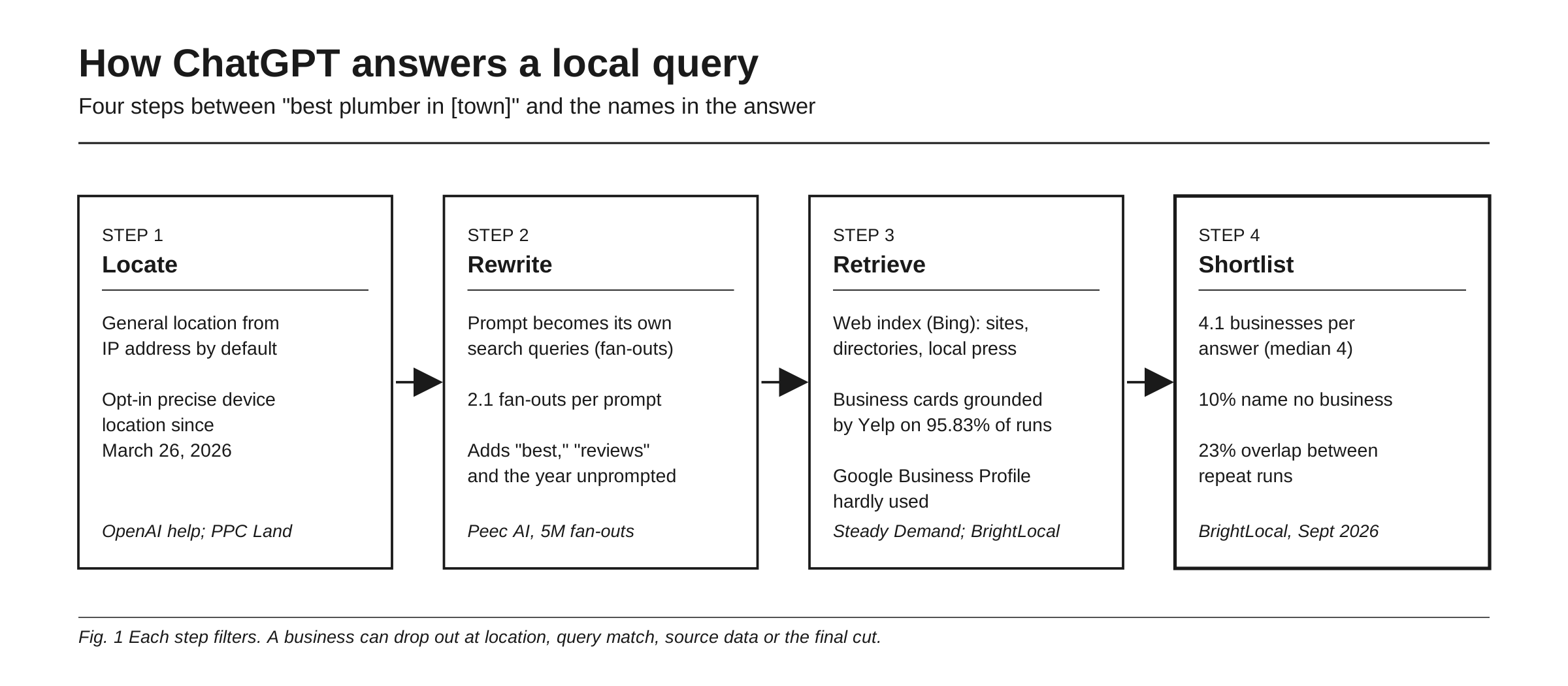
Each step filters. A business can drop out because ChatGPT placed the user in the wrong part of town, because the rewritten query never matched its pages, because the source it relies on has thin data, or because it lost the final cut to better-reviewed competitors. The step you fail at tells you what to fix.
Below, each step with the public data as of September 2026. We flag sample sizes, because a 200,000-prompt panel and a few dozen observed searches do not carry the same weight.
Step 1: ChatGPT decides where “here” is
Before any search runs, ChatGPT needs a location. OpenAI’s help documentation, as quoted in an OpenAI Community thread in February 2025, says “ChatGPT also collects general location information based on your IP address” and “may share it with third-party search providers to improve the accuracy of your results.” On March 26, 2026, OpenAI added opt-in location sharing. In OpenAI’s documentation as quoted by PPC Land, “Precise location means ChatGPT can use your device’s specific location, such as an exact address.” It is off by default.
Because precise location is off by default, many local answers likely start from a coarse IP guess. Separately, BrightLocal’s September 2026 study shows how loosely ChatGPT ties its picks to a point on the map. BrightLocal ran about 200,000 localized, non-branded prompts for roughly 1,300 business locations over 60 days through its own Local AI Visibility Tracker; it does not say whether it queried ChatGPT through the API or the app. Only 53% of ChatGPT’s recommended businesses were within 5 km of the search location, and its 90% “circle of influence” stretched to 287 km, against 64 km for Google AI Mode and 38 km for AI Overviews. Results also moved inside a single town: overlap between different grid points in the same town was 36.2%, and only 3.5% of ChatGPT results were present at every point.
The practical read: put the town in the prompt. “In Boise” states the location outright. “Near me” leaves ChatGPT to infer it, and an edge-of-metro business can win or lose on that inference. For how this differs from location effects on non-local brands, see geo-variation in brand recommendations.
Step 2: It rewrites your question into searches
ChatGPT does not search the user’s exact words. It writes its own queries, called fan-outs. Peec AI analyzed 5 million fan-out queries collected April 1 to 21, 2026, and found ChatGPT ran 2.1 fan-outs per prompt on average, compared with 1.4 for Perplexity and 6.8 for Grok. In that dataset, as reported by PPC Land, ChatGPT injected words the user never typed: “best” in 15.33% of affected responses, “review(s)” in 6.84%, and the year “2026” in 5.44%. The sample was not local-specific, but the pattern likely carries: according to Peec AI, ChatGPT looks for reviews even when users never ask for them.
How much it searches depends on the model. Suganthan Mohanadasan read ChatGPT’s network traffic in his own Pro account for a few days, about 1,240 source records across a few dozen searches, and published the results in Search Engine Journal on June 30, 2026. He describes it as “not a population study.” On the fast model he saw “one reworded query and done.” On the Thinking model, asked to compare a few products, it ran “roughly 15 to 40 sub-queries.” He also reported that “best coffee near me” “flips to the local pipeline,” with a config value, local_results_limit, set to 2.
Do not over-read that. BrightLocal’s far larger sample counted 4.1 businesses per written response; one plausible reading is that the structured local layer returns a couple of places while the text names more. Either way, the window is narrow.
Step 3: Which sources it actually pulls
ChatGPT local answers draw on two kinds of input: ordinary web pages from its search index, and structured business data behind the place cards. BrightLocal’s 2024 study described ChatGPT search as “mostly powered by Bing’s Index,” and its 2026 study said ChatGPT’s “relationships with Yelp and Bing mean it’s surfacing slightly different businesses” than Google’s AI products. The same study stated that Google Business Profile is “hardly used by ChatGPT.”
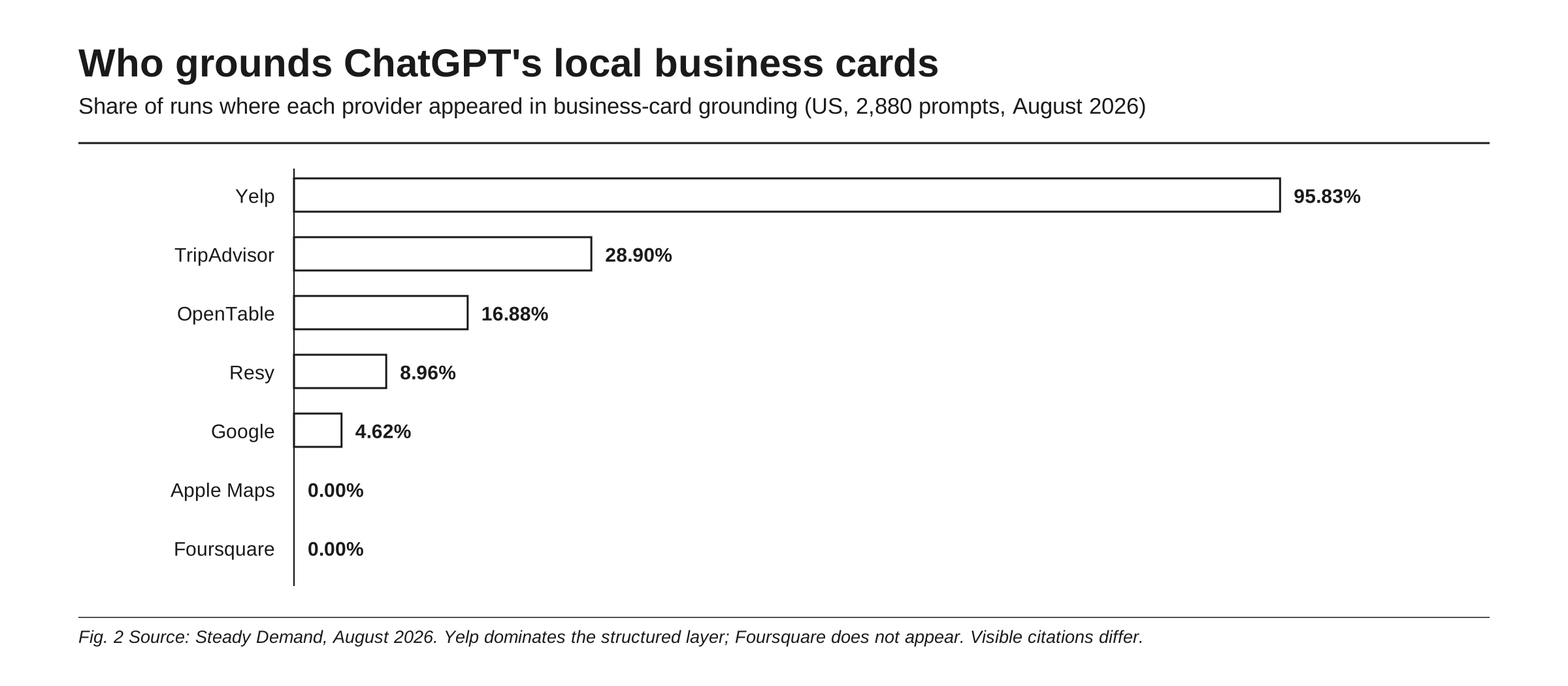
The structured layer is where Yelp dominates. Steady Demand, a local SEO agency, ran 2,880 prompts across 12 US metros and 12 verticals in one 72-hour window in August 2026 (2,879 usable runs on ChatGPT’s primary surface, plus a 1,728-run cross-check on a different API surface), and separated what ChatGPT visibly cites from what it retrieves and from what grounds its business cards. Yelp grounded the business cards on 95.83% of runs, from 93.75% for hair salons to 97.92% for plumbers. TripAdvisor followed at 28.90%, then OpenTable at 16.88%. Google sat at 4.62% and Foursquare at zero. That lines up with the licensing deal Axios reported on July 23, 2026, under which Yelp licenses reviews, photos and other business information to OpenAI and ChatGPT shows Yelp ratings. Steady Demand itself calls its result a partnership snapshot, not a permanent property of ChatGPT.
Visible citations differ. In the same study, Yelp appeared in visible citations on only 1.04% of runs, while TripAdvisor appeared on 13.55%. Retrieved is not the same as cited: in Mohanadasan’s small, tech-skewed batch of commercial queries, Reddit was fetched 278 times and cited 11 times. Reading only the links in the answer misses the data that decided it, a distinction covered in how to track citations and sources in AI search.
The web layer matters too. In BrightLocal’s 800-search study from November 2024, business websites made up 58% of ChatGPT’s local sources, business mentions 27% and directories 15%. Three Best Rated was 24% of directory sources and Tripadvisor 8%. Local publications such as Eater, Thrillist, Secret Seattle and San Diego Magazine showed up for hospitality and city terms, while Reddit and Quora did not appear at all in that study. A much smaller BrightLocal test of 20 searches, published July 2025, found ChatGPT used only dental directories for dentist queries and leaned on Super Lawyers and FindLaw for legal ones. Yext’s analysis of 6.8 million citations, published October 2025, found 48.73% of OpenAI’s citations came from listings, concentrated on Google. That data came through model APIs in July and August 2025, from Yext clients and prospects worldwide, before the Yelp deal, so it does not match the 2026 picture above.
Two myths to drop. Foursquare: the widely repeated claim that 60% to 70% of ChatGPT local results come from Foursquare traces to a May 2025 study of 50 prompts in five Spanish cities, and Steady Demand found zero Foursquare grounding on ChatGPT’s primary US surface. Steady Demand notes this does not prove the Spanish result was wrong when measured. BBB: it appears in the appendix of BrightLocal’s 2024 directory list, but we found no study before September 2026 that gives it a verified ChatGPT-specific share.
Step 4: How many businesses make the cut
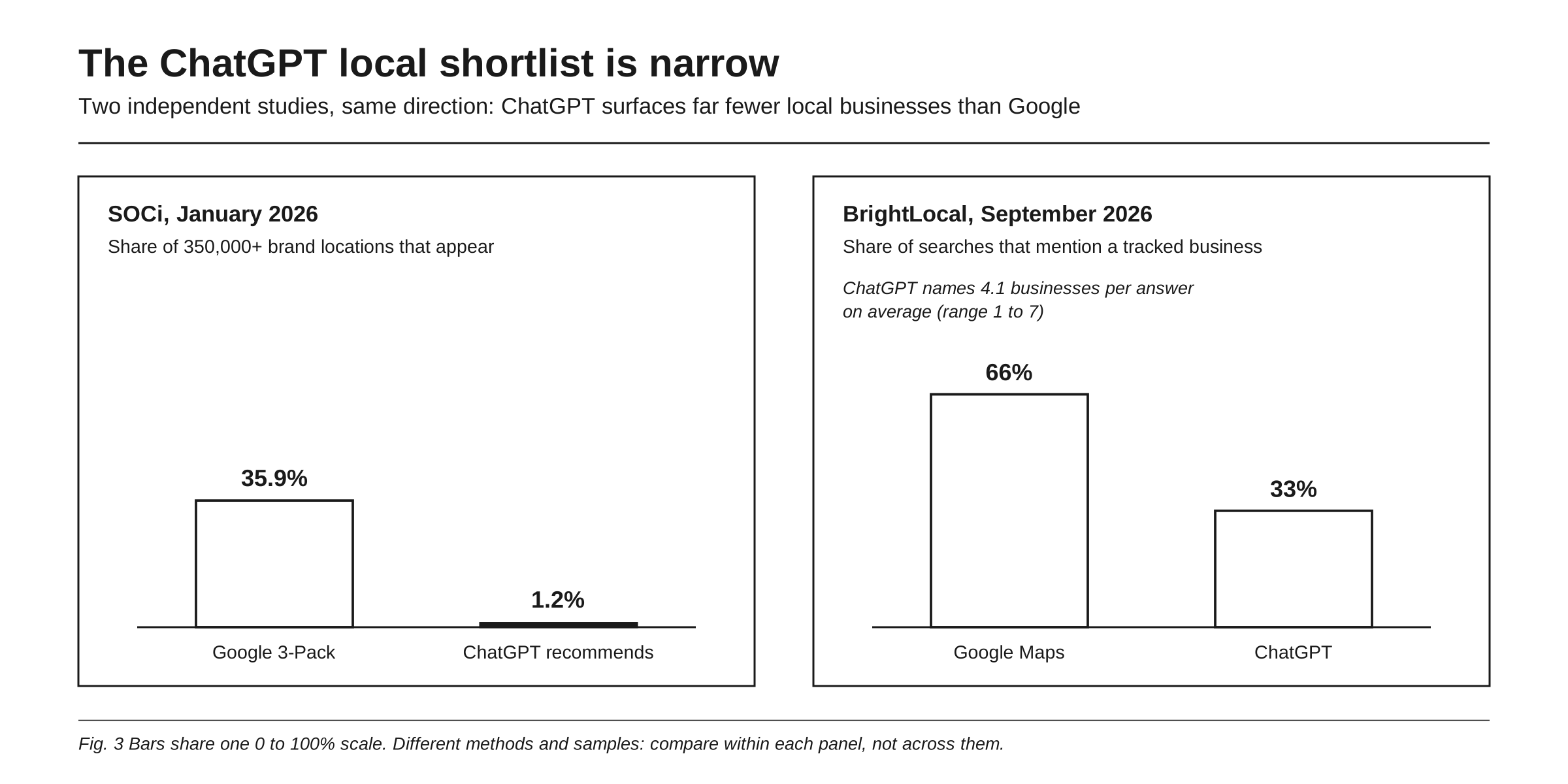
Then ChatGPT names very few businesses. BrightLocal measured 4.1 per response (range 1 to 7, median 4), and 10% of ChatGPT responses named no business at all. ChatGPT mentioned a tracked business in 33% of searches, against 66% for Google Maps. SOCi’s 2026 Local Visibility Index, a vendor report announced in a press release, covered more than 350,000 locations across 2,751 multi-location brands and found ChatGPT recommended 1.2% of locations, while the average appearance rate in Google’s local 3-Pack was 35.9%. The locations ChatGPT did recommend averaged 4.3 stars.
The shortlist is also unstable. BrightLocal found only 23% average overlap between ChatGPT result sets on repeat searches, though a business that appears once is seen again in about half of later attempts (50% persistence for ChatGPT). One check proves little; you need repeated runs, as explained in how many times to ask before you trust the answer.
What a local business should fix to get picked
Each fix maps to a step where businesses drop out.
- Claim and complete your Yelp listing first. Yelp grounded ChatGPT’s business cards on 95.83% of Steady Demand’s runs and now licenses its data to OpenAI. Categories, hours, service area, photos and phone matter most there.
- Earn reviews on the platforms ChatGPT reads, not only Google. BrightLocal says Google Business Profile is hardly used by ChatGPT, and SOCi’s recommended locations averaged 4.3 stars. A strong Google rating with a thin Yelp profile can still leave you weak in ChatGPT.
- Keep NAP identical across Yelp, Bing Places, your vertical platforms and your site. BrightLocal describes ChatGPT search as mostly Bing-powered, and Steady Demand saw Yelp-grounded cards. Mismatches can make it harder to tie your reviews to your business.
- Get onto your category’s directories. Restaurants and hotels need TripAdvisor, and restaurants OpenTable; they grounded business cards on 28.90% and 16.88% of Steady Demand’s runs across all verticals. In BrightLocal’s small 2025 test, dentists were sourced from dental directories and lawyers from Super Lawyers and FindLaw. Three Best Rated alone was 24% of ChatGPT’s directory sources in BrightLocal’s 2024 data.
- Build service plus town pages on your own site. Business websites were 58% of ChatGPT’s local sources in BrightLocal’s 2024 study and 72% for transactional searches. One page per core service per town, with prices, hours and real review excerpts, matches the “best,” “reviews” and year-stamped fan-outs ChatGPT writes.
- Earn local press and “best of” mentions. Business mentions were 27% of ChatGPT’s local sources in 2024, including city publications.
- Do not prioritize Foursquare for US ChatGPT. Steady Demand found zero Foursquare grounding on ChatGPT’s primary surface and one citation in 1,728 cross-check runs.
- Test with the town in the prompt, repeatedly. IP location is coarse and repeat-run overlap was 23%, so one “near me” screenshot proves little. Run “best [service] in [town]” many times and read it as a rate.
Where Rankry fits
Rankry runs a stable set of buyer-intent prompts every day across ChatGPT, Claude, Gemini, Perplexity, Grok and Google AI Mode and AI Overviews. For a local business, that means prompts with the town in the text, such as “best emergency plumber in Boise,” and a daily read on whether you are mentioned, where you rank against competitors down the street, and which sources each engine cited. Choose Local when you set up Rankry, and your prompts carry your location. New prompts are answered as soon as you add them, so a new neighborhood or service is one prompt away, and AI traffic tracking shows whether people actually arrive from ChatGPT and other AI platforms.
FAQ
Where does ChatGPT get local business information? From two layers: web pages found through its search index, which BrightLocal describes as mostly Bing’s, and structured business data behind its place cards. In Steady Demand’s August 2026 study, Yelp grounded those cards on 95.83% of runs, TripAdvisor on 28.90% and Google on 4.62%. Business websites, directories and local publications fill the written answer.
How does ChatGPT know what town I am in? By default it uses general location based on your IP address, which it may share with third-party search providers, according to OpenAI’s help documentation. Since March 26, 2026, users can opt in to precise device location. IP location is coarse, so typing the town name into the question gives ChatGPT a clearer signal than “near me.”
How many businesses does ChatGPT recommend for a local query? Few. BrightLocal’s September 2026 study of about 200,000 localized prompts counted an average of 4.1 businesses per ChatGPT response, with a range of 1 to 7 and a median of 4. Ten percent of responses named no business. SOCi found ChatGPT recommended only 1.2% of more than 350,000 brand locations it analyzed.
Does Google Business Profile help me show up in ChatGPT? Not much directly. BrightLocal’s 2026 research said Google Business Profile is hardly used by ChatGPT, even though it matters a lot for Google AI Mode and AI Overviews. Keep it accurate for Google, but for ChatGPT focus on Yelp, Bing Places, your category’s directories, and your own service pages.
Is it true that ChatGPT uses Foursquare for local results? Not in current US data. The 60% to 70% Foursquare figure traces to a May 2025 study of 50 prompts in five Spanish cities. Steady Demand’s August 2026 US study found Foursquare at zero across 2,879 runs on ChatGPT’s primary surface, in visible citations, retrieved sources and business-card grounding, plus one citation in 1,728 cross-check runs. Prioritize Yelp and vertical platforms instead.
Sources
- Study: AI local search data, BrightLocal, September 16, 2026
- ChatGPT’s Local Results Aren’t Coming From Foursquare (And Probably Never Really Were), Steady Demand, August 21, 2026
- Exclusive: Yelp deal pushes local reviews into ChatGPT, Axios via Yahoo Finance, July 23, 2026
- How ChatGPT Actually Picks Sources (I Read The Network Traffic, Not The Outputs), Search Engine Journal, June 30, 2026
- Fan-outs per prompt by engine, Peec AI, May 2026
- What ChatGPT actually searches for: 5 million fanout queries analyzed, PPC Land, June 6, 2026
- ChatGPT quietly rolled out location sharing, PPC Land, March 28, 2026
- How did ChatGPT determine my location? (quoting OpenAI’s ChatGPT search help article), OpenAI Community, February 19, 2025
- In AI-Driven Discovery, Few Brands Are Chosen, Most Disappear (2026 Local Visibility Index), SOCi, January 28, 2026
- AI Citations, User Locations, & Query Context, Yext Research, October 9, 2025
- Uncovering ChatGPT Search Sources, BrightLocal, December 12, 2024
- AI Search Makes Local Listings More Important Than Ever, BrightLocal, July 22, 2025
See which businesses ChatGPT names for “best [service] in [your town],” which sources it cites, and whether you make the shortlist day after day. Start a free 7-day Rankry trial, no card.