Google launched Universal Cart in the US on October 15, 2026, in Google Search and the Gemini app. Shoppers save products from different retailers into one cart, and the cart, built on the 60+ billion listings in Google’s Shopping Graph, sends alerts when a price drops or an item comes back in stock. At checkout there are two paths, both built on the Universal Commerce Protocol (UCP): pay on Google with Google Pay at participating merchants, or transfer the items to the merchant’s own cart and finish there. Either way, Google says the merchant remains the seller of record. Paying on Google requires a UCP integration, a specific feed attribute and selection into an early access program limited to products sold in the US, while everything the cart shows depends on the accuracy of your Merchant Center data.
Universal Cart is easy to confuse with agentic checkout, a separate Google feature from November 2025. Google groups UCP under “agentic commerce,” but its launch post files Universal Cart under practical shopping tools, not agentic capabilities. That difference decides what you need to configure, so this guide sticks to what Google has documented.
What launched on October 15
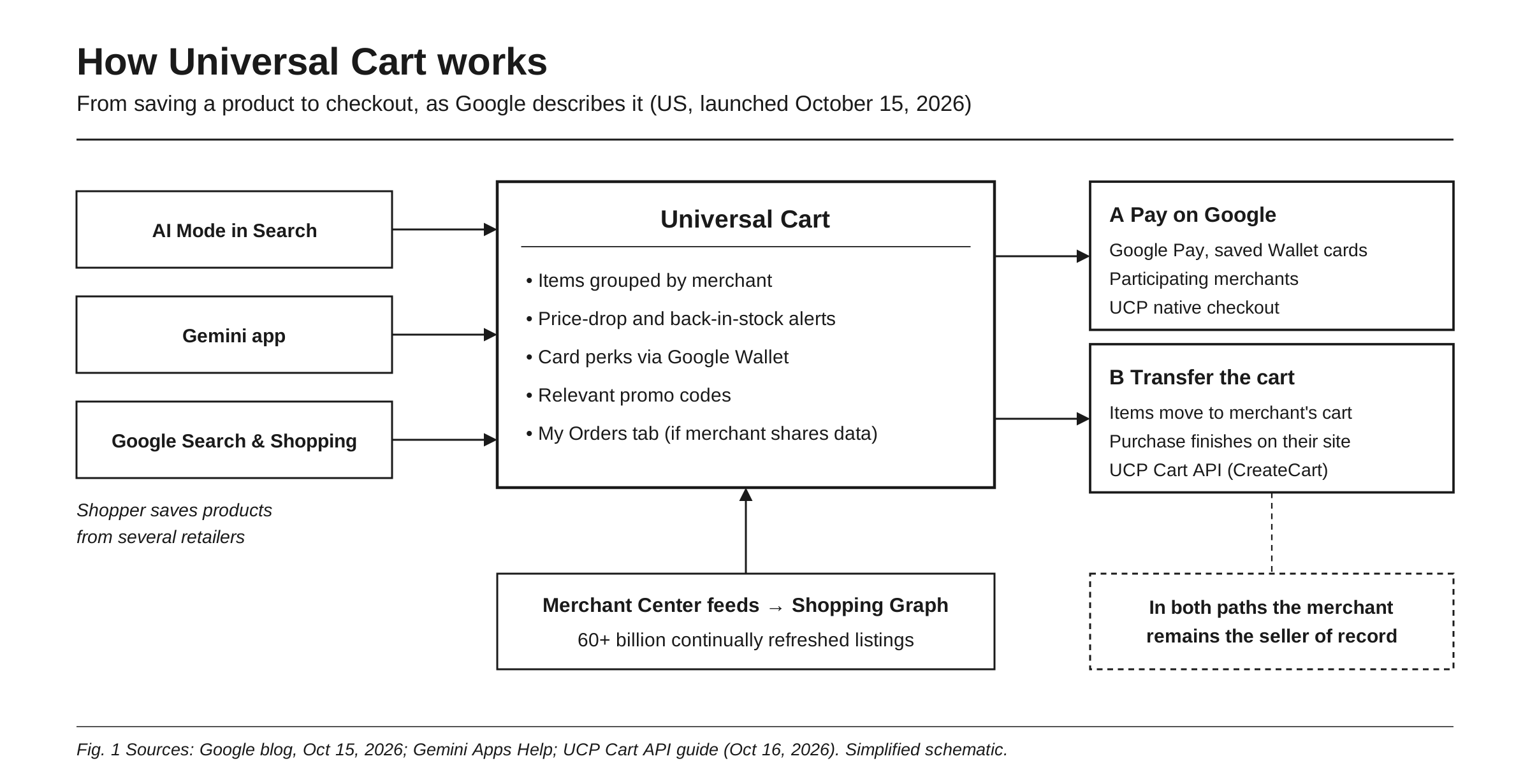
Google previewed Universal Cart at Google I/O on May 19, 2026, saying it would roll out in Search and the Gemini app in the US “this summer, with YouTube and Gmail to follow.” The October 15 post confirmed the US rollout and described four jobs:
- Save across retailers. A shopper can add a handbag in AI Mode and a sweater in the Gemini app, and both wait in one cart.
- Watch price and stock. The cart is “built on the 60+ billion continually refreshed product listings in Google’s Shopping Graph” and sends notifications about price drops or when an item comes back in stock.
- Suggest savings. The cart is built on Google Wallet, so it can use your card perks to help pick a payment method, and it shows relevant promo codes.
- Check out. Shoppers can pay with Google Pay in a few taps at many stores, or move items to the merchant’s cart. Google named Nike, Sephora, Target, Ulta Beauty, Walmart, Wayfair and “many Shopify merchants.”
Google’s Gemini help page adds the shopper view: products in the cart are grouped by merchant, a “My Orders” tab shows order status for merchants that share order data with Google, and the feature is US only.
One framing line in the launch post matters for merchants. Google says it works on two tracks, agentic capabilities that act on the shopper’s behalf and practical tools that give shoppers control, and that Universal Cart belongs to the second.
Two ways out of the cart, and where agentic checkout fits
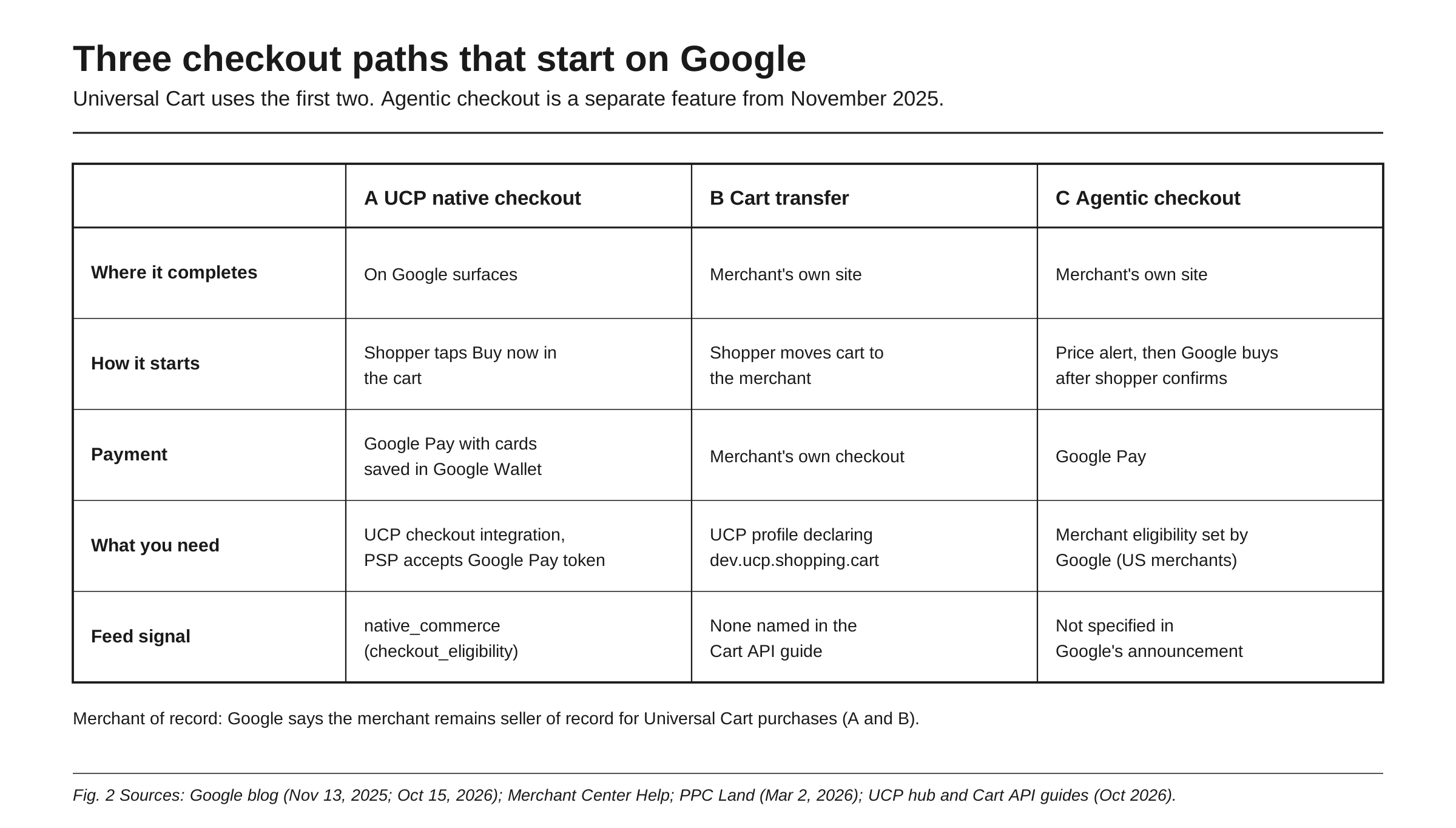
Three mechanisms are easy to blur.
Google Pay checkout on Google (UCP native checkout). Google’s Merchant Center Help describes it this way: with the older checkout button, the transaction happens on your site; with the UCP checkout, “the checkout happens directly on Google’s surfaces while keeping you the merchant of record.” Shoppers pay with card details already saved in Google Wallet. You do not need a Google Pay button on your own site, but, as PPC Land reported from the help page in March 2026, your payment provider must be able to accept a Google Pay payment token. Google’s developer guide states that only listings carrying the native_commerce(checkout_eligibility) attribute show the Buy now button.
Cart transfer to your site. Google’s Cart API guide (last updated October 16, 2026) says the API “supports Google’s Universal Cart feature by allowing a one-way population of the cart on your system,” through a CreateCart call. It requires UCP version 2026-04-08 or later and a UCP profile published at /.well-known/ucp that declares the dev.ucp.shopping.cart capability. Native checkout is not required for cart transfer. Updating, deleting or syncing carts is not supported in this first release, and Google recommends responding in under one second and planning capacity for peak campaigns.
Agentic checkout (November 2025). This is the older feature. A shopper tracks a product’s price, and when it falls within budget, Google can buy it on the merchant’s site using Google Pay, after the shopper confirms the purchase and shipping details. It rolled out on Search, including AI Mode, with eligible US merchants such as Wayfair, Chewy and Quince. Google’s help page draws the line: agentic checkout buys “on the customer’s behalf directly on a merchant’s website,” while UCP is the protocol that standardizes the exchange between the AI agent and the merchant’s backend.
If you also sell through ChatGPT, its shopping rules work differently and vary by market, covered in ChatGPT Shopping in the US vs Europe.
What feeds the cart: Shopping Graph and Merchant Center
The cart’s alerts are only as good as the listing data underneath. Google described the Shopping Graph in November 2025 as more than 50 billion product listings, 2 billion of which are updated every hour; the October 2026 post puts it at 60+ billion. Google’s UCP help pages say Merchant Center “will continue to be the central hub to prepare your product data,” with the best preparation being data “as robust and up-to-date as possible.”
Price accuracy is a documented failure point. Google’s Merchant Center Help says Googlebot compares the price attribute in your feed with the price on your landing page or in structured data, and a product with a mismatch may be disapproved. Google adds that price mismatches may lead to account suspension. Three specifics from that page are worth checking before the holidays:
- Googlebot reads the HTML your server returns. A price injected later by JavaScript can trigger an error.
- If you use
sale_price, thesale_price_effective_dateand its time zone must be right, or the listing shows the wrong price. - After a fix, Googlebot recrawls disapproved products “over the next few hours or days.”
A price-drop alert on a stale price sends a shopper to a broken promise. Google’s September 16 post claims that merchants adopting core Merchant Center feed best practices see, on average, a 5% increase in conversions the following month. That is Google’s own figure with no sample disclosed, so read it as directional. The same post says conversational attributes submitted by lululemon were incorporated 50% of the time in relevant AI Mode recommendations during testing, again a single-brand Google example. Being shown and being buyable are separate bars, as cited vs transactable in AI shopping explains.
Who is eligible right now
- Country. Google’s UCP integration hub guide (last updated October 19, 2026) says: “Scope: this applies only to products sold within the United States.” Google’s September post says the hub capabilities come to Australia and Canada “early next year.”
- Selection. The UCP checkout “is available for select merchants.” The documented sequence is: complete the technical implementation, submit the interest form, wait to be selected, then onboard in Merchant Center, where a sandbox validates your UCP profile, cart transfer and checkout APIs. Merchant Center also flags needed changes to feed attributes, returns or account configuration.
- Platforms. If you sell through a third-party platform, Google says to ask that provider about its UCP plans. Google named “many Shopify merchants” at launch.
- Account settings. Google’s Merchant Center requirements for UCP checkout, as summarized by theroberthu.com on October 16, 2026, require a return policy and customer support contacts in Merchant Center.
- Excluded products. The same summary lists subscriptions, personalized goods, pre-orders, final-sale items and age-restricted products as ineligible for checkout.
Google says UCP “already enables direct checkout for hundreds of thousands of brands and retailers,” a company claim with no list attached. Google publishes the requirements but not how it chooses among applicants, so anyone promising guaranteed acceptance is guessing.
Merchant setup checklist (documented requirements only)
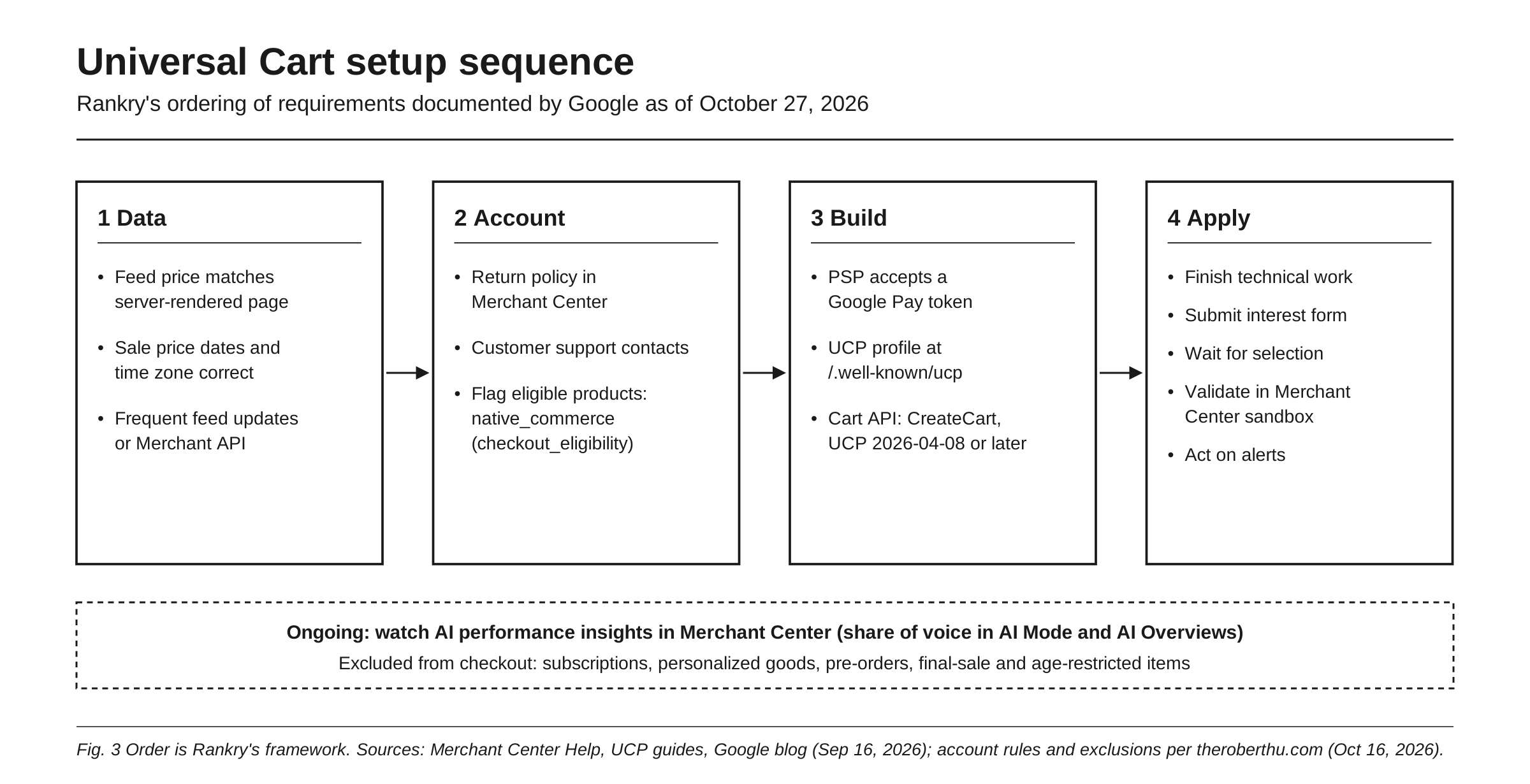
The ordering is Rankry’s; every requirement in it comes from the Google pages in the sources. For a broader readiness review of agent checkout, see an agentic commerce readiness check.
-
Confirm scope. UCP checkout covers products sold in the US. If you sell only in Canada or Australia, Google points to early 2027 for hub capabilities.
-
Fix price parity first. Make the feed price match the server-rendered price on the landing page, check
sale_price_effective_dateand time zones, and clear any price-mismatch disapprovals. -
Keep availability current. Back-in-stock and price-drop alerts run on Shopping Graph data, so schedule frequent feed updates or use the Merchant API, the two methods Google’s help page names for frequently changing prices.
-
Set returns and support contacts in Merchant Center. Both are listed requirements for UCP checkout.
-
Flag eligible products. Add
native_commerce(checkout_eligibility)to products you want to show the Buy now button, and keep subscriptions, personalized, pre-order, final-sale and age-restricted items out. -
Check payments. Confirm your payment provider can accept a Google Pay payment token.
-
Build cart transfer if you want it. Publish a UCP profile at
/.well-known/ucpwithdev.ucp.shopping.cart, support UCP version 2026-04-08, implement CreateCart, and size capacity for Black Friday traffic. -
Apply and validate. Submit the interest form after the technical work, then use the Merchant Center sandbox once selected and act on any alerts it raises.
-
Ask your platform. Shopify and other platform merchants should confirm what their provider handles before building anything custom.
How to tell whether it is working
Google gives merchants one new measurement surface. Since September 16, AI performance insights in Merchant Center has been available in Australia, Canada, India, New Zealand and the US, letting retailers compare their share of voice with other brands across AI Mode and AI Overviews. That is worth checking weekly through the holiday season, alongside price-mismatch and checkout alerts.
It has limits. It covers Google surfaces only, and Universal Cart is one entry point among several where shoppers now build lists, which we mapped for the holidays in our Black Friday guide to AI gift lists. A product can carry perfect feed data and still lose the recommendation that comes before the cart.
That earlier step is what Rankry measures. Rankry runs a stable set of buyer-intent prompts across ChatGPT, Claude, Gemini, Perplexity, Grok and Google AI Mode and AI Overviews, every day, and shows which brands each engine names, ranks and cites, next to your competitors. Its AI traffic tracking shows the visits AI platforms send to your site, so you can see whether AI visibility turns into traffic. Merchant Center shows how you compare on Google’s AI surfaces; Rankry adds the other engines and the prompts behind each recommendation.
FAQ
Is Universal Cart the same as Google’s agentic checkout? No. Agentic checkout, launched in November 2025, lets Google buy a tracked item on the merchant’s site with Google Pay after the shopper confirms. Universal Cart is a cross-retailer cart in Search and the Gemini app, with checkout on Google through UCP or a transfer to the merchant’s cart. Google places Universal Cart in its practical tools track, not its agentic track.
Who is the merchant of record when a shopper pays on Google? The merchant. Google’s launch post says merchants “will remain the seller of record” and provide order confirmations and customer support, and its Merchant Center help describes the UCP checkout as happening on Google’s surfaces while keeping you the merchant of record. Google’s Merchant Center requirements, as summarized in October 2026, also call for a return policy and customer support contacts for UCP checkout.
Do I need UCP for my products to appear in Universal Cart? Google has not published a separate rule for saving products to the cart. What it documents: the Google Pay Buy now button needs a UCP integration, the native_commerce(checkout_eligibility) attribute and selection into early access, and cart transfer needs the Cart API declared in your UCP profile. Accurate Merchant Center data underpins both.
Is Universal Cart available outside the US? Not as of late October 2026. Google launched it in the US, its Gemini help page says the feature is US only, and its developer guide limits UCP checkout to products sold in the US. Google says the hub capabilities come to Australia and Canada early next year. In May it said UCP checkout would later reach the U.K., with no date.
Which products cannot use Google Pay checkout? Per Google’s Merchant Center requirements as summarized in October 2026: subscriptions, personalized goods, pre-orders, final-sale items and age-restricted products. Leave these without the checkout eligibility flag, since only listings that carry it show the Buy now button for Google Pay checkout on Google.
Sources
- Google’s new Universal Cart launches today in the U.S., Google, October 15, 2026
- Google Shopping introduces Universal Cart, agentic shopping, Google, May 19, 2026
- Google Shopping launches agentic checkout and more AI shopping tools, Google, November 13, 2025
- Retailers: Get ready for AI-driven holiday shopping, Google, September 16, 2026
- About Universal Commerce Protocol (UCP) integration hub in Merchant Center, Google for Developers, last updated October 19, 2026
- Cart API, Google Universal Commerce Protocol (UCP) Guide, Google for Developers, last updated October 16, 2026
- About the Universal Commerce Protocol (UCP) and UCP-powered checkout feature on Google, Google Merchant Center Help, n.d. (accessed November 2026)
- How to onboard to the UCP integration hub in Merchant Center, Google Merchant Center Help, n.d. (accessed November 2026)
- Manage your universal cart, Gemini Apps Help, n.d. (accessed November 2026)
- How to fix: Mismatched product price, Google Merchant Center Help, n.d. (accessed November 2026)
- Google’s UCP checkout help page is finally here: what merchants need to know, PPC Land, March 2, 2026
- Canada and Australia face 2027 wait for Google’s Merchant Center UCP hub, PPC Land, October 7, 2026
- Google Universal Cart: How Checkout and Cart Transfer Work, theroberthu.com, October 16, 2026
See whether AI Mode, Gemini and ChatGPT recommend your brand before shoppers ever reach a cart. Start a free 7-day Rankry trial, no card.