ChatGPT shopping does not work the same way on both sides of the Atlantic. In the US, OpenAI says shopping is live, merchants can share product feeds (Shopify and Etsy catalogs are already integrated), and purchases finish on the merchant’s own site after OpenAI stepped back from Instant Checkout in March 2026. In Europe, OpenAI’s feed specification says the standard upload targets the US, and October 2026 research from Peec AI, a vendor, reports that European product results still come from Google Shopping. OpenAI began testing ads in the US in February 2026 and launched them in 31 European countries in August, but OpenAI says personalized ads are not initially available in the EEA or Switzerland. On top of that, the European Commission designated ChatGPT a Very Large Online Search Engine under the Digital Services Act on August 31, 2026, with compliance due by January 2027.
The same prompt about running shoes can pull from different product data, carry differently targeted ads, and sit under different law, depending on where the shopper is. One playbook will be wrong for one market.
What ChatGPT shopping looks like in the US
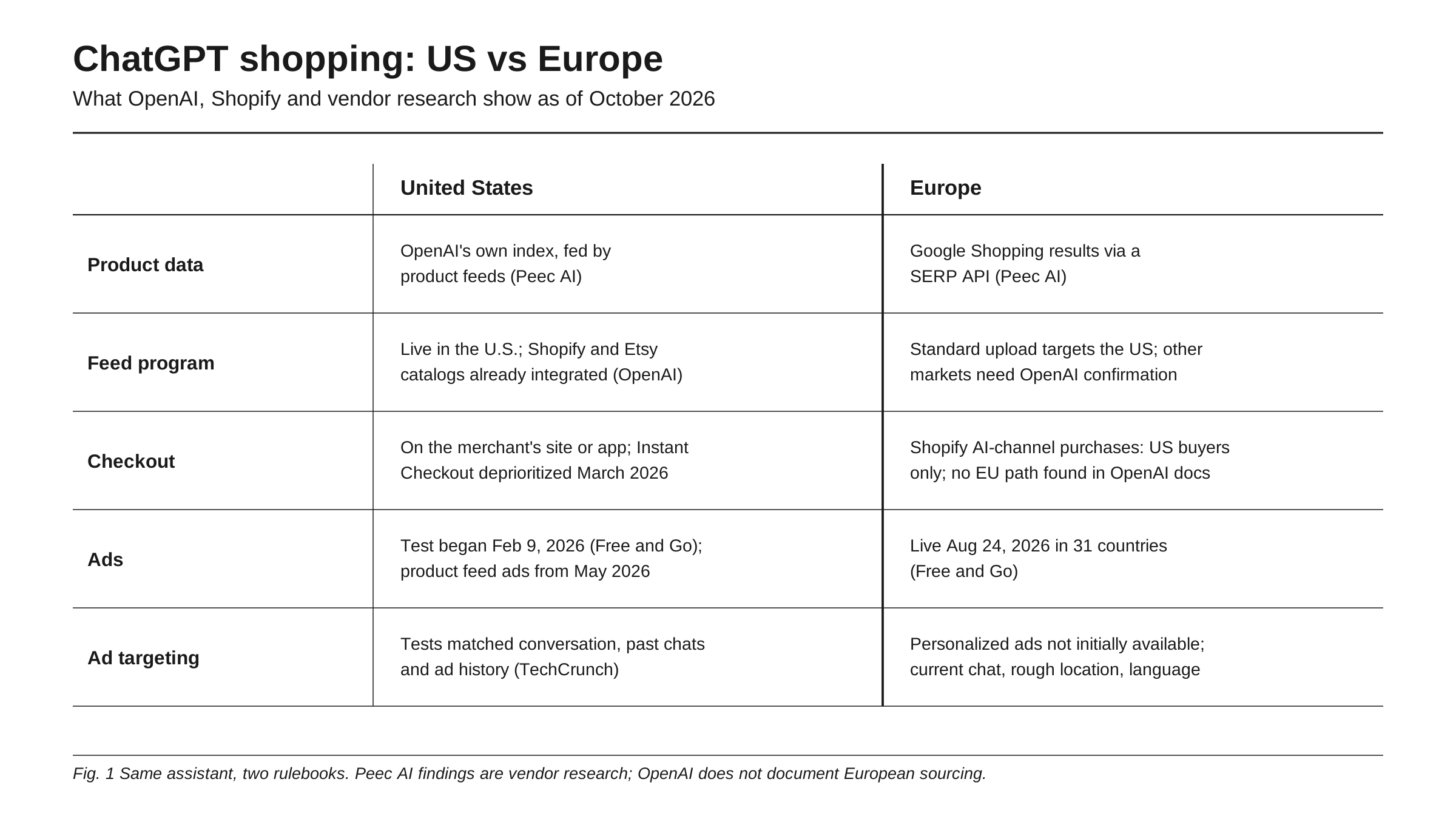
OpenAI’s merchant page is direct about scope: “Shopping is currently live for ChatGPT users in the U.S.” Merchants apply to share a product feed, and OpenAI says that if you sell through Shopify or Etsy, “your catalog is already integrated.” The page also says OpenAI sends shoppers to your site or app by default, “with no fees for purchases made on your site or app.”
That model is new. Instant Checkout, launched in September 2025 with Etsy among the first merchants, let shoppers pay inside ChatGPT. In a March 24, 2026 blog post, OpenAI wrote that “the initial version of Instant Checkout did not offer the level of flexibility that we aspire to provide,” and said it would let merchants use their own checkout while it focused on product discovery. Walmart’s Daniel Danker told Wired that conversion for items sold inside the chatbot was three times lower than for items that required clicking out, as Modern Retail reported.
Shopify’s documentation, updated June 18, 2026, adds details that matter for cross-border sellers. ChatGPT is open to any Shopify Catalog merchant selling to US buyers, regardless of where the store is based, and buyers complete the purchase on the merchant’s store through an in-app browser. Purchasing across Shopify’s AI channels is currently available to US buyers only.
The feed spec lists nine required fields: item_id, title, description, url, brand, seller_name, image_url, availability and price. Checkout eligibility needs a separately enabled integration plus a public privacy policy and terms of service. For what an agent needs from your checkout, see an agentic commerce readiness check.
Where European shopping results come from
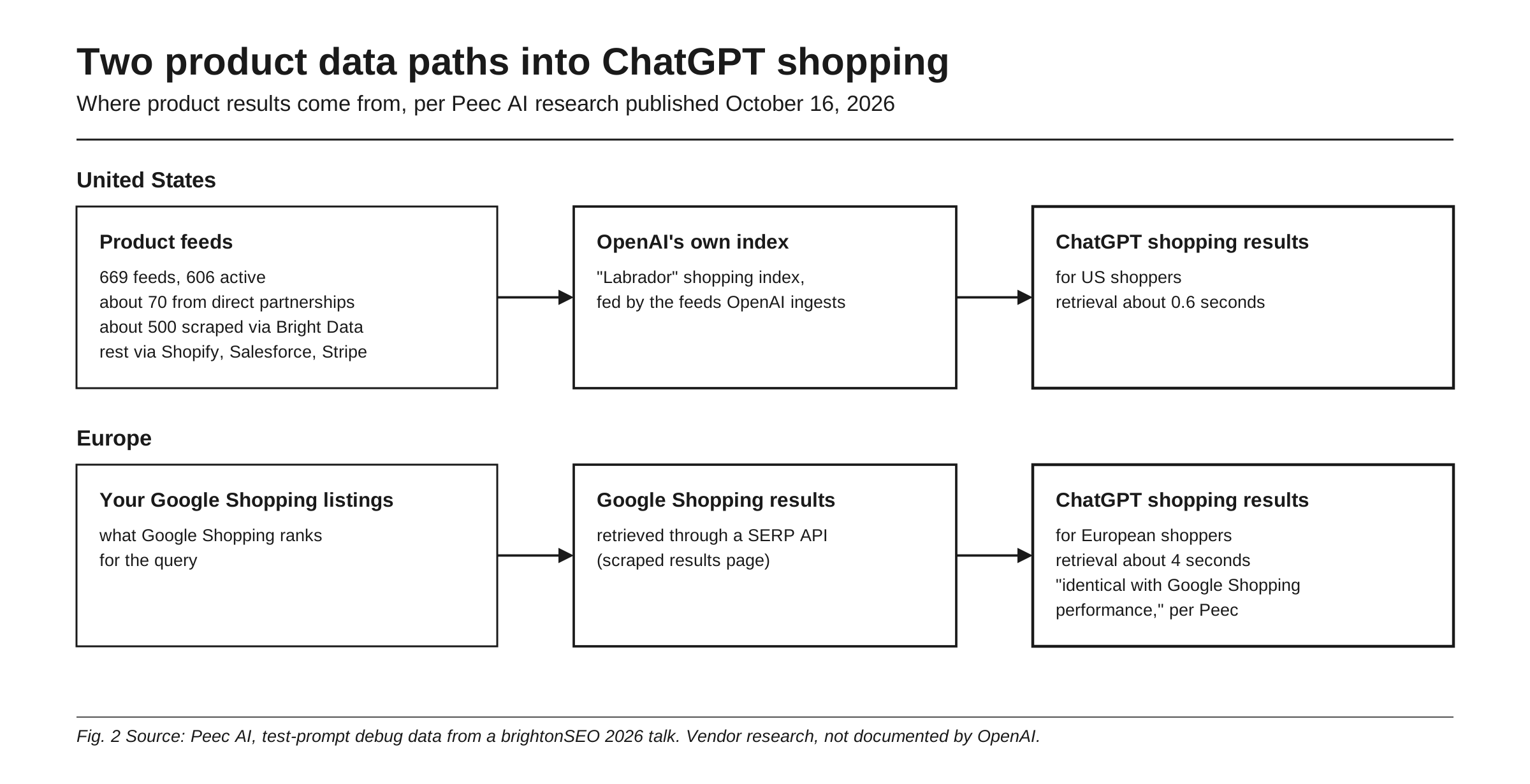
OpenAI’s feed spec says the standard OpenAI-format upload “currently targets the US,” and that merchants should use additional markets “only after OpenAI confirms the integration and its allowed countries and currencies.” OpenAI does not document where European shopping results come from. The best public evidence is vendor research.
On October 16, 2026, Peec AI published findings from a brightonSEO 2026 talk by Malte Landwehr, its CPO and CMO. Peec reports that US products now come from feeds OpenAI indexes itself: 669 feeds at the time of the talk, 606 of them active, about 70 from direct partnerships and about 500 that OpenAI built by scraping retailer websites through Bright Data. In Europe, Peec says products still come from Google Shopping, retrieved through a SERP API, and concludes that “for now, ChatGPT performance in the region is identical with Google Shopping performance.” Peec also reports that product descriptions are cut at 50 tokens, roughly 40 words.
Know the limits. These observations come from ChatGPT debug data on test prompts, such as one for running shoes. Peec does not publish a sample size or method, and Peec sells shopping analytics. An earlier Peec dataset, published in Search Engine Land in March 2026, extracted around 5,000 ChatGPT carousels with 43,000 products and found that over 83% of carousel products were strong matches for products in Google’s top 40 organic shopping results, versus a little under 11% for Bing. It did not break results out by country and predates the US switch Peec describes.
We found no independent, multi-market study comparing ChatGPT shopping results between the US and Europe as of mid-October 2026. The evidence does support one point: the same product can reach US and European shoppers through different pipes, a sharper version of the variation covered in geo-variation in brand recommendations.
Ads: same placements, different data rules
OpenAI began testing ads in the US on February 9, 2026, for logged-in adults on the Free and Go tiers. TechCrunch reported that in tests OpenAI matched ads to the subject of conversations, past chats and previous ad interactions. OpenAI says ads skip users under 18 and sensitive topics such as health, mental health and politics, and that “Ads do not influence the answers ChatGPT gives you.” Product feed ads followed in May 2026, days after OpenAI opened a beta self-serve Ads Manager to US businesses, and the feed spec carries a separate is_ads_eligible flag.
Europe got ads on August 24, 2026, in 31 countries: the 27 EU member states plus Iceland, Liechtenstein, Norway and Switzerland, bringing the total to 40 markets. Only Free and Go users see them. OpenAI’s FAQ states: “Personalized ads are not initially available in the European Economic Area (EEA) or Switzerland.” Notebookcheck reported that ad selection uses the current conversation, rough location and language, leaving out earlier chats and saved memories. Digiday reported that OpenAI relies on consent as the legal basis for personalized ads, and that users who do not consent still see contextual ads.
Our read: a European ChatGPT ad is matched to what the shopper is discussing right now, so product data and query relevance carry more of the load than audience history does in the US.
The EU rulebook around ChatGPT shopping
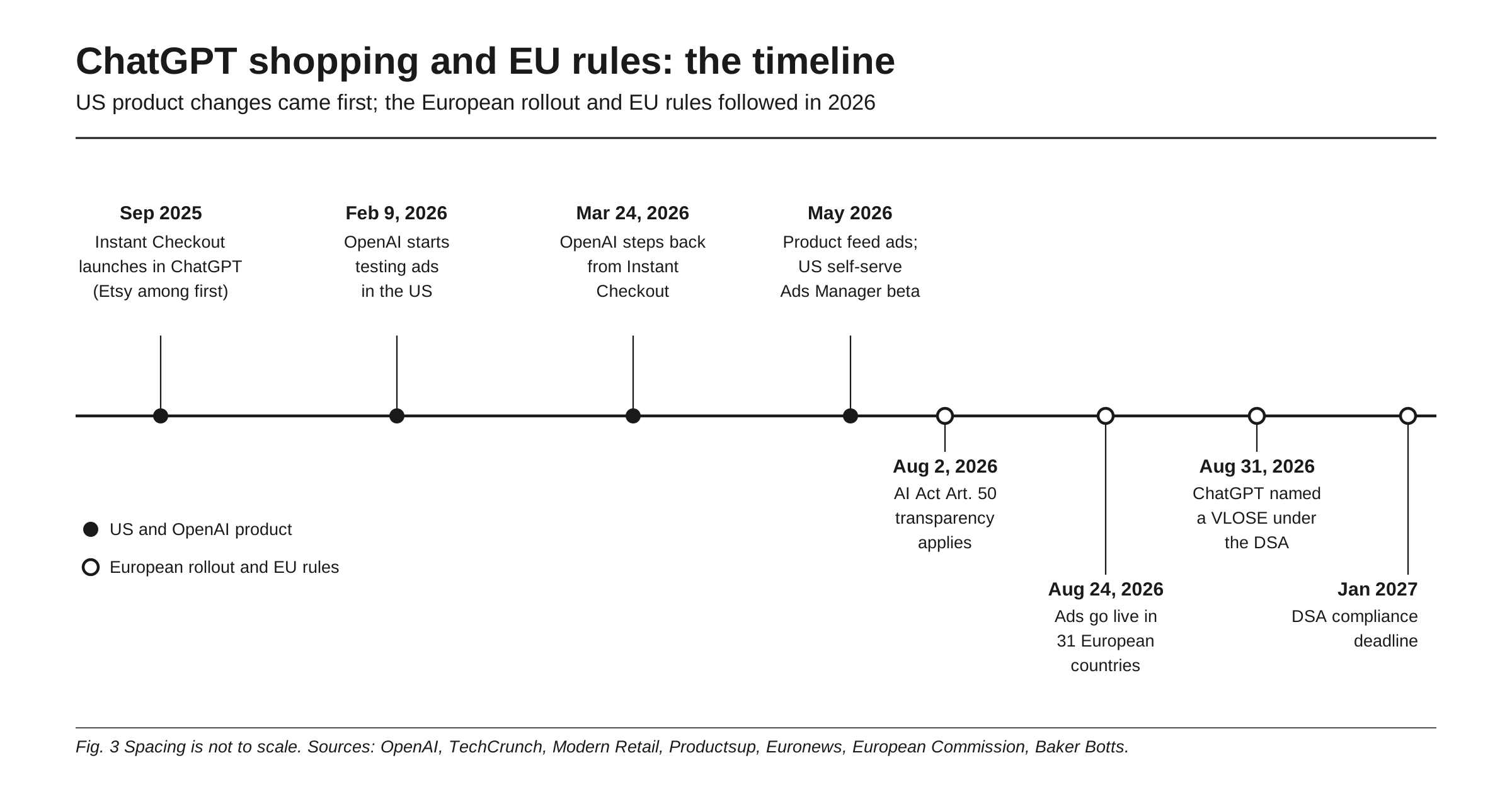
The biggest change is the DSA. The Commission’s August 31, 2026 press release calls ChatGPT a hybrid service that qualifies as an online search engine because it responds to prompts “including by searching the web.” ChatGPT has until January 2027 to comply, supervised by the Commission with Ireland’s Coimisiún na Meán. OpenAI reported about 159.1 million average monthly active recipients of ChatGPT search in the EU over the six months ending March 31, 2026, against a 45 million threshold. Per Search Engine Journal’s summary, the obligations include annual independent audits, an option not based on profiling where recommender systems are used, and a public ad repository where ads are shown, so EU ChatGPT ads are likely to become publicly inspectable.
The other regimes are less settled or less direct:
- DMA. On July 30, 2026, a Commission spokesperson said it would assess user figures that ChatGPT announced above the gatekeeper thresholds. We found no gatekeeper designation as of this article’s date.
- AI Act. Article 50 transparency duties applied from August 2, 2026: providers must tell users they are dealing with an AI system and mark generative output in machine-readable form, with a marking grace period until December 2, 2026 for generative systems already on the market before August 2, 2026, per Baker Botts. For ChatGPT itself, these duties sit with OpenAI as the provider.
- Consumer law. Ireland, where ChatGPT is established for DSA purposes, added to its list of prohibited commercial practices in 2022: “providing search results in response to a consumer’s online search query without clearly disclosing any paid advertisement or payment specifically for achieving higher ranking of products within the search results.” If shopping answers count as search results under rules like this, paid placement in them needs clear disclosure.
- GDPR. Consent drives ad personalization in Europe, and OpenAI’s conversion pixel added consent management and a country data field by May 2026, per Shopifreaks.
This is a summary of public texts, not legal advice. Check specifics with counsel.
A two-column checklist for US and EU merchants
This is our framework, built from the sources above: one decision per row, read for each market.
| Step | US merchants | EU merchants |
|---|---|---|
| 1) Product data | Share a feed with OpenAI, or confirm your Shopify or Etsy catalog is integrated. | Treat Google Shopping as your ChatGPT shopping layer for now, per Peec, and keep those listings complete and accurate. |
| 2) Feed fields | Fill all nine required fields and put key facts in the first 40 words of each description. | Build the same OpenAI-format feed now, so you are ready when OpenAI confirms more countries and currencies. |
| 3) Checkout | Make your click-out checkout work cleanly in an in-app browser. In-ChatGPT checkout needs a separate integration, a privacy policy and terms. | Expect no in-ChatGPT checkout. Shopify’s AI channel purchasing covers US buyers only, so your own checkout carries the sale. |
| 4) Cross-border | If you ship to Europe, European shoppers may see your products through Google Shopping data, not your OpenAI feed. | If you ship to the US, Shopify’s ChatGPT channel accepts Catalog merchants from any store location. |
| 5) Ads | Use product feed ads with is_ads_eligible set, and expect personalization options. | Plan for contextual matching only at launch, and check that your pixel consent setup works. |
| 6) Compliance | Keep return, privacy and terms URLs public in the feed. Expect no ad delivery near health, mental health or politics, which OpenAI excludes. | Expect your ads to appear in a public ad repository once ChatGPT’s DSA obligations apply, review paid-ranking disclosure, and confirm consent flows with counsel. |
| 7) Measurement | Look for utm_medium=feed in analytics, which Peec reports on US shopping product links, and watch ChatGPT referrals. | Track Google Shopping performance as the leading indicator, plus ChatGPT referrals to your site. |
In both columns, being recommended and being buyable are separate bars, see cited vs transactable in AI shopping.
What to watch next
Three signals deserve a calendar slot. OpenAI’s merchant page says it plans to expand to more merchants and regions over time, without a date. ChatGPT’s DSA obligations apply by January 2027, which should bring a public ad repository and, where recommender systems are used, a non-profiling option. And Peec expects OpenAI to move Europe onto its own product index eventually, which would make your OpenAI feed matter there as much as Google Shopping does today. Until then, European ChatGPT shopping is a moving target with thin public documentation.
The practical response is measurement. Rankry tracks how ChatGPT, Gemini, Perplexity, Claude, Grok and Google AI Mode mention and rank your brand on a stable set of buyer-intent prompts, every day, so a change in where products come from shows up as a change in who gets named. Its AI traffic tracking script shows which AI referrals reach your site, and competitor comparison shows who took the slot you lost.
FAQ
Is ChatGPT shopping available in Europe? European users can see product results, but OpenAI says shopping is currently live for ChatGPT users in the U.S. Peec AI’s October 2026 research reports that European product results come from Google Shopping data rather than merchant feeds sent to OpenAI. OpenAI says it plans to expand to more regions over time but has not published a date for Europe.
Can EU merchants send a product feed to OpenAI? Not through the standard path yet. OpenAI’s feed spec says the standard upload currently targets the US and that additional markets should be used only after OpenAI confirms the integration and its allowed countries and currencies. EU merchants selling to US buyers through Shopify can reach US shoppers, because Shopify’s ChatGPT channel accepts Catalog merchants from any store location.
Can shoppers still buy inside ChatGPT? Mostly no. In March 2026 OpenAI said the first version of Instant Checkout lacked flexibility and that it would let merchants use their own checkout. OpenAI’s merchant page now says purchases are completed on merchant-owned websites or apps. Shopify routes ChatGPT buyers to the merchant’s store in an in-app browser, and only for US buyers.
Are ChatGPT ads personalized in the EU? Not at launch. OpenAI’s FAQ says personalized ads are not initially available in the EEA or Switzerland. European ads launched on August 24, 2026, matched to the current conversation, rough location and language. Digiday reported that OpenAI relies on consent as the legal basis for personalized ads, so personalization depends on user opt-in when it arrives.
What does the DSA designation mean for merchants? It puts obligations on OpenAI, not on you directly. By January 2027 ChatGPT must assess systemic risks, offer an option not based on profiling where it uses recommender systems, and keep a public repository of the ads it shows. For advertisers, that means EU ChatGPT ads and their targeting details are likely to become publicly visible. Your own consumer law and GDPR duties stay the same.
Sources
- Power product discovery in ChatGPT, OpenAI, n.d. (accessed November 2026)
- Products (product feed spec), Agentic Commerce, OpenAI Developers, n.d. (accessed November 2026)
- OpenAI’s plans to make ChatGPT more like Amazon aren’t going so well, TechCrunch, March 24, 2026
- What went wrong with ChatGPT’s Instant Checkout, Modern Retail, March 27, 2026
- Agentic Commerce on Shopify: How It Works (2026), Shopify, June 18, 2026
- ChatGPT Shopping optimization in 2026: US vs. Europe, Peec AI, October 16, 2026
- New finding: ChatGPT sources 83% of its carousel products from Google Shopping via shopping query fan-outs, Search Engine Land, March 5, 2026
- ChatGPT rolls out ads, TechCrunch, February 9, 2026
- Our approach to advertising and expanding access to ChatGPT, OpenAI, January 16, 2026
- OpenAI brings product feed ads to ChatGPT, Productsup, May 10, 2026
- ChatGPT to start showing ads across Europe next week, Euronews, August 21, 2026
- ChatGPT ads hit Europe on Monday, but not the personalized kind, Notebookcheck, August 22, 2026
- OpenAI builds offerings on consent as it expands ChatGPT ads to Europe, Digiday, August 18, 2026
- Commission designates ChatGPT, Reddit, Roblox under Digital Services Act, European Commission, August 31, 2026
- ChatGPT Is Now A “Very Large Online Search Engine” In The EU, Search Engine Journal, August 31, 2026
- ChatGPT and Roblox in the EU’s sights, as Brussels prepares to trigger the Digital Markets Act, Eunews, July 30, 2026
- EU AI Act Article 50 Transparency Obligations Go Live, Baker Botts, September 10, 2026
- Consumer Rights Act 2022, Section 157, Irish Statute Book, 2022
- OpenAI lays groundwork for ChatGPT ads in EU with consent management updates to conversion tracking pixel, Shopifreaks, May 1, 2026
See whether ChatGPT names your products for the buyer prompts you care about, and track it every day. Start a free 7-day Rankry trial, no card required.