Being recommended by an AI is worthless if an agent cannot complete the purchase, and agentic checkout is a chain where any broken link loses the sale: the agent has to read your product, confirm availability, build a cart at the right price, pass payment safely, and hand the order to you to fulfill. The dominant model settled in 2026 as “discover in chat, transact on the merchant site,” which is good news, you keep the customer, the data, and the merchant-of-record status, but it means your checkout must accept a buyer that is an agent, not a human clicking through a visual funnel. Readiness comes down to four things: a complete real-time feed, coverage across the commerce protocols engines use, live price and stock accuracy, and a checkout that never requires a human hand. This guide is the readiness check; the visibility side, getting cited in the first place, is its companion, cited versus buyable in AI shopping.
You can win the recommendation and still lose the sale at the checkout door. This is the operations half of AI shopping, and it is invisible until an agent tries to buy and cannot.
The agent checkout, step by step
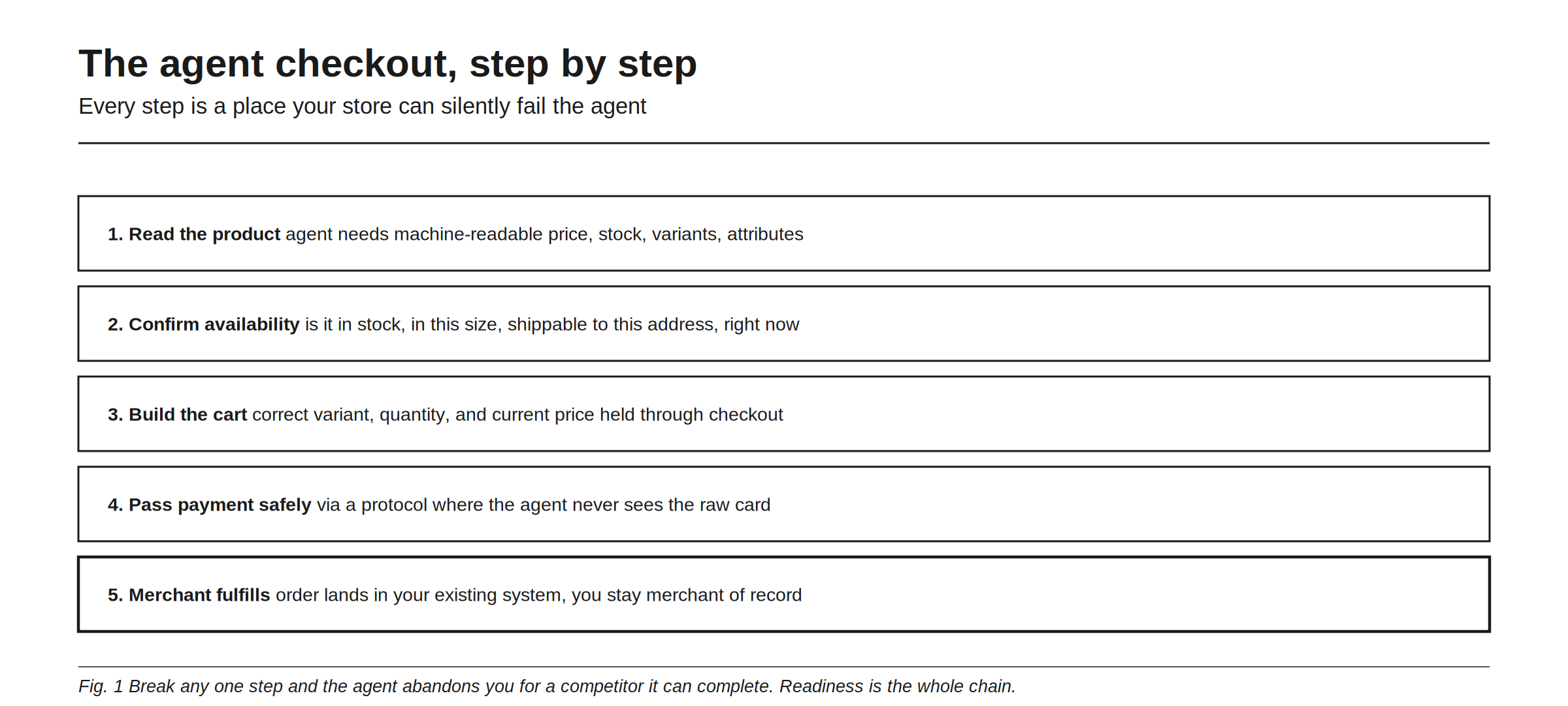
An agent purchase is a five-step chain. First, read the product: the agent needs machine-readable price, stock, variants, and attributes. Second, confirm availability: is it in stock, in this size, shippable to this address, right now. Third, build the cart: correct variant, quantity, and current price held through checkout. Fourth, pass payment safely, through a protocol where the agent never sees the raw card. Fifth, the merchant fulfills: the order lands in your existing system and you stay merchant of record.
Break any one step and the agent abandons you for a competitor it can complete. Readiness is the whole chain, not any single piece. The agents doing this are a specific category of automated traffic, distinct from crawlers and scrapers, mapped in the five types of AI bots. Treating them as ordinary visitors is the first mistake; they behave like a buyer with no eyes and no patience for anything a human would have to resolve.
Discover in chat, transact on your site
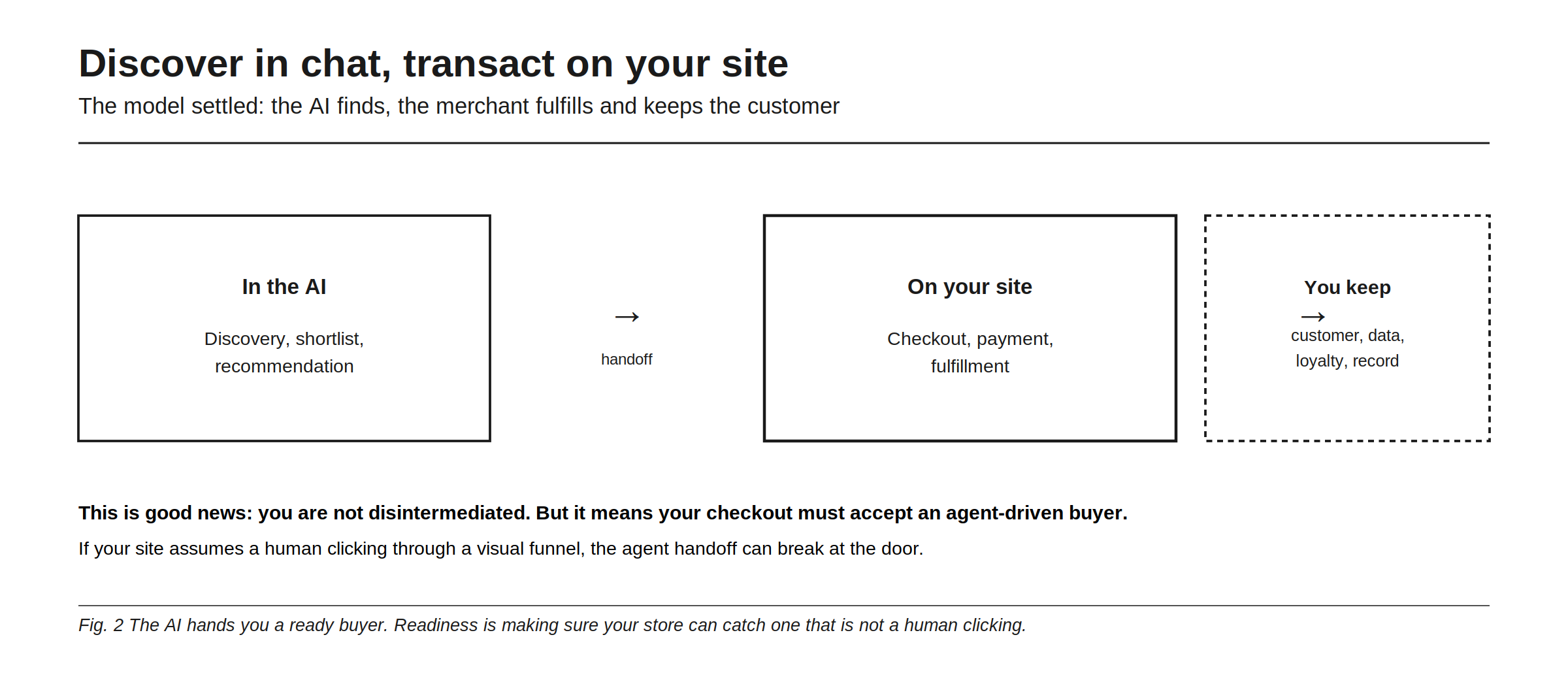
The industry converged on a clear division of labor. In the AI: discovery, shortlist, recommendation. On your site: checkout, payment, fulfillment. And you keep the customer, the data, the loyalty relationship, and the merchant-of-record status. Early experiments with buying entirely inside the chat gave way to this handoff model, partly because shoppers preferred to complete purchases where they already had accounts and saved payment methods.
This is good news: you are not disintermediated, you still own the customer. But it means your checkout must accept an agent-driven buyer, and if your site assumes a human clicking through a visual funnel, the agent handoff can break at the door. The AI hands you a ready buyer; readiness is making sure your store can catch one that is not a human clicking. That handoff is the transactional cousin of the zero-click shift in agentic search versus zero-click, except here the goal is a completed sale, not an answer.
Your agentic readiness checklist
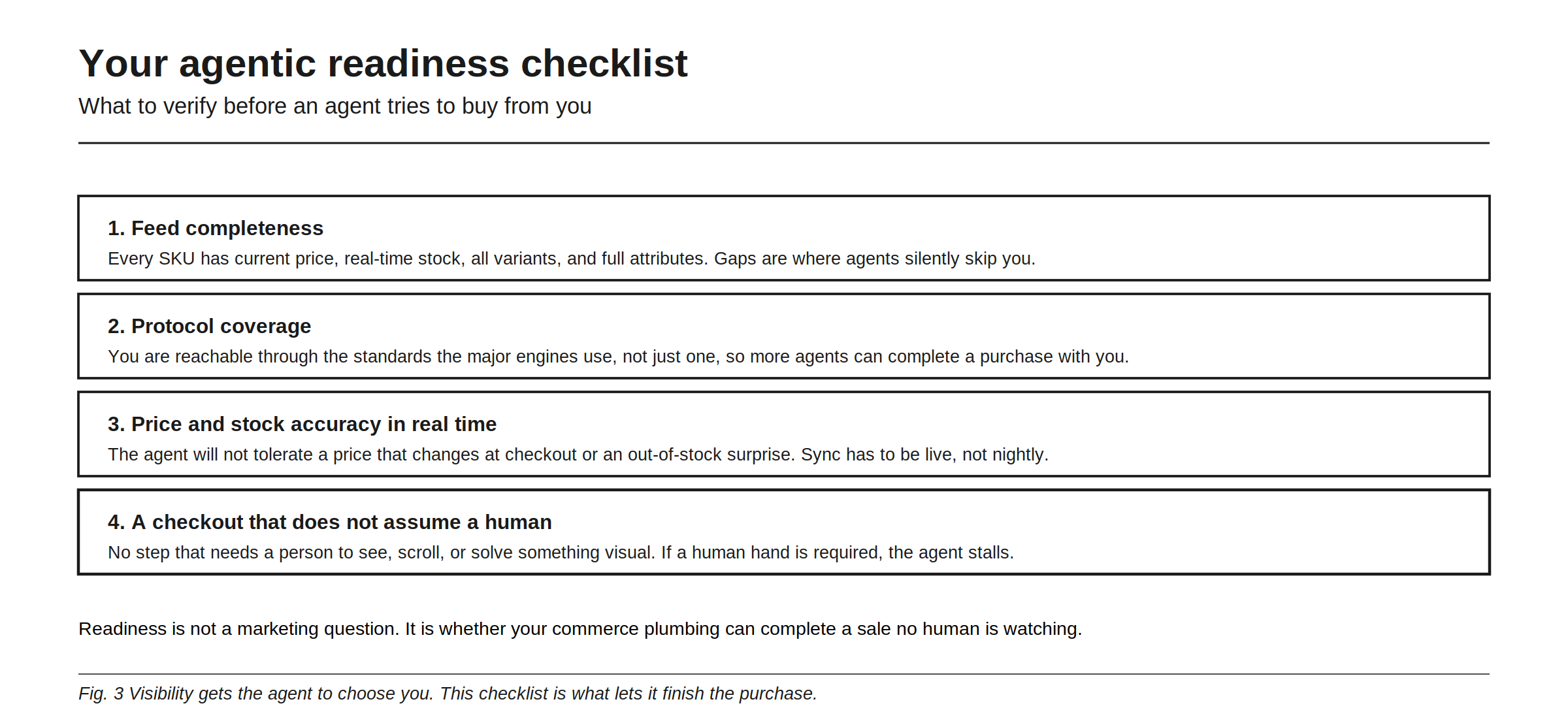
Four things to verify before an agent tries to buy from you. First, feed completeness: every SKU has current price, real-time stock, all variants, and full attributes, because gaps are where agents silently skip you. Second, protocol coverage: you are reachable through the standards the major engines use, not just one, so more agents can complete a purchase with you, and merchants supporting multiple protocols reach meaningfully more agent traffic. Third, price and stock accuracy in real time: the agent will not tolerate a price that changes at checkout or an out-of-stock surprise, so sync has to be live, not nightly. Fourth, a checkout that does not assume a human: no step that needs a person to see, scroll, or solve something visual, because if a human hand is required, the agent stalls.
Readiness is not a marketing question. It is whether your commerce plumbing can complete a sale no human is watching. The structured-data foundation under the feed is covered in what structured data actually does for AI visibility. Visibility gets the agent to choose you; this checklist is what lets it finish the purchase.
The mistake that costs the most
The single most expensive misunderstanding here is thinking agentic readiness is a big, distant infrastructure project you can defer. For many merchants, the platform they already use is quietly turning it on: major commerce platforms now syndicate product data to AI channels by default and standardize it for agents automatically. That means the question is often not “should we build this” but “do we know what our feed looks like to an agent right now, and where it fails.” A brand can be one stale price field or one visual-only checkout step away from losing agent sales it never sees, because a failed agent purchase produces no abandoned-cart email, no error in your funnel, no trace. The fix is to test the chain the way an agent experiences it and close the gaps, feed, protocols, sync, checkout, before the volume grows. Very small catalogs benefit least, since there is little for an agent to browse, but any brand with real product breadth is exposed. Rankry shows whether AI engines are recommending your products in the first place, per engine, so you know where the agent journey starts before you audit whether it can finish, from $99 a month on a no-card trial.
FAQ
What is agentic commerce readiness? It is whether an AI agent can actually complete a purchase from your store: read your product data, confirm availability, build a cart at the right price, pass payment through a supported protocol, and hand you the order to fulfill. Missing any step means the agent abandons you for a competitor it can complete.
Do AI agents buy inside the chat or on my website? The settled model is “discover in chat, transact on the merchant site.” The AI handles discovery and recommendation, then hands off to your checkout for payment and fulfillment. You keep the customer relationship, the data, and merchant-of-record status, but your checkout must accept an agent-driven buyer.
What breaks an agent checkout most often? Thin or stale product feeds, prices or stock that are not synced in real time, supporting only one commerce protocol, and checkout steps that assume a human, anything visual a person must see, scroll, or solve. Any of these can silently stop the purchase after the AI recommended you.
Do I need to support multiple commerce protocols? Yes, increasingly. Different engines transact through different standards, so supporting only one limits which agents can buy from you. Merchants reachable across multiple protocols capture meaningfully more agent-driven purchases than those present in a single ecosystem.
Is agentic readiness a huge technical project? Not always. Many major commerce platforms now syndicate and standardize product data for AI channels by default, so part of it may already be on. The real task is knowing how your feed and checkout look to an agent today and fixing the specific gaps, rather than assuming it works.
Know whether AI engines are recommending your products before you audit whether an agent can buy them, tracked per engine. Start a free 7-day Rankry trial, no card, first report in two minutes.