This holiday season, AI assistants are a shopping channel you can plan for. Adobe expects AI traffic to US retail sites to rise 130% year over year between November 1 and December 31, with the biggest jump on Thanksgiving. In our framing, a gift prompt like “best gifts for a coffee lover under $50” is answered from three places: editorial lists and gift guides, product feeds, and your own pages. The editorial lane is the hardest to enter late: in BrightEdge’s study of ChatGPT holiday prompts at six large US retailers, none of the six ranked among the 15 most-cited sources for gift prompts, and print gift guides were planned months ago. What you still control in late October is feed accuracy and the pages engines already cite, refreshed for 2026.
Black Friday is November 27. Much of what an assistant will say about your category that week depends on pages and feeds that already exist today.
What the 2026 holiday forecasts say about AI
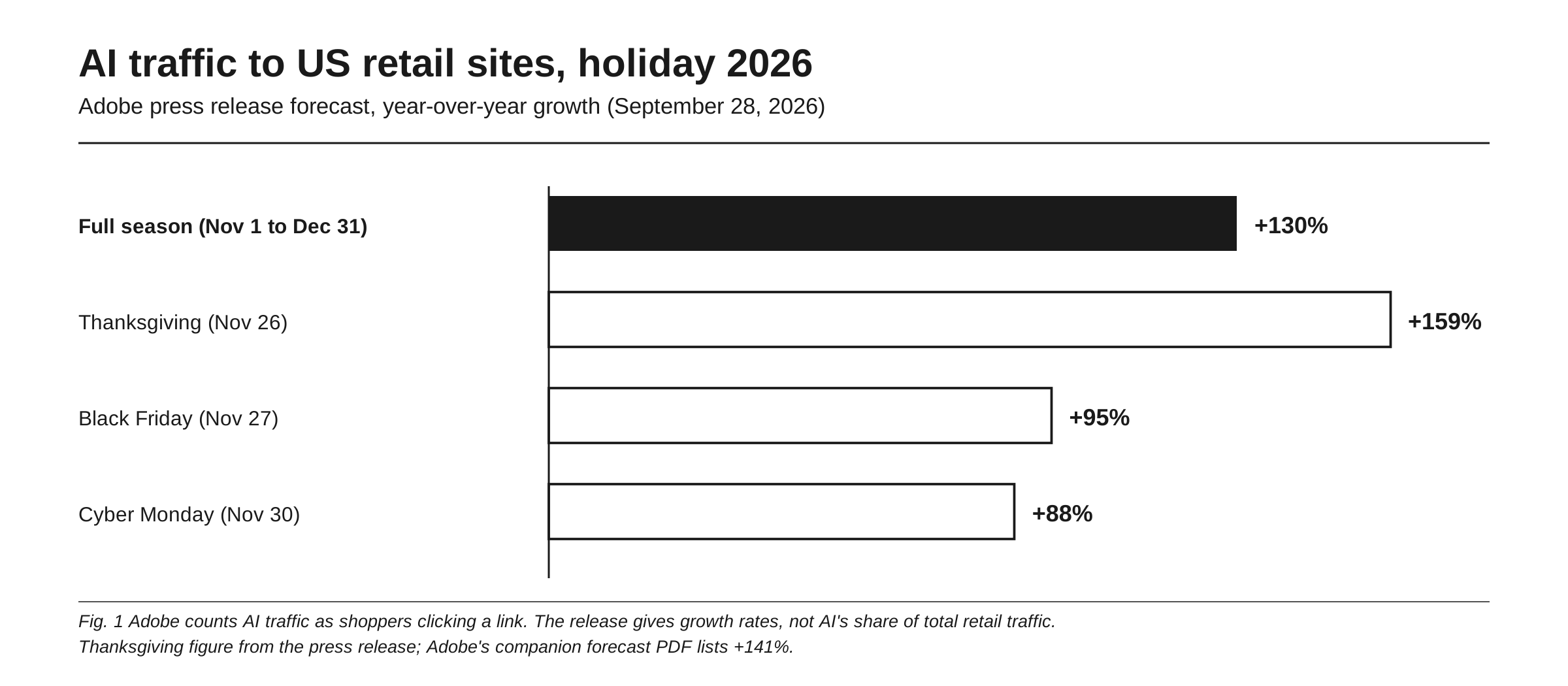
Adobe’s forecast, released September 28, is based on over 1 trillion visits to US retail sites, 100 million SKUs and 18 product categories. It projects $275.1 billion in US online sales for November and December, up 6.7%. For AI, Adobe expects traffic to US retail sites to rise 130% year over year, led by Thanksgiving (up 159%), then Black Friday (up 95%) and Cyber Monday (up 88%). Adobe’s companion forecast PDF lists Thanksgiving at 141%; we use the press release figure. Adobe counts AI traffic as shoppers clicking a link, so these are visits, not answers. In an Adobe survey of 5,000 consumers fielded in July, 77% of those who had used AI for online shopping said they felt more confident in their purchase.
One caution: the release gives growth rates, not AI’s share of total retail traffic. A 130% rise tells you the direction and the peak days, not the size of the channel.
Salesforce’s July 20 predictions use a much wider lens. Salesforce predicts that “20% of all 2026 holiday ecommerce traffic will originate from AI chat agents,” without naming a region, and its definition includes consumer-facing bots, autonomous agents and “competitor scrapers fueling algorithmic price-matching.” That mixes several kinds of bot traffic, so it is not comparable to Adobe’s count of shopper clicks. Salesforce also predicts one in three ecommerce sites will have a site-specific shopper agent live by Cyber Week.
Where shoppers will meet AI this season
ChatGPT. Shopping is live for US users, and Shopify and Etsy catalogs are already connected, per OpenAI’s merchant and help pages as reported by Search Engine Journal on September 9. OpenAI’s shopping research mode, launched in November 2025, builds buyer’s guides and says “Results are organic and based on publicly available retail sites.” Ads began testing in the US on February 9 for logged-in adults on the Free and Go tiers, shown beneath responses, and OpenAI says “Ads do not influence the answers ChatGPT gives you.” In May, Productsup reported that OpenAI had announced catalog-based product ads. Regional differences are covered in ChatGPT Shopping in the US vs Europe.
Google. Agentic checkout, announced in November 2025, lets shoppers track a price and have Google buy on the merchant’s site with Google Pay after they confirm, for eligible merchants in AI Mode in the US. On October 15, Google launched Universal Cart in the US across Search and the Gemini app, drawing on “60+ billion continually refreshed product listings” and sending price-drop and back-in-stock alerts. Since September 16, Merchant Center also shows retailers in the US and four other countries their share of voice across AI Mode and AI Overviews.
Meta Muse. Meta began rolling out Muse in the US on September 8. It can check out with Link by Stripe and checks with the person before making a purchase. How it builds a shortlist is in how Meta Muse builds its shortlist.
Perplexity. Since late November 2025, US users get a free shopping assistant with Instant Buy through PayPal, and product cards draw on reviews and guides, per Engadget.
How a gift-list prompt gets answered
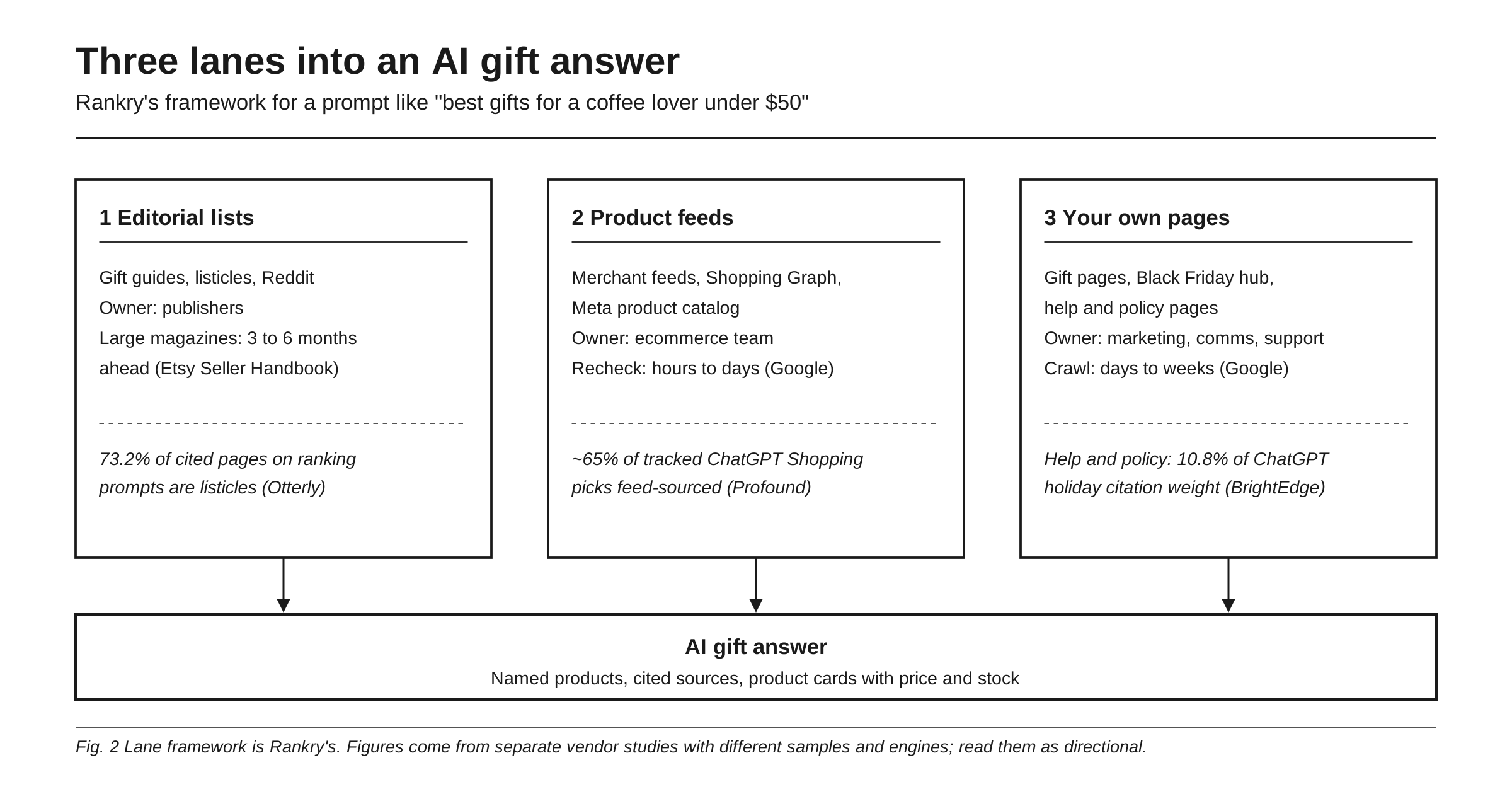
In our framing, a gift answer is assembled from three lanes. Each has different owners and different lead times.
Lane 1: editorial lists. Gift prompts are ranking questions, and ranking questions pull listicles. In an OtterlyAI vendor study of 617,985 US citations from September 2026, 73.2% of cited pages were listicles when the prompt asked for a ranking. In Otterly’s retail sector, 46.4% of citations to listicles, comparisons and guides came from compensated publishers, sites that say they may earn from what they recommend. BrightEdge’s October 8 study found Reddit, Good Housekeeping and Forbes leading citations for gift prompts. Why lists win is covered in why listicles get most AI citations.
Lane 2: product feeds. The product cards under an answer increasingly come from structured feeds. Profound, a vendor that runs its customers’ prompts daily (about 1.76 million runs in July), reported via Search Engine Journal that feed-integrated retrieval made up about 65% of the ChatGPT Shopping recommendations it tracked as of September 3. That is observational data from one vendor’s prompts, and OpenAI has not confirmed it. Google draws on its Shopping Graph. For Muse, Profound’s small vendor study (50 prompts, one category) found it queries a Meta product catalog in parallel with live browsing. In our reading, the “under $50” part of a gift prompt is applied to price data, so a feed price that is wrong or stale can drop you out of the answer.
Lane 3: your own pages. BrightEdge’s October 16 study of four large US retailers, using June to August data, found that half of ChatGPT’s top holiday prompts were logistics questions, against 28% on Google AI Overviews. Help and policy pages took 10.8% of ChatGPT’s citation weight and 0.9% of AI Overviews’, while commercial pages took 64.6% on AI Overviews. Being cited and being buyable are different goals, as cited vs transactable in AI shopping explains, and your own pages serve both.
Lead times: what is locked and what is still open
Publisher gift guides. Etsy’s Seller Handbook says large magazines work three to six months ahead, with editors looking for products from July through September, and regional magazines two to four months ahead. Some blogs and online publications might not start their guides until October or November. So most print guides are closed for 2026, and some online guides may still be open.
Crawling and indexing. Google’s own documentation says “Crawling can take anywhere from a few days to a few weeks.” A new gift page published the week of Thanksgiving may not be crawled in time.
Freshness works against new pages, not for them. BrightEdge’s October 8 study of 13,915 ChatGPT holiday prompts found “no recency discount”: at least 11.0% of holiday prompts cited a page tied to a past year, and nine of the ten highest-volume prompts citing a 2025 announcement named no year. Best Buy’s single permanent Black Friday hub held 37.6% of its Black Friday citations. BrightEdge advises retitling evergreen pages for the current year before October ends, and its October 16 study adds: “Update pages that already exist before commissioning new ones.”
Feeds react fastest, and break fastest. Google Merchant Center compares feed prices with landing pages and can disapprove products that do not match. Its help page lists sale price dates or time zones set incorrectly among the common reasons, and Googlebot reads prices from the HTML your server returns, so prices added by JavaScript after the page loads trigger an error.
Rankry’s holiday plan: late October to Cyber Monday
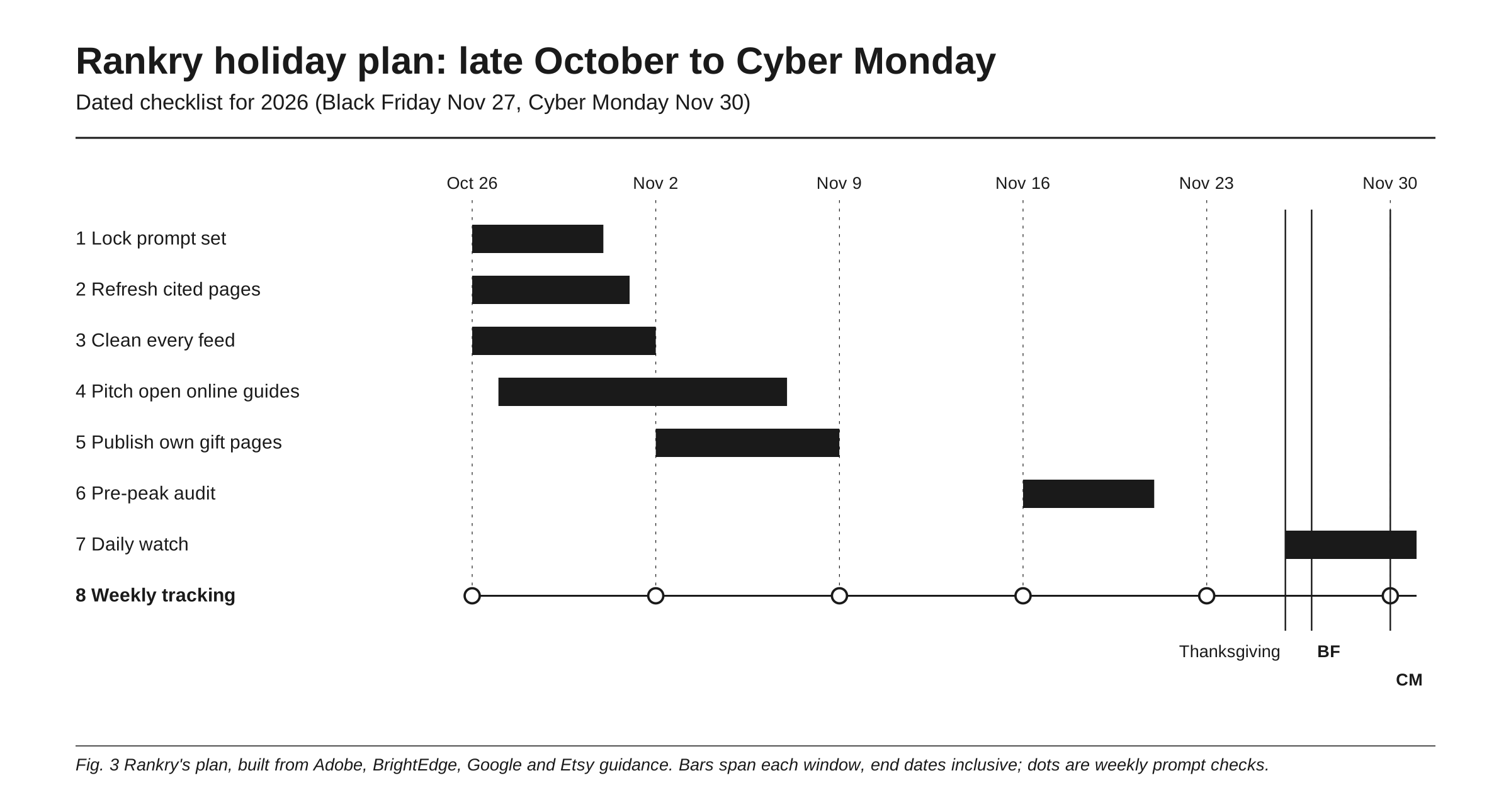
This is our plan, built from the sources above. Dates assume Black Friday on November 27 and Cyber Monday on November 30.
- October 26 to 30: lock your prompt set. Write 20 to 40 gift prompts in your buyers’ words (“gifts for a new runner under $75”), plus logistics prompts (“does [brand] price match on Black Friday”). Run them across engines and record which URLs get cited. That list is your outreach and refresh map.
- October 26 to 31: refresh pages engines already cite. Retitle evergreen gift and deal pages for 2026, update last year’s announcements or point them to this year’s version, and keep one permanent Black Friday hub URL.
- By November 2: clean every feed. Check your Merchant Center, Meta catalog and, if you sell on Shopify, your Shopify catalog. Price, availability, images and titles must match the landing page, in server-rendered HTML. Set sale price start and end dates with the correct time zone.
- October 27 to November 6: pitch online gift guides that are still open. Prioritize publications already cited for your gift prompts. Send price, a clear “best for” line, stock assurance through December, and product samples. Disclose any paid placement.
- By November 9: publish or update your own gift pages. Organize by recipient and price band, show real prices and stock, and put the four facts BrightEdge flags (sale dates, return window, price-match terms, shipping cutoff) on a crawlable page.
- November 16 to 20: pre-peak audit. Recheck feed prices against landing pages, confirm Black Friday sale prices are scheduled, and fix disapprovals before Thanksgiving week.
- November 26 to 30: watch daily. Swap out-of-stock items on gift pages, check that sale prices went live in feeds, and rerun the logistics prompts.
- Weekly from October 26, then December 1: measure and archive. Track the same prompts every week, then save the cited sources list. It is your pitch list for 2027, when outreach should start in July.
How to measure gift-list visibility
Gift answers move fast in a season where prices and stock change daily, so a single screenshot tells you little. Rankry runs a stable set of buyer-intent prompts every day across ChatGPT, Claude, Gemini, Perplexity, Grok and Google AI Mode and AI Overviews, showing whether you are mentioned, how you rank, which sources are cited, and how you compare with competitors. A new gift prompt added on Black Friday morning is answered right away, and Rankry’s AI traffic tracking shows the visits AI platforms send to your site, your own view of the kind of AI clicks Adobe is forecasting. Meta Muse can be added to the tracked engines too.
FAQ
How much AI shopping traffic will retailers see this holiday season? Adobe’s September 28 press release forecasts AI traffic to US retail sites will rise 130% year over year from November 1 to December 31, with Thanksgiving up 159% (141% in Adobe’s forecast PDF), Black Friday up 95% and Cyber Monday up 88%. Adobe measures shoppers clicking a link. It gives growth rates, not AI’s share of total traffic, so it does not say how big the channel is.
Where do AI assistants get gift recommendations? From three lanes, in our framing: editorial lists and gift guides, product feeds, and the brand’s own pages. In BrightEdge’s study of ChatGPT holiday prompts at six US retailers, Reddit, Good Housekeeping and Forbes led citations for gift prompts. In Profound’s ChatGPT tracking, about 65% of product recommendations came from feeds, and Google draws on its Shopping Graph.
Is it too late to get into holiday gift guides? For most print guides, yes: per Etsy’s Seller Handbook, large magazines work three to six months ahead. Some blogs and online publications might not start their guides until October or November, so late-October pitches may still land. Focus on publications that AI engines already cite for your gift prompts, and pair outreach with feed and page fixes you control.
Can I pay to appear in AI shopping answers? In ChatGPT, OpenAI began testing ads in the US in February 2026 for logged-in adults on the Free and Go tiers, shown beneath responses, and says ads do not influence answers. Productsup reported in May 2026 that OpenAI announced catalog-based product ads. OpenAI says ads are labeled and kept separate from the answer, so paying does not replace the work of getting cited.
How often should I check AI gift recommendations during Cyber Week? Weekly tracking of a fixed prompt set is the baseline from late October. From Thanksgiving through Cyber Monday, check daily, because prices, stock and sale status move fast on sale days, and Google’s Merchant Center can disapprove products whose feed price does not match the page. Rerun logistics prompts too, since half of ChatGPT’s top holiday prompts in BrightEdge’s data were logistics questions.
Sources
- Adobe: U.S. Holiday Shopping Season to Hit Record $275.1 Billion Online, Rising 6.7% YoY, Adobe, September 28, 2026
- 2026 Holiday Predictions: A Unified Yet Fractured Journey, Salesforce, July 20, 2026
- Google AI Overviews vs ChatGPT: Half of ChatGPT’s Holiday Citations Point to Pages Marketing Does Not Own, BrightEdge, October 16, 2026
- Before Black Friday, Update the Pages ChatGPT Already Cites, BrightEdge, October 8, 2026
- What Content Do AI Engines Cite? A Study of 617,985 Citations Across 7 Engines and 5 Industries, OtterlyAI, October 14, 2026
- ChatGPT Shopping Results Lean Hard on Product Feeds, Search Engine Journal, September 9, 2026
- Introducing shopping research in ChatGPT, OpenAI, November 24, 2025
- Our approach to advertising and expanding access to ChatGPT, OpenAI, January 16, 2026
- You might start seeing ChatGPT ads today, 9to5Google, February 9, 2026
- OpenAI brings product feed ads to ChatGPT, Productsup, May 10, 2026
- Google Shopping launches agentic checkout and more AI shopping tools, Google, November 13, 2025
- Google’s new Universal Cart launches today in the U.S., Google, October 15, 2026
- Retailers: Get ready for AI-driven holiday shopping, Google, September 16, 2026
- Introducing Muse: The World’s First Personal AI Agent Built for Everyone, Meta, September 8, 2026
- The era of personal agents: Muse and Instinct, Profound, October 2, 2026
- Perplexity announces its own take on an AI shopping assistant, Engadget, November 25, 2025
- Getting Your Products Into Holiday Gift Guides, Etsy Seller Handbook, October 15, 2026
- Ask Google to recrawl your URLs, Google Search Central, last updated December 10, 2025
- How to fix: Mismatched product price, Google Merchant Center Help, n.d.
- 2026 U.S. Holiday Forecast, Adobe Digital Insights, September 2026
See which gift prompts already name your products, and which sources the engines cite instead, before Black Friday. Start a free 7-day Rankry trial, no card.