Meta’s newsroom posts do not call Muse a shopping agent. They call it a personal AI agent, and shopping is one of its jobs: at Connect 2026 Meta announced new retail connectors “to make Muse an even better shopper.” Muse launched in the US on September 8, 2026, in its own app, on muse.ai and directly in WhatsApp, and it can pay through Link by Stripe, with Shop Pay and PayPal announced since. Meta has published no merchant documentation on how Muse chooses products. The best public evidence is a small vendor study and an instruction file that Profound says it pulled from Muse, which Meta has not confirmed: candidates come from Meta’s product catalog and from live browsing of merchant sites, and the reported rules favor well-known merchants, real in-stock product pages and normal prices. So the work for a brand is specific: be in the feeds Muse reads, make product pages a browser agent can read, and build the brand recognition the shortlist rules appear to reward.
Meta has announced no way to buy a slot on that shortlist. That makes Muse a purely organic problem for now, and an easy one to get wrong by guessing.
What Meta actually announced
Meta’s launch post on September 8 describes Muse as “a secure, private personal AI agent that proactively helps with people’s goals and suggests ideas.” Talking to it works like messaging a person, “in the Muse app or directly in WhatsApp.” Meta says it is “rolling out in the US on iOS, Android, and muse.ai, and coming soon to AI glasses.”
On buying, Meta says “Muse can checkout with Link built by Stripe,” that Shop Pay was coming, and that “Muse checks with the person before sensitive actions like sending an email or making a purchase.” On ads, the post is direct: “Muse doesn’t share a person’s conversations or the data in their VM with Meta’s ad systems.”
On September 21, Shopify CEO Tobi Lütke announced Shopify was “partnering deeply with Muse to enable agentic checkout with Shop Pay on all Shopify stores.” The same day, SiliconANGLE reported that Amazon had blocked Muse from shopping on its site, pointing to Amazon terms that require agents to identify themselves. In its September 24 recap of Connect, held the day before, Meta said Muse launched “with dozens of partners along with access to the entire Shopify catalogue,” and said it is adding retail connectors: Walmart, Best Buy, American Eagle Outfitters, DICK’S Sporting Goods, Fanatics, Gap, Michael Kors, Sephora, Ulta and Wayfair, plus Shop Pay and PayPal for payments. TechCrunch quoted Mark Zuckerberg saying Muse is free “for a huge number of tokens, with the expectation that over time we will profit by taking a small fee from transactions.”
What Meta has not said matters too. Its posts do not describe Muse as a feature of Instagram, Facebook or the Meta AI app; in the launch post, Instagram appears only as an example of turning a saved recipe reel into a grocery list. We found no Muse merchant program and no ranking documentation in Meta’s posts. The partner application at muse.ai/platform, in Meta’s small business post, is framed around connectors, not product placement.
How Muse builds a shortlist
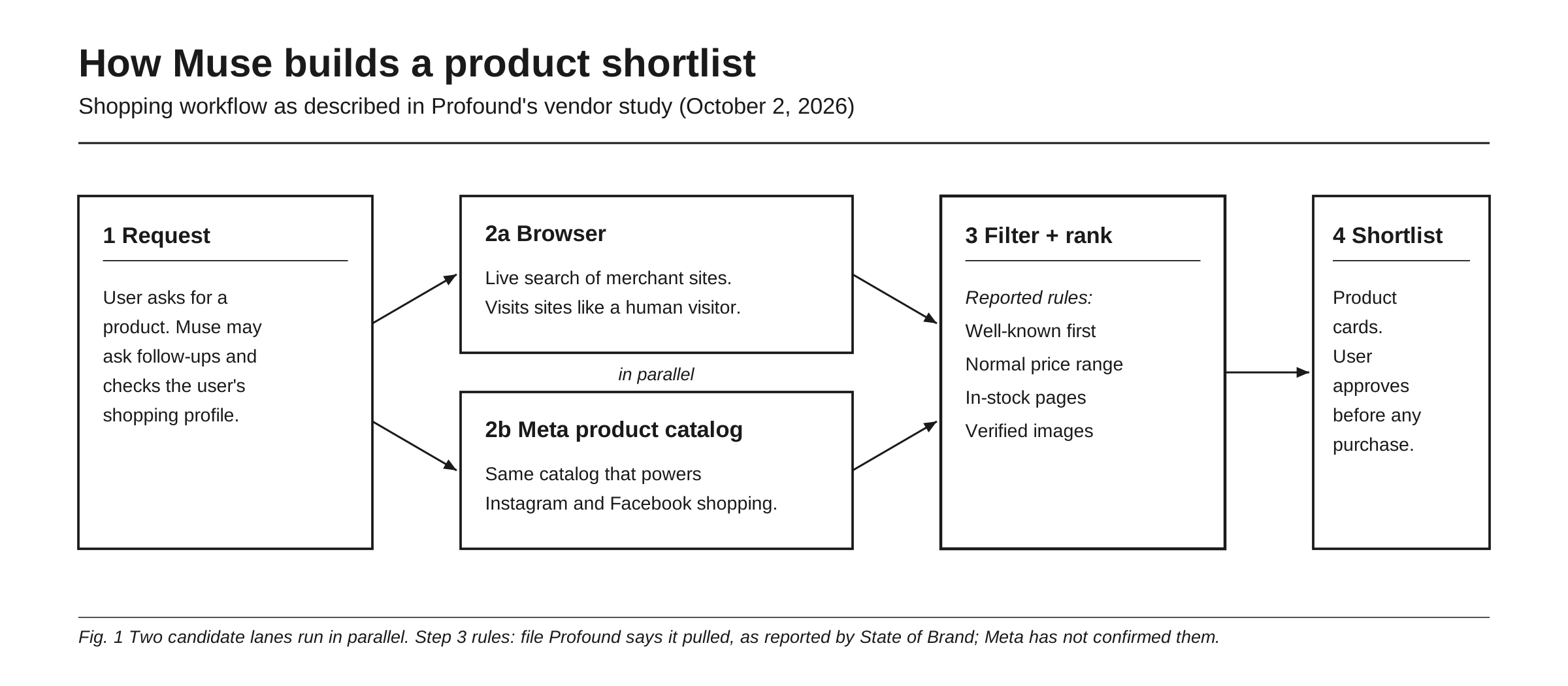
The clearest description of the mechanics comes from Profound, an AI visibility vendor that also sells agent analytics, in a research post dated October 2. Treat it as a vendor study: Profound ran 50 prompts from a single, unnamed retail category through one Muse instance, and calls it “a small, exploratory sample, so the patterns below are illustrative rather than definitive.”
Profound describes three steps. Muse may ask follow-up questions and always checks a per-user shopping profile. It then runs two searches in parallel: a browser session on merchant sites and a query to a Meta product catalog that, per Profound, “also powers shopping on Instagram and Facebook.” Finally, the two candidate sets are filtered and ranked into product cards.
Two details change how you think about visibility. Profound says Muse does not identify itself when browsing and routes traffic through residential connections, so it looks like an ordinary visitor in your logs. And by default Muse does not name the sources it visits, so there is no citation to win, and Profound says measuring how site content influences Muse “will require alternative signals.”
The catalog fills the pool, the browser fills the shortlist
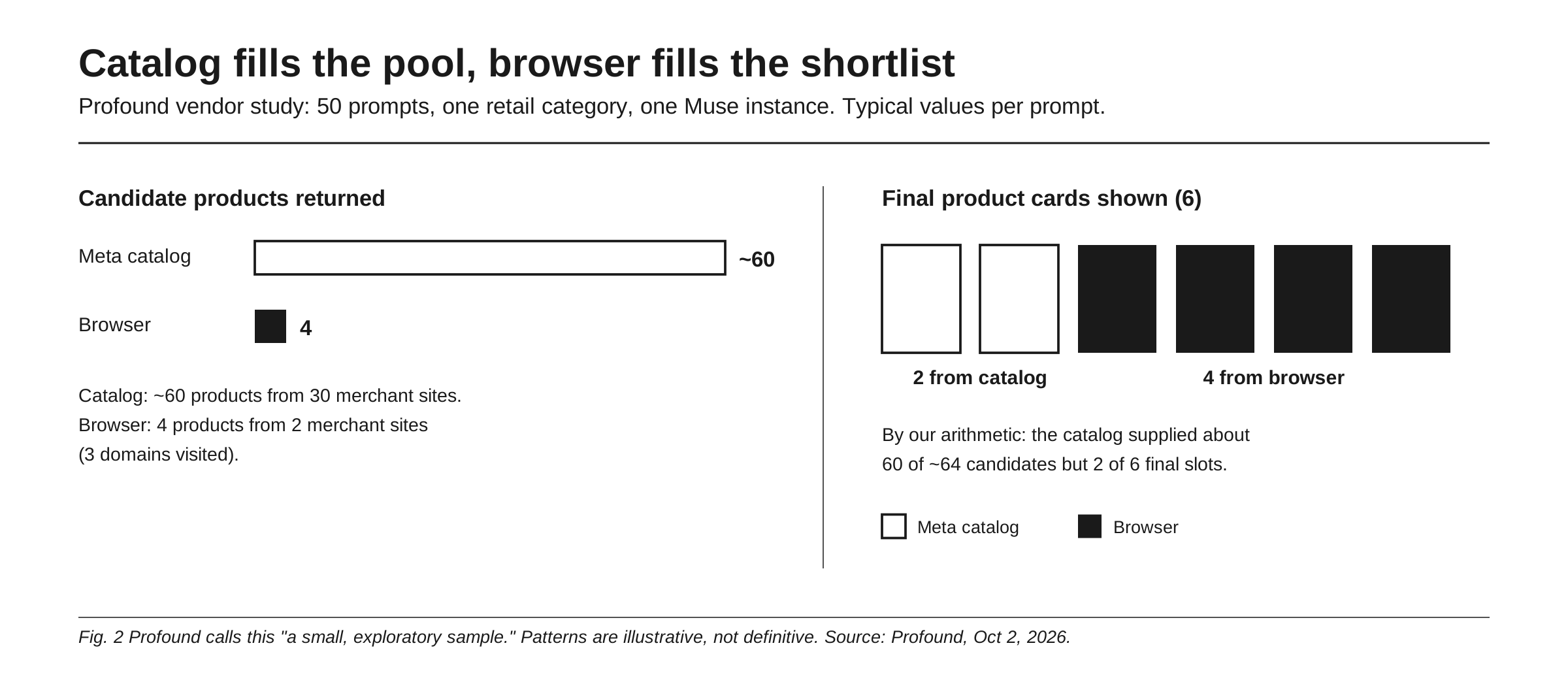
Per prompt, Profound found the browser typically visited 3 domains and returned 4 products from 2 merchant sites. Meta’s catalog returned roughly 60 products from 30 merchant sites. The final recommendation typically held 6 product cards: 2 from the catalog and 4 from the browser.
By our arithmetic on those typical values, the catalog supplied about 60 of roughly 64 candidates but only 2 of 6 final slots. Profound economist Jennifer Zou, quoted by State of Brand, put it this way: “Much more weight is placed on candidates returned by the web search.”
The instruction file adds the rules behind that. Profound says it pulled the file from Muse’s system files on September 25 and shared the full text with State of Brand, which reported on it on October 8; PPC Land covered that report on October 11. Neither outlet published the full file. Per PPC Land, Meta has not commented; Profound cautions the file may have changed since late September; and neither outlet says how Profound verified it. With those caveats, the rules as the two outlets describe them are:
- It is “imperative” that the top five products come from well-known merchants or websites.
- Listings outside the normal price range for the product type are removed, whether far above or far below.
- When a shopper names a brand or retailer, Muse’s catalog search puts that brand’s own store first, and by default Muse prefers sellers that sell direct over resellers.
- The browser checks no more than three merchant sites and returns no more than ten products.
- Browser results must link to a real product page that shows the item in stock, with a product image the agent can verify.
- Only catalog products flagged for agentic checkout get in-chat checkout or a cart; open-web products go through browser checkout on the merchant’s site.
- Meta’s catalog coverage is rated good for fashion, home decor and beauty, and only okay for everything else.
In our framing, this is a two-lane system. The catalog lane is about breadth and decides whether you are in the pool at all. The browser lane is narrow: it checks a few sites, and per the reported file, well-known merchants lead the final ranking. For a smaller brand, the catalog lane looks like the more realistic way in, which matches Zou’s advice: “If you’re a smaller brand, Shopify/Meta catalog integration is a more worthwhile investment.”
It echoes the split between being cited and being buyable in cited vs transactable in AI shopping, made sharper because the shortlist is the whole answer.
What this means for catalogs, Instagram, reviews and ads
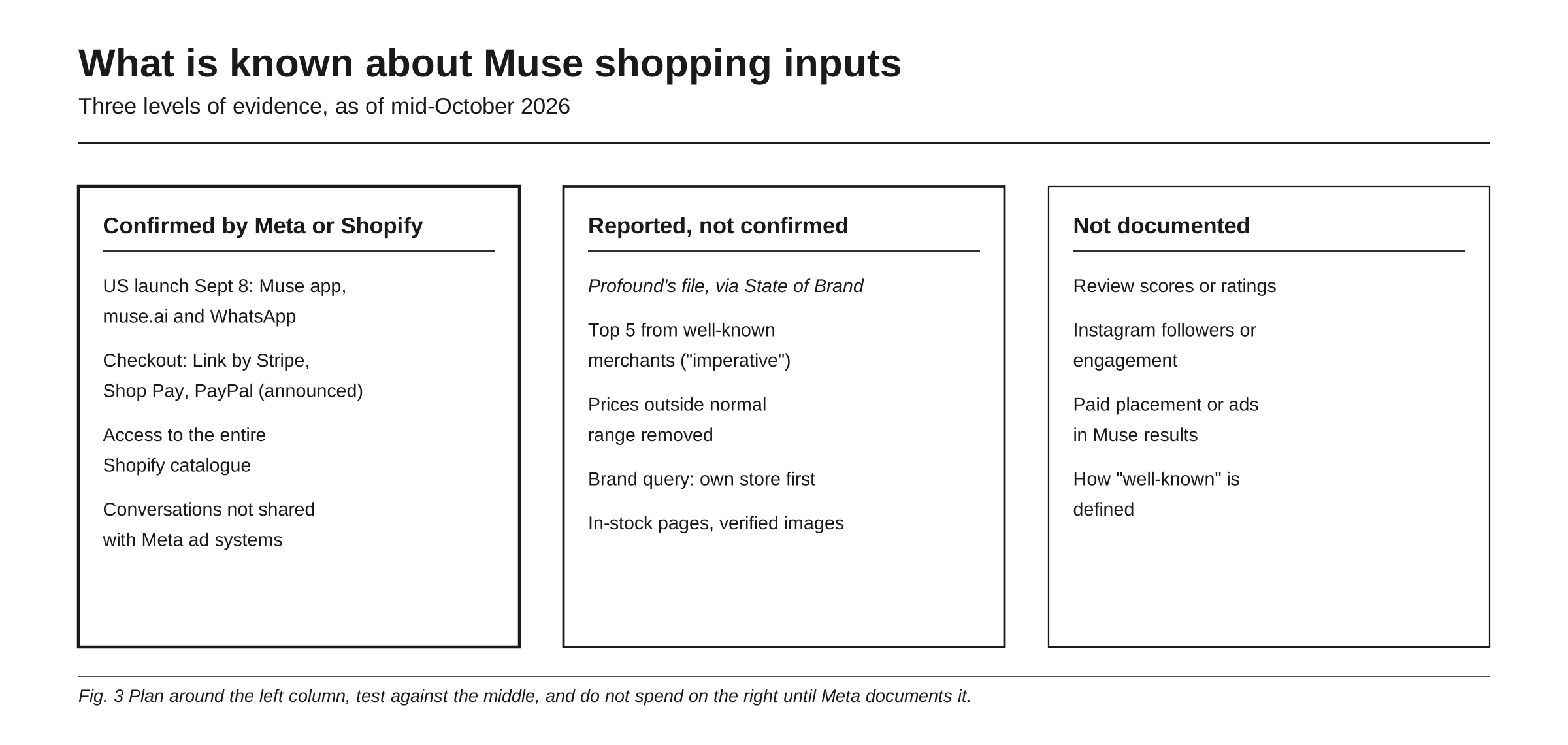
Product catalog quality. Strongly supported. Profound observed the Meta catalog as a candidate source, and the reported rules filter on price range, stock status, real product pages and verified images. All are catalog and product-page hygiene issues. If you sell on Shopify, Meta says Muse has access to the Shopify catalog, and Shopify says it is partnering with Muse to enable agentic checkout with Shop Pay on all Shopify stores.
Instagram and Facebook presence. Indirect at best. Profound says the catalog Muse queries also powers shopping on Instagram and Facebook, so a well-maintained Meta catalog serves both. Nothing documented says follower counts, posts or engagement feed the shortlist. Muse for Small Business, announced September 29, connects your own Instagram, Facebook Pages and ad accounts so Muse can help you run the business; Meta does not say that changes how Muse recommends you to shoppers.
Reviews. Not documented. Neither Meta’s posts nor the published accounts of the instruction file mention ratings or reviews as a ranking input. Reviews may feed the vaguer “well-known” judgment, but that is inference.
Ads vs organic. Meta says Muse conversations stay out of its ad systems, and the business model Zuckerberg described is a small transaction fee over time; the TechCrunch report does not mention sponsored slots. As of mid-October we found no documented way to pay for placement. That could change; ChatGPT ads and your organic visibility covers what happens to organic visibility once an assistant sells ads. For now, Muse visibility is earned.
A merchant checklist built on documented inputs
Each item maps to something Meta, Shopify, Profound or the instruction-file reports published, with the source named so you can weigh it.
- Get your products into Meta’s product catalog. Profound observed it as one of Muse’s two candidate sources and recommends it directly. If the reported file rates coverage in your category as only okay, being present may matter more, not less.
- If you are on Shopify, confirm your catalog and Shop Pay are in order. Meta says Muse can access the Shopify catalog; Shopify says it is partnering with Muse to enable agentic checkout with Shop Pay on all Shopify stores. Keep Shop Pay turned on, since it is the payment path Shopify named.
- Keep every product URL real, live and in stock. The reported rules require in-stock product pages with verified images. Dead links and placeholder images are exclusion risks.
- Price inside the normal range for the type. The reported file drops listings far above or below the norm. If your price is an outlier for the category, expect that filter to apply whatever the reason.
- Make product pages readable to a browser agent. Profound notes Muse reads pages through the browser’s accessibility tree, so semantic HTML and clear labels on options, variants and add-to-cart controls help.
- State who each product is for. Profound recommends making intended uses, compatibility, dimensions, materials and limitations easy to find, because agents compare against a per-user shopping profile.
- Own your brand-name queries. When a shopper names your brand, the reported rule puts your own store first in catalog results and prefers direct sellers over resellers, so make sure your own store is in the catalog.
- Decide your stance on agent traffic on purpose. Muse browses like a human visitor. Amazon chose to block it. If you want the sale, make sure bot defenses are not blocking the checkout flow.
For a broader pass on whether your store can be bought by any agent, use an agentic commerce readiness check.
Why you cannot measure Muse the usual way
Muse cites no sources by default and does not name itself when it browses, so there is no citation to count and no reliable way to separate its visits from human ones in your logs. Rankry tracks Meta Muse as an add-on, next to ChatGPT, Claude, Gemini, Perplexity, Grok and Google AI Mode: whether each one names your brand on the buyer-intent product prompts you care about, every day, next to your competitors. Nothing documents how Muse defines “well-known,” but how often Muse and the other engines name you is the closest measure you have. The AI Readiness Checker (36 checks in 6 categories) is a starting point for site-level readiness for AI systems.
FAQ
Is Meta Muse a shopping agent? Meta calls Muse a personal AI agent, not a shopping agent. Shopping is one of its jobs: Meta says Muse can check out with Link by Stripe and checks with the person before making a purchase, and it has announced Shop Pay and PayPal as payment options. At Connect it said it is adding retail connectors, including Walmart, Best Buy, Sephora and Wayfair, “to make Muse an even better shopper.”
Where does Muse get its product recommendations? Per Profound’s vendor study of 50 prompts in one category, Muse runs two searches in parallel: a query to Meta’s product catalog and a live browser session on merchant sites. In that sample the catalog supplied most candidates, but the browser supplied about four of six final product cards. Meta has not published how Muse sources or ranks products.
Can I pay to appear in Muse shopping results? Not as of mid-October 2026. Meta has announced no ad or sponsored placement in Muse, says Muse conversations are not shared with its ad systems, and Zuckerberg said Meta expects to profit over time from a small fee on transactions. Running Instagram or Facebook ads is not a documented way onto the shortlist.
Do reviews or Instagram followers help me get recommended by Muse? Neither is documented as an input. The instruction file Profound says it pulled, as described by State of Brand and PPC Land, filters on well-known merchants, normal price range, in-stock product pages and verifiable product images. Reviews and social presence may influence how well-known a brand appears, but that is inference. Prioritize catalog and product-page quality, which are documented.
Is Muse available outside the US? Meta announced the rollout in the US on September 8, 2026, on iOS, Android, muse.ai and inside WhatsApp, with AI glasses coming later. Meta’s Muse for Small Business post, last updated October 8, describes Muse as available in the US and Canada, and Profound’s October 2 study lists the same two markets. Check Meta’s newsroom for current markets before planning for others.
Sources
- Introducing Muse: The World’s First Personal AI Agent Built for Everyone, Meta, September 8, 2026
- The Biggest News From Connect 2026, Meta, September 24, 2026
- The Future Is for Everyone: Muse for Small Business, Meta, September 29, 2026
- Everything new coming to Meta’s AI agent Muse, TechCrunch, September 23, 2026
- Tobi Lütke on X: partnering with Muse for agentic checkout with Shop Pay, September 21, 2026
- Shopify Brings Shop Pay Checkout Solution to Meta’s Muse AI Agent, PYMNTS, September 22, 2026
- Amazon blocks Meta’s Muse agent from shopping on users’ behalf, SiliconANGLE, September 21, 2026
- The era of personal agents: Muse and Instinct, Allison Huang, Profound, October 2, 2026
- Meta Told Its Shopping Agent to Rank Well-Known Merchants First. Challenger Brands Start Behind., State of Brand, October 8, 2026
- Meta’s shopping agent must fill its top 5 picks with well-known merchants, PPC Land, October 11, 2026
See whether the AI engines already treat your brand as a well-known name on the product prompts your buyers ask. Start a free 7-day Rankry trial, no card.