In 2026 ChatGPT started showing ads, and the August rollout made it a real channel: sponsored placements expanded to 31 European markets on August 24, reached a roughly one-billion-dollar annualized run rate in under 200 days, and now appear in about half of US replies. For your organic visibility, the key facts are these: ads currently sit in a separate labeled “Sponsored” block beneath the answer, not woven into it, so the answer itself is still earned rather than bought; but a competitor can now pay to sit beside the answer even when the AI recommends you; and targeting runs on the conversation topic and user memory, not cross-web tracking. Notably, one major rival removed ads entirely to protect answer trust. This guide covers what changed and what to actually do, whether or not you ever buy a slot.
The headline is not “you should run ChatGPT ads.” It is that being organically recommended just became necessary but no longer sufficient, and you need to know why.
The moment ads entered the answer
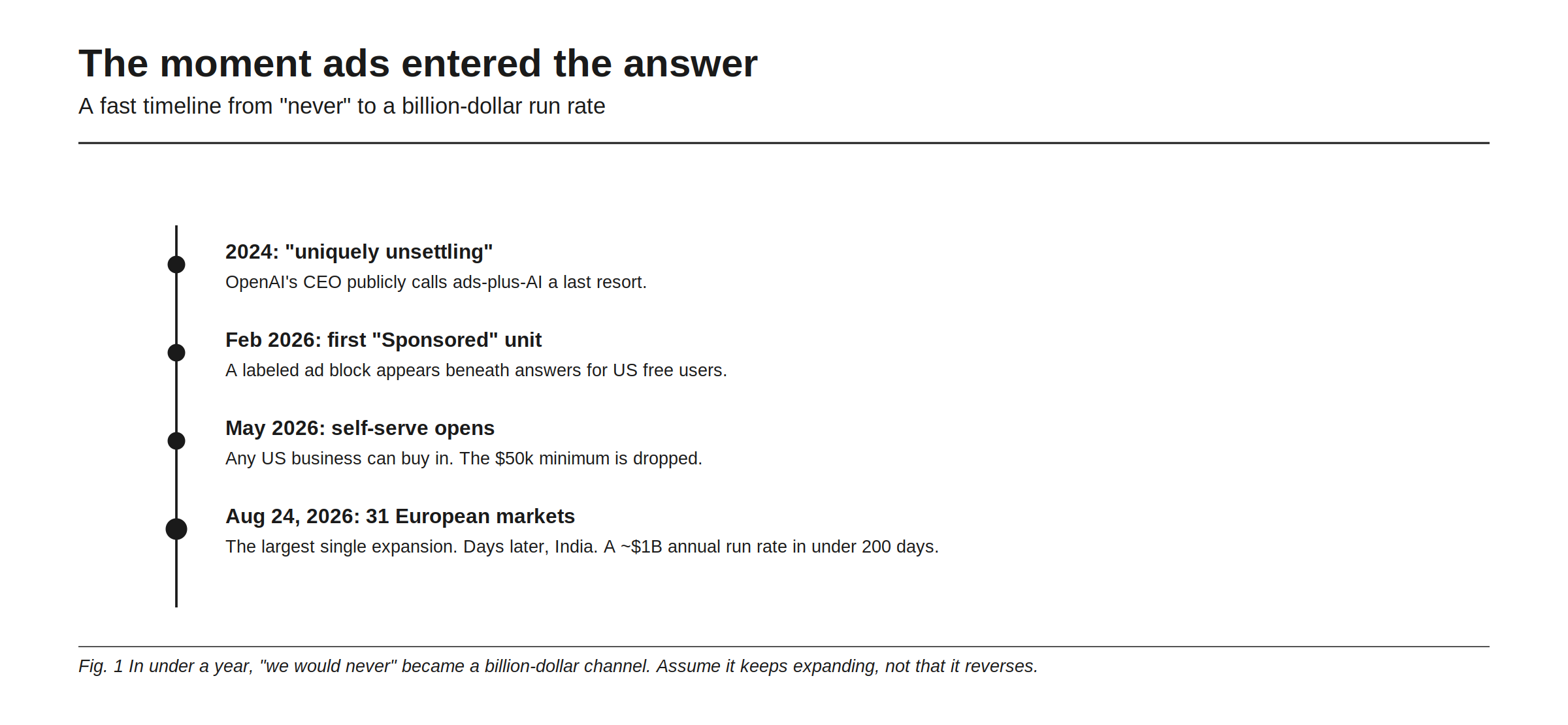
The speed is the story. In 2024 OpenAI’s CEO publicly called combining ads with AI “uniquely unsettling” and framed advertising as a last resort. In February 2026 a labeled “Sponsored” unit appeared beneath answers for US free users. In May the self-serve Ads Manager opened to any US business, with the earlier large minimum spend dropped so small advertisers could join. And on August 24, 2026, sponsored placements expanded to 31 European markets in a single move, with India following days later and the channel reaching a roughly one-billion-dollar annual run rate in under 200 days.
In under a year, “we would never” became a billion-dollar business. The practical lesson is to assume this keeps expanding rather than reverses, and to plan your visibility strategy for a world where AI answers have a paid layer, not just an organic one.
What ads change for organic visibility
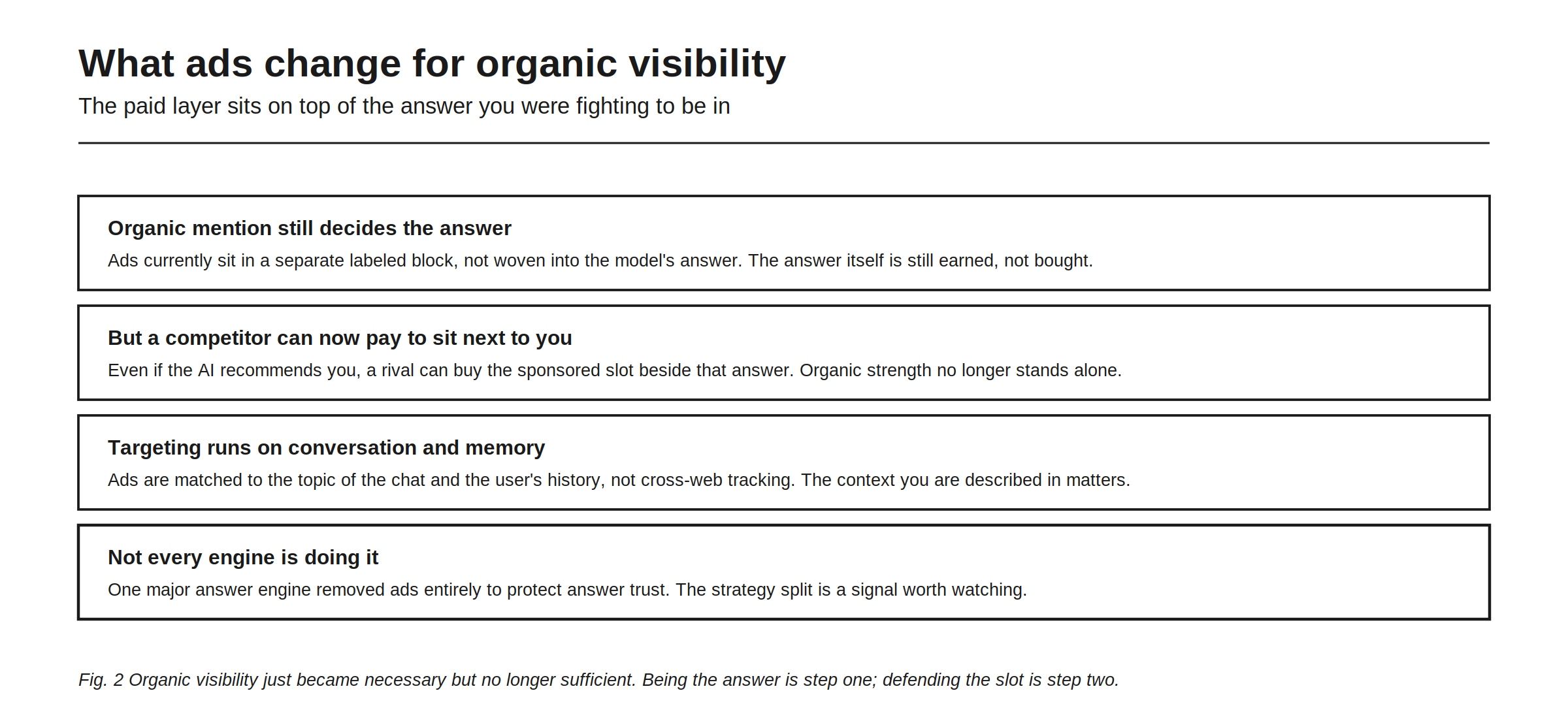
Four things follow. First, organic mention still decides the answer: ads sit in a separate labeled block, not inside the model’s response, so the answer itself is still earned, and your organic recommendation remains your strongest asset. Second, a competitor can now pay to sit next to you: even if the AI recommends you, a rival can buy the sponsored slot beside that answer, so organic strength no longer stands entirely alone. Third, targeting runs on conversation and memory: ads are matched to the topic of the chat and the user’s history rather than cross-web tracking, and the advertiser never receives the chat content, which means the context you are described in matters. Fourth, not every engine is doing it: one major answer engine removed ads entirely to protect answer trust, and that strategic split is a signal worth watching.
The net effect: organic visibility just became necessary but not sufficient. Being the answer is step one; whether you need to defend the adjacent slot is step two, and it depends on how competitive and commercial your category is. The reason your organic answer still matters most is covered in the mention-versus-recommendation gap.
What to do about it now
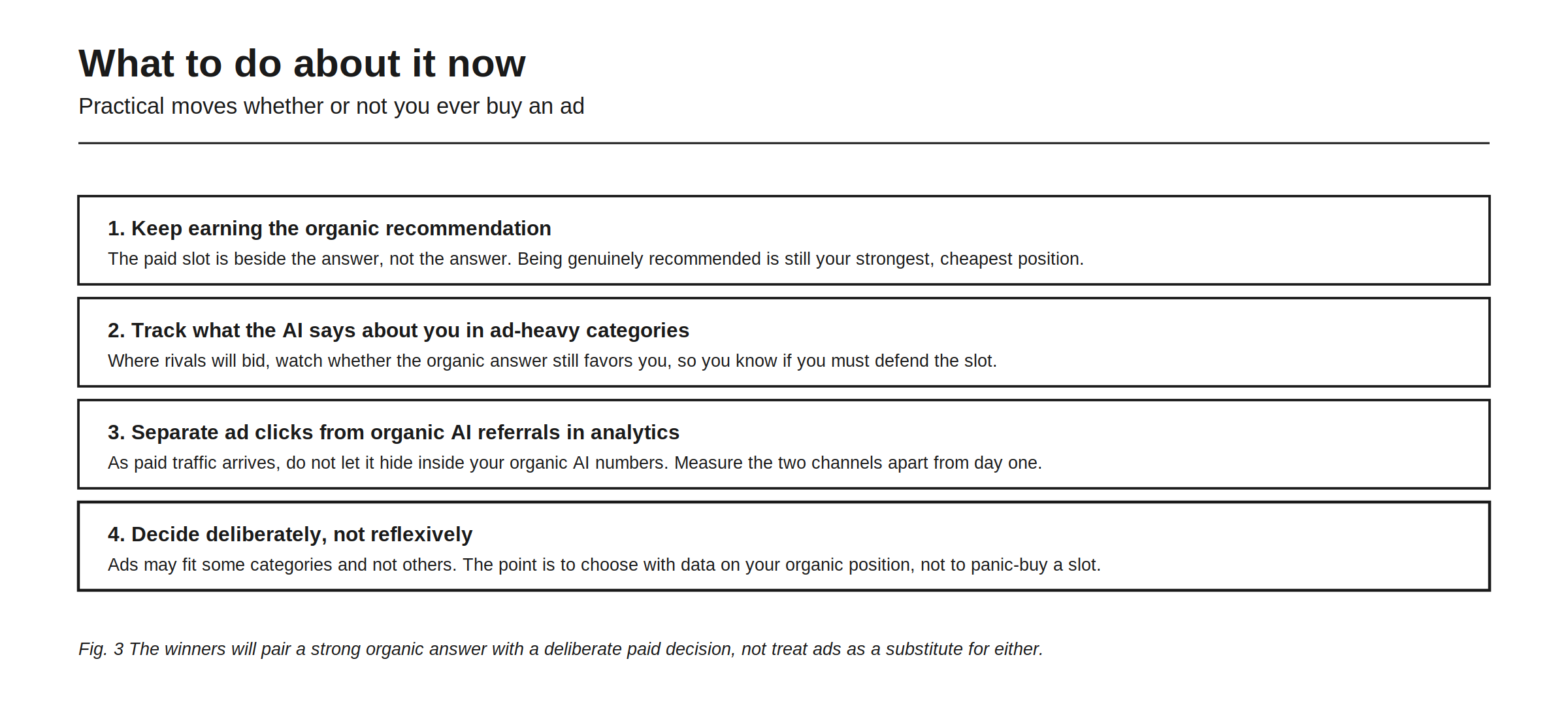
Four moves, none of which require buying an ad. First, keep earning the organic recommendation, because the paid slot is beside the answer, not the answer, and a genuine recommendation is still your strongest and cheapest position. Second, track what the AI says about you in ad-heavy categories, because where rivals will bid you want to know whether the organic answer still favors you, so you can tell if you must defend the slot. Third, separate ad clicks from organic AI referrals in your analytics from day one, so paid traffic does not quietly hide inside your organic AI numbers. Fourth, decide deliberately rather than reflexively, because ads may fit some categories and not others, and the point is to choose with data on your organic position, not to panic-buy a slot because everyone is talking about the channel.
The teams that win here will pair a strong organic answer with a deliberate paid decision, and treat ads as neither a threat to flee nor a substitute for being genuinely recommended. Watching your organic standing is what tells you which. The measurement side is in Introducing AI Traffic and the monitoring loop in how to monitor your brand across AI search engines.
The bigger pattern
Ads in AI answers are one instance of a larger shift: the AI answer is becoming a real estate market, with an organic layer you earn and a paid layer you buy, much as search did fifteen years ago. The difference is that in a chat answer there is no page of ten results to spread across, so the competition for the small number of named brands is sharper, and the value of being the organically recommended one is higher, not lower. That is the counterintuitive part worth holding onto: the arrival of ads makes strong organic visibility more valuable, because it is the position a competitor now has to pay to sit next to. The distinction between being mentioned and being recommended, which decides that value, is in the mention-versus-recommendation gap.
FAQ
Does ChatGPT show ads now? Yes. Since early 2026 ChatGPT has shown labeled “Sponsored” placements beneath answers for users on its free and lower tiers, and in August 2026 it expanded to 31 European markets and reached a roughly one-billion-dollar annual run rate. Higher paid tiers remain ad-free.
Do ChatGPT ads change the AI’s actual answer? As implemented, ads appear in a separate labeled block beneath the answer, not woven into the model’s response, so the answer itself is still generated organically. A paid slot can sit beside a recommendation, but it does not replace how the answer is formed.
How is ChatGPT ad targeting different from Google or Meta? It is matched to the topic of the current conversation and the user’s memory and past ad interactions, not cross-web tracking, and advertisers do not receive the chat content. The context in which the AI describes your brand becomes part of what you compete on.
Should I run ChatGPT ads? It depends on your category and how commercial and competitive your buyer questions are. Decide with data on your current organic position rather than reflexively. The paid slot is beside the answer; a strong organic recommendation is still the higher-value position.
Are all AI engines adding ads? No. One major answer engine removed advertising entirely to protect answer trust, while OpenAI expanded aggressively. This strategic split means the advertising landscape differs by engine, so track each one separately rather than assuming a single trend.
Track whether the AI still recommends you organically in the categories where rivals will bid, across every engine. Start a free 7-day Rankry trial, no card, first report in two minutes.