Since September 2026, several rank-tracking vendors have reported that Google sometimes answers their automated queries with complete, normal-looking results pages whose results have been swapped out. Nozzle, whose October 10 study anchored much of the coverage, counted 8.0% of the pages it collected from September 13 to October 9 as poisoned, against 0.17% before; Ahrefs puts the affected share at 5% to 20%, depending on the data provider. Google has not commented publicly, so the motive is unconfirmed, though vendors read it as a response to large-scale scraping for AI systems, and Google’s spam policies already list scraping results for rank-checking purposes as a violation. The practical risk is fake drops and recoveries in rank reports, and possibly in AI Overview tracking built on scraped Google pages. The fix is verification: compare against a keyword’s usual results over weeks, re-check before acting, and use Search Console as the first-party referee.
If a client’s rankings fell off a cliff one morning in October and came back two days later, this is a plausible explanation. The harder problem is the drop that nobody notices was fake.
What rank trackers reported, and when
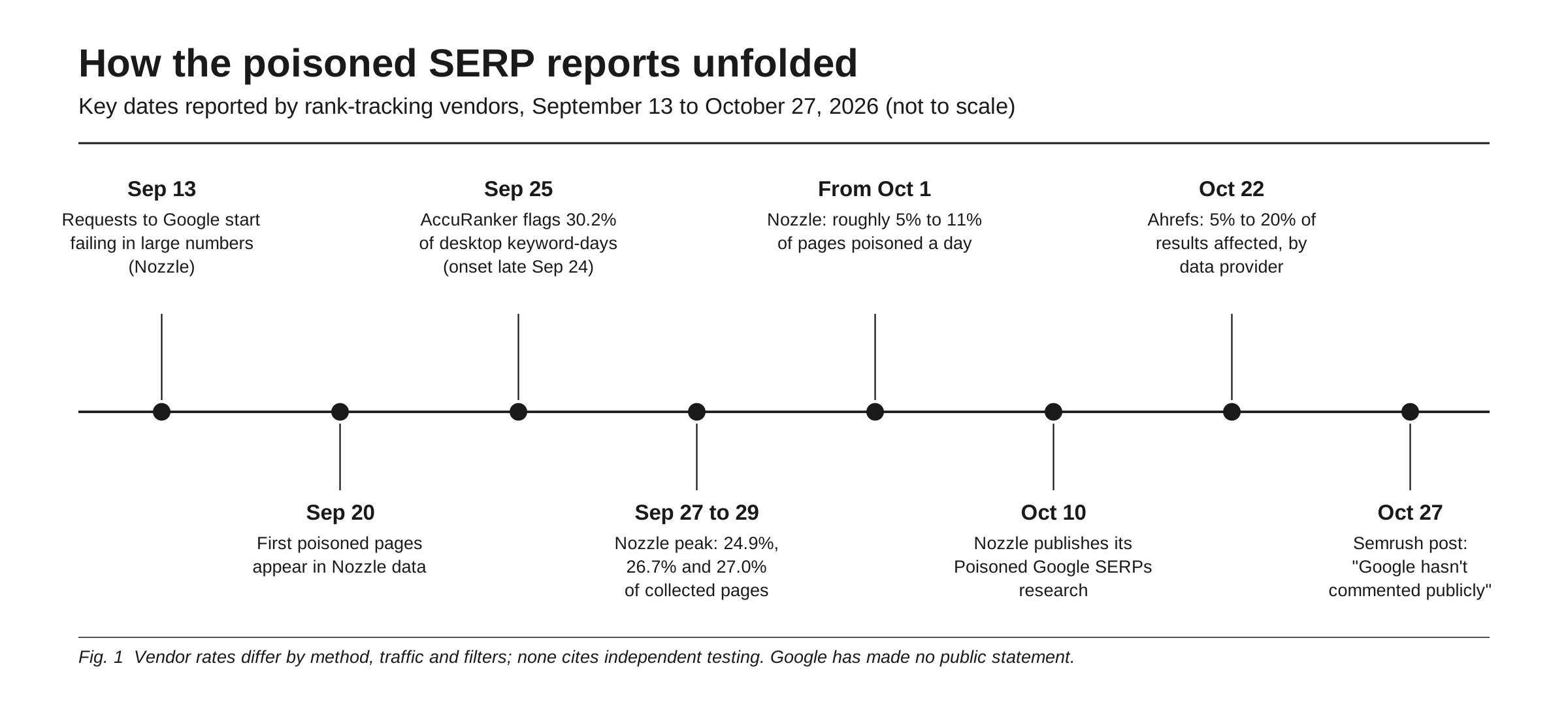
According to Nozzle, requests to Google started failing in large numbers on September 13, and the first poisoned pages appeared on September 20. Its sample covered 27.5 million results pages collected from September 13 to October 9, 17.8 million of them with enough history to judge, across 49 countries on desktop, iPhone and Android. The poisoned share peaked at 24.9%, 26.7% and 27.0% on September 27 to 29, then settled at roughly 5% to 11% a day from October 1. A later Nozzle update reported 8.7% of first pages poisoned from September 13 to October 21.
Derek Perkins of Nozzle told Search Engine Roundtable’s Barry Schwartz that Google is taking a three-pronged approach, which Schwartz listed as “Super wide IP blocking, which targets major residential proxy networks,” “A significant increase in the use of captchas,” and “Google is injecting bad data into suspect SERPs.” Schwartz wrote that the third “concerns me the most,” and with reason: blocked requests fail loudly, while poisoned pages look fine.
Other vendors confirmed the pattern with different numbers:
- AccuRanker saw onset late on September 24, with 30.2% of desktop keyword-days flagged on September 25 and 0.58% on October 17. On September 29, when Nozzle measured 27%, AccuRanker measured 1.4%.
- Ahrefs (October 22): “between 5% and 20% of search results affected,” depending on the data provider, with filters rejecting abnormal results.
- SEOmonitor: about 8% of daily Google results incomplete or incorrect, re-pulled before recording.
- SE Ranking (October 16): roughly 2% of tracked results still affected.
- Semrush: seeing the issue “since late summer,” with impact on tracked rankings “limited.”
- SerpApi (October 14): an update that “should reduce” poisoned results.
These rates are not comparable. Each vendor measures its own traffic, after its own filters, with its own definition, and Search Engine Journal found that none of the vendors it reviewed cites independent testing of its checks. The spread is itself the lesson, a point covered in why AI visibility trackers never show the same number.
What a poisoned page looks like
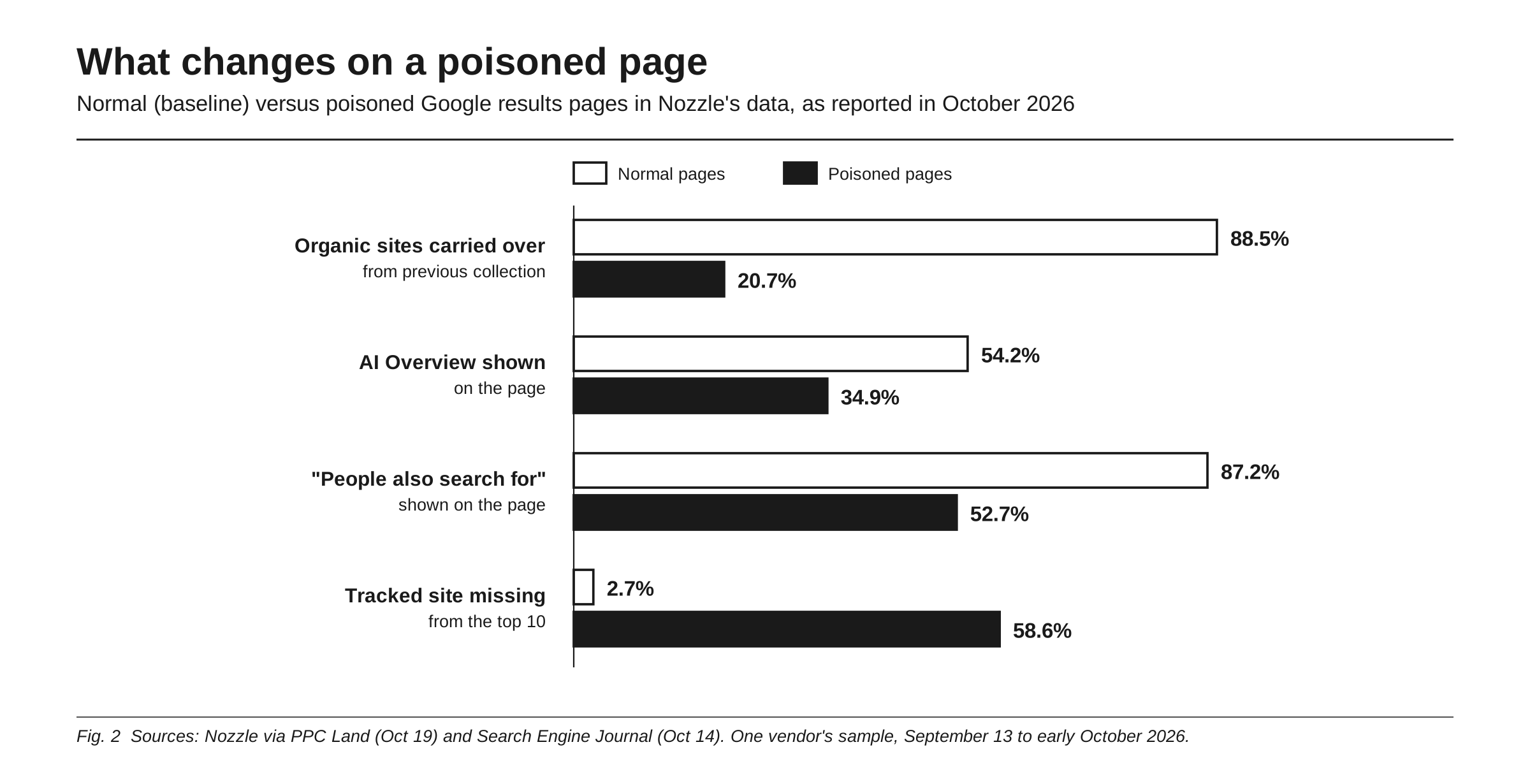
Nozzle’s test is history-based. A keyword’s “usual sites” are those that held a top 10 position on at least 60% of its pages from August 20 to September 9. A page counts as poisoned when fewer than half of those usual sites appear and they return on a later collection.
On poisoned pages in Nozzle’s data, only 20.7% of organic sites carried over from the previous collection, against 88.5% normally. A customer’s own tracked site was missing from the top 10 on 58.6% of poisoned pages, against 2.7% at baseline. Reddit’s share of top 10 appearances rose from 20.8% to 28.8%, and Facebook’s from 28.3% to 33.8%. Ads held steadier, carrying over 83.7% of the time against 70.6% normally.
Two traits make detection possible. Poisoning is short: 80% of spells lasted a single collection, and on 77.9% of affected pages the usual sites returned within three days. And it is incoherent: Semrush describes cases where a page looks normal at first but results further down only loosely match the query, such as a Brazilian stroller search returning a dental supply store’s page because both share the Portuguese word “carrinho.”
What is known, and what is speculation
Known. Multiple vendors have reported swapped results, most dating the onset to September 2026; Semrush says it has seen the issue “since late summer.” Google has made no public statement on it, as both Semrush and AccuRanker note. Google’s spam policies (page last updated August 28, 2026) define machine-generated traffic as “the practice of sending automated queries to Google” and state: “This includes scraping results for rank-checking purposes or other types of automated access to Google Search conducted without express permission.” They add: “Such activities violate our spam policies and the Google Terms of Service.” The Terms of Service prohibit “using automated means to access content from any of our services in violation of the machine-readable instructions” on Google’s pages.
Also known, but separate. On December 19, 2025, Google announced a suit against SerpApi “for circumventing security measures protecting others’ copyrighted content that appears in Google search results.” The U.S. District Court for the Northern District of California dismissed the original complaint in July 2026. Google filed an amended complaint on August 10, and SerpApi, which contests the claims, filed a motion to dismiss it on August 24.
Speculation. Why Google does this. Nozzle calls it “Google’s response to AI scraping, and rank trackers are caught in it.” Barry Schwartz wrote that he assumes it “was not directly aimed at Google tracking tools that SEOs use but rather the AI bots scraping its search results and Google’s duel with SerpApi.” SISTRIX writes: “Analysis tools like ours aren’t the target, but they are caught up in it.” All of this is plausible. None of it is confirmed by Google, and no source we found shows a link between the lawsuit and the poisoned pages.
Why this matters for AI Overview and AI Mode tracking
Rank tracking is not the only casualty. Google offers no official API for AI Overviews or AI Mode, so tools that report them get the answer by automating Google’s results pages. That puts AI Overview tracking on the same collection path that is now being poisoned.
The effect is measurable in one direction. In Nozzle’s data, AI Overviews appeared on 34.9% of poisoned pages against 54.2% of normal ones. Our inference: a tracker that stores a poisoned fetch may record “no AI Overview,” or “brand not cited,” for a query where real users saw an AI Overview citing you. The coverage of Nozzle’s study we reviewed reports no AI Mode figures, so treat AI Mode data with the same caution until someone measures it.
Google’s own data does not fill the gap. The Search Console generative AI reports, launched for a subset of sites on June 3 and rolled out to all sites on August 31, 2026, show impressions in AI features by page, country, device and date, with no click data as of the August rollout. They cannot tell you which answer text appeared for a query, but they can confirm whether your pages were being shown at all. That makes Search Console the referee, as covered in Google Search Console for AI visibility.
How to detect poisoned data: Rankry’s five-check triage
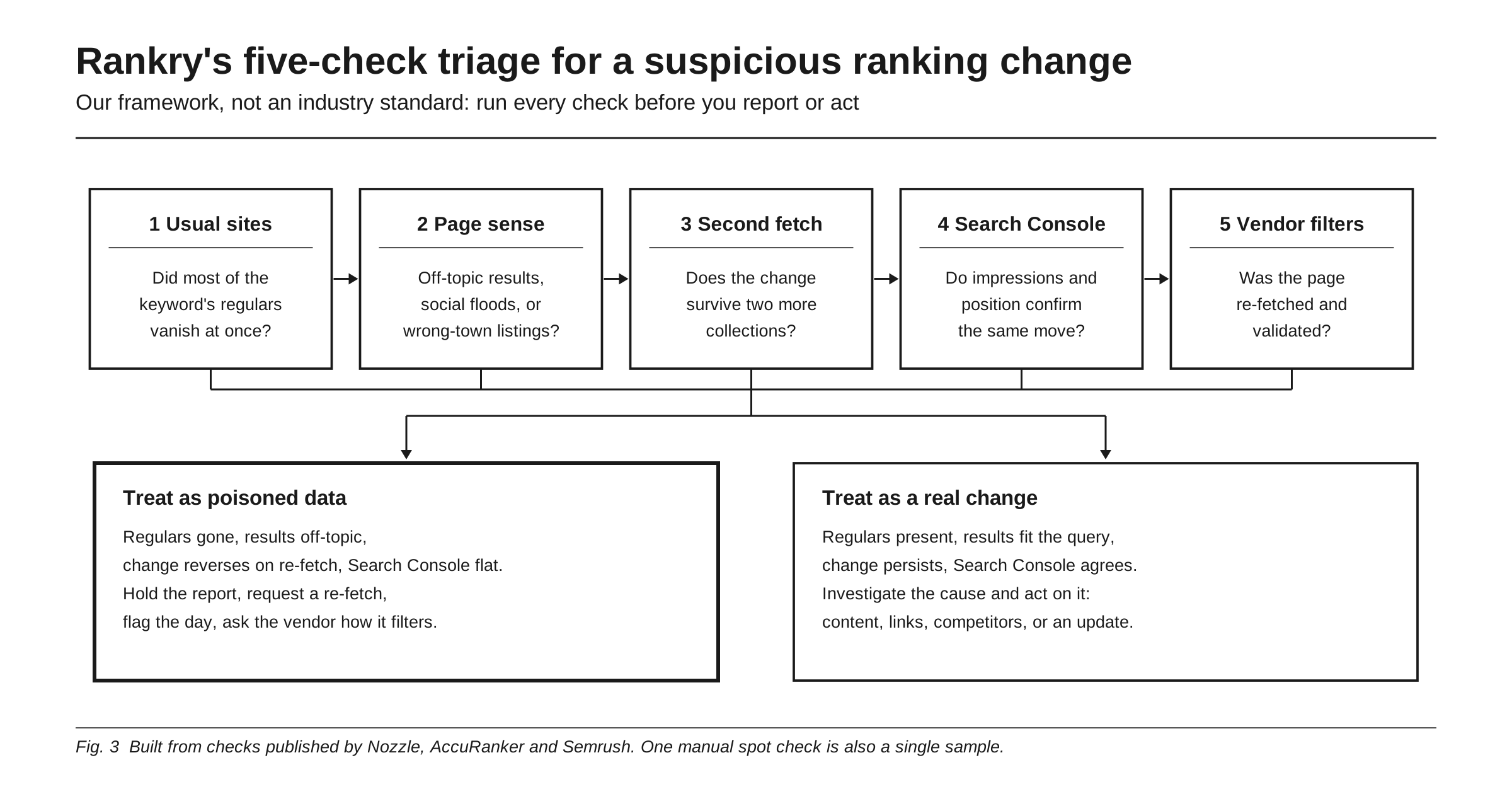
This is our framework, not an industry standard. It combines the checks vendors have published with the rule we apply to any noisy data: never act on one sample.
-
Compare against the usual sites, not yesterday. Look at who held the top 10 over the previous several weeks. If most of those regulars vanished on the same day, suspect the page, not your site. Yesterday’s page may itself be poisoned.
-
Check whether the page makes sense. Off-topic results, a sudden wave of social and forum pages, or businesses from the wrong town in a local query all point to bad data. Check the lower results too, where Semrush found loose matches.
-
Wait for a second collection. Poisoning usually reverses within days. A real ranking change persists. Hold any client report or remediation work until the move survives at least two more collections, the same multi-run logic in how many times to ask before you trust the answer.
-
Cross-check Search Console for the same query and dates. If impressions and average position held steady while the tracker shows a collapse, treat the tracker data as suspect. Do the same with the generative AI report before concluding you lost AI Overview visibility.
-
Ask your vendor how it filters. Ask whether it re-fetches suspect pages before storing them, whether it cleans past data, and whether flagged days are marked in reports. Ahrefs, AccuRanker and SEOmonitor have each described some form of this; get your vendor’s answer in writing.
For manual spot checks, use a clean browser session in the target location and compare a handful of the affected keywords. One manual check is also a single sample, but if it contradicts a dramatic drop and Search Console agrees, you have your answer.
How Rankry fits
Rankry tracks how ChatGPT, Claude, Gemini, Perplexity, Grok and Google AI Mode and AI Overviews mention, rank, cite and recommend brands across a stable set of buyer-intent prompts, every day, so one odd day stands out against the days around it. Any data about Google surfaces, from any tool, Rankry included, should be spot-checked against Search Console and a manual look before anyone acts on it.
FAQ
What is a poisoned SERP? A poisoned SERP is a complete, normal-looking Google results page served to a suspected automated query, with results that differ from what users see. Nozzle defines it as a page missing more than half of a keyword’s usual top 10 sites, which then return on a later collection. Nothing in the page itself marks it as altered, so tools have to detect it by comparison.
Has Google confirmed it is poisoning results? No. As of late October 2026, Google had made no public statement, according to Semrush and AccuRanker. Google’s spam policies do say scraping results for rank-checking purposes is machine-generated traffic that violates its policies and Terms of Service. The motive, a response to AI-driven scraping, is the interpretation of Nozzle and others, not a Google statement.
How much rank tracking data is affected? It depends on the vendor. Nozzle counted 8.0% of collected pages as poisoned from September 13 to October 9, with peaks near 27%. Ahrefs reports 5% to 20% depending on the provider, SEOmonitor about 8% of daily results, and SE Ranking about 2% by mid-October. Each figure reflects one vendor’s own traffic and filters.
Does this affect AI Overview tracking? It can. Google offers no official API for AI Overviews or AI Mode, so trackers collect them from results pages, the same path being poisoned. In Nozzle’s data, AI Overviews appeared on 34.9% of poisoned pages against 54.2% of normal ones, so a poisoned fetch can understate your AI Overview presence. Verify with Search Console’s generative AI report.
How can I tell a real ranking drop from a poisoned one? Check whether most of the keyword’s usual competitors vanished at once, whether the results fit the query, and whether the drop reverses on the next collection. Then compare Search Console impressions and average position for the same query and dates. A real drop persists and shows up in Search Console; a poisoned one usually does not.
Sources
- Third-Party Google Rank Tracking Struggling Now, Search Engine Roundtable, October 12, 2026
- Poisoned Google SERPs, Nozzle, October 10, 2026
- Analysis: Google Is Poisoning Search Results For Rank Trackers, Search Engine Journal, October 14, 2026
- Google feeds rank trackers swapped results on 8% of pages, Nozzle finds, PPC Land, October 19, 2026
- How Rank Trackers Say They Handle Suspect Google Results, Search Engine Journal, October 23, 2026
- An update on Google’s poisoning of search results, Ahrefs, October 22, 2026
- Poisoned SERPs: An update on Google ranking data in Semrush, Semrush, October 27, 2026
- How AccuRanker Handles Poisoned SERPs, AccuRanker, October 19, 2026
- Spam policies for Google web search, Google Search Central, updated August 28, 2026
- Google Terms of Service, Google, effective July 30, 2026
- Why we’re taking legal action against SerpApi’s unlawful scraping, Google, December 19, 2025
- Google tried again. We’re moving to dismiss their claims a second time., SerpApi, August 25, 2026
- Google Amends Lawsuit Against SerpApi Over Licensed Content, Search Engine Roundtable, August 12, 2026
- AI Visibility Tools Compared: How They Actually Work, Growth Method, August 11, 2026
- Introducing Search Generative AI performance reports in Search Console, Google Search Central Blog, June 3, 2026
- Google Search Console AI Reports Rolled Out Worldwide, Search Engine Journal, August 31, 2026
- Why Google ranking data collection is changing, SISTRIX, October 7, 2026
Track AI visibility on a stable prompt set, and keep your Google data honest with first-party checks. Start a free 7-day Rankry trial, no card required.